Actinomorphic, hypogynous with twisted aestivation
2
Actinomorphic, epigynous with valvate aestivation
3
Zygomorphic, hypogynous with imbricate aestivation
4
Zygomorphic, epigynous with twisted aestivation
Official Solution
Correct Option:
(1)
The correct option is (A): Actinomorphic, hypogynous with twisted aestivation.
02
PYQ 2020
easy
biologyID: neet-ug-
The ovary is half inferior in:
1
Brinjal
2
Mustard
3
Sunflower
4
Plum
Official Solution
Correct Option:
(4)
Plum, peach and rose flowers are perigynous and ovary is half inferior.
03
PYQ 2024
easy
biologyID: neet-ug-
Match List I with List II
List I (Types of Stamens)
List II (Example)
A
Monoadelphous
I
Citrus
B
Diadelphous
II
Pea
C
Polyadelphous
III
Lily
D
Epiphyllous
IV
China-rose
Choose the correct answer from the options given below:
1
A-IV, B-II, C-I, D-III
2
A-IV, B-I, C-II, D-III
3
A-I, B-II, C-IV, D-III
4
A-III, B-I, C-IV, D-II
Official Solution
Correct Option:
(1)
To solve the problem of matching List I with List II correctly, we need to understand the classification of different types of stamen arrangements in plants and their corresponding examples.
Explanation of Terms:
Monoadelphous: Stamens are united into a single group. Example: China-rose.
Diadelphous: Stamens are united into two groups. Example: Pea.
Polyadelphous: Stamens are united into more than two groups. Example: Citrus.
Epiphyllous: Stamens are attached to the petals (perigyny). Example: Lily.
Accordingly, the correct matches are:
A-IV: Monoadelphous - China-rose
B-II: Diadelphous - Pea
C-I: Polyadelphous - Citrus
D-III: Epiphyllous - Lily
Thus, the correct answer is A-IV, B-II, C-I, D-III.
04
PYQ 2024
easy
biologyID: neet-ug-
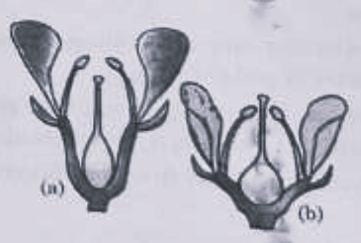
Identify the type of flowers based on the position of calyx, corolla and androecium with respect to the ovary from the given figures (a) and (b).
1
(a) Epigynous; (b) Hypogynous
2
(a) Hypogynous; (b) Epigynous
3
(a) Perigynous; (b) Epigynous
4
(a) Perigynous; (b) Perigynous
Official Solution
Correct Option:
(4)
The position of floral organs in relation to the ovary can be categorized as follows:
Hypogynous – The floral organs are attached below the ovary (e.g., in a buttercup).
Epigynous – The floral organs are attached above the ovary (e.g., in a daisy).
Perigynous – The floral organs are attached at the same level as the ovary (e.g., in a peach flower).
Step 1: In Figure (a), the floral organs are attached at the same level as the ovary, so it is Perigynous.
Step 2: In Figure (b), the floral organs are also attached at the same level as the ovary, so it is Perigynous.
Thus, the correct answer is (4) (a) Perigynous; (b) Perigynous.
05
PYQ 2024
easy
biologyID: neet-ug-
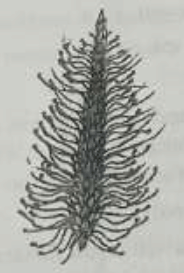
Identify the correct description about the given figure.
1
Wind pollinated plant inflorescence showing flowers with well exposed stamens.
2
Water pollinated flowers showing stamen with mucilaginous covering.
3
Cleistogamous flowers showing autogamy
4
Compact inflorescence showing complete autogamy.
Official Solution
Correct Option:
(1)
Wind-pollinated plants exhibit specific adaptations to enhance pollination efficiency:
They typically have exposed stamens that allow easy pollen release into the air.
Their flowers are often small and inconspicuous and lack nectar or fragrance.
Pollen grains are usually light and produced in large quantities to increase the chances of successful pollination.
Thus, the correct answer is (1) Wind-pollinated plant inflorescence showing flowers with well-exposed stamens.
06
PYQ 2024
easy
biologyID: neet-ug-
Identify the set of correct statement: A. The flowers of Vallisneria are colourful and produce nectar. B. The flowers of waterlily are not pollinated by water. C. In most of water-pollinated species, the pollen grains are protected from wetting. D. Pollen grains of some hydrophytes are long and ribbon like. E. In some hydrophytes, the pollen grains are carried passively inside water. Choose the correct answer from the options given below
1
C, D and E only
2
A, B, C and D only
3
A, C, D and E only
4
B, C, D and E only
Official Solution
Correct Option:
(4)
The problem asks which statements about different flowering plants are correct. Let's analyze each statement:
A. The flowers of Vallisneria are colourful and produce nectar. Vallisneria is a submerged aquatic plant whose flowers are generally pale and do not produce nectar, as they do not rely on insect pollination. Hence, statement A is incorrect.
B. The flowers of waterlily are not pollinated by water. Water lilies are primarily pollinated by insects and not water. Hence, statement B is correct.
C. In most water-pollinated species, the pollen grains are protected from wetting. Water-pollinated species tend to have adaptations to prevent pollen grains from getting wet, such as hydrophobic surfaces. This statement is correct.
D. Pollen grains of some hydrophytes are long and ribbon-like. This is an adaptation to efficiently travel through water and reach the female flower. This statement is correct.
E. In some hydrophytes, the pollen grains are carried passively inside water. Some hydrophytic plants release pollen into the water to passively reach other plants. This statement is correct.
Based on this analysis, the correct set of statements is B, C, D, and E, matching the option: B, C, D and E only.
07
PYQ 2024
easy
biologyID: neet-ug-
Which of the following is an example of actinomorphic flower?
1
Datura
2
Cassia
3
Pisum
4
Sesbania
Official Solution
Correct Option:
(1)
An actinomorphic flower, also known as a radial symmetrical flower, is one that can be divided into equal halves along multiple planes. This symmetry is akin to a circle or a star where any plane passing through the center will divide the flower into identical parts.
Let's review the characteristics of flowers given in the options:
Datura: Datura flowers are indeed actinomorphic. They have a radial symmetry that allows them to be split into equal halves in multiple ways.
Cassia: Flowers of Cassia genus, like Cassia fistula, are zygomorphic, meaning they have bilateral symmetry and only one plane that divides them into mirror-image halves.
Pisum: Commonly known as the pea plant, its flowers are zygomorphic. They exhibit bilateral symmetry, meaning they can only be divided into mirror halves by a single plane.
Sesbania: Like Pisum, Sesbania flowers also show zygomorphic attributes with bilateral symmetry.
Therefore, among the options provided, Datura is the correct example of an actinomorphic flower.
About The Flower - NEET-UG
The Flower is a vital chapter for NEET-UG aspirants. Mastering the concepts covered in this chapter is essential for securing a top rank.
By rigorously practicing the previous year questions associated with this chapter, you can identify high-yield topics, understand the examiner's perspective, and boost your confidence during the actual exam.
Frequently Asked Questions
Why focus on The Flower PYQs?
Analyzing PYQs for this specific chapter reveals the most frequently tested concepts and the typical complexity of questions, allowing you to tailor your study plan efficiently.
How to best use this analysis?
Review the topic breakdown to see which sub-topics within The Flower carry the most weight. Then, tackle the questions iteratively to solidify your understanding.