The principal nitrogenous excretory compound in humans is synthesised
1
in kidneys but eliminated mostly through liver
2
in kidneys as well as eliminated by kidneys
3
in liver and also eliminated by the same through bile
4
in the liver, but eliminated mostly through kidneys.
Official Solution
Correct Option:
(4)
The principle nitrogenous excretory compound in humans is urea. Urea is produced in a series of reactions (urea cycle) which take place in the mitochondrial matrix and cytosol of liver cells. Urea cycle (ornithine cycle) is the series of biochemical reactions that converts ammonia, which is highly toxic, and carbon dioxide to the much less toxic urea during the excretion of metabolic nitrogen derived from the deamination of excess amino acids. The urea is ultimately excreted in solution in urine.
02
PYQ 2012
medium
biologyID: neet-ug-
The maximum amount of electrolytes and water ( percent) from the glomerular filtrate is reabsorbed in which part of the nephron?
1
Ascending limb of loop of Henle
2
Distal convoluted tubule
3
Proximal convoluted tubule
4
Descending limb of loop of Henle
Official Solution
Correct Option:
(3)
During glomerular filtration in kidneys, ultrafiltration of blood occurs i.e., almost all the constituents of plasma except proteins pass onto the Bowman's capsule. Then nearly 99% of the filtrate is reabsorbed by renal tubules. Proximal convoluted tubules shows maximum reabsorption and nearly all the essential nutrients and 70-80% of electrolytes and, water are reabsorbed by this segment.
03
PYQ 2013
medium
biologyID: neet-ug-
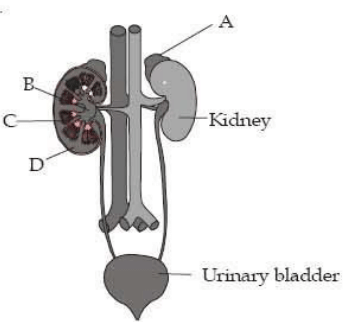
Figure shows human urinary system with structures labelled A to D. Select option which correctly identifies them and gives their characteristics and/ or functions
1
A-Adrenal gland-located at the anterior part of kidney. Secrete Catecholamines which stimulate glycogen breakdown
2
B-Pelvis-broad funnel shaped space inner to hilum, directly connected to loops of Henle
3
C-Medulla - inner zone of kidney and contains complete nephrons
4
D-Cortex- outer part of kidney and do not contain any part of nephrons
Official Solution
Correct Option:
(1)
The correct option is (A): A-Adrenal gland-located at the anterior part of kidney. Secrete Catecholamines which stimulate glycogen breakdown.
04
PYQ 2014
medium
biologyID: neet-ug-
Which of the following causes an increase in sodium reabsorption in the distal convoluted tubule?
1
Increase in antidiuretic hormone levels
2
Decrease in aldosterone levels
3
Decrease in antidiuretic hormone levels
4
Increase in aldosterone levels
Official Solution
Correct Option:
(4)
The correct option (D): Increase in aldosterone levels.
05
PYQ 2016
medium
biologyID: neet-ug-
The part of nephron involved in active reabsorption of sodium is
1
distal convoluted tubule
2
Proximal convoluted tubule
3
Bowman’s capsule
4
descending limb of Henle’s loop
Official Solution
Correct Option:
(2)
Tubular Reabsorption in the Kidney
From the Bowman’s capsule, a glomerular filtrate enters the proximal convoluted tubule. In this part of the nephron, absorption of selected materials takes place from the filtrate into the blood of the peritubular capillaries or vasa recta. This process is called tubular reabsorption.
Reabsorption Process:
Reabsorption involves both passive and active transport across the tubular epithelium. About 65 percent of the glomerular filtrate is normally reabsorbed in the proximal convoluted tubule before it reaches the loop of Henle.
Materials Reabsorbed:
The following materials are absorbed during the process of tubular reabsorption:
Glucose
Amino acids
Vitamins
Hormones
Sodium (Na+)
Potassium (K+)
Chlorides (Cl-)
Phosphates (PO₄³⁻)
Bicarbonates (HCO₃⁻)
Much of the water
Some urea
Mechanism of Reabsorption:
Sodium and potassium ions are reabsorbed by primary active transport, which uses energy to move these ions against their concentration gradients. This ensures the selective reabsorption of essential materials from the filtrate.
06
PYQ 2019
medium
biologyID: neet-ug-
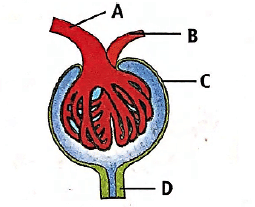
The given figure represents the Malpighian body. Identify the labelled parts to and select the correct option
1
a
2
b
3
c
4
d
Official Solution
Correct Option:
(3)
Answer (c) c
About Human Excretory System - NEET-UG
Human Excretory System is a vital chapter for NEET-UG aspirants. Mastering the concepts covered in this chapter is essential for securing a top rank.
By rigorously practicing the previous year questions associated with this chapter, you can identify high-yield topics, understand the examiner's perspective, and boost your confidence during the actual exam.
Frequently Asked Questions
Why focus on Human Excretory System PYQs?
Analyzing PYQs for this specific chapter reveals the most frequently tested concepts and the typical complexity of questions, allowing you to tailor your study plan efficiently.
How to best use this analysis?
Review the topic breakdown to see which sub-topics within Human Excretory System carry the most weight. Then, tackle the questions iteratively to solidify your understanding.