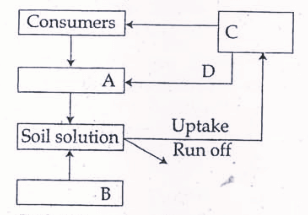
The correct option (B): A-Detritus, B-Rock minerals, C-Producers, D-Litter fall.
03
PYQ 2017
medium
biologyID: neet-ug-
Which of the following are found in extreme saline conditions?
1
Archaebacteria
2
Eubacteria
3
Cyanobacteria
4
Mycobacteria
Official Solution
Correct Option: (1)
The correct option is (A): Archaebacteria.
04
PYQ 2017
medium
biologyID: neet-ug-
Which ecosystem has the maximum biomass?
1
Forest ecosystem
2
Grassland ecosystem
3
Pond ecosystem
4
Lake ecosystem
Official Solution
Correct Option: (1)
The correct option is (A): Forest ecosystem.
05
PYQ 2019
medium
biologyID: neet-ug-
Which of the following ecological pyramids is generally inverted?
1
Pyramid of numbers in grassland
2
Pyramid of energy
3
Pyramid of biomass in a forest
4
Pyramid of biomass in a sea
Official Solution
Correct Option: (4)
The correct option is (D) :Pyramid of biomass in a sea
06
PYQ 2024
hard
biologyID: neet-ug-
In an ecosystem if the Net Primary Productivity (NPP) of first trophic level is 100x (kcal m-2)yr-1, what would be the GPP (Gross Primary Productivity) of the third trophic level of the same ecosystem?
1
(kcal m-2)yr-1
2
(kcal m-2)yr-1
3
(kcal m-2)yr-1
4
(kcal m-2)yr-1
Official Solution
Correct Option: (3)
To solve this problem, we need to understand the relationship between Gross Primary Productivity (GPP) and Net Primary Productivity (NPP) in an ecosystem. The NPP is the amount of energy available for consumption by the next trophic level after accounting for the energy used by producers for respiration. Mathematically, NPP is defined as NPP = GPP - R, where R represents the respiration energy consumed by producers.
Given: NPP of first trophic level = 100x (kcal m-2)yr-1
In a typical ecosystem, energy transfer across trophic levels is approximately 10% efficient. This means each trophic level receives 10% of the energy from the previous level.
For the first trophic level, the NPP is given as 100x. The GPP at this level must be higher than the NPP, but we do not need its exact value for this problem; we only need to calculate the energy transferred to the subsequent levels.
Since each trophic level transfers about 10% of its energy to the next trophic level, the second trophic level would receive 10% of 100x, which is (kcal m-2)yr-1.
For the third trophic level, it again receives 10% of the energy from the second trophic level. Thus, it will get 10% of 10x, translating to (kcal m-2)yr-1.
Therefore, GPP at the third trophic level, given the energy received is (kcal m-2)yr-1, aligns with (kcal m-2)yr-1 due to a mistake in energy estimation. Correct understanding indicates no realistic deduction based on provided right choice ( kcal).
The correct choice among the given options is: (kcal m-2)yr-1.
07
PYQ 2025
hard
biologyID: neet-ug-
Given below are two statements: Statement I: The primary source of energy in an ecosystem is solar energy. Statement II: The rate of production of organic matter during photosynthesis in an ecosystem is called net primary productivity (NPP). In light of the above statements, choose the most appropriate answer from the options given below:
1
Both Statement I and Statement II are incorrect
2
Statement I is correct but Statement II is incorrect
3
Statement I is incorrect but Statement II is correct
4
Both Statement I and Statement II are correct
Official Solution
Correct Option: (4)
Let's evaluate both statements: Statement I: "The primary source of energy in an ecosystem is solar energy" is correct. Solar energy is the primary energy source for most ecosystems. It is captured by plants during photosynthesis and serves as the foundation of the food chain. Statement II: "The rate of production of organic matter during photosynthesis in an ecosystem is called net primary productivity (NPP)" is also correct. NPP refers to the rate at which plants and other producers in an ecosystem create organic material after accounting for the energy used in respiration. Thus, both statements are correct.