Organisms And Populations
60 previous year questions.
High-Yield Trend
Chapter Questions 60 MCQs
What is true for photolithotrops
Obtain energy from radiations and hydrogen from organic compounds
Obtain energy from radiations and hydrogen from inorganic compounds
Obtain energy from organic compounds
Obtain energy from inorganic compounds
Choose the correct sequence of stages of growth curve for Bacteria
In a population, unrestricted reproductive capacity is called as
Which one of the following is one of the characteristics of a biological community?
What type of human population is represented by the following age pyramid?
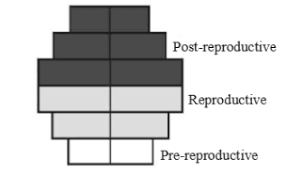
endoparasitism
Natality refers to
Amensalism can be represented as :
Species A (+) ; Species B (0)
Species A (−) ; Species B (0)
Species A (+) ; Species B (+)
Species A (−) ; Species B (−)
endoparasitism
List I | List II | ||
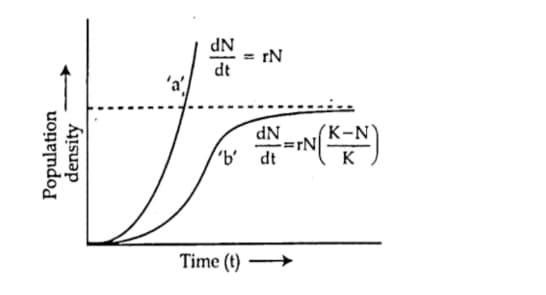
| A | Logistic growth | I | Unlimited resource availability condition |
| B | Exponential growth | II | Limited resource availability condition |
| C | Expanding age pyramid | III | The percent individuals of pre-reproductive age is largest followed by reproductive and post reproductive age groups |
| D | Stable age pyramid | IV | The percent individuals of pre-reproductives and reproductive age group are same |
Match List I with List II.
List I (Interacting species) | List II (Name of interaction) | ||
| A | Leopard and a Lion in a forest/grassland | I | Competition |
| B | A Cuckoo laying egg in a Crow’s nest | II | Brood parasitism |
| C | Fungi and root of a higher plant in Mycorrhizae | III | Mutualism |
| D | A cattle egret and a Cattle in a field | IV | Commensalism |
Choose the correct answer from the options given below
Match List I with List II:
| List I (Interaction) | List II (Species A and B) | ||
| A. | Mutualism | I. | +(A), O(B) |
| B. | Commensalism | II. | –(A), O(B) |
| C. | Amensalism | III. | +(A), –(B) |
| D. | Parasitism | IV | +(A), +(B) |
Choose the correct answer from the options given below:
A-IV, B-I, C-II, D-III
A-IV, B-III, C-I, D-II
A-III, B-I, C-IV, D-II
A-IV, B-II, C-I, D-III
About Organisms And Populations - NEET-UG
Organisms And Populations is a vital chapter for NEET-UG aspirants. Mastering the concepts covered in this chapter is essential for securing a top rank.
By rigorously practicing the previous year questions associated with this chapter, you can identify high-yield topics, understand the examiner's perspective, and boost your confidence during the actual exam.
Frequently Asked Questions
Why focus on Organisms And Populations PYQs?
Analyzing PYQs for this specific chapter reveals the most frequently tested concepts and the typical complexity of questions, allowing you to tailor your study plan efficiently.
How to best use this analysis?
Review the topic breakdown to see which sub-topics within Organisms And Populations carry the most weight. Then, tackle the questions iteratively to solidify your understanding.