The effective capacitance between the points and in the circuit shown in is (capacitance of each capacitor is
1
2
2
4
3
3
4
0.4
Official Solution
Correct Option:
(4)
Capacitance of 2 capacitors in parallel = 1 + 1 = 2 F Capacitance of 1 F, 2 F and 1 F in series is given by, C =
02
PYQ 2021
medium
physicsID: kcet-202
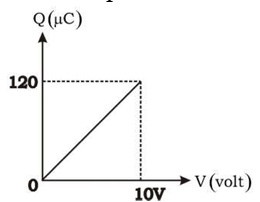
In figure, charge on the capacitor is plotted against potential difference across the capacitor. The capacitance and energy stored in the capacitor are respectively.
1
12 μF, 1200 μJ
2
12 μF, 600 μJ
3
24 μF, 600 μJ
4
24 μF, 1200 μJ
Official Solution
Correct Option:
(2)
1. Capacitance:
The capacitance of a capacitor is defined as the ratio of the charge stored to the potential difference across it:
From the graph, we can see that when , . Therefore:
2. Energy Stored:
The energy stored in a capacitor can be calculated using the following formula:
Using the values from the graph ( and ):
Alternatively, using the calculated capacitance:
The correct answer is (B) 12 μF, 600 μJ.
03
PYQ 2021
easy
physicsID: kcet-202
An electrician requires a capacitance of 6 μF in a circuit across a potential difference of 1.5 kV. A large number of 2 μF capacitors which can withstand a potential difference of not more than 500 V are available. The minimum number of capacitors required for the purpose is
1
3
2
9
3
6
4
27
Official Solution
Correct Option:
(4)
1. Number of capacitors in series:
To withstand the potential difference, we need to connect capacitors in series. The voltage across each capacitor in a series connection adds up to the total voltage. Therefore, the number of capacitors required in series is:
2. Equivalent capacitance of series combination:
The equivalent capacitance of capacitors in series is given by:
Since all the capacitors have the same capacitance ( ), the equivalent capacitance of the series combination is:
3. Number of parallel combinations:
To achieve the desired capacitance, we need to connect multiple series combinations in parallel. The equivalent capacitance of capacitors in parallel is the sum of their individual capacitances. Let be the number of parallel combinations required. Then:
4. Total number of capacitors:
The total number of capacitors needed is the product of the number of capacitors in series and the number of parallel combinations:
The correct answer is (D) 27.
04
PYQ 2021
medium
physicsID: kcet-202
If a slab of insulating material (conceptual) 4 × 10⁻³ m thick is introduced between the plates of a parallel plate capacitor, the separation between the plates has to be increased by 3.5 × 10⁻³m to restore the capacity to original value. The dielectric constant of the material will be
1
6
2
8
3
10
4
12
Official Solution
Correct Option:
(2)
1. Initial Capacitance:
The capacitance of a parallel plate capacitor without any dielectric is given by:
where is the permittivity of free space, is the area of the plates, and is the initial separation between the plates.
2. Capacitance with Dielectric Slab:
When a dielectric slab of thickness m and dielectric constant is introduced between the plates (without changing the separation ), the new capacitance becomes:
3. Capacitance with Increased Separation and Dielectric Slab:
To restore the capacitance to the original value , the separation between the plates is increased by m. The new separation is m. The capacitance with the increased separation and dielectric slab is :
4. Equating New and Original Capacitance:
We are given that the capacity is restored to the original value, so .
Therefore, we can equate the expressions for and :
5. Simplifying the Equation by Equating Denominators:
Since is present in the numerator of both sides and is non-zero, we can equate the denominators:
6. Solving for the Dielectric Constant :
Subtract from both sides of the equation:
Combine the numerical terms:
Add to both sides:
Divide both sides by :
Solve for :
Final Answer: The dielectric constant of the material will be 8.
05
PYQ 2023
medium
physicsID: kcet-202
A parallel plate capacitor of capacitance C1 with a dielectric slab in between its plates is connected to a battery. It has a potential difference V1 across its plates. When the dielectric slab is removed, keeping the capacitor connected to the battery, the new capacitance and potential difference are C2 and V2 respectively. Then,
1
V1 > V2, C1 > C2
2
V1 < V2, C1 > C2
3
V1 = V2, C1 > C2
4
V1 = V2, C1 < C2
Official Solution
Correct Option:
(3)
A parallel plate capacitor with capacitance C1 and a dielectric slab is connected to a battery, providing a potential difference V1.
When the dielectric slab is removed while keeping the battery connected, the capacitance changes to C2, and the new potential difference is V2.
Understanding the Changes
The capacitance of a parallel plate capacitor with a dielectric is given by: where is the dielectric constant and is the capacitance without the dielectric.
When the dielectric is removed, the new capacitance becomes: Since , it follows that:
Effect on Voltage
Since the capacitor remains connected to the battery, the voltage across the plates is maintained at the same level:
Conclusion
From the above analysis: C1 > C2 and V1 = V2.
Hence, the correct answer is: V1 = V2, C1 > C2.
06
PYQ 2023
hard
physicsID: kcet-202
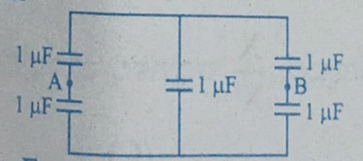
Five capacitors each of value 1 μF are connected as shown in the figure. The equivalent capacitance between A and B is
1
1 μF
2
2 μF
3
5 μF
4
3 μF
Official Solution
Correct Option:
(1)
Given: Five capacitors each of value 1 μF are connected as shown in the figure. The equivalent capacitance between A and B needs to be calculated.
Step-by-Step Solution
Step 1: Identify the Configuration
We have two sets of capacitors in parallel connected to each other in series.
Step 2: Calculate Equivalent Capacitance of Each Set in Parallel
For the set connected to point A:
For the set connected to point B:
Step 3: Calculate Equivalent Capacitance of the Series Combination
Since the middle capacitor is in series with the parallel combinations, we calculate the equivalent capacitance as:
Step 4: Final Equivalent Capacitance
The final equivalent capacitance between points A and B is therefore:
07
PYQ 2026
medium
physicsID: kcet-202
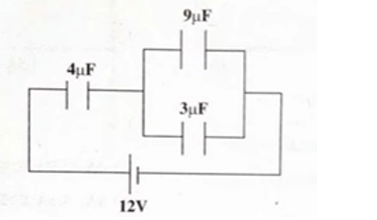
In the circuit shown in the figure, the potential difference across the 4 F capacitor is
1
3 V
2
4 V
3
9 V
4
12 V
Official Solution
Correct Option:
(3)
Step 1: Understanding the Question:
We need to find the voltage across a specific capacitor in a series-parallel combination connected to a 12V DC source. Step 2: Key Formula or Approach:
1. Capacitance in parallel:
2. Capacitance in series:
3. Charge: . In series, charge is the same for all components.
4. Potential difference: Step 3: Detailed Explanation:
1. First, simplify the parallel part: The and capacitors are in parallel.
.
2. This combination is in series with the capacitor and the 12V battery.
3. Equivalent capacitance of the circuit ( ):
4. Total charge supplied by the battery ( ):
5. Since the capacitor is in series with the main circuit, it carries the total charge .
6. Potential difference across the capacitor ( ): Step 4: Final Answer:
The potential difference across the 4 F capacitor is 9 V.
08
PYQ 2026
easy
physicsID: kcet-202
A parallel plate capacitor has a uniform electric field 'E' in the space between the plates. If the distance between the plates is 'd' and area of each plate is 'A', the energy stored in the capacitor is
1
2
3
4
Official Solution
Correct Option:
(3)
Step 1: Understanding the Question:
The question asks for the expression of the total electrostatic energy stored in a parallel plate capacitor in terms of the internal electric field and physical dimensions. Step 2: Key Formula or Approach:
1. Energy stored in a capacitor:
2. Capacitance of parallel plates:
3. Potential difference: Step 3: Detailed Explanation:
Substitute the expressions for and into the energy formula:
Alternatively, using the concept of energy density ( ):
Energy density
Total energy Step 4: Final Answer:
The energy stored in the capacitor is .
About Capacitors And Capacitance - KCET
Capacitors And Capacitance is a vital chapter for KCET aspirants. Mastering the concepts covered in this chapter is essential for securing a top rank.
By rigorously practicing the previous year questions associated with this chapter, you can identify high-yield topics, understand the examiner's perspective, and boost your confidence during the actual exam.
Frequently Asked Questions
Why focus on Capacitors And Capacitance PYQs?
Analyzing PYQs for this specific chapter reveals the most frequently tested concepts and the typical complexity of questions, allowing you to tailor your study plan efficiently.
How to best use this analysis?
Review the topic breakdown to see which sub-topics within Capacitors And Capacitance carry the most weight. Then, tackle the questions iteratively to solidify your understanding.