When light passes form one medium to another, there is a change in
1
frequency and velocity
2
frequency and wavelength
3
wavelength and velocity
4
root mean square momentum
Official Solution
Correct Option: (3)
The correct option is(C): wavelength and velocity.
when light passes from one medium to another, there is indeed a change in both wavelength and velocity. These changes are fundamental to the behavior of light as a wave and are governed by the refractive properties of the two media involved. This phenomenon is well-documented and is a key concept in the study of optics and wave propagation. Frequency remains same.
03
PYQ 1996
medium
physicsID: kcet-199
Optical fiber works on the principle of
1
refraction
2
reflection
3
total internal reflection
4
scattering
Official Solution
Correct Option: (3)
Total internal reflection is a powerful process since it can be used to confine light. One of the most common applications of total internal reflection is in fibre optics. An optical fibre is a thin, transparent fibre, usually made of glass or plastic, for transmitting light. If light is incident on a cable end with an angle of incidence greater than the critical angle then the light will remain trapped inside the glass strand. In this way, light travels very quickly down the length of the cable over a very long distance (tens of kilometers).
04
PYQ 1997
medium
physicsID: kcet-199
A point source of light produces an illumination at a point. When the distance between them is made four times its original value, the intensity at that point becomes
1
2
3
4
Official Solution
Correct Option: (4)
05
PYQ 1997
medium
physicsID: kcet-199
The focal length of a plano convex lens is equal to its radius of curvature. The value of the refractive index of its material is
1
2
2
1.5
3
1.6
4
1.33
Official Solution
Correct Option: (1)
Using we get
06
PYQ 1997
medium
physicsID: kcet-199
The normal magnifying power of a simple microscope is 6. The focal length of the convex lens uses is
1
50 cm
2
5 m
3
0.05 m
4
0.5 cm
Official Solution
Correct Option: (3)
07
PYQ 1999
medium
physicsID: kcet-199
A mirror forms a real image of unit magnification, Its nature is
1
concave
2
plane
3
parabolic
4
convex
Official Solution
Correct Option: (1)
Concave mirror
08
PYQ 1999
medium
physicsID: kcet-199
A convex lens of refractive index behaves as a convex lens of smaller power in a liquid of refractive index and as a concave lens in another liquid of refractive index . Then relation between and is
1
2
3
4
Official Solution
Correct Option: (2)
09
PYQ 2001
medium
physicsID: kcet-200
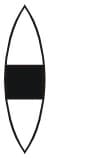
How will the image formed by a convex lens be affected if the central portion of the lens is wrapped in black paper?
1
Full image will be formed but without the central portion
2
Two images will be formed, one due to each exposed half
3
No image will be formed
4
Full image will be formed but it is less bright.
Official Solution
Correct Option: (4)
Any image is formed by a large number of rays passing from the object. Therefore, if any part of the lens is covered, the brightness of the image will be less as compared to the image formed without wrapping the lens.
Therefore option D) is the correct answer - If the central portion of the convex lens is wrapped in black paper, then a full image will be formed but it will be less bright.
Convex lens with central portion wrapped in black paper
10
PYQ 2002
easy
physicsID: kcet-200
The light reflected by a plane mirror may form a real image
Official Solution
Correct Option: (1)
11
PYQ 2002
easy
physicsID: kcet-200
Light appears to travel in straight line because
Official Solution
Correct Option: (1)
12
PYQ 2002
easy
physicsID: kcet-200
A convex lens is made up of three different materials as shown in the figure. For a point object placed on its axis, the number of images formed are
1
1
2
5
3
4
4
3
Official Solution
Correct Option: (4)
Three
13
PYQ 2002
medium
physicsID: kcet-200
An object is placed 12 cm to the left of a converging lens of focal length 8 cm. Another converging lens of 6 cm focal length is placed at a distance of 30 cm to the right of the first lens. The second lens will produce
1
no image
2
a virtual enlarged image
3
a real enlarged image
4
real inverted image
Official Solution
Correct Option: (3)
The correct answer is C:a real enlarged image
14
PYQ 2002
medium
physicsID: kcet-200
A ray of light travels from an optically denser to a rarer medium. The critical angle for the two media is C. The maximum possible deviation of the ray will be
1
2
2 C
3
4
Official Solution
Correct Option: (3)
When > C, deviation is maximum , Here d = - 2C
15
PYQ 2003
easy
physicsID: kcet-200
A fish looking up through the water sees the outside world contained in a circular horizon. If the refractive index of water is 4/3 and the fish is 12 cm below the surface of water, the radius of circle in centimetre is
1
2
3
4
Official Solution
Correct Option: (1)
16
PYQ 2003
medium
physicsID: kcet-200
The aperture of objective lens of a telescope is made large so as to
1
focus on distant objects
2
make image abberation less
3
increase the resolving power of telescope
4
increase the magnifying power of the telescope.
Official Solution
Correct Option: (3)
increases
17
PYQ 2003
medium
physicsID: kcet-200
A lamp hanging 4 m above the table is lowered by 1 m. The illumination on the table
1
decreases by 77.7%
2
increases by 77.7%
3
decreases by 25%
4
increases by 25%
Official Solution
Correct Option: (2)
77.7% increase.
18
PYQ 2004
medium
physicsID: kcet-200
A thin plano-convex lens acts like a concave mirror of focal length when silvered from its plane surface. The refractive index of the material of the lens is The radius of curvature of the convex surface of the lens will be ............
1
0.4 m
2
0.2 m
3
0.1 m
4
0.75 m
Official Solution
Correct Option: (2)
Answer (b) 0.2 m
19
PYQ 2004
easy
physicsID: kcet-200
The refractive index of a particular material is for blue light, for yellow light and for red light. The dispersive power of the material is .........
1
0.0615
2
0.024
3
0.031
4
1.6
Official Solution
Correct Option: (1)
20
PYQ 2004
medium
physicsID: kcet-200
Rainbow is formed due to.............
1
refraction
2
dispersion and total internal reflection
3
total internal reflection
4
scattering
Official Solution
Correct Option: (2)
The rainbow is an example of the dispersion of sunlight by the water droplets in the atmosphere. A Rainbow is a beautiful phenomenon that occurs due to a combination of the refraction of sunlight by spherical droplets of water and of internal (not total) reflection.
The dispersion of light is the splitting of light into its constituent colors.
Total internal reflection is when the ray of light travels in a denser medium towards the rare medium and gets reflected back inside the initial medium.
As the light shows Total internal reflection and dispersion by splitting into the colors in the rainbow. Therefore, option B is the correct answer.
21
PYQ 2005
medium
physicsID: kcet-200
Which mirror is to be used to obtain a parallel beam of light from a small lamp ?
1
Plane mirror
2
Convex mirror
3
Concave mirror
4
Any one of these
Official Solution
Correct Option: (3)
It lamp is placed at the focus of concave mirror then we get parallel beam of light.
22
PYQ 2006
medium
physicsID: kcet-200
A transparent cube of edge contains a small air bubble. Its apparent distance when viewed through one face of the cube is and when viewed from the opposite face if . The actual distance of the bubble from the second face of the cube is
1
0.06 m
2
0.17 m
3
0.05 m
4
0.04 m
Official Solution
Correct Option: (1)
23
PYQ 2006
medium
physicsID: kcet-200
White light is incident on one of the refracting surfaces of a prism of angle . If the refractive indices for red and blue colours are and respectively, the angular separation between these two colours when they emerge out of the prism is
1
2
3
4
Official Solution
Correct Option: (2)
Angular dispersion,
24
PYQ 2007
medium
physicsID: kcet-200
A prism of a certain angle deviates the red and blue rays by and respectively. Another prism of the same angle deviates the red and blue rays by and respectively. The prisms are small angled and made of different materials. The dispersive powers of the materials of the prisms are in the ratio
1
2
3
4
Official Solution
Correct Option: (2)
Dispersive power, For 1st prism,
where Similarly, for 2 nd prism,
25
PYQ 2007
medium
physicsID: kcet-200
A ray of light is travelling from glass to air. (Refractive index of glass = ) The angle of incidence is . The deviation of the ray is
1
2
3
4
Official Solution
Correct Option: (3)
Refractive index,
Critical angle for glass When the angle of incidence in the denser medium is greater than the critical angle, reflection takes place inside the denser medium.
Hence, a ray of light incident at in glass medium undergoes total internal reflection. Deviation (from the-figure) or
26
PYQ 2007
medium
physicsID: kcet-200
A ray of light is incident normally on one face of a right angled isosceles prism. It then grazes the hypotenuse. The refractive index of the material of the prism is
1
1.732
2
1.5
3
1.414
4
1.33
Official Solution
Correct Option: (3)
Refractive index, where C is the critical angle.
Here, (as shown)
or or
27
PYQ 2008
easy
physicsID: kcet-200
A fish in water (refractive index ) looks at a bird vertically above in the air. If is the height of the bird and is the depth of the fish from the surface, then the distance of the bird as estimated by the fish is
Official Solution
Correct Option: (1)
28
PYQ 2008
easy
physicsID: kcet-200
Figure shows a mixture of blue, green and red coloured rays incident normally on a right angled prism. The critical angles of the material of the prism for red, green and blue are , and respectively. The arrangement will separate
1
red colour from blue and green
2
blue colour from red and green
3
green colour from red and blue
4
all the three colours.
Official Solution
Correct Option: (1)
Condition of no emergence is
As angle of prism is greater than critical angle for blue and green coloured rays, total internal reflection will take place at second surface and hence the arrangement will separate red colour from blue and green.
29
PYQ 2008
medium
physicsID: kcet-200
Blue colour of sea water is due to
1
interference of sunlight reflected from the water surface
2
scattering of sunlight by the water molecules
3
image of sky in water
4
refraction of sunlight
Official Solution
Correct Option: (2)
Blue colour of sea water is due to scattering of sunlight by water molecules
30
PYQ 2008
easy
physicsID: kcet-200
A ray of light enters from a rarer to a denser medium. The angle of incidence is . Then the reflected and refracted rays are mutually perpendicular to each other. The critical angle for the pair of media is
1
2
3
4
Official Solution
Correct Option: (3)
From law of reflection, and
or
From E (ii) or But (where is critical angle)
31
PYQ 2009
easy
physicsID: kcet-200
According to Newton's Corpuscular Theory, the speed of light is
1
lesser in rarer medium
2
lesser in denser medium
3
independent of the medium
4
same in all the media
Official Solution
Correct Option: (1)
According to Newton's corpuscular theory, speed of light in a rarer medium (like air) is lesser than that in a denser medium (like water, glass).
32
PYQ 2009
easy
physicsID: kcet-200
In fog, photographs of the objects taken with infra-red radiations are more clear than those obtained during visible light because
1
scattering of l-R light is more than visible light
2
the intensity of I-R light from the object is less
3
scattering of l-R light is less than visible light
4
l-R radiation has lesser wavelength than visible radiation
Official Solution
Correct Option: (3)
In fog, visible light is scattered more according to Rayleigh scattering, but scattering of infrared radiations is less due to high wavelengths, hence in fog, photographs of the objects taken with infrared radiations are more clear.
33
PYQ 2010
easy
physicsID: kcet-201
Two beams of red and violet colours are made to pass separately through a prism of . In the minimum deviation position, the angle of refraction inside the prism will be
1
greater for violet colour
2
for both the colours
3
greater for red colour
4
equal but not for both the colours
Official Solution
Correct Option: (2)
Here, Angle of prism, For minimum deviation, or for both colours.
34
PYQ 2011
hard
physicsID: kcet-201
A planoconvex lens has a maximum thickness of . When placed on a horizontal table with the curved surface in contact with the table surface, the apparent depth of the bottommost point of the lens is found to be . If the lens is inverted such that the plane face of the lens is in contact with the surface of the table, the apparent depth of the center of the plane face is found to be .The radius of curvature of the lens is
1
68 cm
2
75 cm
3
128 cm
4
34 cm
Official Solution
Correct Option: (4)
35
PYQ 2011
medium
physicsID: kcet-201
Two thin lenses have a combined power of . When they are separated by a distance of , their equivalent power becomes . Their individual powers (in diopters) are
1
1,8
2
2,7
3
3,6
4
4,5
Official Solution
Correct Option: (3)
Given,
Hence, the above equation is correct for and
36
PYQ 2011
medium
physicsID: kcet-201
If the scattering intensity of a liquid is units at a wavelength of , then the scattering intensity at a wavelength of will be approximately
1
13 units
2
16 units
3
20 units
4
24 units
Official Solution
Correct Option: (3)
Intensity,
units
37
PYQ 2012
medium
physicsID: kcet-201
A point source of light is kept below the surface of water at a depth of m. The radius of the circular bright patch of light noticed on the surface of water is
1
2
3
4
Official Solution
Correct Option: (2)
When the ray of light is incident from water-air interface at critical angle , the refracted ray becomes parallel to the interface.
Hence, the radius of the circular bright patch of light noticed on the surface of water is given by (see figure)
38
PYQ 2012
medium
physicsID: kcet-201
A monochromatic beam of light is travelling from medium of refractive index to a medium of refractive index . In the medium , there are number of waves in certain distance. In the medium , there are number of waves in the same distance. Then, refractive index of medium with respect to medium is
1
2
3
4
Official Solution
Correct Option: (4)
If x number of waves of wavelength and y number of waves of wavelength are present in same distance s, then
or
39
PYQ 2013
medium
physicsID: kcet-201
Radii of curvature of a converging lens are in the ratio . Its focal length is and refractive index is . Then its radii of curvature are
1
9 cm and 18 cm
2
6 cm and 12 cm
3
3 cm and 6 cm
4
4.5 cm and 9 cm
Official Solution
Correct Option: (4)
Given, and Let and We know the focal length of converging lens By using relation Substituting all the values, we get and
40
PYQ 2014
medium
physicsID: kcet-201
An object is placed at in front of a concave mirror produces three times magnified real image. What is focal length of the concave mirror ?
1
15 cm
2
6.6 cm
3
10 cm
4
7.5 cm
Official Solution
Correct Option: (1)
We know that Linear magnification Given, object displaced
all real image are inverted) So,
Since, mirror is concave .
41
PYQ 2014
medium
physicsID: kcet-201
A microscope is having objective of focal length and eyepiece of focal length If tube length is and image is formed at the least distance of distinct vision, what is the magnification produced by the microscope ? Take
1
6
2
150
3
25
4
125
Official Solution
Correct Option: (2)
By compound microscope
(where length of tube , focal length of objective lens , focal length of eye-piece
42
PYQ 2015
medium
physicsID: kcet-201
A person wants a real image of his own, times enlarged. Where should he stand infront of a concave mirror of radius of curvature ?
1
10 cm
2
30 cm
3
90 cm
4
20 cm
Official Solution
Correct Option: (4)
Given, ,
We know that,
We know that,
Initial position of a person,
43
PYQ 2016
medium
physicsID: kcet-201
A plane glass plate is placed over a various coloured letters (violet, green, yellow, red). The letter which appears to raised more
1
Red
2
Yellow
3
Green
4
Violet
Official Solution
Correct Option: (4)
where, reflective index of medium Apparent depth But,
Thus, is greater to all of them Apparent depth is minimum for violet. It means that the violet letter appear raised more.
44
PYQ 2017
medium
physicsID: kcet-201
According to Cartesian sign convention, in ray optics
1
all distances are taken positive
2
all distances are taken negative
3
all distances in the direction of incident ray are taken positive
4
all distances in the direction of incident ray are taken negative
Official Solution
Correct Option: (3)
According to cartesian sign convention, in ray optics all distance in the direction of incident ray are taken positive
45
PYQ 2018
medium
physicsID: kcet-201
An object is placed at a distance of 20 cm from the pole of a concave mirror of focal length 10 cm. The distance of the image formed is
1
+ 20 cm
2
+ 10 cm
3
- 20 cm
4
- 10 cm
Official Solution
Correct Option: (3)
46
PYQ 2019
easy
physicsID: kcet-201
A girl of height with her eye level at stands in front of plane mirror of height fixed to a wall. The lower edge of the mirror is at a height of above her feet level. The height of her image the girl can see in the mirror is
1
130 cm
2
140 cm
3
120 cm
4
150 cm
Official Solution
Correct Option: (3)
Ray diagram of a girl standing in front of a plane mirror is given below,
Applying the property of triangle and from similar triangles and
Since,
Let and
So, the maximum height seen by the girl,
Since, the height above her eyes, has not effected the mirror height, because it is just in front of the mirror.
47
PYQ 2019
medium
physicsID: kcet-201
A Point object is moving uniformly towards the pole of a concave mirror of focal length 25 cm along its axis as shown below. The speed of the object is 1 . At t = 0, the distance of the object from the mirror is 50 cm. The average velocity of the image formed by the mirror between time t = 0 and t = 0.25 s is
1
zero
2
3
infinity
4
Official Solution
Correct Option: (3)
Focal length = 25 cm
48
PYQ 2020
medium
physicsID: kcet-202
The refracting angle of prism is A and refractive index of material of prism is The angle of minimum deviation is
1
2
3
4
Official Solution
Correct Option: (1)
49
PYQ 2020
easy
physicsID: kcet-202
An object approaches a convergent lens from the left of the lens with a uniform speed and stops at the focus, the image
1
Moves away from the lens with an uniform speed 5 m/s
2
Moves away from the lens with an uniform acceleration
3
Moves away from the lens with a non- uniform acceleration
4
Moves towards the lens with a non-uniform acceleration
Official Solution
Correct Option: (3)
Velocity of image in convex lens and image will move from focus to infinity (i.e. away from the lens). From the formula, velocity of image
(because
We can see that acceleration of image , i.e varies with distance of object So the image moves away from the lens with a non-uniform acceleration
50
PYQ 2022
medium
physicsID: kcet-202
A convex lense of focal length 'l' is placed somewhere in between an object and a screen. The distance between the object and the screen is 'x'. If the numerical value of the magnification produced by the lens is 'm'. Then the focal lenght of the lens is
1
2
3
4
Official Solution
Correct Option: (2)
To find the focal length of the lens, we can use the lens formula:
We know that:
Solving the lens formula for :
Now, let's consider the situation where the lens is placed somewhere between the object and the screen. The distance between the object and the screen is given as . We can divide this distance into two parts:
u is the object distance, the distance between the object and the lens.
v is the image distance, the distance between the lens and the screen.
Therefore,
Rearranging the equation, we have:
Substituting this value of into the lens formula equation:
Let's solve this equation for:
Now, we need to find the expression for the focal length, so we take the reciprocal of both sides:
To simplify this expression, we can find the common denominator:
Simplifying further:
Factoring out from the denominator:
Now, we can divide both the numerator and denominator by :
Since the given distance between the object and the screen is , and the object distance is , we can rewrite the equation as:
Therefore, the correct option is (B):
51
PYQ 2022
medium
physicsID: kcet-202
The power of equi - concave lens is - 4.5 D and is made of a material R.I. 1.6, the radii of the curvature of the lens is
1
- 2.66 cm
2
- 26.6 cm
3
115.44 cm
4
+36.6 cm
Official Solution
Correct Option: (2)
1/f = (n - 1) (1/R₁ - 1/R₂)
Given:
Power of the lens (P) = -4.5 D
Material refractive index (n) = 1.6
Since the lens is equi-concave, the radii of curvature of both surfaces will have the same magnitude but opposite signs (R₁ = -R₂).
Using the lens maker's formula and substituting the given values, we can solve for the magnitude of the radii of curvature:
Now, we can find the value of by rearranging the equation:
Substituting the value of from the given power:
Converting to centimeters, we have:
The radii of curvature of the lens is approximately -540 cm or -5.4 m. Among the given options, the closest value to -540 cm is (B) -26.6 cm.
52
PYQ 2022
medium
physicsID: kcet-202
The refracting angle of prism is A and refractive index of material of prism is The angle of minimum deviation is
1
2
3
4
Official Solution
Correct Option: (1)
53
PYQ 2022
easy
physicsID: kcet-202
For light diverging from of finite point source
1
The wave front is parabolic
2
The wave front is cylindrical
3
The intensity at the wave front does not depend on the distance
4
The intensity decreases in proportion to the distance squared
Official Solution
Correct Option: (4)
For light diverging from a finite point source:
The wave front is spherical, not parabolic. When light spreads out from a point source, it forms concentric spherical wave fronts around the source.
The wave front appears cylindrical only in the far-field (Fraunhofer) region, where the distance from the source is significantly greater than the source's dimensions.
The claim that intensity at the wave front remains unchanged with distance is incorrect. As light propagates outward, its intensity decreases due to the spreading of light over a larger area.
The intensity decreases in proportion to the square of the distance. This follows the inverse-square law, meaning the intensity III is inversely proportional to the square of the distance rrr from the source:
Thus, the correct statement for light diverging from a finite point source is: "The intensity decreases in proportion to the distance squared."
54
PYQ 2022
medium
physicsID: kcet-202
Focal length of a convex lens will be maximum for
1
Green Light
2
Blue Light
3
Red Light
4
Yellow Light
Official Solution
Correct Option: (3)
The focal length of a convex lens is influenced by the refractive index of the material it is composed of and the wavelength of light passing through it. The refractive index of a material varies slightly with different wavelengths of light, which in turn affects the focal length.
In general, the refractive index of a material decreases as the wavelength of light increases. This phenomenon is known as dispersion. Among the options given, red light has the longest wavelength (longer than green, blue, and yellow light), so the refractive index of the lens material will be the least for red light.
According to the lens maker's formula, a lower refractive index corresponds to a longer focal length for a convex lens. Therefore, the focal length of a convex lens will be maximum for (C) red light.
55
PYQ 2022
easy
physicsID: kcet-202
A ray of light passes through an equilateral glass prism in such a manner that an angle of incidence is equal to the angle of emergence and each of these angles is equal to 3/4 of the angle of prism. The angle of deviation is
1
20 degree
2
45 degree
3
30 degree
4
39 degree
Official Solution
Correct Option: (3)
Given the relationships:
Angle of incidence (i) = Angle of emergence (e)
Angle of incidence (i) = Angle of emergence (e) = * Angle of prism (A)
We can set up the following equations:
i = e (1)
i = e = * A (2)
The angle of deviation (D) is related to the angle of incidence and angle of emergence by the formula:
D = (i + e) - A (3)
Substituting equation (2) into equation (3), we get:
D = * A + * A - A
D = * A - A
D =
From the given information, we know that each of the angles of incidence and emergence is equal to of the angle of prism. Therefore, the angle of deviation is equal to half of the angle of prism.
Since the given prism is an equilateral prism, the angle of prism (A) is 60 degrees. Substituting this value into the equation for the angle of deviation, we get:
D = = 30 degrees
Hence, the correct option is (C) 30 degrees.
56
PYQ 2023
hard
physicsID: kcet-202
An equiconvex lens made of glass of refractive index has focal length f in air. It is completely immersed in water of refractive index . The percentage change in the focal length is
1
300% decrease
2
400% decrease
3
300% increase
4
400% increase
Official Solution
Correct Option: (3)
Given Information: Refractive index of glass, Refractive index of water,
Step-by-Step Explanation:
Step 1: Focal length of the lens in air ( )
For an equiconvex lens (radius of curvature same for both sides), the focal length in air is given by the lens maker's formula:
Substitute the value of :
Thus,
Step 2: Focal length of lens in water ( ):
When immersed in water, the lens formula becomes:
Substitute the given values:
Thus,
Hence, the new focal length in water is:
Step 3: Calculate the percentage change in focal length clearly:
The initial focal length was , and it becomes .
Change in focal length:
Percentage increase in focal length:
Thus, the focal length increases by 300% when immersed in water.
57
PYQ 2023
medium
physicsID: kcet-202
For a given pair of transparent media, the critical angle for which colour is maximum?
1
Red
2
Blue
3
Violet
4
Green
Official Solution
Correct Option: (1)
The critical angle ( ) for total internal reflection is given by the relation:
where is the refractive index of the denser medium relative to the rarer medium.
Important: Refractive index ( ) varies with wavelength (colour) due to dispersion. For visible light, the refractive index is highest for violet (shortest wavelength) and lowest for red (longest wavelength).
Step-by-Step Logic:
Red light has the longest wavelength, thus the smallest refractive index ( ).
As refractive index decreases, the critical angle increases, because:
Therefore, among visible colours, red will have the smallest refractive index, and thus the maximum critical angle.
58
PYQ 2023
hard
physicsID: kcet-202
When light propagates through a given homogeneous medium, the velocities of
1
Primary wavefronts are lesser than those of secondary wavelets
2
Primary wavefronts are greater than or equal to those of secondary wavelets.
3
Primary wavefronts and wavelets are equal
4
Primary wavefronts are larger than those of secondary wavelets
Official Solution
Correct Option: (2)
Concept:
According to Huygens' principle, every point on a primary wavefront acts as a source of secondary wavelets. The new position of the primary wavefront after a given time interval is given by the envelope (common tangent) of all these secondary wavelets.
Key Point:
In a homogeneous medium, the speed of the primary wavefront and secondary wavelets are equal. This ensures that the new wavefront formed (by the secondary wavelets) moves forward smoothly and consistently.
However, mathematically, the envelope (primary wavefront) can never move slower than the wavelets. It is either moving at the same speed (in homogeneous media) or faster (in specific geometrical conditions).
Hence, the correct option:
In a homogeneous medium, the velocities of primary wavefronts are greater than or equal to those of secondary wavelets.
59
PYQ 2026
medium
physicsID: kcet-202
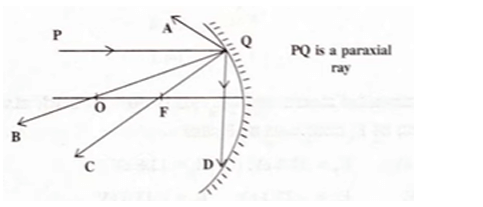
The direction of a ray of light incident on a concave mirror is shown by PQ, while direction in which the ray would travel after reflection is shown by four rays marked as A, B, C and D as shown in the figure. Which of the four rays correctly shows the direction of the reflected ray?
1
D
2
C
3
B
4
A
Official Solution
Correct Option: (2)
Step 1: Understanding the Question:
The question asks to identify the correct reflected path for a specific incident ray on a concave mirror based on standard rules of ray diagrams. \ Step 2: Detailed Explanation:
According to the properties of spherical mirrors:
1. A ray of light incident parallel to the principal axis of a concave mirror will, after reflection, pass through its principal focus ( ).
2. In the provided diagram, the ray PQ is incident parallel to the principal axis (noted as a paraxial ray).
3. Analyzing the four proposed reflected paths: - Ray A: Reflects upwards away from the axis (incorrect for concave reflection). - Ray B: Passes through the center of curvature (incorrect for a parallel incident ray). - Ray C: Passes through the principal focus . This follows the fundamental rule. - Ray D: Reflects straight down (incorrect).
Therefore, ray C correctly represents the reflected ray. Step 4: Final Answer:
The reflected ray is shown by ray C, which corresponds to option (2). \
60
PYQ 2026
medium
physicsID: kcet-202
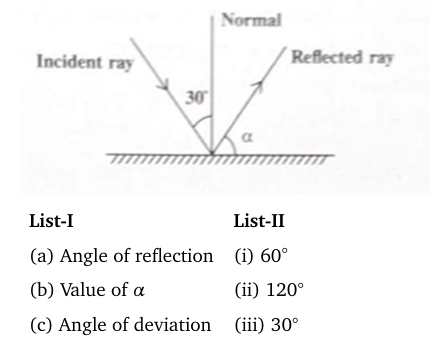
With reference to the figure shown below, match the following:
1
a - i, b - ii, c - iii
2
a - ii, b - i, c - iii
3
a - iii, b - i, c - ii
4
a - iii, b - ii, c - i
Official Solution
Correct Option: (3)
Step 1: Understanding the Question:
This question requires applying the basic laws of reflection at a plane mirror and understanding geometric optics terms like angle of reflection, glancing angle, and angle of deviation. \ Step 2: Key Formula or Approach:
1. Law of Reflection: Angle of incidence ( ) = Angle of reflection ( ). \
2. Normal Geometry: The normal is perpendicular to the mirror surface. Glancing angle ( ) = . \
3. Angle of Deviation ( ): The angle through which the incident ray is turned after reflection. For a single reflection, or . \ Step 3: Detailed Explanation:
From the given figure: \
- The incident ray makes an angle of with the normal. Thus, Angle of incidence . \
- (a) Angle of reflection ( ): By the law of reflection, . This matches with (iii).
- (b) Value of : is the angle between the reflected ray and the mirror surface. Since the angle between the normal and the mirror is , . This matches with (i).
- (c) Angle of deviation ( ): The deviation is . This matches with (ii).
Combining these: a - iii, b - i, c - ii. Step 4: Final Answer:
The correct matching corresponds to code (3). \