Magnetic field here means strength of magnetic field i.e. magnetic induction.
02
PYQ 1997
medium
physicsID: kcet-199
Magnetic field due to a long straight conductor of length, carrying current at a point distance
from it, is given by
1
2
3
4
Official Solution
Correct Option:
(1)
Standard relator.
03
PYQ 2001
easy
physicsID: kcet-200
The magnetic fields at two points on the axis of a circular coil at distance of 0.05 m and 0.2 m
from the centre are in the ratio 8 :1 . The radius of the coil is
Official Solution
Correct Option:
(1)
04
PYQ 2006
medium
physicsID: kcet-200
A solenoid long and in diameter possesses turns per cm length. A current of flows through it. The magnetic field at the axis inside the solenoid is
1
2
3
4
Official Solution
Correct Option:
(1)
Magnetic field at the axis inside the solenoid Here, tums/cm = turns/m,
05
PYQ 2008
medium
physicsID: kcet-200
The magnetic field at the centre of a circular current carrying conductor of radius is . The magnetic field on its axis at a distance from the centre is . The value of will be
1
2
3
4
Official Solution
Correct Option:
(3)
Magnetic field at the center of the circular current carrying loop Magnetic field at a distance on the axis where
Or
06
PYQ 2009
easy
physicsID: kcet-200
The magnetic dipole moment of a current loop is independent of
1
number of turns
2
area of the loop
3
current in the loop
4
magnetic field in which it is lying
Official Solution
Correct Option:
(4)
Magnetic dipole moment of a current is given by
where number of turns current in a loop area of the loop From the above relation it is clear that magnetic dipole moment of a current loop is independent of the magnetic field in which it is lying.
07
PYQ 2010
medium
physicsID: kcet-201
A thin flexible wire of length L is connected to two adjacent
fixed points and carries a current I in the clockwise direction,
as shown in the figure. When the system is put in a uniform
magnetic field of strength B going into the plane of the paper,
the wire takes the shape of a circle. The tension in the wire is
1
IBL
2
3
4
Official Solution
Correct Option:
(3)
For small angles,
Correct option is (c)
08
PYQ 2014
medium
physicsID: kcet-201
A solenoid of inductance carries a current of . What is the magnetic energy stored in a solenoid ?
1
2 J
2
1 J
3
4 J
4
5 J
Official Solution
Correct Option:
(2)
By energy stored in an inductor ( inductance of inductor, current)
where
09
PYQ 2017
medium
physicsID: kcet-201
The magnetic field at the center of a current carrying loop of radius is times that at a point along its axis. The distance of this point from the centre of the loop is
1
0.2 m
2
0.1 m
3
0.05 m
4
0.25 m
Official Solution
Correct Option:
(1)
We know that,
Given that,
On squaring both sides, we get
10
PYQ 2020
easy
physicsID: kcet-202
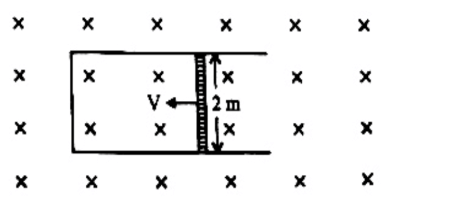
A rod of length 2 m slides with a speed of 5 ms-1 on a rectangular conducting frame as shown in figure. There exists a uniform magnetic field of 0.04 T perpendicular to the plane of the figure. If the resistance of the rod is 3 Ω. The current through the rod is
1
75 mA
2
133 mA
3
0.75 A
4
1.33 A
Official Solution
Correct Option:
(2)
The induced electromotive force (EMF) in the rod is given by the formula: Where: is the magnetic field strength (0.04 T), is the velocity of the rod (5 ms ), is the length of the rod (2 m). Substituting the values: Now, using Ohm’s Law, the current through the rod is: Thus, the current through the rod is 133 mA.
11
PYQ 2020
medium
physicsID: kcet-202
The magnetic field at the origin due to a current element placed at a point with vector position is
1
2
3
4
Official Solution
Correct Option:
(1)
The magnetic field due to a current element at a point with position vector is given by the Biot-Savart law: Where: is the permeability of free space, is the current, is the current element, is the position vector, is the distance between the current element and the point where the magnetic field is being calculated. Thus, the magnetic field at the origin due to the current element is given by option (A).
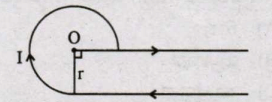
In the given problem, the magnetic field at point O is due to the two different segments of the current-carrying wire. We apply the Biot-Savart law to calculate the magnetic field contributions. 1. For the straight segment of the wire (along the horizontal direction): The magnetic field at point O due to this segment is given by the formula: 2. For the curved segment of the wire (in the circular loop): The magnetic field at point O due to this loop is given by the formula: Thus, the total magnetic field at point O is the sum of the two contributions: Therefore, the correct answer is (C).
13
PYQ 2020
medium
physicsID: kcet-202
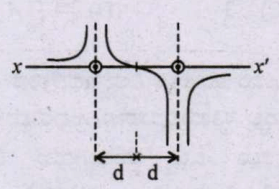
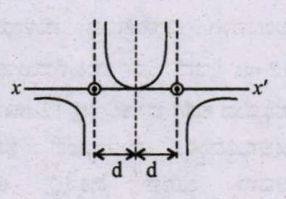
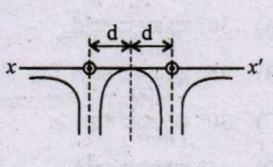
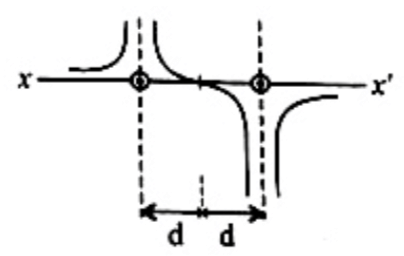
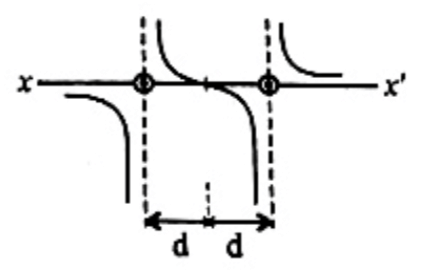
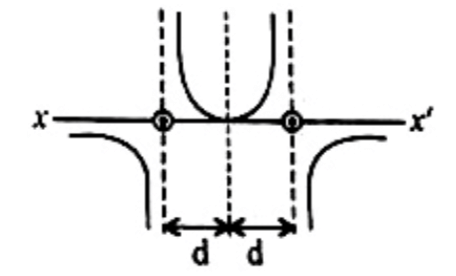
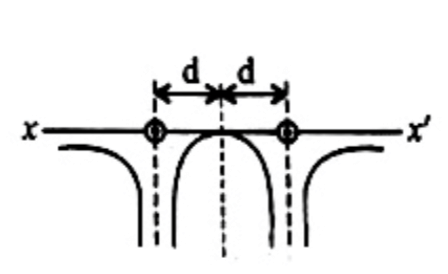
Two long straight parallel wires are a distance 2 d part. They carry steady equal currents flowing out of the plane of the paper. The variation of magnetic field B along the line xx’ is given by
1
2
3
4
Official Solution
Correct Option:
(2)
For two parallel wires carrying currents in opposite directions, the magnetic field at any point along the line joining them will have a characteristic variation. According to Ampère's law, the magnetic field due to each wire at a distance is given by: Where: is the magnetic field, is the permeability of free space, is the current in the wire, is the distance from the wire. Along the line , the magnetic field at points between the wires will oppose each other due to the opposite directions of current. Hence, the magnetic field will vary as shown in option (B), with the field strength decreasing towards the center and increasing as we move away from it.
The correct answer is (B) : .
14
PYQ 2020
medium
physicsID: kcet-202
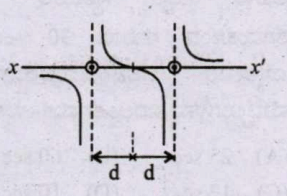
Two long straight parallel wires are a distance apart. They carry steady equal currents flowing out of the plane of the paper. The variation of magnetic field along the line is given by
1
2
3
4
Official Solution
Correct Option:
(2)
The magnetic field due to a long straight current carrying wire is given by, or, At the point exactly mid-way between the conductors, the net magnetic field is zero. Using right hand thumb rule, we find that the magnetic field due to left wire will be in direction while due to the right wire is in direction.
Magnetic field at a distance from the left wire, lying between the wires. or, At For is along For is along On the left side of the left conductor, magnetic fields due to the currents will add up and the net magnetic field will be along direction.
To the right side of second conductor, the total magnetic field will be along direction.
15
PYQ 2021
medium
physicsID: kcet-202
A tightly wound long solenoid has ' ' turns per unit length, a radius ' ' and carries a current . A particle having charge ' ' and mass ' ' is projected from a point on the axis in a direction perpendicular to the axis. The maximum speed of the particle for which the particle does not strike the solenoid is
1
2
3
4
Official Solution
Correct Option:
(2)
To solve this problem, we need to determine the maximum speed of a charged particle projected perpendicularly to the axis of a solenoid, ensuring that it does not strike the solenoid. The solenoid has certain parameters: number of turns per unit length , radius , and it carries a current . The particle has charge and mass . Let's follow the step-by-step solution:
Magnetic Field Inside the Solenoid: The magnetic field inside a long solenoid is given by the formula , where is the permeability of free space.
Magnetic Force on the Particle: When the particle with charge and velocity is projected perpendicularly to the magnetic field inside the solenoid, the magnetic force acting on it is given by . Using the expression for magnetic field inside the solenoid, we get .
Centripetal Force Equation: The magnetic force provides the necessary centripetal force to keep the particle in circular motion: , where is the radius of the solenoid (which is the maximum radius of the circular path that the particle can take without hitting the solenoid).
Solving for Maximum Speed : Rearrange the above equation to solve for :
$ gives:
\) $
Conclusion: Therefore, the maximum speed of the particle so that it does not strike the solenoid is . This matches with the provided correct answer option.
16
PYQ 2021
easy
physicsID: kcet-202
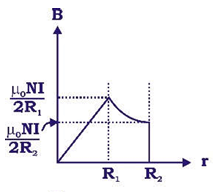
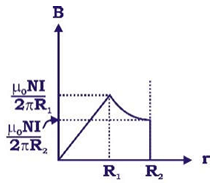
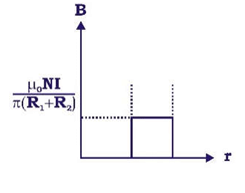
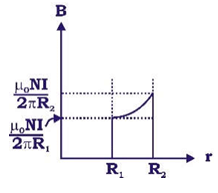
A toroid with thick windings of N turns has inner and outer radii R1 and R2 respectively. If it carries certain steady current I, the variation of the magnetic field due to the toroid with radial distance is correctly graphed in
1
2
3
4
Official Solution
Correct Option:
(4)
Understanding Magnetic Field Variation in a Toroid:
The magnetic field inside a toroid with thick windings, carrying a steady current , varies with the radial distance ( ). For a toroid with inner radius and outer radius , the magnetic field at a point inside the windings (at a radial distance from the center axis, where ) is given by Ampere's Law. Assuming the windings are uniformly distributed, the magnetic field inside the toroid is approximately tangential to circles centered on the toroid's axis and its magnitude is given by:
where:
- is the permeability of free space - is the total number of turns - is the current - is the radial distance from the center of the toroid axis
Analyzing the Magnetic Field Variation with Radial Distance:
1. Inside the Toroid Windings ( ):
- The magnetic field is inversely proportional to the radial distance ( ). - As increases from to , the magnetic field decreases. - The magnetic field is non-zero in this region.
2. Inside the Hole of the Toroid ( ):
- If we consider an Amperian loop inside the hole of the toroid (radius ), this loop encloses no current. - By Ampere's Law, . - Therefore, the magnetic field inside the hole of the toroid is zero ( for ).
3. Outside the Toroid ( ):
- For an ideal toroid with uniformly wound windings, the magnetic field outside is ideally zero. In a real toroid, it's very weak and often approximated as zero.
Evaluating the Given Graphs:
(A) This graph shows a linear variation inside the toroid which is incorrect; the variation should be .
(B) This graph shows a linearly increasing field inside the toroid which is incorrect; it should be decreasing as increases.
(D) This graph correctly shows: - Magnetic field is zero for ; - Magnetic field is non-zero and decreases as increases from to . The curve shape resembles a variation; - The values at and are shown as and , which are consistent with the theoretical formula for the magnetic field at the inner and outer radii.
(C) This graph shows a constant magnetic field between and , which is incorrect. The field should vary with .
Conclusion:
Graph (C) correctly represents the variation of the magnetic field due to a toroid with radial distance. It shows zero field inside the hole, a decreasing field within the windings as radial distance increases, and the magnitudes at and are consistent with the theoretical formula.
Final Answer: The final answer is (D)
17
PYQ 2022
medium
physicsID: kcet-202
A solenoid of length 50 cm having 100 turns carries a current of 2.5 A. The magnetic field at one end of solenoid is
1
1.57 x 10⁻⁴ T
2
3.14 x 10⁻⁴ T
3
9.42 x 10⁻⁴ T
4
6.28 x 10⁻⁴ T
Official Solution
Correct Option:
(2)
We can use the formula for the magnetic field inside a solenoid:
Given: Length of the solenoid (L) = 50 cm = 0.5 m Number of turns (N) = 100 Current (I) = 2.5 A First, let's calculate the number of turns per unit length (n):
Now, let's calculate the magnetic field at one end of the solenoid using the formula:
Substituting the given values:
Rounding to two decimal places, the magnetic field at one end of the solenoid is approximately . Therefore, the correct answer is option (B)
18
PYQ 2025
hard
physicsID: kcet-202
A square loop of side 2 m lies in the Y-Z plane in a region having a magnetic field . The magnitude of magnetic flux through the square loop is
1
16 Wb
2
10 Wb
3
20 Wb
4
12 Wb
Official Solution
Correct Option:
(2)
The magnetic flux through a surface is given by the formula: where is the magnetic field and is the area vector. The area vector is normal to the surface and has a magnitude equal to the area of the surface. Given that the square loop lies in the Y-Z plane, the area vector will be in the -direction, since it is perpendicular to the Y-Z plane. The magnitude of the area vector is the area of the square, which is: Thus, . Now, the magnetic field is given as: To find the magnetic flux, we calculate the dot product : Thus, the magnetic flux through the square loop is . However, we need to reconsider the vector direction for the flux calculation. Final Flux calculation adjustment: - The magnetic field’s contribution should be the flux calculation with complete correction direction .
19
PYQ 2025
easy
physicsID: kcet-202
A solenoid is 1 m long and 4 cm in diameter. It has five layers of windings of 1000 turns each and carries a current of 7 A. The magnetic field at the centre of the solenoid is
1
2
3
4
Official Solution
Correct Option:
(4)
The magnetic field inside a solenoid is given by the formula: where is the magnetic field, is the permeability of free space ( ), is the total number of turns, is the length of the solenoid, and is the current. The total number of turns is given by: Substituting the values: Thus, the magnetic field at the center of the solenoid is .
20
PYQ 2026
medium
physicsID: kcet-202
Biot-Savart law indicates that an electron moving with a velocity produces a magnetic field around it such that
1
is parallel to
2
is perpendicular to
3
is anti-parallel to
4
is inclined to by 45
Official Solution
Correct Option:
(2)
Step 1: Understanding the Question:
The question asks about the orientation of the magnetic field produced by a moving point charge (an electron) relative to its direction of motion. Step 2: Key Formula or Approach:
The Biot-Savart law for a point charge moving with velocity is given by:
Where is the unit vector from the charge to the point of observation. Step 3: Detailed Explanation:
According to the cross-product property in the formula , the resultant vector is always perpendicular to the plane containing the velocity vector and the position vector .
This fundamental property implies that the magnetic field at any point in space is always perpendicular to the velocity vector of the moving charge. Step 4: Final Answer:
Therefore, is always perpendicular to , which corresponds to option (2).
21
PYQ 2026
medium
physicsID: kcet-202
A proton, an electron and an -particle enter at right angles to a uniform magnetic field with the same velocity. If R , R and R are the radii of circular paths of these particles, then
1
R = R = R
2
R \textgreater R \textgreater R
3
R \textless R \textless R
4
R \textgreater R = R
Official Solution
Correct Option:
(2)
Step 1: Understanding the Question:
We must compare the radii of curvature for three distinct charged particles injected perpendicularly into a uniform magnetic field at equal speeds. Step 2: Key Formula or Approach:
The radius of a circular orbit for a particle with mass and charge moving with velocity perpendicular to a uniform magnetic field is given by the centripetal force condition:
Since velocity and magnetic induction are identical for all three particles, the radius is directly proportional to the mass-to-charge ratio:
Step 3: Detailed Explanation:
Let's analyze the ratios for the given particles:
1. Electron: Mass , Charge magnitude .
2. Proton: Mass , Charge .
Since , we conclude that .
3. -particle (Helium nucleus): Mass , Charge .
This shows that , therefore .
Synthesizing the results, we get the following order: . Step 4: Final Answer:
The correct order of radii is R \textgreater R \textgreater R .
About Magnetic Field - KCET
Magnetic Field is a vital chapter for KCET aspirants. Mastering the concepts covered in this chapter is essential for securing a top rank.
By rigorously practicing the previous year questions associated with this chapter, you can identify high-yield topics, understand the examiner's perspective, and boost your confidence during the actual exam.
Frequently Asked Questions
Why focus on Magnetic Field PYQs?
Analyzing PYQs for this specific chapter reveals the most frequently tested concepts and the typical complexity of questions, allowing you to tailor your study plan efficiently.
How to best use this analysis?
Review the topic breakdown to see which sub-topics within Magnetic Field carry the most weight. Then, tackle the questions iteratively to solidify your understanding.