The inward and outward electric flux from a closed surface are respectively and unit. Then the net charge inside the closed surface is
1
coulomb
2
coulomb
3
coulomb
4
coulomb
Official Solution
Correct Option:
(2)
Flux = flux = (8 - 4) 10 = 4 Net charge inside the surface = - 4
02
PYQ 2006
medium
physicsID: kcet-200
The top of the atmosphere is at about with respect to the surface of the earth, corresponding to an electric field that decreases with altitude. Near the surface of the earth, the field is about . Still, we do not get an electric shock as we step out of our house into the open because (assume the house to be a steel cage so that there is no field inside)
1
there is a pd between our body and the ground
2
is not a high electric field so that we do not feel the shock.
3
our body and the ground forms an equipotential surface.
4
the atmosphere is not a conductor
Official Solution
Correct Option:
(4)
Dry atmosphere is not a conductor. Only when top of the atmosphere increases to a very large value and there is moisture in the air the lightning strikes the ground. Since is not very high voltage so, it will not strike the ground.
03
PYQ 2007
medium
physicsID: kcet-200
Two identical charges repel each other with a force equal to when they are apart in air. The value of each charge is
1
2 mc
2
3
2 nc
4
Official Solution
Correct Option:
(4)
Coulomb force is given by
or
04
PYQ 2018
medium
physicsID: kcet-201
The magnitude of point charge due to which the electric field 30 cm away has the magnitude , will be
1
2
3
4
Official Solution
Correct Option:
(1)
05
PYQ 2020
medium
physicsID: kcet-202
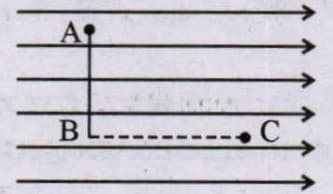
Figure shows three points A, B and C in a region of uniform electric field . The line AB is perpendicular and BC is parallel to the field lines. Then which of the following holds good? (VA, VB and VC represent the electric potential at points A, B and C respectively)
1
VA=VB = VC
2
VA=VB > VC
3
VA=VB < VC
4
VA>VB = VC
Official Solution
Correct Option:
(2)
In a uniform electric field, the electric potential decreases in the direction of the field. Since point B is at a lower potential than point A (due to the perpendicular direction of the line AB to the field lines), the potential at point B will be less than at point A. As point C lies along the field lines, the potential at C will be the lowest among the three. Therefore, the potential decreases as we move from A to B to C.
The correct option is (B) : VA=VB > VC
06
PYQ 2020
medium
physicsID: kcet-202
An infinitely long thin straight wire has uniform charge density of What is the magnitude of electric field at a distance from the axis of the wire ?
1
2
3
4
Official Solution
Correct Option:
(3)
For an infinitely long wire with uniform linear charge density , the electric field at a distance from the wire is given by the formula: Where: - is Coulomb's constant, - is the charge density, - is the distance from the wire. Substituting the values into the formula: Thus, the magnitude of the electric field at a distance 20 cm from the wire is .
07
PYQ 2020
medium
physicsID: kcet-202
The electric field lines on the left have twice the separation on those on the right as shown in figure. If the magnitude of the field at is , what is the force on charge kept at ?
1
2
3
4
Official Solution
Correct Option:
(1)
Problem Analysis:
The problem provides a diagram of electric field lines.
It states that the separation between the field lines on the left (region B) is twice the separation between the field lines on the right (region A). Let the separation at A be and at B be . So, .
The magnitude of the electric field at point A is given as .
We need to find the force on a charge placed at point B.
Key Concept:
The density of electric field lines (number of lines per unit area perpendicular to the lines) is proportional to the magnitude of the electric field strength. Therefore, where the lines are closer together, the field is stronger, and where they are farther apart, the field is weaker. Specifically, the electric field strength is inversely proportional to the separation between the lines (assuming a uniform distribution in the perpendicular dimension shown):
This implies that the ratio of electric fields at two points is inversely proportional to the ratio of the separations at those points:
Calculations:
Use the relationship between field strength and separation:
Substitute :
Calculate the electric field strength at B ( ):
Given :
Calculate the force on the charge at point B ( ) using the formula :
Substitute and (Note: ):
The final answer is (A): .
08
PYQ 2021
medium
physicsID: kcet-202
Electric field due to infinite, straight uniformly charged wire varies with distance ‘r’ as
1
r
2
3
4
r2
Official Solution
Correct Option:
(2)
Step 1: Recall the formula for the electric field due to a uniformly charged infinite wire
For an infinitely long, straight uniformly charged wire, the electric field at a point at a distance from the wire is given by Gauss's law.
Gauss's law states that:
where is the charge enclosed by the Gaussian surface, and is the permittivity of free space.
For an infinitely long wire, the electric field at a distance from the wire is radial and uniform in magnitude at all points on a circle around the wire.
Step 2: Use symmetry and apply Gauss's law
Consider a Gaussian surface in the form of a cylinder with its axis coincident with the wire. The radius of this cylindrical surface is , and the length of the cylinder is .
The electric flux through the curved surface of the cylinder is:
Since the electric field is uniform and radial, the flux through the two ends of the cylinder is zero. The charge enclosed by the Gaussian surface is the charge on the length of the wire, which is , where is the linear charge density.
By Gauss's law:
Step 3: Solve for the electric field
Solving for :
Thus, the electric field due to an infinitely long uniformly charged wire is inversely proportional to the distance from the wire.
Final Answer: The electric field due to an infinite, straight uniformly charged wire varies with distance as , which matches option (B).
09
PYQ 2023
hard
physicsID: kcet-202
Electric field at a distance ‘r’ from an infinitely long uniformly charged straight conductor, having linear charge density λ is E1. Another uniformly charged conductor having same linear charge density λ is bent into a semicircle of radius ‘r’. The electric field at its centre is E2 . Then
1
2
E1 = E2
3
E1 = πrE2
4
E2 = πrE1
Official Solution
Correct Option:
(2)
Given problem:
Electric field at a distance from an infinitely long uniformly charged straight conductor with linear charge density is .
Another uniformly charged conductor with the same linear charge density is bent into a semicircle of radius . The electric field at its center is .
We need to find the relationship between and .
Step 1: Electric Field due to an Infinitely Long Uniformly Charged Straight Conductor
The electric field at a distance from an infinitely long uniformly charged straight conductor with linear charge density is given by:
Step 2: Electric Field due to a Semicircular Conductor
Consider a semicircular conductor of radius with linear charge density . We need to find the electric field at the center of this semicircle.
To do this, we can use the principle of symmetry and integration. The semicircle can be divided into small segments, each contributing to the electric field at the center. Due to symmetry, the horizontal components of the electric field from each segment will cancel out, leaving only the vertical components.
The electric field due to a small segment of the semicircle at an angle from the vertical is given by:
where and .
Thus,
The vertical component of is:
Integrating from to :
Step 3: Comparing and
From the calculations, we see that:
Thus, .
Therefore, the correct answer is:
10
PYQ 2025
hard
physicsID: kcet-202
A potential at a point A is 3 V and that at another point B is 5 V. What is the work done in carrying a charge of 5 mC from B to A?
1
4 J
2
-40 J
3
40 J
4
-0.4 J
Official Solution
Correct Option:
(2)
The work done in moving a charge between two points in an electric field is given by: where is the potential difference between the two points, and is the charge being moved. - The potential difference between points A and B is: - The charge being moved is . Now, the work done in moving the charge is: Thus, the work done in moving the charge from B to A is: Hence, the correct answer is:
About Electric Field - KCET
Electric Field is a vital chapter for KCET aspirants. Mastering the concepts covered in this chapter is essential for securing a top rank.
By rigorously practicing the previous year questions associated with this chapter, you can identify high-yield topics, understand the examiner's perspective, and boost your confidence during the actual exam.
Frequently Asked Questions
Why focus on Electric Field PYQs?
Analyzing PYQs for this specific chapter reveals the most frequently tested concepts and the typical complexity of questions, allowing you to tailor your study plan efficiently.
How to best use this analysis?
Review the topic breakdown to see which sub-topics within Electric Field carry the most weight. Then, tackle the questions iteratively to solidify your understanding.