A hole is drilled along the earth's diameter and a stone is dropped into it. When the stone is at the centre of earth, it has
1
mass
2
weight
3
acceleration
4
potential energy
Official Solution
Correct Option: (1)
At the center of the earth everything is weightless as acceleration and potential energy vanish. So it has only mass.
02
PYQ 1994
medium
physicsID: kcet-199
At what height over the earth's pole, the free fall acceleration decreases by . (Assume the radius of earth to be )
1
1.253 km
2
64 km
3
32 km
4
80 km
Official Solution
Correct Option: (3)
i.e. i.e. i.e. = 32 km
03
PYQ 1996
medium
physicsID: kcet-199
A satellite in a circular orbit of radius has a period of . Another satellite with orbital radius around the,same planet will have a period (in hours)
1
2
3
4
Official Solution
Correct Option: (3)
According to Kepler's third law
04
PYQ 1999
medium
physicsID: kcet-199
A body is projected vertically upwards from the surface of a planet of radius with a velocity equal to half the escape velocity for that planet. The maximum height attained by the body is
1
2
3
4
Official Solution
Correct Option: (1)
Total energy = K.E. + P.E. = = Final energy when body comes to rest at heigh i.e. Max.height = r - R = R - R =
05
PYQ 2003
easy
physicsID: kcet-200
If both the mass and radius of the earth decrease by . then
1
the escape velocity would increase
2
the escape velocity would decrease
3
the acceleration due to gravity would decrease
4
the acceleration due to gravity would increase
Official Solution
Correct Option: (4)
and Clearly reduction in R will increase g .
06
PYQ 2003
medium
physicsID: kcet-200
Weight of a body of mass m decreases by when it is raised to height above the earth's surface. If the body is taken to a depth in a mine, change in its weight is
1
0.5% increase
2
1% increase
3
0.5% decrease
4
2% decrease
Official Solution
Correct Option: (3)
where d = h (given) Clearly d = h brings 0.5% decrease in g.
07
PYQ 2005
medium
physicsID: kcet-200
If is the mass of the earth and its radius, the ratio of the gravitational acceleration and the gravitational constant is :
1
2
3
4
Official Solution
Correct Option: (2)
Gravitational acceleration is given by
where gravitational constant
08
PYQ 2011
easy
physicsID: kcet-201
Two satellites of mass and are orbiting a planet in orbits of radius . Their periods of revolution will be in the ratio of
1
9:01
2
3:01
3
1:01
4
1:03
Official Solution
Correct Option: (3)
The Correct Option is (C): 1:1
09
PYQ 2012
medium
physicsID: kcet-201
A planet moving around sun sweeps area in days, in days and in days. Then the relation between and is
1
2
3
4
Official Solution
Correct Option: (1)
By Kepler's second law of motion,
or Or
10
PYQ 2014
medium
physicsID: kcet-201
What is a period of revolution of earth satellite ? Ignore the height of satellite above the surface of earth. Given : (1) The value of gravitational acceleration (2) Radius of earth . Take
1
156 minutes
2
90 minutes
3
85 minutes
4
83.73 minutes
Official Solution
Correct Option: (4)
Given,
We know that the period of revolution of the earth satellite
[if , then, So,
and
11
PYQ 2014
medium
physicsID: kcet-201
Period of geostationary satellite is
1
12 h
2
48 h
3
24 h
4
30 h
Official Solution
Correct Option: (3)
Geostationary satellite have an orbital period of exactly 1 day or . That is why they can always stay above the same place on the earth, as the earth also makes one turn per day.
12
PYQ 2017
medium
physicsID: kcet-201
The value of acceleration due to gravity at a depth of is equal to (Given Radius of earth=6400km)
1
2
3
4
Official Solution
Correct Option: (4)
Given. Depth We know that,
Here
13
PYQ 2018
medium
physicsID: kcet-201
A mass �m� on the surface of the Earth is shifted to a target equal to the radius of the Earth. If �R� is the radius and �M� is the mass of the Earth, then work done in this process is
1
2
3
4
Official Solution
Correct Option: (1)
14
PYQ 2018
medium
physicsID: kcet-201
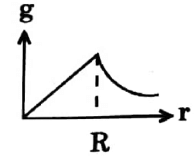
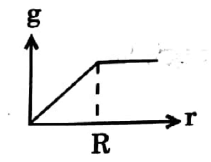
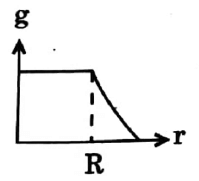
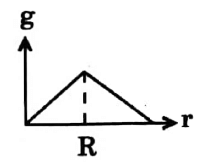
Which of the following graphs correctly represents the variation of ??' on the Earth ?
1
2
3
4
Official Solution
Correct Option: (2)
Upto the surface of earth Outside the surface of earth
15
PYQ 2018
medium
physicsID: kcet-201
A space station is at a height equal to the radius of the Earth. If is the escape velocity on the surface of the Earth, the same on the space station is ....... times .
1
2
3
4
Official Solution
Correct Option: (3)
K.E. = P.E.
But
16
PYQ 2020
hard
physicsID: kcet-202
The value of acceleration due to gravity at a height of from the surface of earth is . At what depth inside the earth is the value of the acceleration due to gravity has the same value ?
1
5 km
2
20 km
3
10 km
4
15 km
Official Solution
Correct Option: (2)
17
PYQ 2021
easy
physicsID: kcet-202
Two bodies of masses 8 kg are placed at the vertices A and B of an equilateral triangle ABC. A third body of mas 2 kg is placed at the centroid G of the triangle. If AG = BG = CG = 1 m, where should a fourth body of mass 4 kg be placed so that the resultant force on the 2 kg body is zero?
1
At C
2
At a point on the line CG such that PG = m
3
At a point P on the line CG such that PG=0.5 m
4
At a point P on the line CG such that PG=2m
Official Solution
Correct Option: (2)
Step 1: Find the resultant force on the 2 kg body due to the 8 kg bodies at A and B.
Let the position of the 2 kg body be at the centroid G. The forces on the 2 kg body due to the 8 kg bodies at A and B are attractive and directed along GA and GB respectively.
Let be the force on the 2 kg body at G due to the 8 kg body at A. . The direction is along GA.
Let be the force on the 2 kg body at G due to the 8 kg body at B. . The direction is along GB.
The resultant force due to masses at A and B is .
In an equilateral triangle, the angle AGB at the centroid is .
Step 2: Using the Parallelogram law
We can use the parallelogram law to find the magnitude of the resultant force, or vector addition.
Vectorially, and , where and are unit vectors along GA and GB.
However, we know that for an equilateral triangle, .
So, .
Thus, the resultant force due to masses at A and B is .
Since AG = BG = CG = 1 m, we can consider as vectors from G to A, G to B, G to C.
Then .
(This is wrong, direction should be from G to A, unit vector is ).
. .
Step 3: Finding the Direction
If we consider unit vectors and .
Let's use . We know that .
So, if we consider unit vectors along .
Let's assume . For equilateral triangle, it is known that .
So, the resultant force due to masses at A and B is . This is not .
Using vector sum, . We want to balance this by a force due to 4 kg mass at P.
We need , so .
We assumed . If we assume unit vectors along and are approximately in the direction of and .
Let's consider magnitude of resultant of and . Angle between and is .
.
The direction of resultant force is along the angle bisector of . The angle bisector of is along GC. So is along GC direction.
So .
We need to place 4 kg mass at P such that force is equal and opposite to .
.
We need .
So .
.
.
For directions to be same, . So P is on the line CG, such that is in the direction of . This is not possible to balance which is in the direction of .
must be in the direction of .
.
.
.
And . So P is on the line CG in the direction of C from G, such that .
Final Answer: The fourth body of mass 4 kg be placed at a point on the line CG such that PG = m
18
PYQ 2025
medium
physicsID: kcet-202
If and are radii, velocities, and angular momenta of a planet at perihelion and aphelion of its elliptical orbit around the Sun respectively, then
1
2
3
4
Official Solution
Correct Option: (2)
In elliptical orbits, according to the conservation of angular momentum, we have the relation: Where is the angular momentum, is the mass of the planet, is the radius, and is the velocity. Angular momentum is conserved in the orbit, and thus: Since the mass is the same, we can cancel it out and get: This shows that the product of the radius and velocity is constant throughout the orbit, even though the velocity at perihelion and aphelion might differ. However, the total angular momentum at different points may vary due to the variation in the distance of the planet from the Sun, meaning . Therefore, the correct option is:
19
PYQ 2026
easy
physicsID: kcet-202
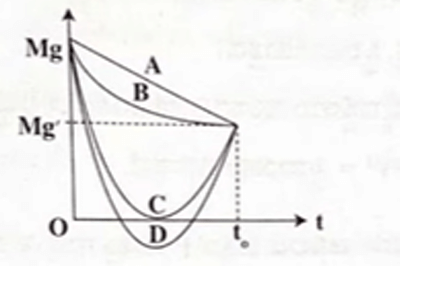
Suppose the acceleration due to gravity at the earth's surface is g m/s and at the surface of moon it is g' m/s . An M kg passenger goes from the earth to the moon in a spaceship moving with a constant velocity (Neglect all other objects in the sky). Which curve best represents the weight (net gravitational force) as a function of time?
1
A
2
B
3
C
4
D
Official Solution
Correct Option: (4)
Step 1: Understanding the Question:
The question asks to identify the graph that best represents the net gravitational force (weight) experienced by a passenger traveling from Earth to the Moon. Step 3: Detailed Explanation:
1. Starting point (Earth's surface): The passenger's weight is . This is the initial maximum value on the graph.
2. Moving away from Earth: As the spaceship moves away from Earth, the gravitational force due to Earth decreases with the inverse square of the distance ( ). Simultaneously, the gravitational force due to the Moon (initially very small) starts to increase as the spaceship gets closer to the Moon ( ).
3. Neutral Point: There will be a point somewhere between Earth and Moon where the gravitational forces exerted by Earth and Moon are equal and opposite, resulting in a net gravitational force of zero. This point is closer to the Moon because Earth is more massive.
4. Approaching the Moon: After passing the neutral point, the gravitational force due to the Moon becomes dominant and increases as the spaceship approaches the Moon's surface.
5. Moon's surface: The gravitational force on the Moon's surface is , which is less than (typically ).
6. Constant Velocity: The mention of "constant velocity" for the spaceship implies that the journey takes a finite time, and the gravitational force profile will be a continuous curve.
Looking at the graphs:
- Curve A and B show a linear or decreasing curve that doesn't reach zero.
- Curve C starts from and linearly decreases to , which is incorrect as gravitational force follows an inverse square law.
- Curve D correctly shows: - Starting at . - Decreasing non-linearly to zero at some point between Earth and Moon. - Increasing again non-linearly as it approaches the Moon. - Ending at a lower value on the Moon's surface.
This precisely matches the expected behavior of net gravitational force. Step 4: Final Answer:
Curve D best represents the weight as a function of time.
20
PYQ 2026
medium
physicsID: kcet-202
Imagine a new planet having the same density as that of the earth, but it is two times bigger than the earth in size. If the acceleration due to gravity on the surface of the new planet is g' and that on the surface of the earth is g, then
1
2
3
4
Official Solution
Correct Option: (3)
Step 1: Understanding the Question:
The problem compares the acceleration due to gravity on the surface of Earth to that of a hypothetical new planet. We are given that the new planet has the same density as Earth but twice its size (radius). Step 2: Key Formula or Approach:
The acceleration due to gravity on the surface of a planet is given by:
Where is the gravitational constant, is the mass of the planet, and is its radius.
We can express mass in terms of density ( ) and volume ( ) for a sphere: .
Substituting into the formula for :
So, . Step 3: Detailed Explanation:
Let the properties of Earth be .
For the new planet, let the properties be .
Given:
- Same density:
- Two times bigger in size (radius):
Now, form the ratio:
Substitute the given relations:
Therefore, . Step 4: Final Answer:
The acceleration due to gravity on the surface of the new planet is .