Pressure of ideal gas at constant volume is proportional to _______.
1
average potential energy of the molecules
2
total energy of the gas.
3
average kinetic energy of the molecules
4
force between the molecules
Official Solution
Correct Option:
(3)
Given:
An ideal gas is kept at constant volume.
Step 1: Understanding Pressure in Terms of Molecular Motion
According to the kinetic theory of gases, the pressure of an ideal gas is given by:
where is the average kinetic energy of the molecules.
Step 2: Identifying the Correct Answer
From the equation above, we see that pressure is directly proportional to the average kinetic energy of the molecules.
Answer: The correct option is C.
02
PYQ 2026
medium
physicsID: kcet-202
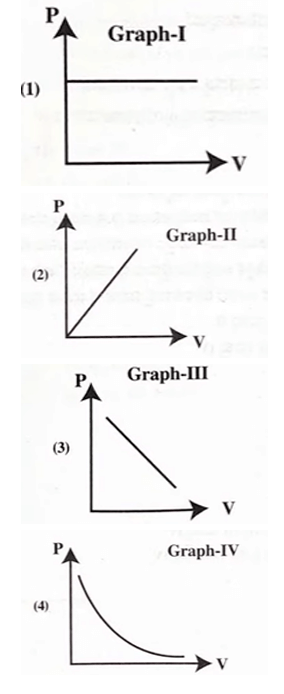
The graph of pressure P and volume V of 1 mole of an ideal gas at constant temperature is
1
Graph-I
2
Graph-II
3
Graph-III
4
Graph-IV
Official Solution
Correct Option:
(4)
Step 1: Understanding the Question:
The question asks to identify the correct Pressure-Volume (P-V) graph for an ideal gas undergoing an isothermal process (constant temperature). Step 2: Key Formula or Approach:
For an ideal gas, the ideal gas law is .
In an isothermal process, temperature ( ) is constant, and for 1 mole, . So, .
This implies . This is the mathematical form of Boyle's Law. Step 3: Detailed Explanation:
A graph of versus where their product is constant ( ) will be a rectangular hyperbola.
Let's examine each graph:
- Graph-I: Shows pressure (P) remaining constant as volume (V) changes. This represents an isobaric process.
- Graph-II: Shows a linear relationship where . This is not isothermal.
- Graph-III: Shows a linear relationship where decreases linearly with . This is also not isothermal.
- Graph-IV: Shows a curve where decreases as increases, and the product remains constant. This is characteristic of a rectangular hyperbola, which correctly represents an isothermal process. Step 4: Final Answer:
Graph-IV correctly depicts the relationship between pressure and volume for an ideal gas at constant temperature.
About Ideal Gas Equation - KCET
Ideal Gas Equation is a vital chapter for KCET aspirants. Mastering the concepts covered in this chapter is essential for securing a top rank.
By rigorously practicing the previous year questions associated with this chapter, you can identify high-yield topics, understand the examiner's perspective, and boost your confidence during the actual exam.
Frequently Asked Questions
Why focus on Ideal Gas Equation PYQs?
Analyzing PYQs for this specific chapter reveals the most frequently tested concepts and the typical complexity of questions, allowing you to tailor your study plan efficiently.
How to best use this analysis?
Review the topic breakdown to see which sub-topics within Ideal Gas Equation carry the most weight. Then, tackle the questions iteratively to solidify your understanding.