X-rays, gamma rays and microwaves travelling in vacuum have
1
same velocity and same frequency
2
same wavelengths but different velocities
3
same frequency but different velocities
4
same velocity but different wavelengths
Official Solution
Correct Option:
(4)
In a vacuum, all light travels the same speed irrespective of the wavelength or frequency of the wave. Gamma radiation has a smaller wavelength and larger frequency, radio waves a smaller frequency and larger wavelength. So, x-rays, gamma rays and microwaves traveling in vacuum have the same velocity but different wavelengths.
02
PYQ 2016
medium
physicsID: kcet-201
Electromagnetic radiation used to sterilise milk is
1
X-ray
2
-ray
3
UV rays
4
Radiowaves
Official Solution
Correct Option:
(3)
UV-rays are used for sterilise milk in dairy
03
PYQ 2020
easy
physicsID: kcet-202
A light beam of intensity is incident normally on a perfectly reflecting surface of sides . The momentum imparted to the surface by the light per second is
1
2
3
4
Official Solution
Correct Option:
(3)
Intensity where is energy of radiation and is incident area
Momentum of radiation is given by
Where is speed of light.
04
PYQ 2021
easy
physicsID: kcet-202
The source of electromagnetic wave can be a charge.
1
Moving with a constant velocity
2
Moving in a circular orbit
3
At rest
4
Moving parallel to the magnetic field
Official Solution
Correct Option:
(2)
Electromagnetic waves are generated by accelerating charges or changing electric or magnetic fields. Let's analyze each option:
1. Moving with a constant velocity:
A charge moving with a constant velocity constitutes a steady current. While a steady current produces a magnetic field, it does not produce electromagnetic waves. Electromagnetic waves are generated when there is a *change* in the electric or magnetic field with time. A charge moving with constant velocity does not have a changing acceleration, and therefore does not radiate electromagnetic waves.
2. Moving in a circular orbit:
A charge moving in a circular orbit is constantly changing its direction of motion. This change in direction implies that the velocity is changing, and hence the charge is accelerating. Specifically, it experiences centripetal acceleration, which is directed towards the center of the circular path. An accelerating charge is a source of electromagnetic waves. Think of synchrotron radiation, which is produced by charged particles moving in circular paths in magnetic fields.
3. At rest:
A charge at rest produces a static electric field around it. However, since it is not moving or accelerating, the electric field is constant in time. A static charge does not generate electromagnetic waves.
4. Moving parallel to the magnetic field:
If a charge is moving parallel to a constant magnetic field, the magnetic force on the charge is given by . If is parallel to , then , so the magnetic force is zero. If there are no other forces causing acceleration, the charge will continue to move with constant velocity (or remain at rest if initially at rest, but the option suggests "moving"). As discussed in point 1, a charge moving with constant velocity does not emit electromagnetic waves.
Conclusion:
Out of the given options, only a charge moving in a circular orbit (option 2) is necessarily accelerating and hence can serve as a source of electromagnetic waves. The other options describe charges that are either at rest or moving with constant velocity, neither of which generates electromagnetic waves.
Final Answer: The final answer is Moving in a circular orbit
05
PYQ 2021
medium
physicsID: kcet-202
Suppose that the electric field amplitude of electromagnetic wave is and its frequency if f = 50 MHz. Then which of the following value is incorrectly computed ?
1
Magnetic field amplitude is 400nT.
2
Angular frequency of EM wave is π × 108 rad/s
3
Propagation constant (angular wave number) is 2.1 rad/m
4
Wavelength of EM wave is 6m.
Official Solution
Correct Option:
(3)
(A) Magnetic field amplitude is 400nT.
The relationship between the electric field amplitude ( ) and magnetic field amplitude ( ) in an electromagnetic wave is given by:
where is the speed of light ( ). Substituting the given value of :
This is correct.
(B) Angular frequency of EM wave is rad/s
Angular frequency ( ) is related to frequency ( ) by:
This is correct.
(C) Propagation constant (angular wave number) is 2.1 rad/m
The propagation constant ( ), also known as the angular wave number, is given by:
where is the wavelength. We know that , so . Thus:
The given value of is incorrect.
(D) Wavelength of the EM wave is 6 m.
The wavelength ( ) is given by:
This is correct.
The correct answer is (C).
06
PYQ 2021
easy
physicsID: kcet-202
Suppose that the electric field amplitude of electromagnetic wave is and its frequency if . Then which of the following value incorrectly computed ?
1
Magnetic field amplitude is .
2
Angular frequency of EM wave is
3
Propagation constant (angular wave number) is
4
Wavelength of EM wave is .
Official Solution
Correct Option:
(3)
To determine which of the given values is incorrectly computed, we need to calculate each related parameter of the electromagnetic wave using the given data:
Electric Field Amplitude,
Frequency,
Let's analyze each option:
Magnetic Field Amplitude: The relation between electric field amplitude and magnetic field amplitude in an electromagnetic wave is given by: \) where is the speed of light. Substituting the values, \) This matches the given value, so it is correctly computed.
Angular Frequency: Angular frequency is calculated as: \) For \) The given value is , which simplifies to so it is correctly computed.
Propagation Constant: The propagation constant or angular wave number is given by: \) where is the wavelength. Wavelength is calculated as: \) Therefore, \) The given value is , which is incorrect.
Wavelength of EM Wave: We already calculated in option 3 that which matches the given value. Hence, it is correctly computed.
Conclusion: The incorrectly computed value is the Propagation constant (angular wave number) as .
07
PYQ 2021
medium
physicsID: kcet-202
The source of electromagnetic wave can be a charge.
1
Moving with a constant velocity
2
Moving in a circular orbit
3
At rest
4
Moving parallel to the magnetic field
Official Solution
Correct Option:
(2)
The question asks us to identify the source of an electromagnetic wave from the behavior of a charge. To answer this, we need to understand when charges produce electromagnetic waves.
An electromagnetic wave is generated when a charge is accelerated. This is because acceleration of a charge alters the electric and magnetic field around it, leading to the propagation of these field changes as waves through space. Let’s evaluate each option based on this principle:
Moving with a constant velocity: A charge moving with constant velocity does not experience acceleration. Hence, it does not produce electromagnetic radiation.
Moving in a circular orbit: When a charge moves in a circular path, it constantly changes direction. This change in direction implies continuous acceleration (centripetal acceleration) even if the speed is constant. This provides a source of electromagnetic waves.
At rest: A charge at rest has no change in velocity (no acceleration), thus it does not emit electromagnetic waves.
Moving parallel to the magnetic field: A charge moving parallel to a magnetic field without any change in speed or direction also means no acceleration, and hence, no electromagnetic radiation is produced.
Based on the above analysis, the correct answer is:
Moving in a circular orbit
This is because the charge exhibits centripetal acceleration in a circular path, which is necessary for the emission of electromagnetic waves.
08
PYQ 2023
easy
physicsID: kcet-202
The ratio of the magnitudes of electric field to the magnetic field of an electromagnetic wave is of the order of
1
108 ms-1
2
10-5 ms-1
3
105 ms-1
4
10-8 ms-1
Official Solution
Correct Option:
(1)
Concept:
For an electromagnetic wave, the ratio of the magnitudes of electric field ( ) and magnetic field ( ) is equal to the speed of light ( ):
Calculation:
The speed of electromagnetic waves (speed of light) in vacuum is approximately:
Given options are approximate orders of magnitude. The correct closest magnitude from the given choices is:
Final Conclusion: The ratio of electric field to magnetic field for electromagnetic waves is of the order .
09
PYQ 2025
hard
physicsID: kcet-202
A series LCR circuit containing an AC source of 100V has an inductor and a capacitor of reactances 24 and 16 respectively. If a resistance of 6 is connected in series, then the potential difference across the series combination of inductor and capacitor will be
1
8 V
2
40 V
3
80 V
4
400 V
Official Solution
Correct Option:
(2)
In a series LCR circuit, the total impedance is given by: Where: - (resistance), - (reactance of the inductor), - (reactance of the capacitor). Thus: The potential difference across the series combination of the inductor and capacitor is: The current in the circuit is given by: Now, the potential difference across the inductor-capacitor combination is: Thus, the correct answer is option (2): 40 V.
10
PYQ 2026
medium
physicsID: kcet-202
What range of electromagnetic spectrum is considered as light?
1
1 mm to 700 nm
2
400 nm to 1 nm
3
400 nm to 700 nm
4
1 nm to 10 nm
Official Solution
Correct Option:
(3)
Step 1: Understanding the Question:
The question asks for the approximate wavelength range of the visible part of the electromagnetic spectrum, which is commonly referred to as "light". Step 3: Detailed Explanation:
The electromagnetic spectrum consists of waves ranging from very long radio waves to very short gamma rays. The "visible light" portion is a tiny fraction that the human eye can perceive.
- Standard scientific texts define this range as approximately 400 nm (violet) to 700 nm (red).
- In terms of frequency, this corresponds to roughly 430–750 THz.
- Option (1) includes infrared, option (2) includes ultraviolet/X-rays, and option (4) is the range for Gamma rays. Step 4: Final Answer:
The considered range of light is 400 nm to 700 nm.
11
PYQ 2026
medium
physicsID: kcet-202
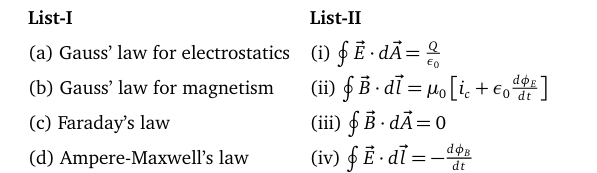
Match the following Maxwell's equations: (The symbols used here have their usual meanings)
1
a - i, b - iii, c - iv, d - ii
2
a - ii, b - iii, c - i, d - iv
3
a - i, b - ii, c - iii, d - iv
4
a - ii, b - iii, c - iv, d - i
Official Solution
Correct Option:
(1)
Step 1: Understanding the Question:
The task is to match the names of the four fundamental equations of electromagnetism with their integral mathematical forms as formulated by Maxwell. Step 3: Detailed Explanation:
- (a) Gauss' law for electrostatics: States that the net electric flux through any closed surface is proportional to the enclosed electric charge. The formula is . This matches with (i).
- (b) Gauss' law for magnetism: States that the net magnetic flux through any closed surface is always zero, implying that magnetic monopoles do not exist. The formula is . This matches with (iii).
- (c) Faraday's law: States that a changing magnetic field induces an electromotive force (emf), where the line integral of the electric field around a closed loop is equal to the negative rate of change of magnetic flux. The formula is . This matches with (iv).
- (d) Ampere-Maxwell's law: Generalizes Ampere's law by including displacement current. It states that magnetic fields are produced by both conduction currents ( ) and time-varying electric fields (flux ). The formula is . This matches with (ii). Mapping: a i, b iii, c iv, d ii. Step 4: Final Answer:
The correct matching sequence is given in code (1).
About Electromagnetic Waves - KCET
Electromagnetic Waves is a vital chapter for KCET aspirants. Mastering the concepts covered in this chapter is essential for securing a top rank.
By rigorously practicing the previous year questions associated with this chapter, you can identify high-yield topics, understand the examiner's perspective, and boost your confidence during the actual exam.
Frequently Asked Questions
Why focus on Electromagnetic Waves PYQs?
Analyzing PYQs for this specific chapter reveals the most frequently tested concepts and the typical complexity of questions, allowing you to tailor your study plan efficiently.
How to best use this analysis?
Review the topic breakdown to see which sub-topics within Electromagnetic Waves carry the most weight. Then, tackle the questions iteratively to solidify your understanding.