Figures below show four ways of making a regular hexagon out of wires of two different kinds P, Q with current beafls at the middle of opposite wires, the magnetic field at the centre of the
hexagon is not zero in
1
case a only
2
cases a and b only
3
case c only
4
cases c and d only
Official Solution
Correct Option: (4)
(c) and (d) do not show symmetry of arrangement.
02
PYQ 1996
medium
physicsID: kcet-199
In India electricity is supplied for domestic use at . It is supplied at in USA. If the resistance of a bulb for use in India is , the resistance of a bulb for use in USA will be
1
R
2
2R
3
R/4
4
R/2
Official Solution
Correct Option: (3)
In India, In USA, as .
03
PYQ 1996
medium
physicsID: kcet-199
An example of a non ohmic device is
1
copper wire
2
platinum resistance thermometer
3
triode
4
potentiometer wire.
Official Solution
Correct Option: (3)
Triode is an example of non ohmic device.
04
PYQ 1996
medium
physicsID: kcet-199
Four resistors of each are connected in the form of a square. Then the effective resistance along the diagonal point is
1
2
3
4
Official Solution
Correct Option: (4)
Total resistance =
05
PYQ 1997
medium
physicsID: kcet-199
An electric bulb marked and , is used in a circuit of supply voltage . Now its power is
1
100 W
2
20 W
3
40 W
4
10 W
Official Solution
Correct Option: (4)
Actual power of bulb Actual voltage of bulb and supply voltage . Power Therefore or, or
(where power when voltage is ).
06
PYQ 1997
medium
physicsID: kcet-199
Calculate the current I in the circuit shown
1
6 A
2
3 A
3
12 A
4
1 A
Official Solution
Correct Option: (2)
Voltage across 6 resistor = 2 3 = 6 V {since} Current through = 1 A {since} I = 2 + 1 = 3 A.
07
PYQ 1997
medium
physicsID: kcet-199
Siemens is a unit of
1
conductance
2
self inductance
3
resistivity
4
mutual inductance
Official Solution
Correct Option: (1)
sienier is a unit of conductance
08
PYQ 1998
medium
physicsID: kcet-199
When 2 equal resistances are connected in parallel to the poles of a cell of negligible internal resistance, the power developed is P. When the same resistances are connected in series across the same cell, the power developed is
1
P
2
P/2
3
P/4
4
4 P
Official Solution
Correct Option: (3)
P =
09
PYQ 1998
medium
physicsID: kcet-199
Kirchhoff's voltage law is based on the law of conservation of
1
momentum
2
charge
3
mass
4
energy
Official Solution
Correct Option: (4)
conservation of energy,
10
PYQ 1999
medium
physicsID: kcet-199
A potentiometer wire of length 1 m and resistance is connected in series with a cell
1
10000
2
19989
3
9989
4
20000
Official Solution
Correct Option: (2)
Current in wire = A Then, I =
R = 19989
11
PYQ 2000
medium
physicsID: kcet-200
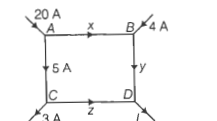
Figure shows currents in a part of an electric circuit, then current is
1
2
3
4
Official Solution
Correct Option: (1)
Applying Kirchhoff's first law,
12
PYQ 2001
medium
physicsID: kcet-200
In the circuit shown in figure, neglecting source resistance, the voltmeter and ammeter readings will respectively be
1
0 V, 8 A
2
150 V, 8 A
3
150 V, 3 A
4
0 V, 3 A
Official Solution
Correct Option: (1)
Circuit is purely resistive in this case current = = 8A.
13
PYQ 2002
easy
physicsID: kcet-200
A superconductor exhibits perfect
1
ferrimagnetism
2
ferromagnetism
3
paramagnetism
4
diamagnetism.
Official Solution
Correct Option: (4)
diamagnetion. When chilled to a specific critical temperature, superconductors have a resistance equal to zero. Below a certain critical temperature, superconductors exhibit the Meissner phenomenon, in which the superconductor expels all magnetic fields. Check the attributes of each option in the question to see which one matches the superconductors. Ferromagnetism: A ferrimagnetic material has atom populations with opposing magnetic moments, the opposing moments are uneven, and a spontaneous magnetization remains. As a result, the characteristics do not correspond to those of superconductors. Ferromagnetism is the fundamental process by which some materials produce permanent magnets. Ferromagnetism is the strongest form and is responsible for the frequent occurrence of magnetism found in magnets. As a result, the characteristics do not correspond to those of superconductors. Paramagnetism is a kind of magnetism in which some materials are weakly attracted by an externally applied magnetic field, causing magnetic fields to be produced in the direction of the applied magnetic field. The properties of paramagnetic materials do not correspond to those of superconductors. Diamagnetism: Diamagnetic materials reject magnetic fields; an applied magnetic field induces an induced magnetic field in them in the opposite direction, resulting in a repulsive force. As a result, the characteristics of superconductors correspond to the features of diamagnetism.
14
PYQ 2002
easy
physicsID: kcet-200
A cell supplies a current of 0.9 A through a resistor and a current of 0.3 A through a resistor. The internal resistance of the cell is
1
2
3
4
Official Solution
Correct Option: (4)
E = and E = E = 0.9 (2 + r) and E = 0.3 (7 + r) 1.8 + 0.9 r = 2.1 + 0.3
15
PYQ 2003
easy
physicsID: kcet-200
13 resistors each of resistance are connected in the circuit as shown in figure. The effective resistance between A and B is
1
2
3
4
Official Solution
Correct Option: (2)
Set of 3 resistors on corner of the square mesh gives equiValant resistance as R . It is a balanced Wheatstone bridge so equivalent resistance is
16
PYQ 2003
medium
physicsID: kcet-200
A potentiometer has uniform potential gradient. The specific resistance of the material of the potentiometer wire is ohm metre and the current passing through it is 0.1 ampere. Cross-section of the wire is . The potential gradient along the potentiometer wire is
1
2
3
4
Official Solution
Correct Option: (2)
R = P.D. = I.R. = 0.1 Potential gradient =
17
PYQ 2003
medium
physicsID: kcet-200
Two wires of same dimensions but resistivities and are connected in series. The equivalent resistivity of the combination is
1
2
3
4
Official Solution
Correct Option: (4)
18
PYQ 2004
medium
physicsID: kcet-200
An unknown resistance is connected in series with a resistance of This combination is connected to one gap of a metre bridge while a resistance is connected in the other gap. The balance point is at . Now, when the resistance is removed the balance point shifts to . The value of is (in ohm)
1
20
2
10
3
60
4
40
Official Solution
Correct Option: (1)
The balance condition of a metre bridge experiment
Here,
1st Case
2nd Case
So, Eqs. (i) and (ii) give
19
PYQ 2005
medium
physicsID: kcet-200
If the potential difference across the internal resistance is equal to the emf of the battery, then
1
2
3
4
Official Solution
Correct Option: (3)
The total Total resistance Current flowing through the circuit
According to question
20
PYQ 2005
medium
physicsID: kcet-200
By using only two resistance coils-singly, in series, or in Parallel-one should be able to obtain resistances of and ohms. The separate resistances of the coil are
1
3 and 4
2
4 and 12
3
12 and 16
4
16 and 3
Official Solution
Correct Option: (2)
If we take , then in series resistance In parallel, resistance So , and
21
PYQ 2006
medium
physicsID: kcet-200
A battery of emf and internal resistance is connected to a resistor. The current in the circuit is . The terminal voltage of the battery when the circuit is closed is
1
10 V
2
0 V
3
1.5 V
4
8.5 V
Official Solution
Correct Option: (4)
terminal Voltage of the battery after closing the circuit is
22
PYQ 2007
medium
physicsID: kcet-200
In the Wheatstone's network given below The current passing through the battery (of negligible internal resistance) is
1
0.72 A
2
0 A
3
0.18 A
4
0.36 A
Official Solution
Correct Option: (4)
The balanced condition for Wheatstone's bridge is given by As is obvious from the given values condition, no current flows through galvanometer. Now, P and R are in series, so Resistance Similarly, Q and S are in series, so Resistance Net resistance of the network as and are in parallel
Hence,
23
PYQ 2010
hard
physicsID: kcet-201
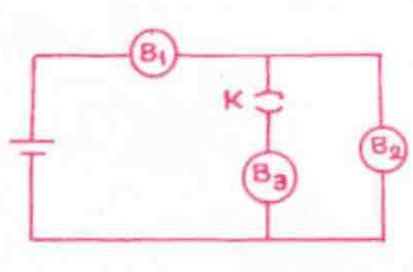
, and are the three identical bulbs connected to a battery of steady e.m.f. with key closed. What happens to the brightness of the bulbs and when the key is opened?
1
Brightness of the bulb, decreases and that of increases.
2
Brightness of the bulbs and decreases.
3
Brightness of the bulbs increases and that of decreases
4
Brightness of the bulbs and increases.
Official Solution
Correct Option: (1)
When key is opened, bulb will not draw any current from the source, so that terminal voltage of source increases. Hence, power consumed by bulb increases, so light of the bulb becomes more. The brightness of bulb decreases.
24
PYQ 2011
hard
physicsID: kcet-201
In the circuit shown, the currents and are
1
2
3
4
Official Solution
Correct Option: (2)
Resistance Electric current
25
PYQ 2011
medium
physicsID: kcet-201
A conductor wire having free electrons/ carries a current of . If the cross-section of the wire is , then the drift velocity of electrons will be .......
1
2
3
4
Official Solution
Correct Option: (2)
Current, Drift velocity
26
PYQ 2012
medium
physicsID: kcet-201
In this circuit, the value of , is
1
0.2 A
2
0.3 A
3
0.4 A
4
0.6 A
Official Solution
Correct Option: (3)
By current divider rule, we have,
27
PYQ 2012
medium
physicsID: kcet-201
Copper and Germanium are cooled from room temperature to . Then the resistance of
1
Germanium decreases, Copper increases
2
Germanium decreases, Copper decreases
3
Germanium increases, Copper decreases
4
Germanb m increases, Copper increases
Official Solution
Correct Option: (3)
The correct option is(C): Germanium increases, Copper decreases.
Resistance of conductor decreases while those of semiconductors increases on cooling.The change in resistance of a material with temperature is described by its temperature coefficient of resistance (TCR). TCR is positive for materials whose resistance increases with temperature, and negative for materials whose resistance decreases with temperature.
28
PYQ 2013
medium
physicsID: kcet-201
In the circuit .The value of and are ________( -resistance)
1
2
3
4
Official Solution
Correct Option: (1)
Applying Kirchoff's 2 nd law in loop
or
Now apply KVL in loop ,
Eliminating / from Equ. (i) and (ii), [from E(i)] and [from E (ii)] So, So, if were known, then from options we could get the answer.
29
PYQ 2013
medium
physicsID: kcet-201
In the circuit diagram ,heat produces in and are in the ratio
1
4:02:03
2
8:04:27
3
2:04:03
4
27:08:04
Official Solution
Correct Option: (2)
We have,
Also,
and From Eqs. (i), (ii) and (iii),
30
PYQ 2014
medium
physicsID: kcet-201
A tuned amplifier circuit is used to generate a carrier frequency of for the amplitude modulation. The value of is
1
2
3
4
Official Solution
Correct Option: (4)
By transistor as an oscillator
where and
31
PYQ 2014
medium
physicsID: kcet-201
A carbon film resistor has colour code Green Black Violet Gold. The value of the resistor is
1
2
3
4
Official Solution
Correct Option: (3)
Corresponding to the colours of the first and second bands green and black, the figures are 5 and 0 . Corresponding to the colour of third band, violet, the multiplier is . Therefore, the value of the resistance is . The Gold colour of the fourth band, indicates the tolerance of So, the value of the resistor is written as
32
PYQ 2015
medium
physicsID: kcet-201
Four identical cells of emf and internal resistance are to be connected in series. Suppose if one of the cell is connected wrongly, the equivalent emf and effective internal resistance of the combination is
1
4E and 4r
2
4E and 2r
3
2E and 4r
4
2E and 2r
Official Solution
Correct Option: (3)
Total internal resistance does not change
Net emf is Here, n = total number of cells = 4 m = wrong connection = 1
i.e.
33
PYQ 2016
medium
physicsID: kcet-201
Effective resistance between and in the following circuit
1
2
3
4
Official Solution
Correct Option: (1)
It is a balanced Wheatstone's bridge network with the resistances being each.
34
PYQ 2016
medium
physicsID: kcet-201
In the following network potential at
1
4 V
2
3 V
3
6 V
4
4.8 V
Official Solution
Correct Option: (4)
Let the potential at is . Application of Kirchhoff's first law at junction gives
35
PYQ 2016
medium
physicsID: kcet-201
Variation of resistance of the conductor with temperature is as shown .The temperature co-efficient of the conductor is
1
2
3
4
Official Solution
Correct Option: (4)
where, is temperature coefficient of conductor
Slope of graph
36
PYQ 2016
medium
physicsID: kcet-201
Mobility of free electrons in a conductor is
1
directly proportional to electron density.
2
directly proportional to relaxation time.
3
inversely proportional to electron density.
4
inversely proportional to relaxation time.
Official Solution
Correct Option: (2)
Key Idea Electron mobility Drift velocity. Mobility of free electrons in a conductor is directly proportional to relaxation time.
37
PYQ 2017
medium
physicsID: kcet-201
The value of in the figure shown below is
1
8A
2
21A
3
19A
4
4A
Official Solution
Correct Option: (2)
38
PYQ 2017
medium
physicsID: kcet-201
In metre bridge experiment, with a standard resistance in the right gap and a resistance coil dipped in water (in a beaker) in the left gap, the balancing length obtained is . If the temperature of water is increased, the new balancing length is
1
> 1
2
< 1
3
1
4
0
Official Solution
Correct Option: (1)
According to the quastion,
If temperature increases than resistance increases. Hence the new balancing is greater than 1
39
PYQ 2019
medium
physicsID: kcet-201
Kichhoff?s junction rule is a reflection of
1
conservation of momentum
2
conservation of current density vector
3
conservation of charges
4
conservation of energy
Official Solution
Correct Option: (3)
Kirchhoff?s junction rule is based on the conservation of charges.
40
PYQ 2019
medium
physicsID: kcet-201
The readings of ammeter and voltmeter in the following circuit are respectively
1
2.7 A, 220 V
2
1.2 A, 120 V
3
2.2 A, 220 V
4
1.5 A, 100 V
Official Solution
Correct Option: (3)
it is a resistive circuit
41
PYQ 2019
medium
physicsID: kcet-201
In a potentiometer experiment, the balancing point with a cell is at a length 240 cm. On shunting the cell with a resistance of 2 , the balancing length becomes 120 cm. The internal resistance of the cell is
1
2
3
4
Official Solution
Correct Option: (4)
Internal resistance of a cell is R
42
PYQ 2020
medium
physicsID: kcet-202
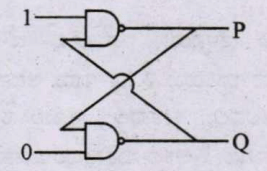
In the following circuit what are P and Q :
1
P = 1, Q = 0
2
P = 0, Q = 1
3
P = 0, Q = 0
4
P = 0, Q = 0
Official Solution
Correct Option: (2)
In this circuit, we have two logic gates: a NAND gate and a NOT gate. The first gate is a NAND gate, which gives a low output (0) only when both inputs are high (1). Since one of the inputs is 1, the other input should be 0 for the output to be 0. So, . The second gate is a NOT gate that inverts the input. The input to this NOT gate is 0, so its output will be 1.
Thus, . Therefore, and .
The correct answer is (B) : P = 0, Q = 1.
43
PYQ 2021
easy
physicsID: kcet-202
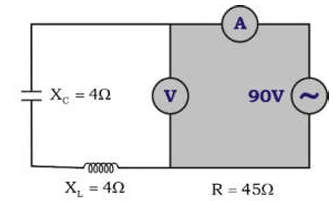
What will be the reading in the voltmeter and ammeter of the circuit shown ?
1
90V, 2A
2
0V, 2A
3
90V, 1A
4
0V, 1A
Official Solution
Correct Option: (2)
1. Impedance of the circuit:
The impedance ( ) of a series RLC circuit is given by:
In this case, , so the impedance is:
2. Current in the circuit:
The current ( ) in the circuit is given by Ohm's law for AC circuits:
where is the source voltage. Substituting the given values:
Since the ammeter is connected in series with the circuit, it will read this current.
3. Voltage across the voltmeter:
The voltmeter is connected across the inductor and capacitor. Since and are equal, the voltage across the inductor ( ) and the voltage across the capacitor ( ) are equal in magnitude but opposite in phase. Therefore, the net voltage across the inductor and capacitor combination is:
Thus, the voltmeter will read 0 V.
The correct answer is (B) 0V, 2A.
44
PYQ 2024
hard
physicsID: kcet-202
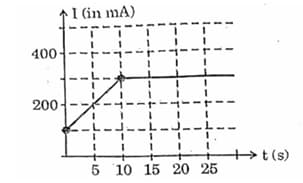
The electric current flowing through a given conductor varies with time as shown in the graph below. The number of free electrons which flow through a given cross-section of the conductor in the time interval is
1
2
3
4
Official Solution
Correct Option: (3)
The charge is given as:
Substituting the values:
45
PYQ 2024
medium
physicsID: kcet-202
is the electric field inside a conductor whose material has conductivity and resistivity . The current density inside the conductor is . The correct form of Ohm's law is
1
2
3
4
Official Solution
Correct Option: (3)
Ohm’s law states that the current density is proportional to the electric field , with the conductivity as the constant of proportionality: This expresses the relationship between the electric field and current density inside a conductor.
46
PYQ 2024
medium
physicsID: kcet-202
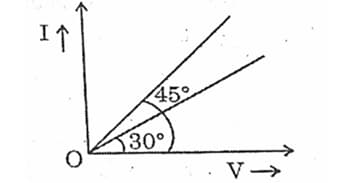
The I-V graph for a conductor at two different temperatures 100°C and 400°C is as shown in the figure. The temperature coefficient of resistance of the conductor is about (in per degree Celsius)
1
2
3
4
Official Solution
Correct Option: (1)
The temperature coefficient of resistance quantifies how much the resistance of a material changes with temperature. The formula for calculating is: where and are the resistances at temperatures and , respectively. Using the graph, you can estimate the resistance at these temperatures, and after performing the calculation, you find:
47
PYQ 2024
medium
physicsID: kcet-202
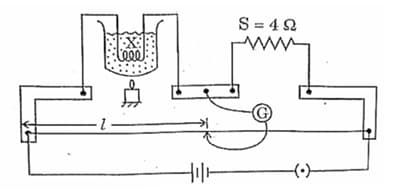
In an experiment to determine the temperature coefficient of resistance of a conductor, a coil of wire X is immersed in a liquid. It is heated by an external agent. A meter bridge set up is used to determine resistance of the coil X at different temperatures. The balancing points measured at temperatures and are 50 cm and 60 cm respectively. If the standard resistance taken out is in both trials, the temperature coefficient of the coil is
1
0.05°C
2
0.02°C
3
0.005°C
4
2.0°C
Official Solution
Correct Option: (3)
To determine the temperature coefficient of resistance, we use the formula: where: - is the resistance at , - is the resistance at , - and . Now substitute the values into the formula:
48
PYQ 2024
medium
physicsID: kcet-202
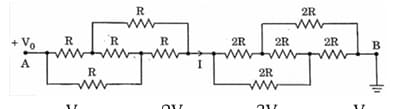
In the circuit shown, the end A is at potential , and end B is grounded. The electric current indicated in the circuit is
1
2
3
4
Official Solution
Correct Option: (3)
The current in the circuit is determined by the formula: where is the effective resistance of the circuit. For the given configuration:
49
PYQ 2025
easy
physicsID: kcet-202
Given, a current carrying wire of non-uniform cross-section, which of the following is constant throughout the length of the wire?
1
Current only
2
Current, electric field, and drift speed
3
Drift speed
4
Current and drift speed
Official Solution
Correct Option: (1)
In a current-carrying wire, the current is constant throughout the length of the wire, even if the cross-section of the wire changes. This is due to the conservation of charge, which ensures that the same amount of charge flows through any cross-sectional area of the wire per unit of time. The electric field and drift speed depend on the cross-sectional area of the wire and may vary along its length if the wire has a non-uniform cross-section. Thus, only the current remains constant throughout the length of the wire.
50
PYQ 2026
medium
physicsID: kcet-202
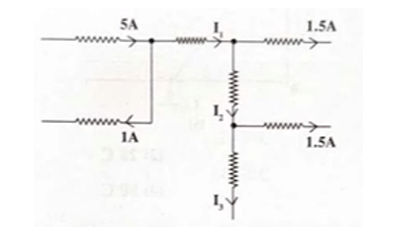
In the figure, the values of currents I , I and I respectively are
1
6A, 1.5A and 1A
2
4A, 2.5A and 2A
3
4A, 2.5A and 1A
4
6A, 4.5A and 1.5A
Official Solution
Correct Option: (3)
Step 1: Understanding the Question:
This question requires applying Kirchhoff's Current Law (KCL) at multiple junctions in a circuit branch to find unknown currents. KCL states that the sum of currents entering a junction equals the sum of currents leaving it. Step 2: Key Formula or Approach:
Kirchhoff's Current Law:
Step 3: Detailed Explanation:
Let's analyze the junctions from left to right as per the diagram: At the first junction (left):
- Current entering from the top-left branch = .
- Current leaving through the bottom-left branch = (as indicated by the arrow pointing away from the junction).
- Current leaving towards the right = .
Applying KCL: . At the second junction (middle-top):
- Current entering from the left = .
- Current leaving towards the right = .
- Current leaving downwards = .
Applying KCL: . At the third junction (bottom-right):
- Current entering from the top = .
- Current leaving towards the right = .
- Current leaving downwards = .
Applying KCL: . Comparing these values ( ) with the options, it matches option (3). Step 4: Final Answer:
The values of currents are and .
51
PYQ 2026
medium
physicsID: kcet-202
Given below are two statements:
Statement I: The resistivity of a conductor is independent of its temperature
Statement II: The resistivity of a semiconductor decreases with increase in temperature
Select the correct option.
1
Both Statement I and Statement II are false
2
Both Statement I and Statement II are true
3
Statement I is true but Statement II is false
4
Statement I is false but Statement II is true
Official Solution
Correct Option: (4)
Step 1: Understanding the Question:
The question evaluates theoretical knowledge regarding how temperature affects the electrical resistivity of different classes of materials (conductors and semiconductors). Step 3: Detailed Explanation: Analysis of Statement I:
Resistivity ( ) of a conductor (metal) depends on temperature as:
where is the temperature coefficient. For conductors, is positive. As temperature increases, thermal vibrations of lattice ions increase, causing more frequent collisions with electrons. This increases resistance and resistivity. Therefore, Statement I is false. Analysis of Statement II:
For semiconductors, the temperature coefficient of resistivity is negative. As temperature increases, more valence electrons gain enough thermal energy to jump into the conduction band, significantly increasing the charge carrier density ( ). This effect outweighs the increase in lattice scattering. Consequently, the resistivity decreases. Therefore, Statement II is true. Step 4: Final Answer:
Statement I is false but Statement II is true, which corresponds to option (4).
52
PYQ 2026
medium
physicsID: kcet-202
The number of electrons moving per second through the filament of a lamp of 60W operating at 120V is nearly (e = 1.6 10 C) \textunderscore\textunderscore\textunderscore\textunderscore\textunderscore\textunderscore\textunderscore
1
6.2 10
2
6.2 10
3
3.1 10
4
3.1 10
Official Solution
Correct Option: (3)
Step 1: Understanding the Question:
The goal is to find the rate of electron flow (electrons per second) in a circuit given the power and voltage of an appliance. Step 2: Key Formula or Approach:
1. Electric Power: .
2. Current and Charge: .
3. Quantization of Charge: .
Combining these, the number of electrons per second ( for ) is:
Now, calculate the number of electrons per second ( ):
Rounding to the nearest significant figures as per options: . Step 4: Final Answer:
The number of electrons moving per second is nearly .
53
PYQ 2026
hard
physicsID: kcet-202
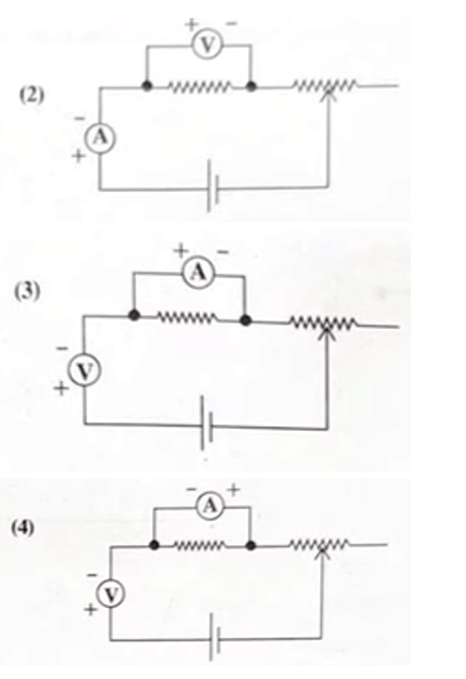
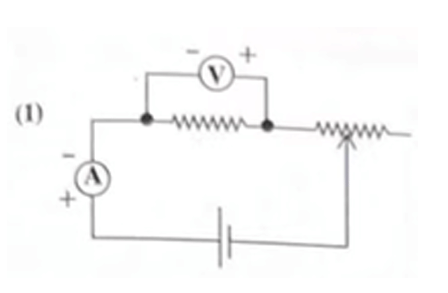
Which of the following circuits is correct for verification of Ohm's law?
1
Figure (1)
2
Figure (2)
3
Figure (3)
4
Figure (4)
Official Solution
Correct Option: (1)
Step 1: Understanding the Question:
Ohm's law states that the current passing through a conductor is directly proportional to the potential difference across it, provided physical conditions remain constant ( ). To verify this experimentally, we need to measure both current and voltage across a known resistor. Step 3: Detailed Explanation:
To correctly measure electrical parameters in a circuit:
1. Ammeter (A): It measures the current ( ) and must be connected in series with the circuit components to ensure the same current flows through it.
2. Voltmeter (V): It measures the potential difference ( ) and must be connected in parallel across the resistor.
3. Polarity: The positive terminal ( ) of both the ammeter and voltmeter must be connected towards the positive terminal of the power source (battery/cell). Analyzing the provided circuit options:
- In Figure (1), the ammeter is in series and the voltmeter is in parallel. Tracing from the battery's positive terminal (the long line on the right), the current flows through the rheostat and enters the right side of the resistor. The positive terminal of the voltmeter is correctly on the right. Current leaves the left side of the resistor and enters the ammeter's positive terminal at the bottom. This configuration is correct.
- In Figure (2), the voltmeter's polarity is reversed ( is incorrectly on the left).
- In Figures (3) and (4), the ammeter is incorrectly placed in parallel across the resistor and the voltmeter is incorrectly placed in series. Step 4: Final Answer:
The correct circuit for verification of Ohm's law is shown in Figure (1).
54
PYQ 2026
easy
physicsID: kcet-202
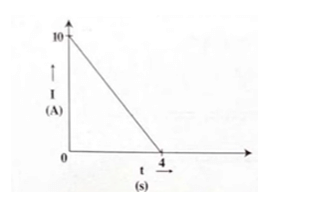
Current flowing through a wire decreases linearly from 10A to zero in 4s as shown in the graph. Find the total charge flowing through the wire in the given time interval.
1
40C
2
20C
3
10C
4
80C
Official Solution
Correct Option: (2)
Step 1: Understanding the Question:
The total charge flowing through a circuit component is equal to the area under its current-time ( ) graph. Step 2: Key Formula or Approach:
The charge is given by the definite integral of current over time:
Geometrically, this corresponds to the area of the region between the graph and the time axis. Step 3: Detailed Explanation:
The provided graph forms a right-angled triangle with the following dimensions:
- Base ( ) = 4 s
- Height (initial current ) = 10 A
The area of a triangle is calculated using the formula:
Substituting the values:
Step 4: Final Answer:
The total charge flowing through the wire is 20C.