Relative permeability of iron is 5500. Its magnetic susceptibility is
1
2
3
4
Official Solution
Correct Option:
(1)
= 5500, using 1 + , we get = 5500 - 1 = 5499.
02
PYQ 2004
easy
physicsID: kcet-200
A bar magnet is equivalent to ............
1
solenoid carrying current
2
circular coil carrying current
3
torroid carrying current
4
straight conductor carrying current
Official Solution
Correct Option:
(1)
Answer (a) solenoid carrying current
03
PYQ 2004
medium
physicsID: kcet-200
Curie-Weiss law is obeyed by iron at a temperature ...........
1
below Curie temperature
2
above Curie temperature
3
at Curie temperature only
4
at all temperatures
Official Solution
Correct Option:
(2)
Above curie temperature.
04
PYQ 2017
medium
physicsID: kcet-201
A magnetic dipole of magnetic moment and moment of inertia performs oscillations in a magnetic field of T. The time taken by the dipole to complete oscillations is
1
36 s
2
6 s
3
12 s
4
18 s
Official Solution
Correct Option:
(3)
Given,
Magnetic moment Moment of inertia Magnetic field We know that. Time For 20 oscillation, Time
05
PYQ 2019
medium
physicsID: kcet-201
Coersivity of a magnet where the ferromagnet gets completely demagnetized is $3 \times 10^3 Am^{?
1
3 A
2
30 mA
3
6 A
4
60 mA
Official Solution
Correct Option:
(1)
06
PYQ 2019
medium
physicsID: kcet-201
A circular current loop of magnetic moment M is in an arbitrary orientation in an external uniform magnetic field . The work done to rotate the loop by 30? about an axis perpendicular to its plane is
1
2
MB
3
Zero
4
Official Solution
Correct Option:
(3)
Even though the coil is rotated, about an axis perpendicular to its plane, the potential energy does not change. Hence, work done is zero.
07
PYQ 2020
medium
physicsID: kcet-202
A paramagnetic sample shows a net magnetization of when placed in an external magnetic field of at a temperature of . When the same sample is placed in an external magnetic field of at a temperature of . the magnetization will be
1
2
3
4
Official Solution
Correct Option:
(2)
For a paramagnetic material, the magnetization is related to the external magnetic field and temperature through Curie's Law, which is given by: Where: is the magnetization, is the external magnetic field, is the temperature in Kelvin. Let the magnetization at the first condition (with T and K) be . Now, the magnetization at the second condition (with T and K) can be calculated using the ratio: Substituting the values: Simplifying the ratio: Thus,
Therefore, the magnetization at the second condition is A/m, and the correct answer is (B).
08
PYQ 2021
easy
physicsID: kcet-202
Earth's magnetic field always has a horizontal component except at
1
equator
2
magnetic poles
3
a latitude of
4
an altitude of
Official Solution
Correct Option:
(2)
The question pertains to the Earth's magnetic field and when it lacks a horizontal component. Understanding this requires a basic comprehension of the Earth's magnetic field structure.
The Earth's magnetic field can be represented by field lines emanating from the magnetic south pole and entering the magnetic north pole. The magnetic field at any given point on Earth can be decomposed into two components:
Horizontal component
Vertical component
At most locations on Earth, both components exist. However, at specific locations, one of these components dominates or completely exists without the other.
Let's examine each option:
Equator: At the magnetic equator, the magnetic field lines are parallel to the surface, meaning there is no vertical component of the magnetic field, only a horizontal component is present.
Magnetic poles: At the magnetic poles, the magnetic field lines are vertical. Here, the horizontal component becomes zero, and only the vertical component is present.
A latitude of and an altitude of : These do not affect the exclusion of the horizontal component. These locations will have both components unless influenced by being a magnetic pole.
Therefore, the correct answer is magnetic poles, as that is the location where the Earth's magnetic field does not have a horizontal component.
09
PYQ 2023
hard
physicsID: kcet-202
The Curie temperatures of Cobalt and iron are 1400K and 1000K respectively. At T = 1600K , the ratio of magnetic susceptibility of Cobalt to that of iron is
1
3
2
3
4
Official Solution
Correct Option:
(1)
Given: Curie temperature of Cobalt, Curie temperature of Iron, Temperature at which susceptibility is measured,
Step-by-Step Explanation:
Step 1: Use Curie-Weiss law for magnetic susceptibility ( ) above Curie temperature ( ):
According to Curie-Weiss law:
where is the Curie constant.
Step 2: Calculate magnetic susceptibility for Cobalt at :
Step 3: Calculate magnetic susceptibility for Iron at :
Important Note: The Curie constant depends on material-specific factors. However, since Cobalt and Iron are both ferromagnetic materials with similar magnetic behaviors, we assume their Curie constants ( ) are nearly equal for comparison.
Step 4: Now calculate the ratio :
Assuming :
Thus, the ratio of magnetic susceptibility of Cobalt to Iron is 3.
10
PYQ 2023
easy
physicsID: kcet-202
A proton and an alpha-particle moving with the same velocity enter a uniform magnetic field with their velocities perpendicular to the magnetic field. The ratio of radii of their circular paths is
1
1 : 4
2
4 : 1
3
1 : 2
4
2 : 1
Official Solution
Correct Option:
(3)
Step 1: Recall the formula for the radius of a charged particle moving in a magnetic field:
When a charged particle with mass , charge , and velocity enters a uniform magnetic field perpendicular to the velocity, the radius ( ) of its circular path is given by:
Step 2: Define parameters clearly:
We have two particles:
Proton: mass , charge
Alpha-particle (He nucleus): mass , charge
Given: Both have the same velocity .
Step 3: Calculate radii separately:
- Radius for proton ( ):
- Radius for alpha particle ( ):
Step 4: Compute the ratio of radii:
Thus, the ratio of radii (proton : alpha-particle) is 1 : 2.
11
PYQ 2026
hard
physicsID: kcet-202
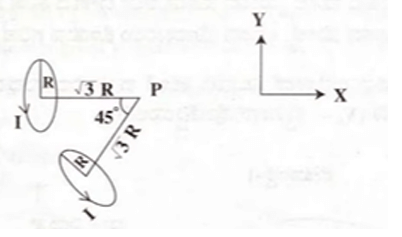
Two identical circular current loops carrying equal currents are placed with their axes inclined at 45 to each other as shown in the figure. The resultant magnetic field at P is
1
2
3
4
Official Solution
Correct Option:
(1)
Step 1: Understanding the Question:
We need to find the vector sum of magnetic fields produced by two identical circular loops at a point P that lies on the axes of both loops at a distance of from their centers. Step 2: Key Formula or Approach:
The magnetic field at a point on the axis of a circular current-carrying loop of radius at a distance from the center is: Step 3: Detailed Explanation:
Given:
Distance .
Calculating the magnitude of the magnetic field from one loop:
Now, let's represent these fields as vectors based on the coordinate system in the figure:
1. The field from the first loop (whose axis is along the X-axis) is:
2. The field from the second loop (whose axis is inclined at 45 to the X-axis) is:
The resultant magnetic field is the vector sum:
Substituting the value of : Step 4: Final Answer:
The resultant magnetic field at P is , which corresponds to option (1).
12
PYQ 2026
medium
physicsID: kcet-202
If a paramagnetic bar is brought near a bar magnet, then it is
1
Attracted by both the poles of the bar magnet
2
Repelled by both the poles of the bar magnet
3
Attracted by the South-pole and repelled by the North-pole of the bar magnet
4
Attracted by the North-pole and repelled by the South-pole of the bar magnet
Official Solution
Correct Option:
(1)
Step 1: Understanding the Question:
The question asks about the magnetic interaction between a paramagnetic material and the poles of a standard permanent bar magnet. Step 3: Detailed Explanation:
Paramagnetic materials have atoms with permanent magnetic dipoles. When placed in an external magnetic field, these dipoles tend to align themselves in the direction of the external field.
A characteristic property of paramagnetic substances is that they are weakly attracted toward stronger parts of an external magnetic field.
A bar magnet has its strongest field intensity near its poles (both North and South).
Therefore, a paramagnetic bar will experience a weak attractive force when brought near either the North pole or the South pole of a bar magnet. Step 4: Final Answer:
It is attracted by both the poles of the bar magnet, which is option (1).
About Magnetism And Matter - KCET
Magnetism And Matter is a vital chapter for KCET aspirants. Mastering the concepts covered in this chapter is essential for securing a top rank.
By rigorously practicing the previous year questions associated with this chapter, you can identify high-yield topics, understand the examiner's perspective, and boost your confidence during the actual exam.
Frequently Asked Questions
Why focus on Magnetism And Matter PYQs?
Analyzing PYQs for this specific chapter reveals the most frequently tested concepts and the typical complexity of questions, allowing you to tailor your study plan efficiently.
How to best use this analysis?
Review the topic breakdown to see which sub-topics within Magnetism And Matter carry the most weight. Then, tackle the questions iteratively to solidify your understanding.