KCET SERIES Physics
Spherical Mirrors
8 previous year questions.
Volume: 8 Ques
Yield: Medium
High-Yield Trend
1
2022 3
2021 2
2020 1
2009 1
1997 Chapter Questions 8 MCQs
01
PYQ 1997
medium
physics ID: kcet-199
Colour of light having maximum speed in air is
1
blue
2
violet
3
yellow
4
red
02
PYQ 2009
easy
physics ID: kcet-200
A convex lens made of glass has focal length in air. If the refractive index of glass is , and that of water is the focal length of lens when immersed in water is
1
0.15 m
2
0.30 m
3
0.6 m
4
0.45 m
03
PYQ 2020
medium
physics ID: kcet-202
The refracting angle of prism is A and refractive index of material of prism is The angle of minimum deviation is
1
2
3
4
04
PYQ 2020
easy
physics ID: kcet-202
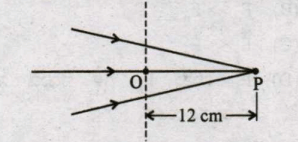
The following figure shows a beam of light converging at point . When a concave lens of focal length is introduced in the path of the beam at a place shown by dotted line such that becomes the axis of the lens, the beam converges at a distance from the lens. The value of will be equal to
1
12 cm
2
24 cm
3
36 cm
4
48 cm
05
PYQ 2021
medium
physics ID: kcet-202
Two thin biconvex lenses have focal lengths and A third thin biconcave lens has focal length of If the two biconvex lenses are in contact, the total power of the lenses is . If the first convex lens is in contact with the third lens, the total power is . If the second lens is in contact with the third lens, the total power is then
1
and
2
and
3
and
4
and
06
PYQ 2021
easy
physics ID: kcet-202
In refraction, light waves are bent on passing from one medium to second medium because, in the second medium.
07
PYQ 2021
medium
physics ID: kcet-202
If the refractive index from air to glass is and that from air to water is , then the ratio of focal lengths of a glass lens in water and in air is
1
2
3
4
08
PYQ 2022
medium
physics ID: kcet-202
The refracting angle of prism is A and refractive index of material of prism is The angle of minimum deviation is
1
2
3
4
About Spherical Mirrors - KCET
Spherical Mirrors is a vital chapter for KCET aspirants. Mastering the concepts covered in this chapter is essential for securing a top rank.
By rigorously practicing the previous year questions associated with this chapter, you can identify high-yield topics, understand the examiner's perspective, and boost your confidence during the actual exam.
Frequently Asked Questions
Why focus on Spherical Mirrors PYQs?
Analyzing PYQs for this specific chapter reveals the most frequently tested concepts and the typical complexity of questions, allowing you to tailor your study plan efficiently.
How to best use this analysis?
Review the topic breakdown to see which sub-topics within Spherical Mirrors carry the most weight. Then, tackle the questions iteratively to solidify your understanding.