The direction of force acting on a current carrying conductor at right angles to a magnetic field is
given by
1
Fleming's left hand rule
2
Fleming's right hand rule
3
Maxwell's right handed cork screw rule
4
Ampere's swimming rule
Official Solution
Correct Option: (1)
Fleming's left hand rule.
02
PYQ 1996
medium
physicsID: kcet-199
A motor
1
converts electrical energy into mechanical energy
2
converts mechanical energy into electrical energy
3
converts electrical energy into a magnetic energy
4
creates mechanical energy.
Official Solution
Correct Option: (3)
Self explanatory
03
PYQ 1998
medium
physicsID: kcet-199
In an ideal transformer, the voltage and the current in the primary are 200 V, 2A and that in the secondary are 2000 V, I A. The value of I is (A)
1
0.2
2
1
3
20
4
2
Official Solution
Correct Option: (1)
Using we get I = 0.2 A.
04
PYQ 1998
medium
physicsID: kcet-199
Choke used to limit high frequency A.C. has
1
a paramagnetic core
2
a diamagnetic core
3
air core
4
iron core.
Official Solution
Correct Option: (3)
air core
05
PYQ 2001
medium
physicsID: kcet-200
An aluminium ring B faces an electromagnet A.The current I through A can be altered
1
Whether I increases or decreases B will not experience any force
2
If I decreases, A will repel B
3
If I increases, A will attract B
4
If I increase, A will repel B.
Official Solution
Correct Option: (4)
Increasing current will induce similar pole on the nearer face of the coil.
06
PYQ 2002
easy
physicsID: kcet-200
A magnet is dropped down an infinitely long vertical copper tube. Then
Official Solution
Correct Option: (1)
07
PYQ 2003
medium
physicsID: kcet-200
When 100 V d.c. is applied across a coil, a current of 1 A flows through it. When 100 V a.c. of 50 Hz is applied to the same coil only 0.5 A flows. The inductance of the coil is
1
0.55 mH
2
5.5 mH
3
0.55 H
4
55 mH
Official Solution
Correct Option: (3)
R = and Z = L = = 0.55 H
08
PYQ 2003
easy
physicsID: kcet-200
A wire in the form of a circular loop of one turn carrying a current produces a magnetic field B
at the centre. If the same wire is looped into a coil of two turns and carries the same current, the new value of magnetic induction at the centre is
1
4B
2
2B
3
3B
4
5B
Official Solution
Correct Option: (1)
A wire in the form of a circular loop of one turn carrying a current produces a magnetic field B at the centre. If the same wire is looped into a coil of two turns and carries the same current, the new value of magnetic induction at the centre is
The magnetic field at its center B = μ0I/2πr
Thus the length of the wire L = 2πr
But the same wire is looped into a coil of radius r2 of two turns
r2 = r/2
The magnetic field at its center B = (μ0I/2πr2) x n = [μ0I/2π(r/2)] x 2 = 4 x μ0I/2πr =4B
B = (2) B = 4B
Magnetic field, also called a vector field, represents the magnetic influence on moving electric charges, magnetic materials, and electric currents. The magnetic fields force moving electrically charged particles in a circular or helical path and the charged particles experience a force perpendicular to their own velocity and to the magnetic field. Magnetic field can be expressed as the area around a magnet wherein the effect of magnetism is felt.
The symbol of the Magnetic Field can be denoted by B or H. It is denoted mathematically by quantities known as vectors which have direction and magnitude both.
Two different vectors help represent magnetic field: Magnetic flux density (or magnetic induction) and Magnetic field strength (or magnetic field intensity) each symbolized by B and H respectively.
The unit of Magnetic Field is Telsa and its base unit is (Newton.Second)/Coulomb.
Magnetic field lines are known to not cross one another. In fact, magnetic lines form closed loops, beginning from the north pole and ending at the south pole.
The density of the field lines generally indicates the strength of the field.
A charged particle moves along the line AB which lies in the same plane of a circular loop of conducting wire as shown in the figure above. Then
1
the current induced will be anticlockwise
2
the current induced will be clockwise
3
no current will be induced in the loop
4
the current induced in the loop will change its direction as the charged particle passes by
Official Solution
Correct Option: (4)
Charged particle approaches and then leaves the loop.
10
PYQ 2004
medium
physicsID: kcet-200
A rectangular coil of turns has an average area of The coil rotates with a speed of in a uniform magnetic field of strength about an axis perpendicular to the field. The peak value of the induced emf is (in volt)
1
2
3
4
Official Solution
Correct Option: (2)
E = BA sin =
11
PYQ 2009
easy
physicsID: kcet-200
Near a circular loop of conducting wire as shown in the figure an electron moves along a straight line. The direction of the induced current if any in the loop is
1
clockwise
2
anticlockwise
3
zero
4
variable
Official Solution
Correct Option: (4)
Since, electron is moving from left to right, the flux linked with loop will first increase and then decrease as the electron passes by. Therefore, induced current in the loop will be first clockwise and then will move in anticlockwise direction as the electron passes by.
12
PYQ 2010
medium
physicsID: kcet-201
There is a uniform magnetic field directed perpendicular and into the plane of the paper. An irregular shaped conducting loop is slowly changing into a circular loop in the plane of the paper. Then
1
AC is induced in the loop.
2
no current is induced in the loop
3
current is induced in the loop in the anti-clockwise direction
4
current is induced in the loop in the clockwise direction
Official Solution
Correct Option: (3)
Due to change in the shape of the loop, the magnetic flux linked with the loop increases. Hence, current is induced in the loop in such a direction that it opposes the increases in flux. Therefore, induced current flows in the anticlockwise direction.
13
PYQ 2011
medium
physicsID: kcet-201
The energy stored in an inductance of self inductance heavy carrying a current of ampere is
1
2
3
4
Official Solution
Correct Option: (2)
The energy stored in an inductor
14
PYQ 2011
medium
physicsID: kcet-201
In the series circuit shown, the impedance is
1
2
3
4
Official Solution
Correct Option: (4)
Impedance,
15
PYQ 2012
medium
physicsID: kcet-201
Direction of current induced in a wire moving in a magnetic field is found using
1
Fleming?s left hand rule
2
Fleming?s right hand rule
3
Ampere?s rule
4
Right hand clasp rule
Official Solution
Correct Option: (2)
Fleming's right hand rule is used to find direction of induced current in a wire moving in a magnetic field.
16
PYQ 2013
easy
physicsID: kcet-201
A rectangular coil of turns and size is placed perpendicular to a magnetic field of . If the field drops to in second, the magnitude of the e.m.f. induced in the coil is
1
2
3
4
Official Solution
Correct Option: (3)
Given, turns,
We know that,
Here,
17
PYQ 2015
easy
physicsID: kcet-201
An aircraft with a wingspan of flies with a speed of in the eastward direction at a constant altitude in the northern hemisphere, where the vertical component of the earth's magnetic field . Then the emf developed between the tips of the wings is
1
0.5 V
2
0.34 V
3
0.21 V
4
2.1 V
Official Solution
Correct Option: (3)
Given,
We know that, emf developed between the tips of the wings,
18
PYQ 2016
medium
physicsID: kcet-201
A long solenoid with turns per cm carries a current of . The magnetic energy stored per unit volume is ........ .
1
2
3
4
Official Solution
Correct Option: (1)
turns turns
The magnetic energy stored per unit volume in a solenoid
(Magnetic field inside the solenoid)
19
PYQ 2017
easy
physicsID: kcet-201
A bar magnet is allowed to fall vertically through a copper coil placed in a horizontal plane. The magnet falls with a net acceleration
1
= g
2
> g
3
< g
4
Zero
Official Solution
Correct Option: (3)
When the magnet is allowed to fail vertically along the axis of loop with its north pole towards the coil. The upper face of the coil will become north pole in an attempt to oppose the approaching north pole of the magnet. Therefore. the acceleration in the magnet is less than .
20
PYQ 2017
medium
physicsID: kcet-201
A jet plane of wing span is travelling towards west at a speed of . If the earth?s total magnetic field is and the dip angle is , at that place, the voltage difference developed across the ends of the wing is
1
1.6 V
2
3.2 V
3
0.8 V
4
6.4 V
Official Solution
Correct Option: (1)
Given, Speed Magnetic field Dip angle We know that, Voltage difference
21
PYQ 2018
medium
physicsID: kcet-201
A jet plane having a wing-span of 25 m is travelling horizontally towards east with a speed of 3600 km/hour. If the Earth?s magnetic field at the location is and the angle of dip is , then, the potential difference between the ends of the wing is
1
4 V
2
5 V
3
2 V
4
2.5 V
Official Solution
Correct Option: (2)
Motional emf:
km/hour =
22
PYQ 2019
medium
physicsID: kcet-201
Though the electron drift velocity is small and electron charge is very small, a conductor can carry an appreciably large current because
1
electron number density depends on temperature
2
electron number density is very large
3
relaxation time is small
4
drift velocity of electron is very large
Official Solution
Correct Option: (2)
Current I = The large value of I is because of number density of free electrons in a conductor (n) which is of the order n =
23
PYQ 2021
easy
physicsID: kcet-202
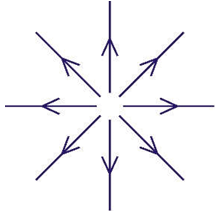
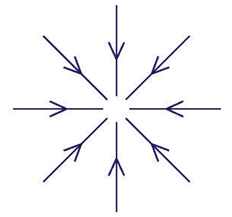
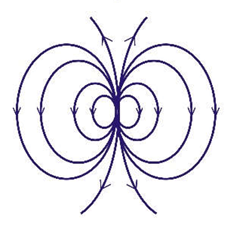
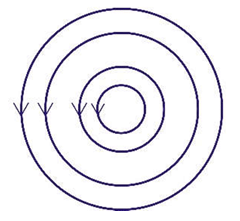
Which of the field pattern given below is valid for electric field as well as for magnetic field ?
1
2
3
4
Official Solution
Correct Option: (3)
Let's analyze each field pattern against the properties of electric and magnetic fields.
(A) Field lines radiating outwards from a central point.
Electric Field: This is a valid representation of the electric field lines originating from a positive point charge.
Magnetic Field: This is NOT a typical valid representation of a fundamental magnetic field source. Magnetic fields do not originate from a point in the same way electric fields originate from point charges (magnetic monopoles are not observed).
(B) Field lines converging inwards towards a central point.
Electric Field: This is a valid representation of the electric field lines terminating at a negative point charge.
Magnetic Field: Similar to (A), this is NOT a typical valid representation of a fundamental magnetic field source. Magnetic fields do not terminate at a point in the same way electric fields terminate at point charges.
(D) Concentric circles.
Electric Field: Electric field lines cannot form closed loops in electrostatics. Electrostatic fields are conservative. Thus, this pattern is NOT valid for an electric field under static conditions.
Magnetic Field: This is a valid representation of the magnetic field lines around a long, straight current-carrying wire. According to Ampère's Law, the magnetic field lines form concentric circles around the wire.
(C) Field lines forming loops between two points (like a dipole).
Electric Field: This pattern can represent the electric field of an electric dipole (two opposite charges). Electric field lines originate from the positive charge and terminate at the negative charge, forming curved paths between them. While not strictly closed loops in the magnetic sense, the overall shape is dipole-like.
Magnetic Field: This pattern is a valid representation of the magnetic field of a magnetic dipole, such as a bar magnet or a current loop. Magnetic field lines emerge from the North pole, curve around, and enter the South pole, forming closed loops that continue inside the magnet.
Considering the question "Which of the field pattern given below is valid for electric field as well as for magnetic field?", we need to find a pattern that can represent both, even if not perfectly in every detail for both types of fields.
Option (C) represents a dipole field. Dipole fields are fundamental in both electrostatics (electric dipole) and magnetostatics (magnetic dipole). While electric field lines do not form closed loops in the same way as magnetic field lines of a magnet, the overall dipole pattern is a common and recognizable representation in both contexts.
Final Answer: The final answer is
24
PYQ 2021
medium
physicsID: kcet-202
A strong magnetic field is applied on a stationary electron. Then the electron
1
Moves in the direction of the field
2
Moves in an opposite direction of the field
3
Remains stationary
4
Starts spinning
Official Solution
Correct Option: (3)
Step 1: Consider the force on a stationary electron in a magnetic field.
The Lorentz force on a charge moving with velocity in a magnetic field is .
Step 2: Apply the condition of a stationary electron.
For a stationary electron, the velocity .
Therefore, the magnetic force .
Step 3: Determine the motion of the electron.
Since the net magnetic force on a stationary electron is zero (and assuming no other forces are considered in this simplified scenario), the electron will remain stationary.
The correct answer is (C) Remains stationary.
25
PYQ 2021
easy
physicsID: kcet-202
A copper rod AB of length l is rotated about end A with a constant angular velocity ω. The electric field at a distance x from the axis of rotation is
1
2
3
4
Official Solution
Correct Option: (1)
Step 1: Recall the relationship between induced electric field and rotation
When a conducting rod rotates about an axis with constant angular velocity, an electric field is induced in the rod due to the motion of charges in the conductor. This is a result of the Lorentz force acting on the free charges within the conductor. The key equation here is the relationship between the induced electric field and the velocity of the charges at a given point.
Step 2: Use the concept of induced electric field
The velocity of a point on the rod at a distance from the axis of rotation is given by:
where: - is the angular velocity, - is the distance from the axis of rotation.
The induced electric field in the rod at a distance from the axis of rotation is given by the formula for the electric field in a rotating conductor:
where: - is the velocity of the point at distance , which is , - is the magnetic field generated by the rotating conductor, - is the length of the rod.
Step 3: Apply the given values
We are given that the rod is rotating about end A with a constant angular velocity . The induced electric field will depend on the rotation of the rod, the magnetic field generated, and the distance from the axis.
Since the magnetic field generated by the rotating conductor will be proportional to the distance from the axis, we find the relation for the electric field. After substituting the necessary terms, we arrive at:
Final Answer: The electric field at a distance from the axis of rotation is , which matches option (A).
26
PYQ 2022
easy
physicsID: kcet-202
A metallic rod of mass per unit length 0.5 kg m-1 is lying horizontally on smooth inclined plane which makes an angle of 30 degree with the horizontal. A magnetic field of strength 0.25 T is acting on it in the vertical direction. When a current I is flowing through it, the rod is not allowed to slide down. the quantity of current required to keep the road stationary is
1
14.76 Å
2
7.14 Å
3
11.32 Å
4
5.98 Å
Official Solution
Correct Option: (3)
Given: Mass per unit length of the metallic rod is
Mass per unit length .
Let be the current flowing through the rod. For equilibrium, the forces acting on the rod balance each other:
Solving for the current :
Substituting the known values:
Therefore, the current flowing through the metallic rod is .
27
PYQ 2022
medium
physicsID: kcet-202
A fully charged capacitor 'C' with initial charge 'q0' is connected to a coil of self inductance 'L' at t = 0. The time at which the energy is stored equally between the electric field and the magnetic field is
1
2
3
4
Official Solution
Correct Option: (3)
A fully charged capacitor with an initial charge is connected to a coil of self-inductance at time . We want to find the time at which the energy stored in the electric field of the capacitor is equal to the energy stored in the magnetic field of the inductor.
In an LC circuit, the charge on the capacitor oscillates sinusoidally. The charge on the capacitor as a function of time is given by:
Where is the angular frequency of oscillation, and .
The energy stored in the capacitor at time is:
The current in the inductor is the derivative of the charge with respect to time:
The energy stored in the inductor at time is:
Since , then , and we can rewrite the inductor energy as:
We want to find the time when . Therefore:
This implies , which means , or .
The first positive solution for is . Therefore:
Therefore, the time at which the energy is stored equally between the electric field and the magnetic field is:
28
PYQ 2022
easy
physicsID: kcet-202
Electrical as well as gravitational effects can be thought to be caused by fields. Which of the following is true for an electrical and gravitational field ?
1
Fields are useful for understanding forces acting through a distance.
2
The field concept is often used to describe contact forces.
3
There is no way to verify the existence of the force field since it is just a concept.
4
Gravitational or electrical field does not exist in the space around an object.
Official Solution
Correct Option: (1)
Answer: The correct statement is: (A) Fields are useful for understanding forces acting through a distance.
Explanation:
Fields are an essential concept in physics that help describe how forces can act through a distance without direct contact. There are two primary types of fields that describe forces acting at a distance:
Electric fields: These are created by electric charges and describe the force that a charge exerts on other charges in its vicinity.
Gravitational fields: These are created by masses and describe the force that a mass exerts on other masses in its vicinity.
Both fields act through space and influence other objects within their reach, which is why we can observe forces at a distance, such as gravitational attraction between planets or the electric force between charged particles.
Therefore, the correct answer is: (A) Fields are useful for understanding forces acting through a distance.
29
PYQ 2022
easy
physicsID: kcet-202
The electric field and the potential of an electric dipole vary with distance 'r' as
1
1/r2 and 1/r3
2
1/r and 1/r2
3
1/r3 and 1/r2
4
1/r2 and 1/r
Official Solution
Correct Option: (3)
Electric Field:
Electric Potential:
Therefore, the correct option is:D.
30
PYQ 2022
easy
physicsID: kcet-202
A charge particle of mass 'm' and charge 'q' is released from rest in an uniform electric field 'E'. Neglecting the effect of gravity, the kinetic energy of the charged particle after 't' second is
1
Eqm/t
2
2E2t2/mq
3
E2q2t2/2m
4
Eq2m/2t2
Official Solution
Correct Option: (3)
Using the equation of motion, calculate the kinetic energy of a particle moving with constant acceleration, where and the energy involved is .
Step 1: Start with the equation of motion:
Rearrange the equation to solve for :
Step 2: Kinetic energy (K) of the particle:
The kinetic energy is given by:
Substitute the value of from earlier:
Step 3: Simplify the equation:
Therefore, the correct expression for the kinetic energy is: , which corresponds to option (C) .
31
PYQ 2022
easy
physicsID: kcet-202
Which of the following radiations is deflected by electric field?
1
γ - Ray
2
X - Ray
3
α - Particles
4
Neutrons
Official Solution
Correct Option: (3)
Answer: The radiation that is deflected by an electric field is α-particles (option C).
Explanation:
α-particles are positively charged particles consisting of two protons and two neutrons. This gives them a positive charge, and when they pass through an electric field, they experience a force due to their charge and can be deflected accordingly.
γ-rays (option A) and X-rays (option B) are forms of electromagnetic radiation, which are not charged particles. Thus, they are not deflected by electric fields.
Neutrons (option D) are neutral particles, meaning they have no net electric charge, so they are also not deflected by electric fields.
Therefore, the correct answer is:α-particles (option C).
32
PYQ 2022
medium
physicsID: kcet-202
A magnetic field of flux density 1.0 Wb m-2 acts normal to a 80 turns coil of 0.01 m2 area. If this coil is removed from the field in 0.2 second, the emf induced in it is
1
0.8 V
2
4 V
3
5 V
4
8 V
Official Solution
Correct Option: (2)
Faraday's law of electromagnetic induction:
In this case, we are given:
Flux density (B) = 1.0 Wb/m²
Area of the coil (A) = 0.01 m²
Number of turns (N) = 80
Time taken (dt) = 0.2 seconds
The magnetic flux (Φ) passing through the coil is given by:
Now, we can calculate the rate of change of magnetic flux :
Since the coil is removed from the field, the final magnetic flux is zero ( ), and the initial magnetic flux ( ) is 0.01 Wb. Substituting these values:
Finally, substituting the values into the emf formula:
Therefore, the emf induced in the coil is 4 V. Option (B) is correct.
33
PYQ 2023
hard
physicsID: kcet-202
The current in a coil changes from 2A to 5A in 0.3s. The magnitude of emf induced in the coil is 1.0V. The value of self-inductance of the coil is
1
100 mH
2
0.1 mH
3
10 mH
4
1.0 mH
Official Solution
Correct Option: (1)
Given Information: Initial current, Final current, Change in time, Induced emf,
Step-by-Step Explanation:
Step 1: Using formula for induced emf due to self-induction:
Self-induced emf ( ) in a coil is given by the formula:
Where is the self-inductance, is the change in current, and is the time interval.
Step 2: Solve for self-inductance :
Calculate change in current, :
Substitute values:
Step 3: Convert inductance into millihenry (mH):
Final Conclusion: The self-inductance of the coil is 100 mH.
34
PYQ 2026
medium
physicsID: kcet-202
In Faraday-Henry's experiment, a coil is connected to a galvanometer. For the deflection of pointer in the galvanometer, which of the following statement/s is/are WRONG? The pointer in the galvanometer deflects - (a) When the bar magnet is moved towards the stationary coil along its axis (b) When the bar magnet is moved away from the stationary coil along its axis (c) When the coil is moved towards the stationary bar magnet along its axis (d) When the coil and the magnet are moved without relative motion between them
1
a and b
2
b and c
3
a, b and c
4
Only d
Official Solution
Correct Option: (4)
Step 1: Understanding the Question:
The question asks to identify the incorrect statement regarding the conditions under which a galvanometer connected to a coil shows a deflection during electromagnetic induction experiments. Step 3: Detailed Explanation:
According to Faraday's experiments, an electromotive force (emf) is induced in a coil only when there is a change in the magnetic flux linked with it. This change in flux is typically caused by the relative motion between the source of the magnetic field (the magnet) and the conductor (the coil).
- Statements (a), (b), and (c): All these cases involve relative motion between the magnet and the coil. This motion changes the magnetic flux passing through the coil, inducing a current and causing the galvanometer pointer to deflect. Thus, these statements describe correct observations.
- Statement (d): When both the coil and the magnet move with the same velocity in the same direction, there is no relative motion between them. Consequently, the magnetic flux through the coil remains constant, no emf is induced, and the galvanometer pointer does not deflect. Stating that the pointer deflects in this scenario is WRONG. Step 4: Final Answer:
The only wrong statement is (d). Hence, the correct option is (4).
35
PYQ 2026
medium
physicsID: kcet-202
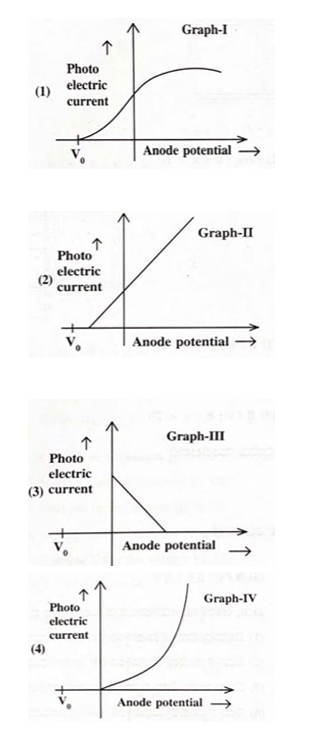
Variation of photoelectric current with anode potential is shown below. Choose the correct option (V = stopping potential).
1
Graph-I
2
Graph-II
3
Graph-III
4
Graph-IV
Official Solution
Correct Option: (1)
Step 1: Understanding the Question:
The goal is to identify the experimentally observed graph that correctly depicts the relationship between the photoelectric current and the potential applied to the collector (anode) plate. Step 3: Detailed Explanation:
In the photoelectric effect experiment:
1. Stopping Potential: When the anode is given a negative potential relative to the cathode, it repels photoelectrons. At a specific negative potential called the stopping potential ( ), even the electrons with the highest kinetic energy cannot reach the anode, and the current becomes zero.
2. Increasing Current: As the anode potential is increased (made less negative and then positive), more photoelectrons are able to reach the collector, resulting in an increase in the measured photoelectric current.
3. Saturation: At sufficiently high positive potentials, all the photoelectrons emitted from the cathode are collected by the anode. Beyond this point, increasing the potential does not increase the current further. this constant value is called the saturation current.
4. Graph Analysis: Graph-I correctly shows the current starting at zero for , increasing as potential becomes positive, and eventually leveling off due to saturation. Graph-II is linear, Graph-III shows a decrease, and Graph-IV starts from the origin without showing a stopping potential; hence they are incorrect. Step 4: Final Answer:
The correctly shown variation is in Graph-I, which corresponds to option (1).