To a fish under water, viewing obliquely a fisherman standing on the bank of a lake, the man looks
1
taller than what he actually is
2
shorter that what he actually is
3
the same height as he actually is
4
depends on the obliquity
Official Solution
Correct Option:
(1)
When a ray from man in air (rarer medium) goes to water (denser medium), then it bends towards the normal. Extend backwards meet at point . Therefore, it appears' to the fish as if the man is taller than what he actually is.
03
PYQ 2009
easy
physicsID: kcet-200
The angle of minimum deviation for an incident light ray on an equilateral prism is equal to its refracting angle. The refractive index of its material is
1
2
3
4
Official Solution
Correct Option:
(1)
For an equilateral prism, angle of prism of refracting angle Here, Refractive index,
04
PYQ 2010
easy
physicsID: kcet-201
A plano-convex lens is made of refractive index of The radius of curvature of the curved surface is . The focal length of the lens is
Official Solution
Correct Option:
(1)
05
PYQ 2011
medium
physicsID: kcet-201
The time required for the light to pass through a glass slab (refractive index = ) of thickness is ( , speed of light in free space).
1
2
3
4
Official Solution
Correct Option:
(2)
We know, We have,Time Or
06
PYQ 2021
medium
physicsID: kcet-202
A slit of width 'a' is illuminated by red light of wavelength . If the first diffraction minimum falls at , then the value of ' ' is
1
2
micron
3
4
Official Solution
Correct Option:
(2)
To determine the slit width 'a' given that the first diffraction minimum occurs at an angle of for red light with a wavelength of , we use the formula for the first diffraction minimum of a single slit:
where:
is the slit width.
is the angle of the first minimum.
is the order of the minimum (for the first minimum, ).
is the wavelength of the light used.
Substituting the given values into the formula:
Knowing that :
Solving for :
Converting to microns (1 micron = 10-6 meters):
Hence, the correct value of 'a' is .
07
PYQ 2021
easy
physicsID: kcet-202
Which of the statements are correct with reference to single slit diffraction pattern? (i) Fringes are of unequal width (ii) Fringes are of equal width (iii) Light energy is conserved (iv) Intensities of all bright fringes are equal
1
(i) and (iii)
2
(i) and (iv)
3
(ii) and (iv)
4
(ii) and (iii)
Official Solution
Correct Option:
(1)
The topic here is the diffraction pattern formed by a single slit. In a single slit diffraction pattern, we observe a central bright fringe surrounded by dark and bright fringes. Let's evaluate each given statement:
Fringes are of unequal width:
This statement is correct. In a single slit diffraction pattern, the central maximum is the widest and subsequent fringes decrease in width. The widths of the side fringes are not equal as observed in double slit interference patterns. Thus, fringes are of unequal width.
Fringes are of equal width:
This statement is incorrect. As mentioned, the central maximum is broader than the other fringes, which makes the fringes unequal in width.
Light energy is conserved:
This statement is correct. In any optical phenomenon, including diffraction, light energy is conserved according to the principle of the conservation of energy. The energy distribution changes, but the total energy remains constant.
Intensities of all bright fringes are equal:
This statement is incorrect. In a single slit diffraction pattern, the intensity of the bright fringes decreases with increasing order from the center. The central maximum is the most intense, and the intensity decreases for higher order maxima.
Based on the analysis, the correct statements are: (i) Fringes are of unequal width, and (iii) Light energy is conserved. Therefore, the correct answer is (i) and (iii).
08
PYQ 2021
medium
physicsID: kcet-202
In refraction, light waves are bent on passing from one medium to second medium because, in the second medium.
1
frequency is different
2
speed is different
3
coefficient of elasticity is different
4
amplitude is smaller
Official Solution
Correct Option:
(2)
Let's analyze each option to understand why light waves bend during refraction.
1. Frequency is different:
The frequency of a light wave is determined by the source of the light and remains constant when light travels from one medium to another. If the frequency were to change, it would imply a change in the fundamental nature of the light itself. Refraction is a phenomenon at the boundary of two media and does not alter the source's frequency. Hence, the frequency of light remains unchanged during refraction.
2. Speed is different:
Refraction is fundamentally caused by the change in the speed of light as it passes from one medium to another. The refractive index of a medium is defined as the ratio of the speed of light in vacuum to the speed of light in that medium ( ). When light enters a medium with a different refractive index, its speed changes. This change in speed at the boundary between two media leads to the bending of the light wave. This is the correct explanation for refraction.
3. Coefficient of elasticity is different:
The coefficient of elasticity is a mechanical property of a medium, related to its ability to deform under stress and return to its original shape. While media have different elastic properties, this is not the primary reason for the refraction of light. Refraction is an electromagnetic phenomenon, governed by the interaction of light with the electromagnetic properties of the medium (like permittivity and permeability), not its mechanical elasticity.
4. Amplitude is smaller:
When light passes from one medium to another, some portion of it may be reflected and some is transmitted. The amplitude of the transmitted light can be smaller than the incident light because some energy is lost due to reflection or absorption. However, a change in amplitude alone does not cause the bending of light. Amplitude relates to the intensity or brightness of light, not the direction of its propagation in refraction. The bending is caused by the change in speed.
Conclusion:
The bending of light waves during refraction is primarily due to the change in the speed of light as it moves from one medium to another. This change in speed causes different parts of the wavefront to travel different distances in the same time, resulting in a change in the direction of propagation.
Final Answer: The final answer is speed is different
09
PYQ 2022
medium
physicsID: kcet-202
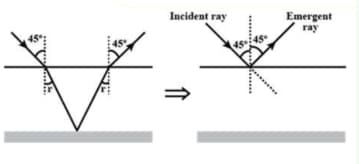
Consider a glass slab which is silvered at one side and the other side is transparent, given the refractive index of the class slab to be 1.5 if a Ray of light is incident at an angle at 45 degree on the transparent side the deviation of the ray of life from its initial path when comes out of the slab is
1
120 degree
2
90 degree
3
45 degree
4
180 degree
Official Solution
Correct Option:
(2)
A ray of light enters the transparent side of a glass slab at an angle of incidence . Due to the refractive index , the ray undergoes refraction and bends towards the normal inside the slab.
It then reaches the silvered surface (back side), where it undergoes reflection (as if hitting a mirror). The reflected ray travels back through the slab and finally emerges from the initial side into the air, undergoing refraction again.
In this setup, due to the combination of refraction and reflection, the emergent ray deviates by from its original direction. This is a special case where the light path effectively makes a right-angle turn due to the geometry and nature of the slab.
Thus, the deviation is:
10
PYQ 2026
medium
physicsID: kcet-202
The critical angle for a monochromatic light going from medium A to medium B is . If the speed of light in medium A is V, then the speed of light in medium B is
1
V (1 - )
2
3
4
V (1 - )
Official Solution
Correct Option:
(3)
Step 1: Understanding the Question:
The goal is to find the speed of light in the second medium (B) using the given critical angle and the speed of light in the first medium (A). Step 2: Key Formula or Approach:
1. Relationship between critical angle ( ) and refractive indices:
2. Relationship between refractive index and speed: Step 3: Detailed Explanation:
For total internal reflection to occur, light must go from a denser medium (A) to a rarer medium (B). Thus .
From the definition of critical angle:
Since refractive index is inversely proportional to the speed of light in the medium ( ):
Substituting the given speed :
Solving for :
Step 4: Final Answer:
The speed of light in medium B is .
11
PYQ 2026
hard
physicsID: kcet-202
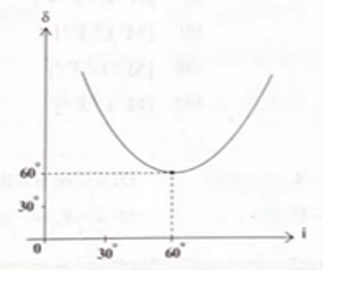
From the graph of angle of deviation versus angle of incidence for an equilateral prism, the refractive index of material of prism is
1
2
3
4
Official Solution
Correct Option:
(3)
Step 1: Understanding the Question:
The question asks us to calculate the refractive index of a prism's material based on a given graph of angle of deviation ( ) vs. angle of incidence ( ) for an equilateral prism. Step 2: Key Formula or Approach:
The refractive index ( ) of a prism can be determined using the prism formula:
Where:
- is the angle of the prism.
- is the angle of minimum deviation. Step 3: Detailed Explanation:
1. Determine the Prism Angle ( ):
An "equilateral prism" has all its internal angles equal to . Therefore, the angle of the prism . 2. Identify the Minimum Deviation ( ) from the graph:
The graph shows how the deviation changes with the angle of incidence. The lowest point on the U-shaped curve represents the condition of minimum deviation.
Looking at the graph, the coordinates of the minimum point are .
Thus, the angle of minimum deviation . 3. Calculation of Refractive Index ( ):
Substitute the values and into the formula:
Using known trigonometric values: and .
Step 4: Final Answer:
The refractive index of the prism material is , which corresponds to option (C).
12
PYQ 2026
easy
physicsID: kcet-202
The incorrect statement about refractive index for a pair of media is
1
It depends upon nature of the first medium
2
It depends upon nature of the second medium
3
It depends upon wavelength of light
4
It depends upon angle of incidence
Official Solution
Correct Option:
(4)
Step 1: Understanding the Question:
The question asks to identify which factor does NOT determine the refractive index of a pair of media. Step 3: Detailed Explanation:
The relative refractive index ( ) for light traveling from medium 1 to medium 2 is a characteristic physical property of that pair of substances for a given wavelength. It is defined as the ratio of the speed of light in medium 1 to the speed of light in medium 2.
- Nature of media: Since speed of light varies in different substances (vacuum, water, glass, etc.), the refractive index inherently depends on the nature of both the first and second media.
- Wavelength of light: According to Cauchy's equation, refractive index decreases as wavelength increases ( ). Thus, it depends on the color/wavelength of light.
- Angle of incidence: While Snell's law states that , this ratio is a constant for the given media and wavelength. Changing the angle of incidence ( ) will change the angle of refraction ( ) accordingly, but the value of the refractive index itself remains unchanged.
Therefore, statement (4) is incorrect. Step 4: Final Answer:
The incorrect statement is (4).
About Refraction Of Light - KCET
Refraction Of Light is a vital chapter for KCET aspirants. Mastering the concepts covered in this chapter is essential for securing a top rank.
By rigorously practicing the previous year questions associated with this chapter, you can identify high-yield topics, understand the examiner's perspective, and boost your confidence during the actual exam.
Frequently Asked Questions
Why focus on Refraction Of Light PYQs?
Analyzing PYQs for this specific chapter reveals the most frequently tested concepts and the typical complexity of questions, allowing you to tailor your study plan efficiently.
How to best use this analysis?
Review the topic breakdown to see which sub-topics within Refraction Of Light carry the most weight. Then, tackle the questions iteratively to solidify your understanding.