Semiconductor Electronics Materials Devices And Simple Circuits
19 previous year questions.
Volume: 19 Ques
Yield: Medium
High-Yield Trend
3
2026
1
2025
2
2023
1
2021
1
2020
2
2019
1
2018
1
2015
3
2010
3
2007
1
1997
Chapter Questions
19 MCQs
01
PYQ 1997
medium
physicsID: kcet-199
At temperature, a - type semiconductor
1
does not have any charge carriers
2
has few holes but no free electrons
3
has few holes and few free electrons
4
has equal number of holes and free electrons
Official Solution
Correct Option: (2)
At temperature, a pure semiconductor behaves as an insulator, because it has a few holes in its valence band. But there is no free electron in this state.
02
PYQ 2007
medium
physicsID: kcet-200
Minority carriers in a semiconductor are
1
Holes
2
Free electrons
3
Both holes and free electrons
4
Neither holes nor free electrons
Official Solution
Correct Option: (2)
In p-type semiconductor density of mobile holes exceeds that of conduction electrons. Hence, minority carriers in p -type
semiconductor are conduction (free) electrons.
03
PYQ 2007
medium
physicsID: kcet-200
In a reverse biased diode when the applied voltage changes by , the current is found to change by . The reverse bias resistance of the diode is
1
2
3
4
Official Solution
Correct Option: (3)
Reverse resistance
04
PYQ 2007
easy
physicsID: kcet-200
The principle of action involves
1
Stimulated emission
2
Population inversion
3
Amplification of particular frequency emitted by the system
4
All of these
Official Solution
Correct Option: (4)
Laser action involves all the given phenomenon (i) Amplification of particular frequency (ii) Population inversion (iii) Stimulated emission
05
PYQ 2010
medium
physicsID: kcet-201
In a p-n junction diode notconnected to any circuit
1
the potential is the same every where
2
the p-type side has a higher potential than the n-type side
3
there is an electric field at the junction directed from the n-type side to p-type side
4
there is an electric field at the junction directed from the p-type side to n-type side
Official Solution
Correct Option: (3)
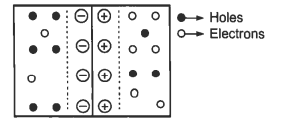
At junction a potential barrier/depletion layer is formed with -side at higher potential and p-side at lower potential. Therefore, there is an electric field at the junction directed from the -side to -side.
06
PYQ 2010
medium
physicsID: kcet-201
Identify the logic operation performed by the circuit given here.
1
NOT
2
NAND
3
OR
4
NOR
Official Solution
Correct Option: (3)
The given gate circuit is a combination of two NOR gates. It is boolean expression of OR gate.
07
PYQ 2010
medium
physicsID: kcet-201
The forbidden energy gap in is . Given, . The maximum wavelength of radiation that will generate an electron hole pair is
1
2
3
4
Official Solution
Correct Option: (1)
Energy gap,
08
PYQ 2015
medium
physicsID: kcet-201
An is constructed from a junction based on a certain semi-conducting material whose energy gap is . Then the wavelength of the emitted light is
1
2
3
4
Official Solution
Correct Option: (3)
Given, energy gap We know that, Wavelength of the emitted light,
09
PYQ 2018
medium
physicsID: kcet-201
The density of an electron-hole pair in a pure germanium is at room temperature. On doping with aluminium, the hole density increases to . Now the electron density (in ) in doped germanium will be
1
2
3
4
Official Solution
Correct Option: (2)
10
PYQ 2019
medium
physicsID: kcet-201
In the following circuit, what are P and Q?
1
P = 0, Q = 1
2
P = 0, Q = 0
3
P = 1, Q = 1
4
P = 1, Q = 0
Official Solution
Correct Option: (1)
For both NOR gates
11
PYQ 2019
medium
physicsID: kcet-201
The conductivity of semiconductor increases with increase in temperature because
1
both number density of charge carriers and relaxation time increase
2
number density of charge carriers increases
3
number density of current carriers increases, relaxation time decreases but effect of decrease in relaxation time is much less than increase in number density
4
relaxation time increases
Official Solution
Correct Option: (3)
As temperature increases the number density of charge carries increases according to the equation Thus as temperature increases, the number density of charge carries increase resulting in conductivity of semiconductors.
12
PYQ 2020
easy
physicsID: kcet-202
A positive hole in a semiconductor is
1
An anti-particle of electron
2
A vacancy created when an electron leaves a covalent bond
3
Absence of free electrons
4
An artificially created particle
Official Solution
Correct Option: (2)
A positive hole in a semiconductor is a vacancy which is created at the site of a covalent bond when an electron leaves a covalent bond.
13
PYQ 2021
easy
physicsID: kcet-202
Three phtodiodes D1, D2, D3 are made of semiconductors having band gaps of 2.5 eV, 2 eV and 3 eV respectively. Which one will be able to detect light of wavelength 600 nm?
1
D1 only
2
Both D1 and D3
3
D2 only
4
All the three diodes
Official Solution
Correct Option: (3)
To determine which photodiode can detect light of wavelength 600 nm, we need to compare the energy of the photon with the band gap energy of each photodiode.
1. Calculate the energy of a photon with a wavelength of 600 nm:
We can use the formula:
where:
is the energy of the photon is Planck's constant ( ) is the speed of light ( ) is the wavelength ( )
Now, convert Joules to electron volts (eV):
2. Compare the photon energy with the band gap energies of the photodiodes:
: Band gap = : Band gap = : Band gap =
For a photodiode to detect the light, the photon energy must be greater than or equal to the band gap energy of the semiconductor material. If the photon energy is less than the band gap, the photon will not have enough energy to excite an electron across the band gap and create an electron-hole pair, which is the basis of photodetection.
: Photon energy ( ) < Band gap ( ) --> Cannot detect : Photon energy ( ) > Band gap ( ) --> Can detect : Photon energy ( ) < Band gap ( ) --> Cannot detect
3. Conclusion:
Only photodiode has a band gap energy ( ) less than the photon energy ( ), so only will be able to detect the light with a wavelength of 600 nm.
Therefore, the answer is: only
14
PYQ 2023
easy
physicsID: kcet-202
When a p-n junction diode is in forward bias, which type of charge carriers flows in the connecting wire?
1
Ions
2
Protons
3
Holes
4
Free electrons
Official Solution
Correct Option: (4)
In a p-n junction diode under forward bias, the charge carriers responsible for current flow in the external circuit are free electrons. These electrons are present in the n-type material, and they move towards the p-type material. The free electrons from the n-side travel through the external circuit to the p-side, where they recombine with holes. This flow of free electrons constitutes the current in the connecting wire.
15
PYQ 2023
hard
physicsID: kcet-202
The energy gap of an LED is 2.4 eV. When the LED is switched ‘ON’, the momentum of the emitted photons is
1
2.56 × 10⁻²⁷ kg.m.s-1
2
1.28 × 10⁻¹¹ kg.m.s-1
3
0.64 × 10⁻²⁷ kg.m.s-1
4
1.28 × 10⁻²⁷ kg.m.s-1
Official Solution
Correct Option: (4)
The energy gap of an LED is given as 2.4 eV. The momentum of the emitted photons can be calculated using the following relation:
Momentum (p) = √(2 * m * E)
Where: m is the mass of the photon, and E is the energy of the photon.
Using the relation between energy and momentum for a photon, we know that:
E = p * c
Where E is the energy of the photon, p is the momentum, and c is the speed of light (approximately 3 × 10⁸ m/s). Therefore, we can rearrange the equation to solve for momentum:
p = E / c
Substituting the values: Energy of the photon = 2.4 eV = 2.4 × 1.602 × 10⁻¹⁹ J Speed of light c = 3 × 10⁸ m/s
Thus, the momentum of the emitted photons is:
p = (2.4 × 1.602 × 10⁻¹⁹) / (3 × 10⁸)
This gives the momentum as 1.28 × 10⁻²⁷ kg·m/s.
Therefore, the correct answer is D: 1.28 × 10⁻²⁷ kg·m/s.
16
PYQ 2025
medium
physicsID: kcet-202
The range of electrical conductivity and resistivity for metals, among the following, is:
1
2
3
4
Official Solution
Correct Option: (1)
For metals, the electrical conductivity ( ) typically ranges from to and the resistivity ( ) is in the range of to . This corresponds to option (1).
17
PYQ 2026
hard
physicsID: kcet-202
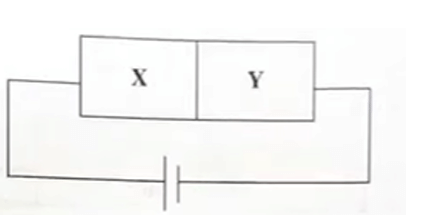
A wafer of pure germanium crystal has two parts X and Y. The end X is obtained by doping with arsenic and Y with indium. It is connected to a battery as shown in the figure. Which of the following statements is correct?
1
X is p-type, Y is n-type and the junction is forward biased
2
X is n-type, Y is p-type and the junction is forward biased
3
X is p-type, Y is n-type and the junction is reverse biased
4
X is n-type, Y is p-type and the junction is reverse biased
Official Solution
Correct Option: (2)
Step 1: Understanding the Question:
The goal of this question is to identify the type of semiconductor formed in each region (X and Y) based on the dopants used and then determine the biasing condition of the resulting p-n junction from the provided circuit diagram. Step 3: Detailed Explanation:
1. Identification of Semiconductor Types:
- Pure Germanium (Ge) belongs to Group 14 of the periodic table.
- Part X: This part is doped with Arsenic (As). Arsenic is a Group 15 element, which means it has 5 valence electrons (pentavalent impurity). When a pentavalent impurity is added to a tetravalent semiconductor like Ge, it provides an extra free electron, creating an n-type semiconductor.
- Part Y: This part is doped with Indium (In). Indium is a Group 13 element, which has 3 valence electrons (trivalent impurity). When a trivalent impurity is added to Ge, it creates a vacancy or "hole," resulting in a p-type semiconductor. 2. Biasing Analysis:
- In the provided diagram, a battery is connected to the X-Y block.
- The longer vertical line of the battery symbol represents the positive terminal, and the shorter, thicker line represents the negative terminal.
- Region X (n-type) is connected to the negative terminal.
- Region Y (p-type) is connected to the positive terminal.
- When the p-type region is connected to the positive terminal and the n-type region is connected to the negative terminal of an external source, the junction is said to be forward biased. Step 4: Final Answer:
Region X is n-type, region Y is p-type, and the configuration is forward biased. This matches statement (B).
18
PYQ 2026
medium
physicsID: kcet-202
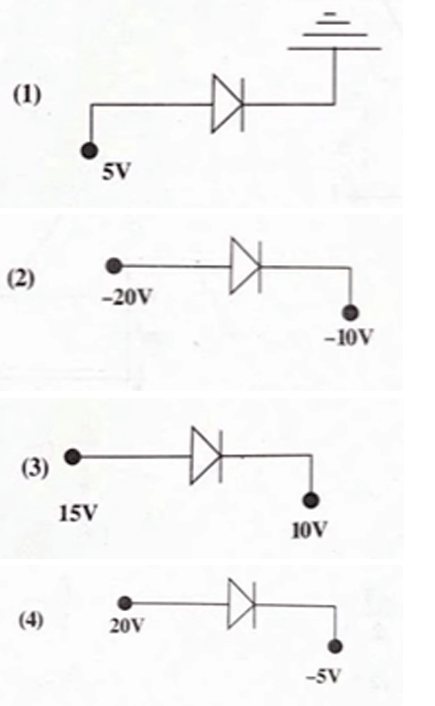
In which of the following figures, diode is reverse biased?
1
Figure (1)
2
Figure (2)
3
Figure (3)
4
Figure (4)
Official Solution
Correct Option: (2)
Step 1: Understanding the Question:
We need to determine which circuit configuration results in a reverse-biased diode by comparing the potentials of the p-side and n-side. Step 3: Detailed Explanation:
A diode is:
- Forward biased if the potential of the p-side ( ) is higher than the potential of the n-side ( ), i.e., .
- Reverse biased if the potential of the p-side ( ) is lower than the potential of the n-side ( ), i.e., .
Let's analyze each case:
(1) , (grounded). Forward biased.
(2) , . Since , Reverse biased.
(3) , . Forward biased.
(4) , . Forward biased. Step 4: Final Answer:
In figure (2), the diode is reverse biased. This corresponds to option (2).
19
PYQ 2026
easy
physicsID: kcet-202
An n-type and p-type semiconductor can be obtained by respectively doping pure silicon with
1
Arsenic and Phosphorous respectively
2
Indium and Aluminium respectively
3
Phosphorous and Indium respectively
4
Aluminium and Boron respectively
Official Solution
Correct Option: (3)
Step 1: Understanding the Question:
The question asks to identify the correct pairs of dopant elements required to create n-type and p-type semiconductors from intrinsic silicon. Step 3: Detailed Explanation:
Silicon is a Group 14 element with 4 valence electrons.
1. n-type semiconductor: Obtained by doping silicon with pentavalent impurities (Group 15 elements) which have 5 valence electrons. Common examples are Phosphorous (P), Arsenic (As), and Antimony (Sb). The fifth electron remains free as a majority charge carrier.
2. p-type semiconductor: Obtained by doping silicon with trivalent impurities (Group 13 elements) which have 3 valence electrons. Common examples are Boron (B), Aluminium (Al), Gallium (Ga), and Indium (In). The deficiency of one electron creates a "hole" as a majority charge carrier.
Evaluating option (3): Phosphorous (Group 15) for n-type and Indium (Group 13) for p-type is a correct match. Step 4: Final Answer:
Phosphorous and Indium are the respective dopants for n and p-type semiconductors, matching option (3).