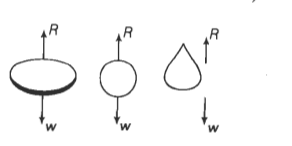
When a body falls in air, the resistance of air depends to a great extent on the shape of the body. different shapes are given. Identify the combination of air resistances which truly represents the physical situation. (The cross sectional areas are the same) 1. Disc
2. Ball
3. cigar sheped
1
1 < 2 < 3
2
2 < 3 < 1
3
3 < 2 < 1
4
3 < 1 < 2
Official Solution
Correct Option: (3)
Fig. 3 is stream lined, so air resistance for it will be minimum. For fig. 1 surface area is maximum, so air resistance for it is maximum. Hence, correct sequence is .
02
PYQ 2014
medium
physicsID: kcet-201
A flow of liquid is streamline if the Reynolds number is
1
greater than 1000
2
between 4000 to 5000
3
less than 1000
4
between 2000 to 3000
Official Solution
Correct Option: (3)
Reynold's number is a pure number and it is equal to the ratio of the inertial force per unit area to the viscous force per unit area for a flowing fluid.
Reynold's number where density of the liquid critical velocity coefficient of viscosity of liquid radius of capillary tube (i) For pure water flowing in a cylindrical pipe, is about 1000 . When , the flow of liquid is streamlined.
(ii) When , the flow of liquid is variable between streamlined and turbulent.
(iii) When , the flow of liquid is turbulent.
03
PYQ 2019
medium
physicsID: kcet-201
An aluminium sphere is dipped into water. Which of the following is true?
1
Buoyancy in water at will be same as that in water at
2
Buoyancy will be less in water at than that in water at
3
Buoyancy may be more or less in water at C depending on the radius of the sphere
4
Buoyancy will be more in water at than that in water at
Official Solution
Correct Option: (2)
Answer (b) Buoyancy will be less in water at than that in water at
04
PYQ 2021
easy
physicsID: kcet-202
Two capillary tubes P and Q are dipped vertically in water. The height of water level in capillary tube P is of the height in capillary tube Q. The ratio of their diameter is _______.
1
2 : 3
2
3 : 2
3
3 : 4
4
4 : 3
Official Solution
Correct Option: (2)
Step 1: Recall the formula for capillary height The height of a liquid column in a capillary tube is given by Jurin's law:
where: - is the height of the liquid column - is the surface tension of the liquid - is the contact angle between the liquid and the tube - is the density of the liquid - is the acceleration due to gravity - is the radius of the capillary tube
Step 2: Identify constant and variable parameters For both capillary tubes P and Q, the liquid is water, so , , , and (assuming the material of the tubes is the same, leading to the same contact angle) are constant.
Step 3: Establish the relationship between height and radius/diameter Since are constants, we can write:
Also, diameter , so . Substituting this, we get:
Thus, the height of the water level is inversely proportional to the diameter of the capillary tube. We can write this relationship as , where is a constant.
Step 4: Apply the relationship to tubes P and Q For tube P: For tube Q:
Step 5: Use the given height relationship We are given that the height of water level in capillary tube P is of the height in capillary tube Q:
Step 6: Substitute the expressions for and Substitute the expressions from Step 4 into the equation from Step 5:
Step 7: Solve for the ratio of diameters Divide both sides by :
Cross-multiply:
Rearrange to find the ratio :
So, the ratio of their diameters is .
Final Answer: The ratio of diameters is , which matches option (B).
05
PYQ 2023
hard
physicsID: kcet-202
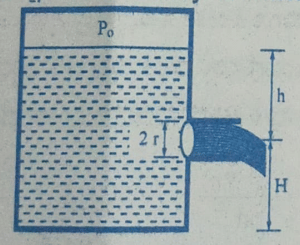
A closed water tank has cross-sectional area A. It has small hole at a depth of h from the free surface of water. The radius of the hole is r so that r << . If Po is the pressure inside the tank above water level, and Pa is the atmospheric pressure, the rate of flow of the water coming out of the hole is [ Ο is the density of water]
1
2
3
4
Official Solution
Correct Option: (1)
Given:
Cross-sectional area of the tank:
Radius of the hole:
Depth of hole below water surface:
Pressure above water level:
Atmospheric pressure:
Density of water:
Step 1: Applying Bernoulliβs Theorem
Using Bernoulliβs equation between the surface of the liquid and the hole: