Two identical conducting balls and have positive charges and respectively but The balls are brought together so that they touch each other and then kept in their original positions. the force between them is
1
less than that before the balls touched
2
greater than that before the balls touched
3
same as that before the balls toucher
4
zero
Official Solution
Correct Option:
(2)
Original charges on spheres and be and respectively. Distance between the two spheres Since, both the spheres are of same size, they will possess equal charges on being brought in contact. Similarly, Therefore, new force of repulsion between spheres and is As
02
PYQ 2014
medium
physicsID: kcet-201
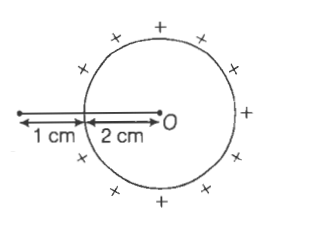
A spherical conductor of radius is uniformly charged with . What is the electric field at a distance of from the centre of the sphere ?
1
2
3
4
Official Solution
Correct Option:
(2)
Given,
Distance from the centre of sphere Charge on sphere
03
PYQ 2016
medium
physicsID: kcet-201
A particle of mass and charge is held at rest on a frictionless horizontal surface at distance from the fixed charge . If the particle is released, it will be repelled. The speed of the particle when it is at a distance of from the fixed charge
1
2
3
4
Official Solution
Correct Option:
(4)
Fixed charge Mass of particle Charge on particle Distance between charges Applying conservation of energy gives
04
PYQ 2018
medium
physicsID: kcet-201
The force of repulsion between two identical positive charges when kept with a separation 'r' in air is 'F' Half the gap between the two charges is filled by a dielectric slab of dielectric constant = 4. Then the new force of repulsion between those two charges becomes
1
2
3
4
Official Solution
Correct Option:
(4)
05
PYQ 2020
medium
physicsID: kcet-202
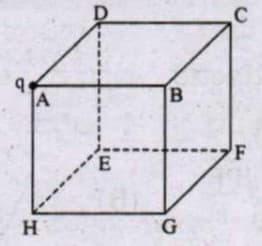
A point charge 'q' is placed at the corner of a cube of side 'a' as shown in the figure. What is the electric flux through the face ABCD?
1
0
2
3
4
Official Solution
Correct Option:
(1)
We are given a point charge placed at the corner of a cube. The problem asks for the electric flux through the face ABCD of the cube. To solve this, we will use Gauss's law, which states that the electric flux through a closed surface is proportional to the charge enclosed by that surface: However, the point charge is placed at the corner of the cube, which is shared by 8 adjacent cubes. Therefore, the charge is equally divided among these 8 cubes. Now, we consider the fact that a cube has 6 faces, and the flux is distributed evenly across all faces if the charge is symmetrically placed within the cube. Since the point charge is placed at a corner, it does not contribute any net flux through any single face. Thus, the flux through each face of the cube is: Hence, the electric flux through the face ABCD is:
Thus, the correct answer is (A) 0.
About Electric Charges And Fields - KCET
Electric Charges And Fields is a vital chapter for KCET aspirants. Mastering the concepts covered in this chapter is essential for securing a top rank.
By rigorously practicing the previous year questions associated with this chapter, you can identify high-yield topics, understand the examiner's perspective, and boost your confidence during the actual exam.
Frequently Asked Questions
Why focus on Electric Charges And Fields PYQs?
Analyzing PYQs for this specific chapter reveals the most frequently tested concepts and the typical complexity of questions, allowing you to tailor your study plan efficiently.
How to best use this analysis?
Review the topic breakdown to see which sub-topics within Electric Charges And Fields carry the most weight. Then, tackle the questions iteratively to solidify your understanding.