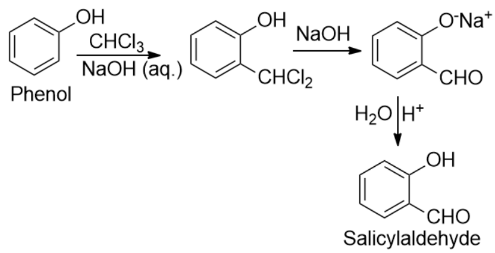
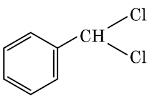
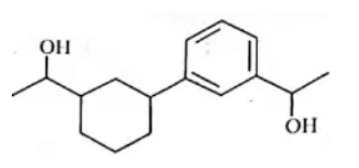
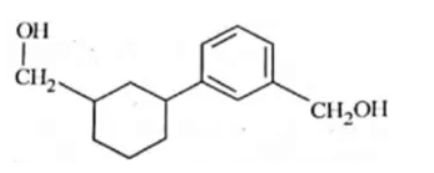
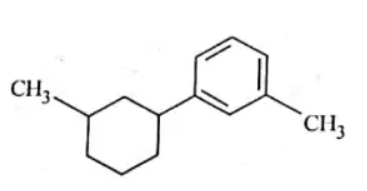
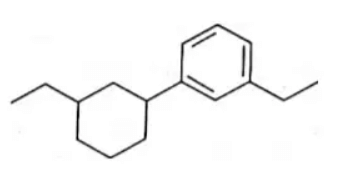
When phenol is treated with and NaOH, the product formed is :-
1
Benzaldehyde
2
Salicylaldehyde
3
Salicylic acid
4
Benzoic acid
Official Solution
Correct Option: (2)
When phenol is treated with chloroform and NaOH, salicylaldehyde is obtained. This is called Reimer-Tiemann reaction.
02
PYQ 1988
medium
chemistryID: neet-ug-
Which one is formed when sodium phenoxide is heated with ethyl iodide?
1
Phenetole
2
Ethyl phenyl alcohol
3
Phenol
4
None of the above
Official Solution
Correct Option: (1)
When sodium phenoxide is heated with ethyl iodide it form ethyl phenyl ether which is also called phenetole. This reaction is called Williamson's synthesis
03
PYQ 1989
medium
chemistryID: neet-ug-
Propene, can be converted into 1-propanol by oxidation. Indicate which set of reagents amongst the following
is ideal to affect the above conversion?
1
(alkaline)
2
Osmium tetroxide
3
and
4
Official Solution
Correct Option: (3)
Here, Half mol of diborane react with propane by Markownikoffs addition it gives tripropyl borane called hydroboration. In presence of in basic medium tripropyl borane gives alcohol. Remember that product is Anti-Markownikoffs rule that is 1-propanol. Reaction is called hydroboration oxidation.
04
PYQ 1992
medium
chemistryID: neet-ug-
Methanol is industrially prepared by
1
oxidation of by steam at
2
reduction of HCHO using
3
reaction of HCHO with a solution of NaOH
4
reduction of CO using and
Official Solution
Correct Option: (4)
Methanol is prepared commercially from water gas which is a mixture of carbon monoxide and hydrogen. In this method, water gas is mixed with its half volume of hydrogen and is passed over heated catalyst at 673 K under high pressure.
Methanol (CH3OH), also known as methyl alcohol, wood alcohol, or wood spirit, is the most basic of a long sequence of organic compounds known as alcohols. It is made up of a methyl group (CH3)connected to a hydroxyl group (OH). Previously, methanol was obtained through the destructive distillation of wood.
05
PYQ 1992
medium
chemistryID: neet-ug-
HBr reacts fastest with
1
2-methyl propan-1-ol
2
2-methyl propan-2-ol
3
propan-2-ol
4
propan-1-ol
Official Solution
Correct Option: (2)
2-methyl propan-2-ol gives carbocation, so it reacts with HBr at faster speed.
06
PYQ 1992
medium
chemistryID: neet-ug-
How many isomers of will be primary alcohols?
1
5
2
4
3
2
4
3
Official Solution
Correct Option: (2)
The primary alcohols isomers of are
07
PYQ 1992
medium
chemistryID: neet-ug-
When phenol is treated with excess of bromine water, it gives
1
m-bromophenol
2
o- and p-bromophenols
3
2,4-dlbromophenol
4
2,4,6-tribromophenol
Official Solution
Correct Option: (4)
Phenol reacts with bromine water (aqueous solution to give a precipitate of 2,4,6-tribromophenol) due to polar solvent!.
08
PYQ 1992
easy
chemistryID: neet-ug-
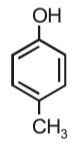
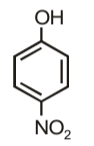
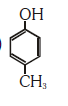
Increasing order of acidic strength among p-methoxy phenol (I), p-methyl phenol (II) and p-nitrophenol (III) is
1
III, I, II
2
II, I, III
3
III, II, I
4
I, II, III
Official Solution
Correct Option: (3)
Nitro group is an electron-withdrawing group, so increase the acidic character of phenol whereas and both are electron releasing groups, so it decrease the acidic character of phenol but group is less electron donating or releasing, so p-methyl phenol is slightly more acidic than p-methoxy phenol and p-nitro phenol is most acidic. So the order of acidic character is p-methoxy phenol < p-methyl phenol < p-nitro phenol.
09
PYQ 1993
easy
chemistryID: neet-ug-
Ethanol and dimethyl ether form a pair of functional isomers. The boiling point of ethanol is higher than that of dimethyl ether due to the presence of
1
H-bonding in ethanol
2
H-bonding in dimethyl ether
3
group in ethanol
4
group in dimethyl ether
Official Solution
Correct Option: (1)
Alcohols have higher boiling points as compared to other organic compounds of similar molecular masses such as ethers. This is due to the presence of intermolecular hydrogen bonding in alcohols which is absent in ethers. Because of hydrogen bonding in alcohols, these exist as associated molecules rather than discrete molecules. Consequently, a large amount of energy is required to break these bonds and therefore, their boiling points are high.
10
PYQ 1995
medium
chemistryID: neet-ug-
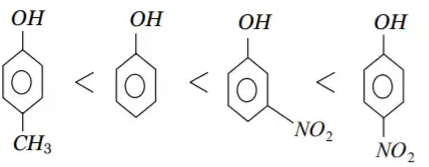
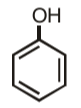
Phenol, p-Methylphenol, m-Nitrophenol and p-Nitrophenol follows order of increasing acidic strength
m-Nitrophenol, p-Nitrophenol, Phenol and p-Methylphenol
Official Solution
Correct Option: (2)
- I group increases acidity of the compound whereas + I group reduces acidity. At -position with respect to , the nitro group increases the acidity lesser than that of at Ortho and Para-positions.
11
PYQ 1999
medium
chemistryID: neet-ug-
Ethyl chloride is converted into diethyl ether by
1
Wurtz synthesis
2
Grignard reaction
3
Perkin- reaction
4
Williamson- synthesis
Official Solution
Correct Option: (4)
It is an example of Williamson- synthesis. Limitations of Williamson- Synthesis alkyl halide does not gives Williamson's synthesis if alkyl halide used in reaction then alkene formed.
12
PYQ 2000
medium
chemistryID: neet-ug-
Which reagent converts to :
1
2
3
4
Official Solution
Correct Option: (2)
The reagent that converts to is . This set of reagents is used in hydroboration-oxidation reactions to convert an alkene into an alcohol.
So, the correct option is (B):
13
PYQ 2000
medium
chemistryID: neet-ug-
Which of the following statement is correct for the stability of ions of ethyl alcohol and phenol:
1
Delocalisation of -electrons in phenoxide ion
2
Delocalisation of electrons in ethoxide ion
3
Inductive effect of ethyl and phenyl group
4
Localisation of -electrons in phenoxide ion
Official Solution
Correct Option: (1)
In phenol, the presence of a benzene ring with its pi electrons allows for delocalization of the lone pair of electrons on the oxygen atom. This delocalization or resonance stabilization makes the phenoxide ion more stable. In contrast, the ethoxide ion does not have the same level of delocalization as in the phenoxide ion. While it has inductive effects from the ethyl group, it does not exhibit the same extent of resonance stabilization through pi-electron delocalization as seen in phenol.
So, the correct option is (A): Delocalisation of -electrons in phenoxide ion
14
PYQ 2001
easy
chemistryID: neet-ug-
In X- H ----- Y, X and Y both are electronegative elements
1
Electro density on X will increase and on H will decrease
2
In both electron density will increase
3
In both electron density will decrease
4
On X electron density will decrease and on H increases
Official Solution
Correct Option: (1)
The correct option is(A): Electro density on X will increase and on H will decrease. In the context of X-H---Y, 'H' forms a direct bond with 'X' while also engaging in a hydrogen bond with 'Y.' Given that both 'X' and 'Y' are electronegative elements with a tendency to attract electrons, the electron density is skewed toward them. In particular, because 'X' forms a direct bond with 'H,' it exerts a stronger pull on electron density, resulting in an increase in electron density on 'X' and a corresponding decrease in electron density on 'H.'
15
PYQ 2002
medium
chemistryID: neet-ug-
propyl alcohol and isopropyl alcohol can be chemically distinguished by which reagent :-
1
2
reduction
3
oxidation with potassium dichromate
4
ozonolysis
Official Solution
Correct Option: (3)
propyl alcohol and isopropyl alcohol gives different product on oxidation with .
16
PYQ 2003
medium
chemistryID: neet-ug-
Which of the following orders of acid strength is correct:
1
RCOOH > ROH > HOH > HC ≡ CH
2
RCOOH > HOH > ROH > HC ≡ CH
3
RCOOH > HOH > HC ≡ CH > ROH
4
RCOOH > HC ≡ CH > HOH > ROH
Official Solution
Correct Option: (2)
Here's the rationale behind this order: 1. Carboxylic acids (RCOOH) are strong acids because they can donate a proton (H+) readily due to the presence of the carboxyl group (COOH). They have a dissociable hydrogen ion (H+), making them stronger acids than the other compounds listed. 2. Water (HOH) is also a strong acid but not as strong as carboxylic acids. Water can act as an acid by donating a proton (H+) to another molecule or ion, but it is weaker than carboxylic acids in this regard. 3. Alcohols (ROH) are weaker acids than both carboxylic acids and water. While they can donate a proton, it's less likely to occur compared to carboxylic acids and water. 4. Alkynes (HC ≡ CH) are the weakest acids among the listed compounds. They are not acidic under normal conditions and do not readily donate protons.
So, the correct order is (B): RCOOH > HOH > ROH > HC ≡ CH.
17
PYQ 2006
medium
chemistryID: neet-ug-
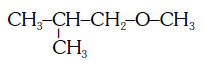
The major organic product in the reaction, CH3 – O – CH(CH3)2 + HI Product is:
1
CH3OH + (CH3)2CHI
2
ICH2OCH(CH3)2
3
CH3OC(CH3)2
4
CH3I + (CH3)2CHOH
Official Solution
Correct Option: (4)
When cold hydrogen iodide (HI) is employed, it leads to the formation of a mixture containing alkyl iodide and alcohol. In the context of mixed ethers, the halogen atom is added to the smaller and less structurally complex alkyl group. Specifically, when CH₃OCH(CH₃)₂ reacts with HI, the result is the production of CH₃I and (CH₃)₂CHOH in the reaction mixture.
So, the correct option is (D): CH3I + (CH3)2CHOH
18
PYQ 2006
medium
chemistryID: neet-ug-
Ethylene oxide when treated with Grignard reagent yields :
1
secondary alcohol
2
tertiary alcohol
3
cyclopropyl alcohol
4
primary alcohol
Official Solution
Correct Option: (4)
When ethylene oxide (an epoxide) is treated with a Grignard reagent (RMgX), it undergoes a nucleophilic addition reaction. The Grignard reagent acts as a strong nucleophile, and it attacks the less hindered carbon atom of the epoxide ring, leading to the formation of a primary alcohol.
So, the correct answer is (D) primary alcohol
19
PYQ 2012
medium
chemistryID: neet-ug-
In the following sequence of reactions, , the end product C is
1
Acetone
2
Methane
3
Acetaldehyde
4
Ethyl alcohol
Official Solution
Correct Option: (4)
The correct answer is D:Ethyl alcohol
Methyl bromide undergoes a reaction with to produce acetonitrile, where the bromine atom is substituted with a cyanide group. The subsequent hydrolysis of the cyanide group results in the formation of a carboxylic group. Finally, the reduction of the carboxylic group leads to the formation of a hydroxyl group.
20
PYQ 2013
medium
chemistryID: neet-ug-
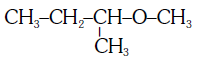
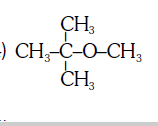
Among the following ethers, which one will produce methyl alcohol on treatement with hot concentrated HI ?
1
2
3
4
Official Solution
Correct Option: (4)
C-O bond cleavage of ether depends on mechanism involved in reaction which can be or . If any one group can form stable carbocation like tertiary butyl group then reaction follow's mechanism
21
PYQ 2014
medium
chemistryID: neet-ug-
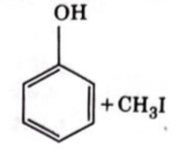
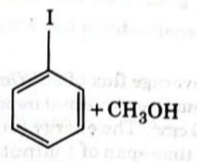
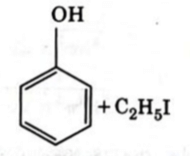
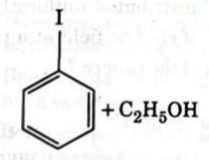
Among the following sets of reactants which one produces anisole ?
1
2
; neutral
3
4
Official Solution
Correct Option: (1)
The correct option (A): .
22
PYQ 2014
medium
chemistryID: neet-ug-
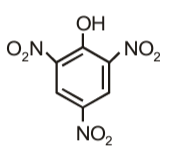
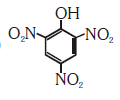
Which of the following will not be soluble in sodium hydrogen carbonate?
1
2,4,6-trinitrophenol
2
Benzoic acid
3
o-nitrophenol
4
Benzenesulphonic acid
Official Solution
Correct Option: (3)
While 2,4,6-trinitrophenol, benzoic acid and benzene sulphonic acid are soluble in Infact,
This reaction is possible in forward direction if acid is more acidic than o-nitrophenol is less acidic than Hence, it is not soluble in sodium hydrogen carbonate.
23
PYQ 2014
medium
chemistryID: neet-ug-
Among the following sets of reactants which one produces anisole?
1
2
3
4
Official Solution
Correct Option: (2)
Williamson's synthesis
24
PYQ 2015
medium
chemistryID: neet-ug-
Reaction of phenol with chloroform in presence of dilute sodium hydroxide finally introduces which one of the following functional group ?
1
2
3
4
Official Solution
Correct Option: (2)
Reimer Tieman reaction
25
PYQ 2016
medium
chemistryID: neet-ug-
The reaction can be classified as:
1
Alcohol formation reaction
2
Dehydration reaction
3
Williamson alcohol synthesis reaction
4
Williamson ether synthesis reaction
Official Solution
Correct Option: (4)
Williamson Ether Synthesis Reaction
The reaction is a typical example of the Williamson ether synthesis method, which involves the formation of an ether from an alkyl halide and an alkoxide ion. This reaction is a nucleophilic substitution where the alkoxide ion attacks the alkyl halide, displacing the halide ion and forming an ether.
The general reaction can be written as:
Explanation:
R - X: Alkyl halide (e.g., alkyl chloride or bromide).
R - ONa: Alkoxide ion (formed by reacting alcohol with a sodium metal or sodium hydride).
R - O - R: The ether product formed after the nucleophilic substitution.
NaX: The sodium halide (e.g., NaCl or NaBr) formed as a by-product.
Conclusion:
The Williamson ether synthesis is an important method for preparing ethers in organic chemistry through a nucleophilic substitution mechanism.
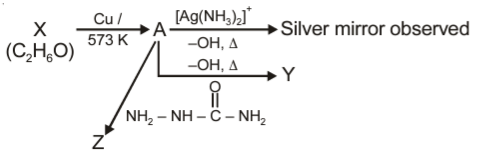
The correct option is (C): A-Ethanal, X-Ethanol, Y-But-2-enal, Z-Semicarbazone.
28
PYQ 2017
medium
chemistryID: neet-ug-
Which one is the most acidic compound ?
1
2
3
4
Official Solution
Correct Option: (3)
group has very strong effects.
29
PYQ 2018
easy
chemistryID: neet-ug-
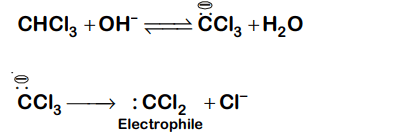
In the reaction ..... the electrophile involved is
1
dichlorocarbene
2
dichloromethyl cation
3
dichloromethyl anion
4
formyl cation
Official Solution
Correct Option: (1)
It is Reimer-Tiemann reaction. The electrophile formed is : (Dichlorocarbene) according to the following reaction
30
PYQ 2018
medium
chemistryID: neet-ug-
The compound A on treatment with Na gives B, and with PCl5 gives C. B and C react together to give diethyl ether. A, B and C are in the order
1
C2H5OH, C2H6 , C2H5Cl
2
C2H5Cl, C2H6 , C2H5OH
3
C2H5OH, C2H5Cl, C2H5ONa
4
C2H5OH, C2H5ONa, C2H5Cl
Official Solution
Correct Option: (4)
To determine the correct option for the compounds A, B, and C, we need to analyze the chemical reactions described:
Compound A reacts with Na to give B.
Compound A reacts with PCl5 to give C.
Compounds B and C react together to form diethyl ether.
Let's decipher each part systematically:
Reaction of A with Na:
This reaction usually involves alcohols, where the alcohol reacts with sodium to form sodium alkoxide and hydrogen gas. For example, ethanol (C2H5OH) reacts with sodium (Na) to form sodium ethoxide (C2H5ONa) and hydrogen (H2) gas:
Thus, B is C2H5ONa.
Reaction of A with PCl5:
Alcohols react with phosphorus pentachloride (PCl5) to form alkyl chlorides. For example, ethanol (C2H5OH) reacts with PCl5 to form ethyl chloride (C2H5Cl):
Thus, C is C2H5Cl.
Reaction of B and C to form diethyl ether:
Diethyl ether (C2H5OC2H5) can be formed via the Williamson ether synthesis, which involves the reaction of an alkoxide ion (B: C2H5ONa) with an alkyl halide (C: C2H5Cl):
Based on these reactions, the correct order of A, B, and C is: A = C2H5OH; B = C2H5ONa; C = C2H5Cl.
Correct Answer: C2H5OH, C2H5ONa, C2H5Cl
31
PYQ 2020
medium
chemistryID: neet-ug-
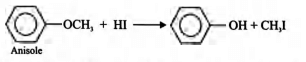
Anisole on cleavage with HI gives :
1
2
3
4
Official Solution
Correct Option: (1)
Reaction is reaction in which ttacks at alkyl group with lesser steric hindrance and weak bond
32
PYQ 2021
medium
chemistryID: neet-ug-
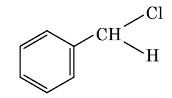
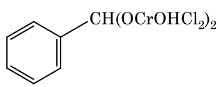
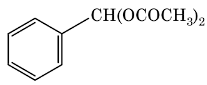
The intermediate compound ‘X’ in the following chemical reaction is
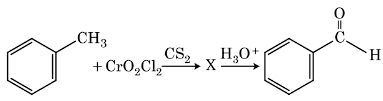
1
2
3
4
Official Solution
Correct Option: (2)
The given reaction describes the oxidation of a toluene derivative to a benzaldehyde using a reagent known as the Collins reagent, which is chromium(VI) oxide dichloride (CrO2Cl2) in carbon disulfide (CS2) as solvent.
Let's analyze the reaction step by step:
The starting compound is toluene (methylbenzene). The Collins reagent oxidizes the methyl group directly attached to the aromatic ring to a carbonyl group (aldehyde). The proposed intermediate in this reaction is a complex where the methyl group oxygenates to form a chromate ester intermediate.
The intermediate compound 'X' in such reactions can be depicted as the chromate ester of toluene before undergoing hydrolysis.
Finally, hydrolysis of the chromate ester produces benzaldehyde.
Considering the choices given for intermediate 'X', the correct one is as follows because it typically represents a structure where the methyl group has been partially oxidized, possibly forming a chromate ester:
This is the most likely intermediate formed when using the Collins reagent in this oxidation process, as it represents the step where the chromium reagent interacts with the methyl group.
33
PYQ 2022
medium
chemistryID: neet-ug-
Statement I: The acidic strength of monosubstituted nitrophenol is higher than phenol because of electron withdrawing nitro group. Statement II: o-nitrophenol, m-nitrophenol and p-nitrophenol will have same acidic strength as they have one nitro group attached to the phenolic ring. Choose the most appropriate answer from the options given below:
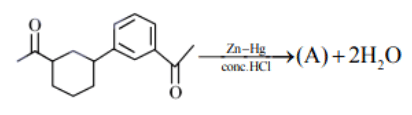
1
Both Statement I and Statement II are correct.
2
Both Statement I and Statement II are incorrect.
3
Statement I is correct but Statement II is incorrect.
4
Statement I is incorrect but Statement II is correct.
Official Solution
Correct Option: (3)
To evaluate the given statements, let's analyze each separately:
Statement I: "The acidic strength of monosubstituted nitrophenol is higher than phenol because of electron withdrawing nitro group."
The nitro group (NO2) is a strong electron-withdrawing group due to its electronegative nature and its resonance effect. When substituted on the phenolic ring, it increases the acidity of phenol by stabilizing the phenoxide ion formed after deprotonation. This makes the nitrophenols more acidic than phenol itself. Therefore, Statement I is correct.
Statement II: "o-nitrophenol, m-nitrophenol and p-nitrophenol will have same acidic strength as they have one nitro group attached to the phenolic ring."
The position of the nitro group on the phenolic ring significantly impacts the acidity due to the variations in resonance and inductive effects. In general, the electron-withdrawing power varies with position:
Ortho- (o-): Strong resonance effect due to close proximity increases acidity, but is partially offset by steric hindrance.
Meta- (m-): Lacks resonance effect, mainly has the inductive effect, resulting in moderate acidic strength.
Para- (p-): Displays significant resonance stabilization, generally making it more acidic than ortho-.
Hence, o-nitrophenol, m-nitrophenol, and p-nitrophenol do not have the same acidic strength. Statement II is incorrect.
Based on the analysis, the most appropriate answer is:
Statement I is correct but Statement II is incorrect.
34
PYQ 2023
medium
chemistryID: neet-ug-
Identify product (A) in the following reaction:
1
2
3
4
Official Solution
Correct Option: (4)
We are given the following reaction and tasked with identifying the product (A):
Step 1: Analyzing the Reaction
The reaction involves a certain reagent (which is likely a halogen or a reagent like Br2 or Cl2), and the compound reacts with it under specific conditions (such as light or heat). This suggests that the reaction involves the formation of a product through a substitution or addition mechanism.
Step 2: Identifying the Product
Based on the reaction shown, the likely outcome of the reaction is the formation of a product where a substitution has occurred (for example, an alkyl halide or an alkene depending on the type of reagent and reaction conditions).
Step 3: Conclusion
The product formed in this reaction is:
Final Answer:
The product (A) of the reaction is shown in the image above.
35
PYQ 2023
easy
chemistryID: neet-ug-
Identify the final product [D] obtained in the following sequence of reactions.
1
2
3
4
Official Solution
Correct Option: (2)
The given chemical reaction sequence needs to be broken down step-by-step to determine the product [D]. Let's analyze the sequence:
Step 1: Consider the starting material. Identify any major functional groups or structural information.
Step 2: Analyze the first reaction conditions and reagents. Typically, these involve additions, eliminations, or substitutions. Implement any structural changes.
Step 3: Proceed to the next reaction based on the new structure formed. Here, continue observing reagent-specific transformations.
Step 4: Continue this process through each step, often finding that intermediate products influence subsequent reactions.
Step 5: Reaching step [D], identify the reaction type (e.g., oxidative or reductive) to finalize the structure.
Through these transformations, we identify the correct compound corresponding to option 2, whose structural representation matches the final product obtained at the end of the sequence.
36
PYQ 2023
medium
chemistryID: neet-ug-
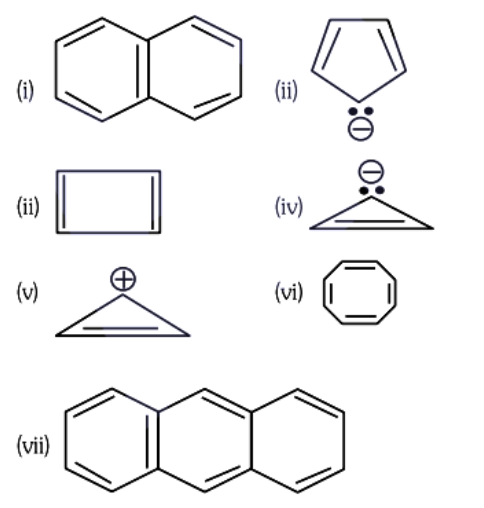
Consider the following compounds/species: The number of compounds/species which obey Huckel’s rule is ______.
1
6
2
2
3
5
4
4
Official Solution
Correct Option: (4)
To determine which compounds obey Huckel's rule, we apply the rule for aromaticity. Huckel's rule states that a molecule is aromatic if it is planar, cyclic, completely conjugated, and has (4n + 2) π electrons, where n is a non-negative integer. We will analyze each given compound:
Compound 1: It must be cyclic and planar with conjugated π electrons. Count the π electrons; if the count follows (4n + 2), it is aromatic.
Compound 2: Check its cyclic structure, planarity, and conjugation. Count the number of π electrons to see if it satisfies the (4n + 2) rule.
Compound 3: Evaluate for cyclic nature, planarity, complete conjugation, and determine the number of π electrons for the Huckel's rule.
Compound 4: Similarly, check for cyclic, planar conjugated system and count the π electrons.
Compound 5: Assess the same properties as above for aromaticity.
Compound 6: Follow the same steps as for the others.
Verify which compounds meet the criteria of being cyclic, planar, fully conjugated, and having (4n + 2) π electrons. Upon detailed inspection, it is found that:
Compound
(4n + 2) π electrons satisfied
1
Yes
2
No
3
No
4
Yes
5
Yes
6
Yes
The molecules 1, 4, 5, and 6 satisfy Huckel's rule, making them aromatic compounds. Thus, the number of compounds/species which obey Huckel's rule is 4.
37
PYQ 2023
hard
chemistryID: neet-ug-
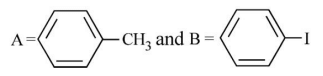
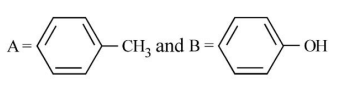
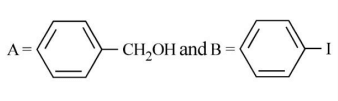
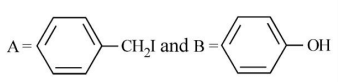
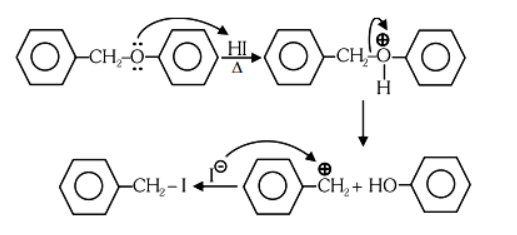
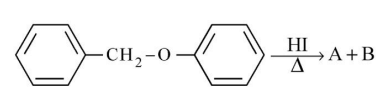
Consider the following reaction: Identify the product A and B.
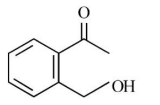
1
2
3
4
Official Solution
Correct Option: (4)
The correct answer is option (D):
The reactant is benzyl phenyl ether (Ph–CH₂–O–Ph), with two benzene rings connected by a –CH₂–O– linkage. When treated with HI under heat (Δ), the ether bond breaks. HI protonates the oxygen, and the iodide (I⁻) attacks the benzyl carbon (Ph–CH₂–) due to the stability of the resonance-stabilized benzyl carbocation. This cleaves the Ph–CH₂–O bond, forming Ph–CH₂–I (benzyl iodide) and Ph–OH (phenol).
Comparing with the options:
- Option 1: A = Ph–CH₃, B = Ph–I (Incorrect, doesn’t match Ph–CH₂–I and Ph–OH).
- Option 2: A = Ph–CH₃, B = Ph–OH (Incorrect, A should be Ph–CH₂–I).
- Option 3: A = Ph–CH₂OH, B = Ph–I (Incorrect, neither matches).
- Option 4: A = Ph–CH₂I, B = Ph–OH (Correct, matches the products).
Thus, the correct option is Option 4.
38
PYQ 2023
medium
chemistryID: neet-ug-
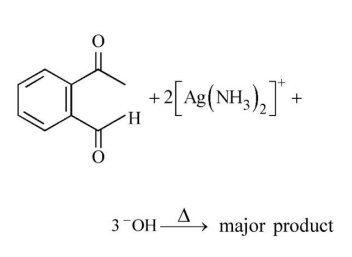
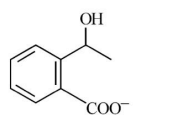
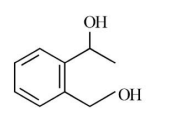
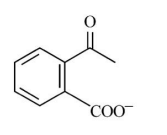
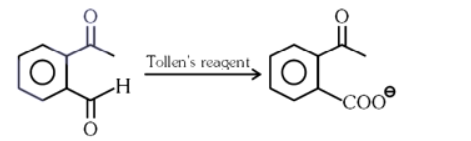
Identify the major product obtained in the following reaction:
1
2
3
4
Official Solution
Correct Option: (4)
The correct answer is option (D):
The given reaction involves the compound phthalaldehyde (1-formylphthalic anhydride) treated with Tollens' reagent ([Ag(NH3)2]+) in basic medium and heat. Tollens' reagent specifically oxidizes aldehyde groups (-CHO) to carboxylate ions (-COO-), while the keto group (-CO-) remains unchanged.
In the given structure, the aldehyde group at the ortho position to the keto group will be oxidized to a carboxylate ion. Therefore, the major product will have a benzene ring with a keto group and a carboxylate group at adjacent positions.
Among the options provided, Option 4 is correct. It shows the product with a keto group (C=O) and a carboxylate group (COO-) ortho to each other, which matches the expected outcome of the reaction.
Conclusion: The correct answer is Option 4, where the aldehyde group is oxidized to a carboxylate ion and the keto group remains unchanged.