Classical Idea Of Redox Reactions Oxidation And Reduction Reactions
4 previous year questions.
Volume: 4 Ques
Yield: Medium
High-Yield Trend
2
2024
1
2022
1
1995
Chapter Questions
4 MCQs
01
PYQ 1995
medium
chemistryID: neet-ug-
The loss of electron is termed as
1
oxidation
2
reduction
3
combustion
4
neutralization
Official Solution
Correct Option: (1)
Losing of electron is called oxidation.
02
PYQ 2022
medium
chemistryID: neet-ug-
In the neutral or faintly alkaline medium, KMnO4 oxidises iodide into iodate. The change in oxidation state of manganese in this reaction is from
1
(+7 to +4)
2
(+6 to +4)
3
(+7 to +3)
4
(+6 to +5)
Official Solution
Correct Option: (1)
In the given reaction, KMnO4 acts as an oxidizing agent, and iodide (I-) is oxidized to iodate (IO3-). In an alkaline or neutral medium, the balanced equation for the oxidation process is as follows:
2 KMnO4 + H2O + I- → 2 MnO2 + 2 KOH + IO3-
To determine the change in the oxidation state of manganese (Mn), let's analyze its transformation in the reaction:
In KMnO4, Mn is in the +7 oxidation state.
In MnO2, Mn is in the +4 oxidation state.
Thus, the change in the oxidation state of manganese is from +7 in KMnO4 to +4 in MnO2.
The correct answer to the change in oxidation state of manganese is (+7 to +4).
03
PYQ 2024
medium
chemistryID: neet-ug-
Which reaction is NOT a redox reaction?
1
Zn+CuSO4→ ZnSO4 + Cu
2
2KCIO3+l2 → 2KIO3 + Cl2
3
H2+Cl2 → 2HCI
4
BaCl2 + Na2SO4 → BaSO4 + 2NaCl
Official Solution
Correct Option: (4)
To determine which reaction is NOT a redox reaction, we must understand what constitutes a redox reaction. In a redox (reduction-oxidation) reaction, there is a transfer of electrons between species, leading to changes in their oxidation states. We'll analyze each option to check the oxidation state changes:
Zn + CuSO4 → ZnSO4 + Cu
Zinc (Zn) is oxidized from 0 to +2 and copper (Cu) is reduced from +2 to 0. This is a redox reaction.
2KClO3 + I2 → 2KIO3 + Cl2
Chlorine changes from +5 in KClO3 to 0 in Cl2 (reduction), and iodine changes from 0 to +5 in KIO3 (oxidation). This is a redox reaction.
H2 + Cl2 → 2HCl
Hydrogen changes from 0 to +1, and chlorine changes from 0 to -1. This is a redox reaction.
BaCl2 + Na2SO4 → BaSO4 + 2NaCl
No change in oxidation states for barium, sodium, or chloride as both sides have the same oxidation numbers. This is a double displacement reaction, not a redox reaction.
The reaction: BaCl2 + Na2SO4 → BaSO4 + 2NaCl is NOT a redox reaction.
04
PYQ 2024
medium
chemistryID: neet-ug-
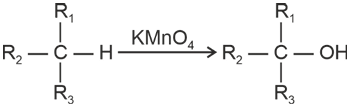
The alkane that can be oxidized to the corresponding alcohol by KMnO4 as per the equation is, when:
1
R1 = H; R2 = H; R3 = H
2
R1 = CH3; R2 = CH3; R3 = CH3
3
R1 = CH3; R2 = H; R3 = H
4
R1 = CH3; R2 = CH3; R3 = H
Official Solution
Correct Option: (2)
Potassium permanganate (KMnO ) is a strong oxidizing agent. It can oxidize alkanes, but it selectively oxidizes tertiary carbons (carbons bonded to three other carbon atoms) to alcohols. In the given reaction, the carbon atom bonded to the hydrogen atom that is being replaced by the hydroxyl group (-OH) must be a tertiary carbon for the oxidation to occur. Let's examine the options: (1) If all R groups are hydrogen atoms, the carbon is primary (bonded to only one other carbon). (2) If all R groups are methyl groups (CH ), the carbon is tertiary (bonded to three other carbons). (3) If R is a methyl group and the other R groups are hydrogen, the carbon is primary. (4) If R and R are methyl groups and R is hydrogen, the carbon is secondary (bonded to two other carbons). Only option (2), where all R groups are methyl groups, results in a tertiary carbon that can be oxidized by KMnO to the corresponding alcohol.