NEET-UG SERIES
Chemistry

Chemical Kinetics

59 previous year questions.

Volume: 59 Ques
Yield: High

High-Yield Trend

3
2025
3
2024
3
2023
2
2022
1
2021
2
2020
4
2019
1
2018
3
2017
2
2016
1
2015
1
2012
1
2011
2
2010
3
2009

Chapter Questions
59 MCQs

01
PYQ 1996
hard
chemistry ID: neet-ug-
The plot of concentration of the reactant versus time for a reaction is a straight line with a negative slope. This reaction follows
1
zero order rate equation
2
first order rate equation
3
second order rate equation
4
third order rate equation
02
PYQ 1996
easy
chemistry ID: neet-ug-
In a reversible reaction, the energy of activation of the forward reaction is 50 kcal. The energy of activation for the reverse reaction will be
1
< 50 kcal
2
50 kcal
3
either greater than or less than 50 kcal
4
> 50 kcal
03
PYQ 1996
medium
chemistry ID: neet-ug-
The given reaction, is an example of
1
third order reaction
2
first order reaction
3
second order reaction
4
none of these
04
PYQ 1997
medium
chemistry ID: neet-ug-

The experimental data for the reaction is The rate equation for the above data is

Exp.[A] Rate
10.500.50
2.0.051.00
3.1.001.00
1
rate = k
2
rate = k
3
rate = k
4
rate = k
05
PYQ 1998
medium
chemistry ID: neet-ug-
The Activation energy of a chemical reaction can be determined by
1
evaluating rate constant at standard temperature
2
evaluating velocities of reaction at two different temperatures
3
evaluating rate constants at two different temperatures
4
changing concentration of reactants
06
PYQ 2000
medium
chemistry ID: neet-ug-
A 300 gram radioactive sample has half life of 3 hour's. After 18 hour's remaining quantity will be:
1

2

3

4

07
PYQ 2000
easy
chemistry ID: neet-ug-
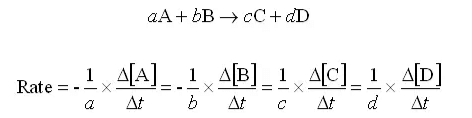
For the reaction which of the following relation correctly represents the consumption & formation of reactants and products :
1
2
3
4
08
PYQ 2000
medium
chemistry ID: neet-ug-
How enzymes increases the rate of reactions?
1
By lowering activation energy
2
By increasing activation energy
3
By changing equilibrium constant
4
By forming enzyme substrate complex
09
PYQ 2001
medium
chemistry ID: neet-ug-
A human body required the 0.01 Curie activity of radioactive susbtance after 24 hours. Half life of radioactive is 6 hours. Then max. activity of radioactive sustance that can be injected will be
1
0.08
2
0.04
3
0.16
4
0.32
10
PYQ 2001
medium
chemistry ID: neet-ug-

When a bio chemical reaction is carried out in laboratory out side the human body in the absence of enzyme, then the rate of reaction obtained is times, than activation energy of reaction in the presence of enzyme is

1

2
P is required
3

Different from, Ea obtained in laboratery

4

Can't say anything

11
PYQ 2001
medium
chemistry ID: neet-ug-
When a biochemical reaction is carried out in laboratory from outside of human body in the absence of enzyme, the rate of reaction obtained is times, then activation energy of the reaction in the presence of enzyme is
1
2
P is required
3
different from obtained in laboratory
4
cannot say any things
12
PYQ 2001
medium
chemistry ID: neet-ug-
For the reaction, rate and rate constant are and respectively. The concentration of in mol will be
1
2
3
4
13
PYQ 2001
medium
chemistry ID: neet-ug-
Half life period of C14 is
1
500 years
2
5000 years
3
50 years
4
5 × 10^4 years
14
PYQ 2002
medium
chemistry ID: neet-ug-

92U235, nucleus absorb a neutron and disintegrate in 54Xe139, 38Sr94 and x So, What will be the product x

1
3 - neutrons
2
2 - neutrons
3
α - partical
4
β - partical
15
PYQ 2002
medium
chemistry ID: neet-ug-
2A B + C
It would be a zero-order reaction when
1
The rate of reaction is proportional to square of conc. of A
2
The rate of reaction remains same at any conc. of A
3
The rate remains unchanged at any conc. of B and C
4
The rate of reaction doubles if conc. of B is increased to double
16
PYQ 2003
medium
chemistry ID: neet-ug-

The radioisotope, tritium 13(H) has a half-life of 12.3 years. If the initial amount of tritium is 32 mg, how many milligrams of it would remain after 49.2 years:

1

1 mg

2

2 mg

3

4 mg

4

8 mg

17
PYQ 2003
medium
chemistry ID: neet-ug-
The reaction follows first order kinetics. The time taken for 0.8 mole of A to produce 0.6 mole of B is 1 hour. What is the time taken for conversion of 0.9 mole of A to produce 0.675 mole of B.
1
1 hour
2
0.5 hour
3
0.25 hour
4
2 hour
18
PYQ 2003
medium
chemistry ID: neet-ug-
The activation energy for a simple chemical reaction, B is in forward direction. The activation energy for reverse reaction
1
can be less than or more than
2
is always double of
3
is negative of
4
is always less than
19
PYQ 2003
medium
chemistry ID: neet-ug-
The temperature dependence of rate constant (k) of a chemical reaction is written in terms of Arrhenius equation, . Activation energy of the reaction can be calculated by plotting
1
log k vs
2
log k vs
3
k vs T
4
k vs
20
PYQ 2003
medium
chemistry ID: neet-ug-
If the rate of a reaction is equal to the rate constant, the order of the reaction is
1
2
2
3
3
0
4
1
21
PYQ 2004
medium
chemistry ID: neet-ug-
The rate of first order reaction is mol at 0.5 M concentration of the reactant. The half-life of the reaction is
1
0.383 min
2
23.1 min
3
8.73 min
4
7.53 min
22
PYQ 2005
medium
chemistry ID: neet-ug-
For a first order reaction, , the reaction rate at reactant concentration of is found to be . The half-life period of the reaction is
1
220 s
2
30 s
3
300 s
4
347 s
23
PYQ 2005
medium
chemistry ID: neet-ug-
The rate of reaction between two reactants A and B decreases by a factor of 4,if the concentration of reactant B is doubled. The order of this reaction with respect to reactant B is:
1
-1
2
-2
3
1
4
2
24
PYQ 2006
easy
chemistry ID: neet-ug-
Consider the reaction, The equality relationship between and is :-
1
2
3
4
25
PYQ 2007
medium
chemistry ID: neet-ug-
If of a first order reaction was completed in , of the same reaction would be completed in approximately ( )
1
50 min
2
45 min
3
60 min
4
40 min
26
PYQ 2007
medium
chemistry ID: neet-ug-
The reaction of hydrogen an iodine monochloride is given as This reaction is of first order with respect to and , following mechanisms were proposed Mechanism : Mechanism : Slow Fast Which of the above mechanism can be consistent with the given information about the reaction:
1
Only B
2
Both A and B
3
Neither A nor B
4
Only A
27
PYQ 2008
easy
chemistry ID: neet-ug-
The rate constants and for two different reactions are and ,respectively. The temperature at which is
28
PYQ 2009
medium
chemistry ID: neet-ug-
Half-life period of a first order reaction is The specific rate constant of the reaction is
1
2
3
4
29
PYQ 2009
easy
chemistry ID: neet-ug-
For the reaction, , If , The value of would be -
1
2
3
4
30
PYQ 2009
easy
chemistry ID: neet-ug-
In the reaction The rate of appearance of bromine is related to rate of disappearance of bromide ions as following
1
2
3
4
31
PYQ 2010
medium
chemistry ID: neet-ug-
The rate of the reaction is given by the rate equation rate = . The value of the rate constant can be increased by -
1
increasing the concentration of NO.
2
increasing the concentration of the
3
increasing the temperature
4
doing all of these
32
PYQ 2010
medium
chemistry ID: neet-ug-
During the kinetic study of the reaction, , following results were obtained . Based on the above data which one of the following is correct?
Run Initial rate of formation of
I 0.1 0.1
II 0.3 0.2
III 0.3 0.4
IV 0.4 0.1
1
Rate = k [B]
2
Rate = k[A][B]
3
Rate = k
4
Rate = k[A]
33
PYQ 2011
medium
chemistry ID: neet-ug-
The rate of the reaction can be written in three ways: The relationship between k and k' and between k and k'' are-
1
k' = k, k''= k
2
k'= 2k; k''= k
3
k'= 2k, k''= k/2
4
k' = 2k; k''= 2k
34
PYQ 2012
medium
chemistry ID: neet-ug-
In a reaction, A + B Product, rate is doubled when the concentration of B is doubled and rate increases by a factor of 8 when the concentrations of both the reactants (A and B) are doubled. Rate law for the reaction can be written as
1
rate = K[A]
2
rate = K
3
rate =
4
rate = k [B]
35
PYQ 2015
medium
chemistry ID: neet-ug-
The rate constant of the reaction is mole per second. If the concentration of A is 5 M, then concentration of after 20 minutes is :
1
0.36 M
2
0.72 M
3
1.08 M
4
3.60 M
36
PYQ 2016
medium
chemistry ID: neet-ug-
The rate of a first order reaction is at 10 seconds and at 20 seconds after initiation of the reaction. The half-life period of the reaction is :
1
34.1 s
2
44.1 s
3
54.1 s
4
24.1 s
37
PYQ 2016
medium
chemistry ID: neet-ug-
The addition of a catalyst during a chemical reaction alters which of the following quantities ?
1
Internal energy
2
Enthalpy
3
Activation energy
4
Entropy
38
PYQ 2017
medium
chemistry ID: neet-ug-
A first order reaction has a specific reaction rate of 10–2 s–1. How much time will it take for 20 g of the reactant to reduce to 5 g?
1
238.6 second
2
138.6 second
3
346.5 second
4
693.0 second
39
PYQ 2017
medium
chemistry ID: neet-ug-
Mechanism of a hypothetical reaction is given below :
(i) (fast)
(ii) (slow)
(iii) (fast)
The overall order of the reaction will be
1
1
2
2
3
0
4
1.5
40
PYQ 2017
easy
chemistry ID: neet-ug-
A first order reaction has a specific reaction rate of . How much time will it take for of the reactant to reduce to ?
1
138.6 sec
2
346.5 sec
3
693.0 sec
4
238.6 sec
41
PYQ 2018
medium
chemistry ID: neet-ug-
When initial concentration of the reactant is doubled , the half-life period of a zero order reaction
1
remains unchanged
2
is halved
3
is tripled
4
is doubled
42
PYQ 2019
easy
chemistry ID: neet-ug-
For a reaction, activation energy E =0 and the rate constant at 200K is 1.6×10 s . The rate constant at 400K will be- [Given that gas constant] R= 8.314 J K mol
1
3.2 ×10 s
2
1.6 × 10 s
3
1.6 × 10 s
4
3.2 × 10 s
43
PYQ 2019
medium
chemistry ID: neet-ug-
If the rate constant for a first order reaction is k, the time(t) required for the completion of 99% of the reaction is given by :
1
t = 4.606/k
2
t = 2.303/k
3
t = 0.693/k
4
t = 6.909/k
44
PYQ 2019
medium
chemistry ID: neet-ug-
For the chemical reaction the correct option is :
1
2
3
4
45
PYQ 2019
medium
chemistry ID: neet-ug-
The rate of radioactive disintegration at an instant for a radioactive same of half life is . The number of radioactive atoms in that sample at that instant is,
1
2
3
4
46
PYQ 2020
easy
chemistry ID: neet-ug-
The half-life for a zero order reaction having initial concentration of reactant is . The rate constant (in for the reaction is
1
2
3
4
47
PYQ 2020
medium
chemistry ID: neet-ug-
The rate constant for a first order reaction is . The time required to reduce of the reactant to is :
1
100 s
2
200 s
3
500 s
4
1000 s
48
PYQ 2021
medium
chemistry ID: neet-ug-

The slope of Arrhenius Plot (ln k v/s ) of first order reaction is −5×10³ K. The value of Ea of the reaction is. Choose the correct option for your answer. [Given R=8.314 JK−1mol−1 ]

1

−83 kJ mol−1

2

41.5 kJ mol−1

3

83.0 kJ mol−1

4

166 kJ mol−1

49
PYQ 2022
medium
chemistry ID: neet-ug-
For a first order reaction A → Products, initial concentration of A is 0.1 M, which becomes 0.001M after 5 minutes. Rate constant for the reaction in min-1 is
1
1.3818
2

0.4606

3

0.9212

4
0.2303
50
PYQ 2022
medium
chemistry ID: neet-ug-
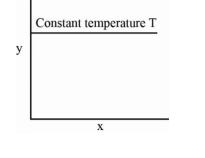
The given graph is a representation of kinetics of a reaction.
The y and x axes for zero and first order reactions, respectively are
1
zero order (y = concentration and x = time), first order ( , and x = concentration)
2
zero order (y = concentration and x = time), first order (y = rate constant and x = concentration)
3
zero order (y = rate and x = concentration), first order ( and x = concentration)
4
zero order (y = rate and x = concentration), first order (y = rate and )
51
PYQ 2023
hard
chemistry ID: neet-ug-
For a certain reaction, the rate= when the initial concentration of A is tripled keeping concentration of B constant, the initial rate would
1
increase by a factor of six.
2
increase by a factor of nine.
3
increase by a factor of three.
4
decrease by a factor of nine.
52
PYQ 2023
easy
chemistry ID: neet-ug-

Which one is an example of heterogenous catalysis?

1

Hydrolysis of sugar catalysed by H+ ions

2

Decomposition of ozone in-presence of nitrogen monoxide

3

Combination between dinitrogen and dihydrogen to form ammonia in the presence of finely divided iron

4

Oxidation of sulphur dioxide into sulphur trioxide in the presence of oxides of nitrogen

53
PYQ 2023
hard
chemistry ID: neet-ug-
Given below are two statements: one is labelled as Assertion A and the other is labelled as Reason R:
Assertion A: A reaction can have zero activation energy.
Reasons R: The minimum extra amount of energy absorbed by reactant molecules so that their energy becomes equal to threshold value, is called activation energy.
In the light of the above statements, choose the correct answer from the options given below:
1
Both A and R are true and R is NOT the correct explanation of A
2
A is true but R is false
3
A is false but R is true
4
Both A and R are true and R is the correct explanation of A
54
PYQ 2024
medium
chemistry ID: neet-ug-
Rate constants of a reaction at 500 K and 700 K are and , respectively. Then, the activation energy of the reaction is:
{Given:}
1
182310 J
2
18500 J
3
18219 J
4
18030 J
55
PYQ 2024
medium
chemistry ID: neet-ug-
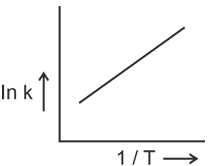
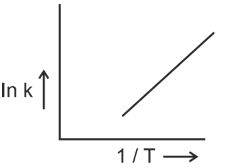
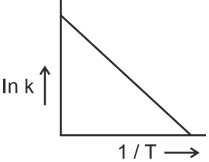
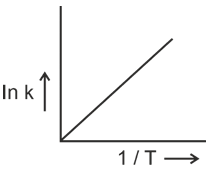
Which of the following plot represents the variation of ln k versus in accordance with the Arrhenius equation?
1
plot1
2
plot2
3
plot3
4
plot4
56
PYQ 2024
medium
chemistry ID: neet-ug-
Following data is for a reaction between reactants A and B:


The order of the reaction with respect to A and B, respectively, are:
1
1, 0
2
0, 1
3
1, 2
4
2, 1
57
PYQ 2025
medium
chemistry ID: neet-ug-
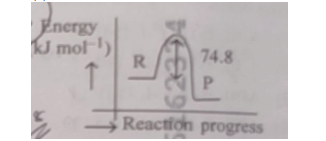
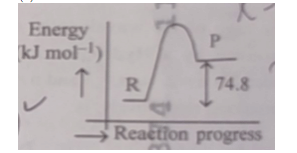
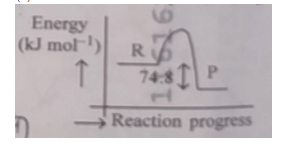
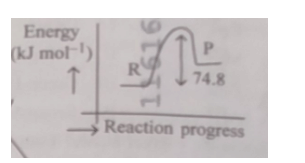
C(s) + 2H (g) CH (g);
Which of the following diagrams gives an accurate representation of the above reaction?
1

2

3

4

58
PYQ 2025
easy
chemistry ID: neet-ug-
If the rate constant of a reaction is 0.03 s , how much time does it take for a 7.2 mol L concentration of the reactant to get reduced to 0.9 mol L ?
(Given: log 2 = 0.301)
1
23.1 s
2
210 s
3
21.0 s
4
69.3 s
59
PYQ 2025
medium
chemistry ID: neet-ug-
If the half-life ( ) for a first-order reaction is 1 minute, then the time required for 99.9% completion of the reaction is closest to:
1
4 minutes
2
5 minutes
3
10 minutes
4
2 minutes