Coordination Compounds
76 previous year questions.
High-Yield Trend
Chapter Questions 76 MCQs
In quantitative analysis of second group in lab. gas is passed in acidic medium for ppt. When and react with , than in which of the following condition, ppt will not be formed due to relative stability:
Which statement is incorrect
Ni(CO)4 – Tetrahedral, paramagnetic
Ni(CN)-24 - Square planar, diamagnetic
Ni(CO)4 - Tetrahedral, diamagnetic
[Ni(Cl)4]-2 – Tetrahedral, paramagnetic
[Fe(η5 – C5H5)2]
K[PtCl3(η2– C2H4)]
[Co(CO)5NH3]+2
Fe(CH3)3
Coordination number of Ni in [(C2O4)3]-4 is
3
6
4
2
The hypothetical complex chloro diaquatriammine cobalt (III) chloride can be represented as
[CoCl(NH3)3(H2O)2]Cl2
[Co(NH3)3(H2O)Cl3]
[Co(NH2)3(H2O)2Cl]
[Co(NH3)3(H2O)3Cl3]
[Cr(CO)6]
[Fe(CO)5]
[Fe(CN)6]–4
[Cr(NH3)6]+3
Diamminedichloroplatinum (II)
Trans-dicyanobis (ethylenediamine) chromium (III) chloride
Tris – (ethylenediamine) cobalt (III) bromide
Pentaamminenitrocobalt (III) iodide
dxz, dx2 –y2
dz2. dxz
dxy, dyz
dx2 y2 dz2
It is a pseudohalide
It can accept electrons from metal species
It forms high spin complexes with metal species
It carries negative charge
3d1x2-y2, 3d1z2, 3d1xz
3d1xy, 3d1x2-y2, 3d1yz
3d1xy, 3d1zy, 3d1xz
3d1xy, 3d1yz, 3d1z2
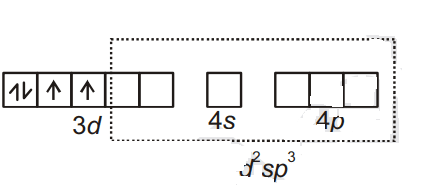
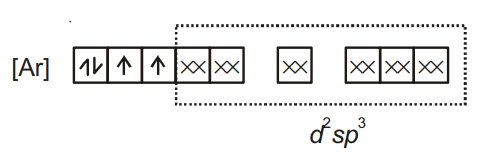
| Column I | Column II | ||
|---|---|---|---|
| (a) | XX' | (i) | T-shape |
| (b) | XX'3 | (ii) | Pentagonal bipyramidal |
| (c) | XX'5 | (iii) | Linear |
| (d) | XX'7 | (iv) | Square-pyramidal |
| (v) | Tetrahedral | ||
| Column I | Column II | ||
| a. | Co3+ | i. | B.M. |
| b. | Cr3+ | ii. | B.M. |
| c. | Fe3+ | iii. | B.M. |
| d. | Ni2+ | iv. | B.M. |
| v. | B.M. | ||
The correct sequence of bond enthalpy of ‘C–X’ bond is
CH3−Cl > CH3−F > CH3−Br > CH3−I
CH3−F < CH3−Cl < CH3−Br < CH3−I
CH3−F > CH3−Cl > CH3−Br > CH3−I
CH3−F < CH3−Cl > CH3−Br > CH3−I
Match List - I with List - II.
List - I | List - II | ||
| (a) | [Fe(CN)6]3− | (i) | 5.92 BM |
| (b) | [Fe(H2O)6]3+ | (ii) | 0 BM |
| (c) | [Fe(CN)6]4− | (iii) | 4.90 BM |
| (d) | [Fe(H2O)6]2+ | (iv) | 1.73 BM |
Choose the correct answer from the options given below.
(a)-(iv), (b)-(i), (c)-(ii), (d)-(iii)
(a)-(iv), (b)-(ii), (c)-(i), (d)-(iii)
(a)-(ii), (b)-(iv), (c)-(iii), (d)-(i)
(a)-(i), (b)-(iii), (c)-(iv), (d)-(ii)
The order of energy absorbed which is responsible for the color of complexes
- Ni(H2O)2(en)2]2+
- [Ni(H2O)4(en)]2+
- [Ni(en)3]2+
Diamminechloridonitrito-N-platinum (II)
Pentaamminecarbonatocobalt (III) chloride
Triamminetriaquachromium (III) chloride
Potassium trioxalatoaluminate (III)
A. All the transition metals except scandium form MO oxides which are iconic
B. The highest oxidation number corresponding to the group number in transition metal oxides is attained in Sc2O3 to Mn2O7
C. Basic character increases from V2O3 to V2O4 to V2O5
D. V2O4 dissolves in acids to give VO salts
E. CrO is basic but Cr2O3 is amphoteric
Choose the correct answer from the options given below:
B and D only
C and D only
B and C only
A and E only
About Coordination Compounds - NEET-UG
Coordination Compounds is a vital chapter for NEET-UG aspirants. Mastering the concepts covered in this chapter is essential for securing a top rank.
By rigorously practicing the previous year questions associated with this chapter, you can identify high-yield topics, understand the examiner's perspective, and boost your confidence during the actual exam.
Frequently Asked Questions
Why focus on Coordination Compounds PYQs?
Analyzing PYQs for this specific chapter reveals the most frequently tested concepts and the typical complexity of questions, allowing you to tailor your study plan efficiently.
How to best use this analysis?
Review the topic breakdown to see which sub-topics within Coordination Compounds carry the most weight. Then, tackle the questions iteratively to solidify your understanding.