Equilibrium
65 previous year questions.
High-Yield Trend
Chapter Questions 65 MCQs
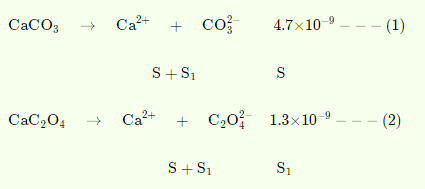
(i)
(ii) .Then,
Which statement is wrong about and ?
Adding 1N,1N soln of CH3COOH and NaOH pH will be seven
pH of dilute and hot H2SO4 is more than concentrate and cold H2SO4
Mixing solution of CH3COOH and HCl, pH will be less than 7
Solubility of a salt is , then find out solubility product.
Reaction BaO2 (s) BaO (s) + O2(g); ∆H = + ve. In equilibrium condition. The pressure of O2 depends on :
Increase mass of BaO2
Increase mass of BaO2 and BaO both
The solubility of MX2–type electrolytes is 0.5 × 10⁻⁴ Mole/lit. then find out the Ksp of electrolytes :
5 × 10–12
25 × 10–10
1 × 10–13
5 × 10–13
presence of HCl decreases the sulphide ion concentration
presence of HCl increases the sulphide ion concentration
solubility product of group II sulphides is more than that of group IV sulphides
sulphides of group IV cations are unstable in HCl
HClO < HClO2 < HClO3 < HClO4
HClO4 < HClO< HClO2 < HClO3
HClO2 < HClO3 < HClO4 < HClO
HClO4 < HClO3 < HClO2 < HClO
pH1 > pH2 pH3 > pH4
pH1 < pH2 < pH3 < pH4
pH1 < pH2 < pH3 pH4
pH1 .> pH2 > pH3 > pH4
The reaction can go to completion by removing OH- ions by adding
A2(g) + B2(g) ⇌ X2(g) ΔrH = – X kJ ?
If the equilibrium constant is at 300K, the value of at the same temperature will be :
3O2 (g) ⇌ 2O3(g) for the above reaction at 298 K, Kc is found to be 3.0 x 10-59. If the conc. of O2 at equilibrium is 0.040 M then concentration of O3 in M is
[Given pKa of CH3COOH = 4.57]
H2O
BF3
OH-
NH3
N2 = 3.0 × 10⁻³ M, O2 = 4.2 × 10⁻³ M and NO = 2.8 × 10⁻³ M.
2NO(g)⇋N2(g) + O2(g)
If 0.1 mol L–1 of NO(g) is taken in a closed vessel, what will be degree of dissociation (a) of NO(g) at equilibrium?
About Equilibrium - NEET-UG
Equilibrium is a vital chapter for NEET-UG aspirants. Mastering the concepts covered in this chapter is essential for securing a top rank.
By rigorously practicing the previous year questions associated with this chapter, you can identify high-yield topics, understand the examiner's perspective, and boost your confidence during the actual exam.
Frequently Asked Questions
Why focus on Equilibrium PYQs?
Analyzing PYQs for this specific chapter reveals the most frequently tested concepts and the typical complexity of questions, allowing you to tailor your study plan efficiently.
How to best use this analysis?
Review the topic breakdown to see which sub-topics within Equilibrium carry the most weight. Then, tackle the questions iteratively to solidify your understanding.