Solutions
58 previous year questions.
High-Yield Trend
Chapter Questions 58 MCQs
A solution contains non volatile solute of molecular mass M2. Which of the following can be used to calculate the molecular mass of solute in terms of osmotic pressure
M2=( )VRT
M2=
M2=
M2=
1 M and 2.5 litre NaOH solution mixed with another 0.5 M and 3 litre NaOH solution. Then find out molarity of resultant solution
sodium acetate
Urea
Cetyl trimethylammonium chloride
Sodium dodecyl sulphonate
0.054
0.042
0.018
0.009
pH of which one of them will be equal to 1 ?
| A | I | ||
| B | Temporary hardness of water | II | An electron deficient hydride |
| C | III | Synthesis gas | |
| D | IV | Non-planar structure |
The correct option for the value of vapor pressure of a solution at 45 C with benzene to octane in molar ratio 3 : 2 is : [At 45 C vapor pressure of benzene is 280 mm Hg and that of octane is 420 mm Hg. Assume Ideal gas]
350 mm of Hg
160 mm of Hg
168 mm of Hg
336 mm of Hg
The molar conductivity of 0.007 M acetic acid is 20 S cm2 mol−1. What is the dissociation constant of acetic acid? Choose the correct option.
2.50×10⁻⁵ mol L−1
1.75×10⁻⁴ mol L−1
2.50×10⁻⁴ mol L−1
1.75×10⁻⁵ mol L−1
P3 > P1 > P2
P2 > P1 > P3
P1 > P2 > P3
P2 > P3 > P1
The right option for the statement “Tyndall effect is exhibited by”, is
Urea solution
NaCl solution
Glucose solution
Starch solution
Pumice stone is an example of -
gel
solid sol
foam
sol
(Molar mass of glucose: 180 g mol-1)
NaCl, CH3OH, cyclohexane, CH3CN
Match List I with List II: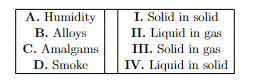
Choose the correct answer from the options given below:
About Solutions - NEET-UG
Solutions is a vital chapter for NEET-UG aspirants. Mastering the concepts covered in this chapter is essential for securing a top rank.
By rigorously practicing the previous year questions associated with this chapter, you can identify high-yield topics, understand the examiner's perspective, and boost your confidence during the actual exam.
Frequently Asked Questions
Why focus on Solutions PYQs?
Analyzing PYQs for this specific chapter reveals the most frequently tested concepts and the typical complexity of questions, allowing you to tailor your study plan efficiently.
How to best use this analysis?
Review the topic breakdown to see which sub-topics within Solutions carry the most weight. Then, tackle the questions iteratively to solidify your understanding.