When aqueous solution of benzene diazoniumchloride is boiled, the product formed is
1
2
3
4
Official Solution
Correct Option: (4)
When an aqueous solution of benzene diazonium chloride ( ) is boiled, it undergoes a reaction known as "benzene diazonium chloride decomposition" or "diazotization." The main product formed is phenol ( ) along with the evolution of nitrogen gas ( ). The reaction can be represented as follows:
So the products formed are (phenol) and (nitrogen gas).
So the correct answer is option (D):
02
PYQ 2009
medium
chemistryID: viteee-2
What are and in the following reaction sequence
1
2
3
4
Official Solution
Correct Option: (3)
03
PYQ 2016
medium
chemistryID: viteee-2
Phenol undergoes electrophilic substitution more easily than benzene because
1
-OH group exhibits +M effect and hence increases the electron density on the o- and p-positions.
2
oxocation is more stable than the carbocation
3
both (a) and (b)
4
-OH group exhibits acidic character
Official Solution
Correct Option: (3)
High stability of oxonium ion (oxocation) is because here every atom (except H) has a complete octet of electrons, while in carbocations, carbon bearing positive charge is having six electrons.
04
PYQ 2016
medium
chemistryID: viteee-2
Anisole is treated with HI under two different conditions.
The nature of A and B will be
1
A and B are and , while C and D are and
2
A and B are and , while C and D are and
3
A and B are and , while C and D are and
4
Both A and B as well as both C and D are and
Official Solution
Correct Option: (1)
Step 1: Nucleophilic Substitution with HI.
In this reaction, anisole undergoes nucleophilic substitution with HI. The methoxy group ( ) is substituted by the iodine atom, forming (phenol) and (methyl iodide). Step 2: Conclusion.
The correct answer is (A), as the products are phenol and methyl iodide.
05
PYQ 2016
medium
chemistryID: viteee-2
Phenol undergoes electrophilic substitution more easily than benzene because
1
group exhibits +M effect and hence increases the electron density on the and positions.
2
group exhibits effect and hence decreases the electron density on the and positions.
3
Oxocation is more stable than the carbocation.
4
Both (a) and (b)
Official Solution
Correct Option: (1)
Step 1: +M Effect of .
The hydroxyl group (-OH) is an electron-donating group via resonance (the +M effect). This increases the electron density at the and positions of the aromatic ring, making electrophilic substitution easier. Step 2: Conclusion.
The correct answer is (A), group exhibits +M effect.
06
PYQ 2017
medium
chemistryID: viteee-2
What is Z in the following sequence of reactions?
1
Benzene
2
Toluene
3
Benzaldehyde
4
Benzoic acid
Official Solution
Correct Option: (1)
Step 1: Understand the reaction.
When phenol reacts with zinc dust, it undergoes reduction to form benzene. Then, when benzene reacts with alkaline potassium permanganate, it is oxidized to form benzoic acid. Step 2: Conclusion.
Thus, Z is benzene in this reaction sequence. Final Answer:
07
PYQ 2017
medium
chemistryID: viteee-2
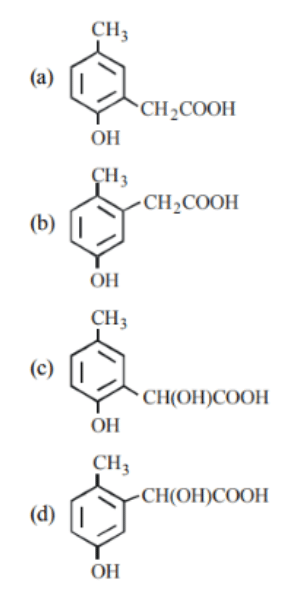
-cresol reacts with chloroform in alkaline medium to give the compound A which adds hydrogen cyanide to form the compound B. The latter on acidic hydrolysis gives chiral carboxylic acid. The structure of the carboxylic acid is
1
A
2
B
3
C
4
D
Official Solution
Correct Option: (1)
Step 1: Analyze the reaction steps.
The reaction involves chloroform and p-cresol to form a product that undergoes further reactions, leading to a chiral carboxylic acid. Step 2: Conclusion.
Thus, the carboxylic acid has the structure . Final Answer:
08
PYQ 2017
medium
chemistryID: viteee-2
A compound is soluble in conc. H SO . It does not decolourise bromine in carbon tetrachloride but is oxidised by chromic anhydride in aqueous sulphuric acid within two seconds, turning orange solution to blue, green and then opaque. The original compound is
1
a primary alcohol
2
a tertiary alcohol
3
an alkane
4
an alkene
Official Solution
Correct Option: (1)
Step 1: Understand the chemical reactions.
The compound undergoes oxidation with chromic anhydride and changes color, which suggests it is a primary alcohol. Primary alcohols are oxidized to aldehydes and then to carboxylic acids. Step 2: Conclusion.
Thus, the original compound is a primary alcohol. Final Answer:
09
PYQ 2017
medium
chemistryID: viteee-2
A substance C H O yields on oxidation a compound, C H O which gives an oxime and a positive iodoform test. The original substance on treatment with conc. H SO gives C H . The structure of the compound is
1
CH COCH OH
2
CH COOH
3
CH COCH CH
4
CH CH OH
Official Solution
Correct Option: (1)
Step 1: Analyze the oxidation and tests.
The given tests (iodoform and oxime) suggest that the original compound is acetaldehyde, which on oxidation gives acetic acid. Step 2: Conclusion.
Thus, the compound is CH COCH OH. Final Answer:
10
PYQ 2017
medium
chemistryID: viteee-2
1-Propanol and 2-propanol can be distinguished by
1
oxidation with alkaline KMnO followed by reaction with Fehling solution
2
oxidation with acidic dichromate followed by reaction with Fehling solution
3
oxidation by heating with copper followed by reaction with Fehling solution
4
oxidation with concentrated H SO followed by reaction with Fehling solution
Official Solution
Correct Option: (2)
Step 1: Understand the chemical reactions.
1-Propanol and 2-propanol can be differentiated based on their oxidation products. Oxidation with acidic dichromate leads to aldehyde formation, and Fehling solution reacts with aldehydes. Step 2: Conclusion.
Thus, the correct distinguishing method is oxidation with acidic dichromate followed by reaction with Fehling solution. Final Answer:
11
PYQ 2018
medium
chemistryID: viteee-2
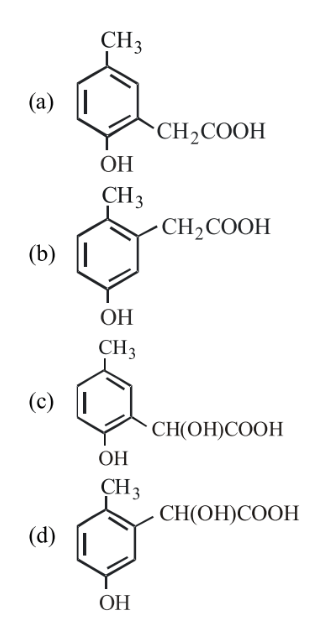
-cresol reacts with chloroform in alkaline medium to give the compound A which adds hydrogen cyanide to form the compound B. The latter on acidic hydrolysis gives chiral carboxylic acid. The structure of the carboxylic acid is:
1
A
2
B
3
C
4
D
Official Solution
Correct Option: (1)
Step 1: -cresol reacts with chloroform in alkaline medium to form a cyano compound. Step 2: The final product after hydrolysis gives a chiral carboxylic acid. The structure of the carboxylic acid is .
Final Answer:
12
PYQ 2018
medium
chemistryID: viteee-2
Compound ‘A’ of molecular formula on treatment with Lucas reagent at room temperature gives compound ‘B’. When compound ‘B’ is heated with alcoholic KOH, it gives isobutene. Compound ‘A’ and ‘B’ are respectively:
1
2-methyl-2-propanol and 2-methyl-2-chloropropane
2
2-methyl-1-propanol and 1-chloro-2-methylpropane
3
2-methyl-1-propanol and 2-methyl-2-chloropropane
4
butan-2-ol and 2-chlorobutane
Official Solution
Correct Option: (3)
Step 1: Lucas reagent reacts with alcohols to form alkyl chlorides. The reaction of Lucas reagent with 2-methyl-1-propanol produces 2-methyl-2-chloropropane. Step 2: Heating 2-methyl-2-chloropropane with alcoholic KOH leads to the formation of isobutene.
Final Answer:
13
PYQ 2019
medium
chemistryID: viteee-2
In the reaction, (B) , the compound (C) is:
1
Benzoic acid
2
Salicylaldehyde
3
Chlorobenzene
4
Salicylic acid
Official Solution
Correct Option: (4)
The reaction involves the formation of salicylic acid from phenol by treating it with sodium hydroxide. Final Answer:
14
PYQ 2019
medium
chemistryID: viteee-2
Ethylene glycol, on oxidation with periodic acid, gives:
1
Oxalic acid
2
Glycol
3
Formaldehyde
4
Glycolic acid
Official Solution
Correct Option: (4)
Oxidation of ethylene glycol (C2H6O2) with periodic acid results in the formation of glycolic acid. Final Answer: