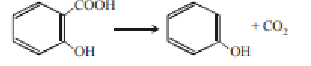
Determine the experimental condition for the following reaction:
1
In presence of KOH
2
On heating
3
In presence of NaOH
4
In presence of HCl
Official Solution
Correct Option:
(3)
Step 1: Understand the reaction. The given reaction shows the conversion of a carboxylic acid to an alcohol with the elimination of carbon dioxide. This type of reaction is typical for decarboxylation, which occurs in the presence of NaOH. Step 2: Conclusion. Thus, the reaction takes place in the presence of NaOH.
02
PYQ 2007
medium
chemistryID: viteee-2
In which of the below reactions do we find -unsaturated carbonyl compounds undergoing a ring closure reaction with conjugated dienes?
1
Perkin reaction
2
Diels-Alder reaction
3
Claisen rearrangement
4
Hoffman reaction
Official Solution
Correct Option:
(2)
Step 1: Identifying the reaction type. The Diels-Alder reaction is a cycloaddition reaction between a diene and a dienophile, often involving -unsaturated carbonyl compounds.
Step 2: Conclusion. Thus, the correct answer is option (B).
Final Answer:
03
PYQ 2007
medium
chemistryID: viteee-2
The epoxide ring consists of which of the following?
1
Three membered ring with two carbon and one oxygen
2
Four membered ring with three carbon and one oxygen
3
Five membered ring with four carbon and one oxygen
4
Six membered ring with five carbon and one oxygen
Official Solution
Correct Option:
(1)
Step 1: Structure of epoxide. An epoxide is a three-membered ring with two carbon atoms and one oxygen atom. It is a cyclic ether with highly strained bonds.
Step 2: Conclusion. Thus, the correct answer is option (A).
Final Answer:
04
PYQ 2007
medium
chemistryID: viteee-2
In the Grignard reaction, which metal forms an organometallic bond?
1
Sodium
2
Titanium
3
Magnesium
4
Palladium
Official Solution
Correct Option:
(3)
Step 1: Grignard reagents. Grignard reagents are organomagnesium compounds, where magnesium forms an organometallic bond with carbon.
Step 2: Conclusion. Thus, the correct answer is option (C).
Final Answer:
05
PYQ 2008
medium
chemistryID: viteee-2
CH CH + HNO
1
CH CH NO
2
CH CH NO + CH NO
3
2CH NO
4
CH =CH
Official Solution
Correct Option:
(2)
Step 1: Identify the reaction type. Ethane reacts with nitric acid at high temperature (around 675 K) to give nitroalkanes via free radical substitution. Step 2: Explain product formation. In ethane, both carbon atoms are equivalent, but radical substitution can lead to formation of two nitro products due to different radical fragmentation pathways: - Nitroethane: CH CH NO - Nitromethane: CH NO Step 3: Conclude the correct option. Thus, the mixture of CH CH NO and CH NO is obtained. Final Answer:
06
PYQ 2008
medium
chemistryID: viteee-2
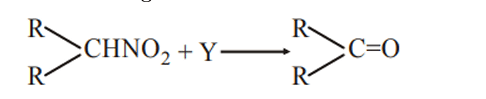
Secondary nitroalkanes can be converted into ketones by using Y. Identify Y from following
1
Aqueous HCl
2
Aqueous NaOH
3
KMnO
4
CO
Official Solution
Correct Option:
(1)
Step 1: Recall reaction of secondary nitroalkanes. Secondary nitroalkanes ( ) upon hydrolysis in acidic medium form ketones. This is known as Nef reaction. Step 2: Nef reaction condition. The nitroalkane is first converted into nitronate salt in base, then acid hydrolysis gives carbonyl compound. But the final conversion to ketone needs aqueous acid (HCl). Step 3: Conclusion. Thus reagent Y is aqueous HCl. Final Answer:
07
PYQ 2008
medium
chemistryID: viteee-2
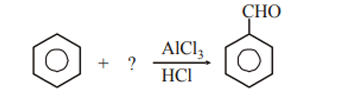
Identify the reactant
1
H O
2
HCHO
3
CO
4
CH CHO
Official Solution
Correct Option:
(3)
Step 1: Identify reaction shown. Benzene is converted into benzaldehyde in presence of and HCl. This is the Gattermann–Koch reaction. Step 2: Reactants of Gattermann–Koch reaction. The formyl group is introduced using:
in presence of (and often CuCl). Step 3: Conclusion. So the missing reactant is carbon monoxide . Final Answer:
08
PYQ 2008
medium
chemistryID: viteee-2
Hydroboration oxidation of 4-methyl-octene would give
1
4-methyl octanol
2
2-methyl decane
3
4-methyl heptanol
4
4-methyl-2-octanone
Official Solution
Correct Option:
(1)
Step 1: Recall hydroboration-oxidation reaction. Hydroboration-oxidation converts an alkene into an alcohol by anti-Markovnikov addition. Reagents:
Step 2: Nature of addition. OH group attaches to the less substituted carbon of the double bond (anti-Markovnikov rule). Step 3: Apply to 4-methyl-octene. Since the alkene has 8 carbon chain with a methyl group at position 4, the product remains an octanol derivative. So the product formed is 4-methyl octanol. Final Answer:
09
PYQ 2009
medium
chemistryID: viteee-2
Identify the alkyne in the following sequence of reactions: Alkyne A
1
2
3
4
Official Solution
Correct Option:
(1)
Step 1: Understand Lindlar reduction. Lindlar catalyst reduces an alkyne to a cis-alkene. So starting alkyne becomes an alkene . Step 2: Use ozonolysis clue. Ozonolysis breaks the double bond to give carbonyl compounds. If ozonolysis gives only one type of product, the alkene must be symmetric. Step 3: Check which alkyne gives symmetric alkene. (A) is symmetric, gives cis-2-butene. cis-2-butene on ozonolysis gives only one kind of product: acetaldehyde (2 moles). Other options are unsymmetrical, giving two different products. Step 4: Hence correct alkyne is option (A). Final Answer:
10
PYQ 2009
medium
chemistryID: viteee-2
One percent composition of an organic compound is carbon: and hydrogen . Its vapour density is . Consider the following reaction sequence:
Identify .
1
2
3
4
Official Solution
Correct Option:
(2)
Step 1: Determine molecular formula of . Assume :
Ratio:
Empirical formula:
Step 2: Use vapour density to find molar mass.
Empirical mass of . So molecular formula:
Thus (ethene). Step 3: Reaction with . Ethene gives chlorohydrin:
So . Step 4: Reaction with followed by hydrolysis.
So:
Final Answer:
11
PYQ 2009
medium
chemistryID: viteee-2
One mole of alkene on ozonolysis gave one mole of acetate aldehyde and one mole of acetone. IUPAC name of is
1
-methyl- -butene
2
-methyl- -butene
3
-butene
4
-butene
Official Solution
Correct Option:
(1)
Step 1: Use ozonolysis rule. Ozonolysis breaks the double bond and converts both carbon atoms of double bond into carbonyl groups. Step 2: Identify products. Products are: - Acetaldehyde: - Acetone: Step 3: Reconstruct the alkene. Acetaldehyde comes from a carbon having and . Acetone comes from a carbon having two groups. Thus alkene must be:
Step 4: Name the alkene. This is -methyl- -butene. Final Answer:
12
PYQ 2010
medium
chemistryID: viteee-2
In the reaction sequence: The product is
1
succinic acid
2
malonic acid
3
oxalic acid
4
maleic acid
Official Solution
Correct Option:
(1)
Step 1: Identify . with alcoholic KOH undergoes dehydrohalogenation (elimination) to form ethene: Step 2: Identify . Ethene adds bromine in presence of to form 1,2-dibromoethane: Step 3: Identify . 1,2-dibromoethane reacts with KCN and both bromines are replaced by CN groups, giving dicyanoethane: Step 4: Final hydrolysis to acid . On acidic hydrolysis, both groups convert to : This is succinic acid. Final Answer:
13
PYQ 2011
medium
chemistryID: viteee-2
undergoes Wurtz reaction. We may expect some of the following products:
1
2
3
4
Official Solution
Correct Option:
(3)
Step 1: Understand the Wurtz reaction. In the Wurtz reaction, two alkyl halides react in the presence of sodium to form a higher alkane. In this case, the reaction leads to the formation of , which is the expected product. Step 2: Conclusion. Thus, the product of the Wurtz reaction for is . Final Answer:
14
PYQ 2011
medium
chemistryID: viteee-2
An alkene having molecular formula on ozonolysis yields glyoxal and 2, 2-dimethyl butane-1, 4-dial. The structure of the alkene is:
1
A
2
B
3
C
4
D
Official Solution
Correct Option:
(2)
Step 1: Understand the reaction mechanism. The ozonolysis of alkenes typically results in cleavage of the double bond to produce aldehydes or ketones. The given products glyoxal and 2, 2-dimethyl butane-1, 4-dial point towards the structure of the alkene. Step 2: Conclusion. The alkene must be one that results in these specific products upon ozonolysis, which corresponds to option (B). Final Answer:
15
PYQ 2012
medium
chemistryID: viteee-2
The IUPAC name of the compound is
1
pent-4-yn-2-ene
2
pent-3-en-1-yne
3
pent-2-en-4-yne
4
pent-1-yn-3-ene
Official Solution
Correct Option:
(2)
The compound is a conjugated system with both a double bond and a triple bond. Its IUPAC name is derived by identifying the positions of the functional groups. The correct name is pent-3-en-1-yne.
Step 2: Conclusion.
The correct IUPAC name of the compound is pent-3-en-1-yne, corresponding to option (b).
16
PYQ 2014
medium
chemistryID: viteee-2
Which of the following compounds cannot be prepared singly by the Wurtz reaction?
1
2
3
4
All of the above can be prepared
Official Solution
Correct Option:
(4)
The Wurtz reaction can be used to prepare alkanes by the coupling of two alkyl halides in the presence of sodium. All of the given compounds can be synthesized through this reaction.
17
PYQ 2014
medium
chemistryID: viteee-2
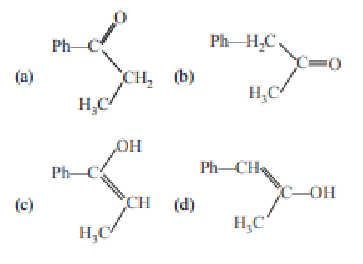
Ph—C=C—CH, undergoes Hg2+ / H+ to give?
1
A
2
B
3
C
4
D
Official Solution
Correct Option:
(1)
The reaction is an example of a nucleophilic addition reaction, where the mercury ion adds to the double bond, leading to the formation of the product.
18
PYQ 2015
medium
chemistryID: viteee-2
Which of the following reactions is used to prepare isobutane?
1
Wurtz reaction of
2
Hydrolysis of n-butylmagnesium iodide
3
Reduction of propanol with red phosphorus and HI
4
Decarboxylation of 3-methylbutanoic acid
Official Solution
Correct Option:
(1)
The Wurtz reaction of leads to the formation of isobutane by coupling two ethyl groups in the presence of sodium.
19
PYQ 2015
medium
chemistryID: viteee-2
The false statements among the following are I. A primary carbocation is less stable than a tertiary carbocation.
II. A secondary propyl carbocation is less stable than allyl carbocation.
III. A tertiary free radical is more stable than a primary free radical.
IV. Isopropyl carbocation is more stable than ethyl carbocation.
1
I and II
2
II and III
3
I and IV
4
II and IV
Official Solution
Correct Option:
(3)
The false statements are: - Statement I: A primary carbocation is less stable than a tertiary carbocation. This is false because a tertiary carbocation is more stable due to alkyl groups providing inductive and hyperconjugative stabilization. - Statement IV: Isopropyl carbocation is more stable than ethyl carbocation. This is false because ethyl carbocation is more stable than isopropyl carbocation, as the inductive effects of alkyl groups play a role.
20
PYQ 2016
medium
chemistryID: viteee-2
Which type of carbocation is/are formed when is treated with an acid?
1
1°
2
2°
3
3°
4
All the three
Official Solution
Correct Option:
(4)
Step 1: Carbocation Formation.
When an alcohol (OH) is treated with an acid, it undergoes dehydration to form carbocations. Depending on the structure, 1°, 2°, or 3° carbocations can be formed. All types can form under the right conditions. Step 2: Conclusion.
The correct answer is (D), All the three.
21
PYQ 2018
medium
chemistryID: viteee-2
HBr reacts with under anhydrous conditions at room temperature to give:
1
2
3
and
4
Official Solution
Correct Option:
(1)
Step 1: When HBr reacts with alkenes in the presence of anhydrous conditions, it adds across the double bond. Step 2: The product formed is a bromoether, where the Br atom adds to the carbon adjacent to the ether group.
Final Answer:
22
PYQ 2019
medium
chemistryID: viteee-2
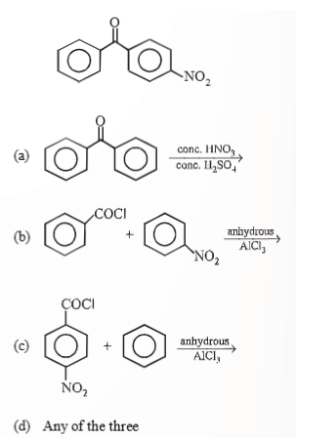
Which are the starting materials for the preparation of the compound shown in the figure?
1
A
2
B
3
C
4
D
Official Solution
Correct Option:
(4)
The given structure corresponds to a nitrated aromatic compound. The possible starting materials could include various sources of nitration such as conc. nitric acid, conc. sulfuric acid, and a chlorination source like with aluminum chloride. Final Answer:
23
PYQ 2019
medium
chemistryID: viteee-2
An alkene of molecular formula on ozonolysis gives -dimethylpropanal and -butanone, then the alkene is:
1
2,2,4-trimethyl-3-hexene
2
2,2,6-trimethyl-3-hexene
3
2,3,4-trimethyl-2-hexene
4
2,2-dimethyl-2-heptene
Official Solution
Correct Option:
(1)
The ozonolysis of the alkene breaks it into aldehydes and ketones. Based on the product distribution, the alkene with the given formula is -trimethyl-3-hexene. Final Answer:
24
PYQ 2019
medium
chemistryID: viteee-2
When acetylene is passed into methanol at 160-200°C in the presence of a small amount of potassium methoxide under pressure, the following is formed:
1
Polyvinyl alcohol
2
Divinyl ether
3
Dimethyl ether
4
Methyl vinyl ether
Official Solution
Correct Option:
(4)
The reaction between acetylene and methanol under these conditions forms methyl vinyl ether through an addition reaction. Final Answer:
25
PYQ 2021
medium
chemistryID: viteee-2
The value of for a reaction is (Given: , and )
1
5
2
10
3
95
4
100
Official Solution
Correct Option:
(2)
To calculate the value of , we use the equation:
Using the relation , we can substitute the values and simplify the expression, resulting in .
26
PYQ 2021
medium
chemistryID: viteee-2
Xenon hexafluoride on partial hydrolysis produces compounds 'X' and 'Y'. Compounds 'X', 'Y' and the oxidation state of Xe are respectively:
1
XeOF (+6) and XeO (+6)
2
XeO (+4) and XeO (+6)
3
XeOF (+6) and XeO F (+6)
4
XeO F (+6) and XeO (+4)
Official Solution
Correct Option:
(3)
Step 1: Hydrolysis of Xenon Hexafluoride.
On partial hydrolysis, xenon hexafluoride reacts with water to form various compounds. The products formed are Xenon oxyfluoride and xenon dioxide fluoride.
Step 2: Oxidation states.
The oxidation state of Xenon in XeOF is +6, and in XeO F , it is also +6.
27
PYQ 2025
medium
chemistryID: viteee-2
The functional group in ethers is:
1
–OH
2
–CHO
3
–O–
4
–COOH
Official Solution
Correct Option:
(3)
Ethers have an oxygen atom bonded to two alkyl/aryl groups.
About Hydrocarbons - VITEEE
Hydrocarbons is a vital chapter for VITEEE aspirants. Mastering the concepts covered in this chapter is essential for securing a top rank.
By rigorously practicing the previous year questions associated with this chapter, you can identify high-yield topics, understand the examiner's perspective, and boost your confidence during the actual exam.
Frequently Asked Questions
Why focus on Hydrocarbons PYQs?
Analyzing PYQs for this specific chapter reveals the most frequently tested concepts and the typical complexity of questions, allowing you to tailor your study plan efficiently.
How to best use this analysis?
Review the topic breakdown to see which sub-topics within Hydrocarbons carry the most weight. Then, tackle the questions iteratively to solidify your understanding.