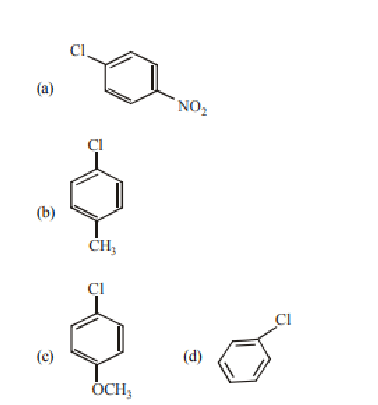
Which of the following compounds undergoes nucleophilic substitution reaction most easily?
1
A
2
B
3
C
4
D
Official Solution
Correct Option: (1)
In nucleophilic substitution reactions, the reactivity depends on the nature of the leaving group. Chlorine in is a good leaving group, making this compound most reactive towards nucleophilic substitution.
Step 2: Conclusion.
The compound undergoes nucleophilic substitution most easily, corresponding to option (a).
02
PYQ 2022
medium
chemistryID: viteee-2
An alkene having molecular formula was subjected to ozonolysis in the presence of zinc dust. An equimolar amount of the following two compounds was obtained. The IUPAC name of the alkene is:
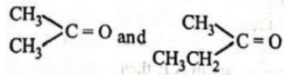
1
3,4-dimethyl-3-pentene
2
3,4-dimethyl-2-pentene
3
2,3-dimethyl-3-pentene
4
2,3-dimethyl-2-pentene
Official Solution
Correct Option: (4)
Step 1: Ozonolysis of alkenes cleaves the carbon-carbon double bond, yielding two carbonyl compounds. The formation of equimolar amounts of the products indicates that the alkene has symmetrical substituents. Step 2: The molecular formula suggests a simple alkene with two methyl groups attached to the main chain. Step 3: The correct IUPAC name of the alkene is 2,3-dimethyl-2-pentene, which contains two methyl groups at the 2nd and 3rd positions on the pentene chain.
03
PYQ 2022
medium
chemistryID: viteee-2
Which of the following order is not correct?
1
(SN2)
2
(SN1)
3
(SN2)
4
All are correct
Official Solution
Correct Option: (2)
Step 1: In SN1 reactions, the rate-determining step involves the departure of the leaving group, followed by the formation of a carbocation. The more stable the carbocation, the faster the reaction. Step 2: The stability of the carbocation depends on the groups attached to the carbon bearing the leaving group. In , the carbocation would be less stable due to the large steric hindrance from the phenyl groups. Step 3: Therefore, the order is incorrect as it does not follow the correct trend based on carbocation stability.
04
PYQ 2022
medium
chemistryID: viteee-2
Rate of dehydration of alcohols follows the order:
1
2
3
4
Official Solution
Correct Option: (2)
Step 1: The rate of dehydration of alcohols follows the order of stability of the carbocation formed during the reaction. Step 2: Tertiary alcohols ( ) form the most stable carbocation, followed by secondary alcohols ( ), primary alcohols ( ), and methanol ( ), which does not form a stable carbocation. Step 3: Thus, the correct order is .
05
PYQ 2022
medium
chemistryID: viteee-2
Which one of the following reactions will not result in the formation of a carbon-carbon bond?
1
Reimer-Tiemann reaction
2
Friedel Craft's acylation
3
Wurtz reaction
4
Cannizzaro reaction
Official Solution
Correct Option: (4)
Step 1: The Reimer-Tiemann reaction involves the formylation of an aromatic compound, which results in the formation of a carbon-carbon bond between the aromatic ring and the formyl group ( bond). Therefore, a C-C bond is formed. Step 2: Friedel Craft's acylation is a reaction where an acyl group ( ) is attached to an aromatic ring, leading to the formation of a new C-C bond. Step 3: The Wurtz reaction involves the coupling of two alkyl halides in the presence of sodium metal, forming a new C-C bond between the two alkyl groups. Step 4: In the Cannizzaro reaction, there is no formation of a new C-C bond. Instead, the reaction involves the disproportionation of non-enolizable aldehydes, leading to the formation of an alcohol and a carboxylate anion without the formation of a new C-C bond. Step 5: Therefore, the correct answer is the Cannizzaro reaction, as it does not form a new C-C bond.
06
PYQ 2022
medium
chemistryID: viteee-2
A catalyst is a substance which:
1
is always in the same phase as in the reaction
2
alters the equilibrium in a reaction
3
does not participate in the reaction but alters the rate of reaction
4
participates in the reaction and provides an easier pathway for the same
Official Solution
Correct Option: (3)
Step 1: A catalyst is a substance that increases the rate of a reaction without being consumed in the reaction. It provides an alternative reaction pathway with a lower activation energy. Step 2: A catalyst does not alter the equilibrium position; it only speeds up the rate of reaction by lowering the energy barrier. Step 3: Therefore, the correct answer is that a catalyst does not participate in the reaction but alters the rate of the reaction.
07
PYQ 2022
medium
chemistryID: viteee-2
Which of the following is a non-reducing sugar?
1
Lactose
2
Fructose
3
Sucrose
4
Maltose
Official Solution
Correct Option: (3)
Step 1: A non-reducing sugar is one that does not have a free aldehyde or ketone group capable of reducing other compounds. Step 2: Sucrose is a disaccharide composed of glucose and fructose, and it does not have a free reducing group because both anomeric carbons are involved in the glycosidic bond. Hence, it is a non-reducing sugar. Step 3: In contrast, lactose, fructose, and maltose all have free reducing groups and can reduce other substances.
08
PYQ 2022
medium
chemistryID: viteee-2
The IUPAC name of the following compound is:
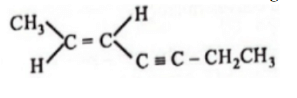
1
2
3
4
Official Solution
Correct Option: (1)
Step 1: The compound has both a double bond and a triple bond, so we need to identify the positions of the double and triple bonds. The IUPAC naming rules state that the lowest set of locants should be used for the multiple bonds. Step 2: The correct location for the double and triple bonds in this compound is at positions 2 and 4, respectively. The correct stereochemistry of the double bond is , which refers to the trans configuration of the substituents. Step 3: Hence, the correct IUPAC name is .
09
PYQ 2022
medium
chemistryID: viteee-2
Which of the following is not present in a nucleotide?
1
Guanine
2
Cytosine
3
Adenine
4
Tyrosine
Official Solution
Correct Option: (4)
Step 1: Nucleotides are the building blocks of nucleic acids, consisting of three components: a nitrogenous base (purine or pyrimidine), a phosphate group, and a sugar (either ribose or deoxyribose). Step 2: The nitrogenous bases found in nucleotides include purines such as adenine (A) and guanine (G), and pyrimidines such as cytosine (C) and thymine (T) (in DNA) or uracil (U) (in RNA). Step 3: Tyrosine is an amino acid, not a nitrogenous base, so it is not part of a nucleotide.
10
PYQ 2022
medium
chemistryID: viteee-2
Heroin is a derivative of:
1
Cocaine
2
Morphine
3
Caffeine
4
Nicotine
Official Solution
Correct Option: (2)
Step 1: Heroin is an opioid drug synthesized from morphine, which is derived from the opium poppy. Morphine is the precursor to heroin. Step 2: Heroin is chemically diacetylmorphine, meaning that it is morphine with two acetyl groups added to the molecule. Step 3: Therefore, heroin is a derivative of morphine, not cocaine, caffeine, or nicotine.
11
PYQ 2023
medium
chemistryID: viteee-2
Indicate the complex ion which shows geometrical isomerism.
1
2
3
4
Official Solution
Correct Option: (1)
Step 1: Understanding geometrical isomerism. - Geometrical isomerism occurs in square planar and octahedral complexes when ligands can be arranged in cis and trans positions. Step 2: Identifying the correct complex. - is an octahedral complex with two identical ligands ( ), which can be cis or trans.
12
PYQ 2023
medium
chemistryID: viteee-2
2-Pentene contains:
1
15 - and one -bond
2
14 - and one -bond
3
15 - and two -bonds
4
14 - and two -bonds
Official Solution
Correct Option: (2)
Step 1: Understanding bonding in 2-Pentene. - 2-Pentene ( ) is an alkene with a double bond between C2 and C3. - A single bond is a sigma ( ) bond, while a double bond consists of one and one bond. Step 2: Counting the bonds. 1. C-C and C-H single bonds are sigma ( ) bonds. 2. One double bond (C2=C3) contributes one sigma and one pi bond. 3. Total sigma bonds = 14.
4. Total pi bonds = 1. Step 3: Identifying the correct answer. - Since 2-Pentene has 14 sigma and one pi bond, the correct option is (B).
13
PYQ 2023
medium
chemistryID: viteee-2
Sucrose, which is dextrorotatory in nature, after hydrolysis gives glucose and fructose, among which: (i) Glucose is laevorotatory and fructose is dextrorotatory. (ii) Glucose is dextrorotatory and fructose is laevorotatory. (iii) The mixture is laevorotatory. (iv) Both are dextrorotatory.
1
(i) and (iii)
2
(iii) and (iv)
3
(ii) and (iii)
4
(iii) only
Official Solution
Correct Option: (2)
Step 1: Understanding the hydrolysis of sucrose. - Sucrose is dextrorotatory ( ), meaning it rotates plane-polarized light to the right. - Upon hydrolysis, it yields glucose and fructose. Step 2: Identifying the optical rotation of products. - Glucose is dextrorotatory ( ). - Fructose is laevorotatory ( ). Step 3: Determining the optical rotation of the mixture. - Since fructose has a higher magnitude of rotation than glucose, the mixture is net laevorotatory. - Hence, statements (iii) and (iv) are correct.
14
PYQ 2023
medium
chemistryID: viteee-2
and are the vapor pressures of pure liquid components A and B, respectively, in an ideal binary solution. If represents the mole fraction of component A, the total pressure of the solution will be:
1
2
3
4
Official Solution
Correct Option: (4)
Step 1: Applying Raoultās Law. - According to Raoultās Law, the total vapor pressure of an ideal binary solution is:
- Since , we substitute: Step 2: Identifying the correct answer. - This matches option (D), so the correct answer is (D).
15
PYQ 2023
medium
chemistryID: viteee-2
In a reaction, the threshold energy is equal to:
1
Activation energy + normal energy of reactants
2
Activation energy - normal energy of reactants
3
Normal energy of reactants - activation energy
4
Average kinetic energy of molecules of reactants
Official Solution
Correct Option: (1)
Step 1: Understanding threshold energy. Threshold energy is the minimum energy required for a reaction to occur. It is given by: Step 2: Identifying the correct option. Since activation energy is the additional energy needed beyond the reactantās normal energy, the threshold energy is their sum.
16
PYQ 2023
medium
chemistryID: viteee-2
Which property of white phosphorus is common to red phosphorus?
1
It burns when heated in air.
2
It reacts with hot caustic soda solution to give phosphine.
3
It shows chemiluminescence.
4
It is soluble in carbon disulphide.
Official Solution
Correct Option: (1)
Step 1: Understanding the properties of phosphorus allotropes. - White phosphorus is highly reactive and catches fire in air. - Red phosphorus is more stable but can still burn in air under sufficient heating. Step 2: Identifying the common property. - White and red phosphorus both burn when heated in air, making option (A) correct.
17
PYQ 2023
medium
chemistryID: viteee-2
molecule is tetrahedral having:
1
Two bonds
2
One bond
3
Four bonds
4
Three bonds
Official Solution
Correct Option: (3)
Step 1: Understanding the bonding in . - Xenon has an expanded octet and forms four bonds with oxygen. - Each oxygen atom forms a bond with xenon. Step 2: Confirming the correct answer. - The molecule is tetrahedral with four bonds.
18
PYQ 2023
medium
chemistryID: viteee-2
What is the correct order of reactivity of alcohols in the following reaction? $ $
1
2
3
4
Official Solution
Correct Option: (3)
Step 1: Understanding the mechanism. - The reaction follows the SN1 mechanism, where the stability of the carbocation intermediate determines the rate. - The order of carbocation stability is , making tertiary alcohols most reactive.
19
PYQ 2023
medium
chemistryID: viteee-2
The Allyl cyanide molecule contains:
1
9 sigma bonds, 4 pi bonds, and no lone pair
2
9 sigma bonds, 3 pi bonds, and one lone pair
3
8 sigma bonds, 5 pi bonds, and one lone pair
4
8 sigma bonds, 3 pi bonds, and two lone pairs
Official Solution
Correct Option: (2)
Step 1: Understanding bond structure in allyl cyanide. - Allyl cyanide ( ) consists of: 1. A C=C double bond (1 sigma, 1 pi bond). 2. A Cā”N triple bond (1 sigma, 2 pi bonds). 3. Single bonds (C-H, C-C, C-N) contributing sigma bonds. Step 2: Counting bonds and lone pairs. - Sigma bonds: 9. - Pi bonds: 3 (1 from C=C and 2 from Cā”N). - Lone pairs: One on nitrogen.