Activation of benzene ring in aniline can be decreased by treating with:
1
Dil. HCl
2
Ethyl alcohol
3
Acetic acid
4
Acetyl chloride
Official Solution
Correct Option: (4)
Step 1: Effect of acetyl chloride on aniline. Acetylation of aniline with acetyl chloride decreases the electron density on the benzene ring, making it less reactive in electrophilic substitution reactions. Step 2: Conclusion. Thus, acetyl chloride decreases the activation of the benzene ring in aniline.
02
PYQ 2006
medium
chemistryID: viteee-2
On comparison with H–C–H bond angle of methane, the C–N–C bond angle of trimethylamine is:
1
Higher
2
No change
3
Not comparable
4
Lower
Official Solution
Correct Option: (2)
Step 1: Bond angles in methane and trimethylamine. The C–N–C bond angle in trimethylamine is very similar to the H–C–H bond angle in methane due to the sp hybridization of both carbon and nitrogen atoms. Step 2: Conclusion. Thus, the C–N–C bond angle in trimethylamine does not differ from the H–C–H bond angle in methane.
03
PYQ 2006
medium
chemistryID: viteee-2
The transition of acylazide (RCON ) with acidic or alkaline medium gives:
1
RCONH
2
R–NH
3
RCOCH
4
RCOOH
Official Solution
Correct Option: (2)
Step 1: Understand the reaction of acylazides. Acylazides ( ) undergo a nucleophilic substitution reaction with water or other nucleophiles, producing amides ( ). Step 2: Conclusion. Thus, acylazide in acidic or alkaline medium reacts to form R–NH .
04
PYQ 2006
medium
chemistryID: viteee-2
The sequence of basic strength of alkyl amines follows the order:
1
RNH >R NH>R N
2
RNH >R N>R NH
3
R NH>RNH >R N
4
R N>RNH >R NH
Official Solution
Correct Option: (1)
Step 1: Basic strength of alkyl amines. The basic strength of alkyl amines decreases as the number of alkyl groups increases because alkyl groups are electron-donating and increase the electron density on nitrogen. More alkyl groups make the nitrogen less available to accept protons. Step 2: Conclusion. Thus, the basic strength order is RNH >R NH>R N.
05
PYQ 2007
medium
chemistryID: viteee-2
The correct sequence of base strengths in aqueous solution is
1
2
3
4
Official Solution
Correct Option: (1)
Step 1: Understanding base strengths. The basicity of amines is influenced by the availability of the lone pair of electrons on nitrogen. In alkylamines, as the number of alkyl groups increases, the electron-donating ability increases, making the amine more basic.
Step 2: Conclusion. Thus, the correct order of base strengths is .
Final Answer:
06
PYQ 2007
medium
chemistryID: viteee-2
When aqueous solution of benzene diazonium chloride is boiled, the product formed is
1
2
3
4
Official Solution
Correct Option: (3)
Step 1: Reaction of diazonium salts. When diazonium salts are heated or boiled in water, they undergo hydrolysis, leading to the formation of phenol.
Step 2: Conclusion. Thus, the correct product formed is phenol , so the correct answer is option (C).
Final Answer:
07
PYQ 2007
medium
chemistryID: viteee-2
The carbamylation reaction is given by aliphatic
1
primary amine
2
secondary amine
3
tertiary amine
4
quaternary ammonium salt
Official Solution
Correct Option: (1)
Step 1: Understanding carbamylation. The carbamylation reaction involves the reaction of a primary amine with isocyanates to form a carbamate (urethane) derivative. This reaction typically occurs with primary amines.
Step 2: Conclusion. Thus, the correct answer is option (A).
Final Answer:
08
PYQ 2008
medium
chemistryID: viteee-2
When acetamide is hydrolysed by boiling with acid, the product obtained is
1
acetic acid
2
ethyl amine
3
ethanol
4
acetamide
Official Solution
Correct Option: (1)
Step 1: Write the compound formula. Acetamide is:
Step 2: Acidic hydrolysis of amides. Amides on hydrolysis with acid produce carboxylic acid and ammonium salt.
Step 3: Identify the organic product. The main organic product is acetic acid (CH COOH). Final Answer:
09
PYQ 2008
medium
chemistryID: viteee-2
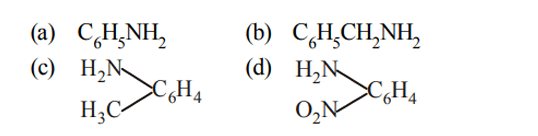
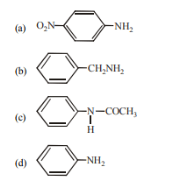
Which will not go for diazotization?
1
A
2
B
3
C
4
D
Official Solution
Correct Option: (2)
Step 1: Meaning of diazotization. Diazotization is the reaction of primary aromatic amines with nitrous acid (NaNO /HCl at 0–5°C) to form diazonium salts. Step 2: Check each option. (A) Aniline (C H NH ) is primary aromatic amine undergoes diazotization. (C) Toluidine derivative still primary aromatic amine undergoes diazotization. (D) Nitroaniline derivative still aromatic primary amine (though slower) undergoes diazotization. (B) Benzylamine (C H CH NH ) is primary aliphatic amine (amino group not directly on aromatic ring). Aliphatic diazonium salts are unstable and decompose immediately, so it is considered that it does not undergo diazotization. Final Answer:
10
PYQ 2009
easy
chemistryID: viteee-2
Consider the following reaction:
Which one of the following statements is true for ? (I) It gives propionic acid on hydrolysis (II) It has an ester functional group (III) It has nitrogen linked to ethyl carbon (IV) It has a cyanide group
1
IV
2
III
3
II
4
I
Official Solution
Correct Option: (2)
Step 1: Recall difference between and . - gives alkyl cyanides ( ) because attacks through carbon. - gives alkyl isocyanides ( ) because attack occurs through nitrogen. Step 2: Apply to given reaction.
So product is ethyl isocyanide. Step 3: Check which statement is true. In , ethyl group is attached to nitrogen:
Thus statement (III) is true. Final Answer:
11
PYQ 2009
medium
chemistryID: viteee-2
In Gattermann reaction, a diazonium group is replaced by using . and are
1
;
2
;
3
;
4
;
Official Solution
Correct Option: (1)
Step 1: Recall Gattermann reaction. Gattermann reaction replaces diazonium group with halogen using copper powder and HX. Step 2: For chlorine substitution. When is introduced, reagent used is:
Step 3: Identify correct pair. Thus:
Final Answer:
12
PYQ 2010
medium
chemistryID: viteee-2
Which of the following converts to ?
1
NaBr
2
NaOBr
3
4
None of the above
Official Solution
Correct Option: (2)
Step 1: Identify required conversion. This is conversion of an amide to an amine with one carbon less. Step 2: Name of reaction. This is Hofmann bromamide reaction (Hofmann rearrangement). Step 3: Reagent used. Hofmann rearrangement uses in presence of strong base which forms in situ. Thus reagent is . Final Answer:
13
PYQ 2010
medium
chemistryID: viteee-2
Nitrobenzene can be converted into azobenzene by reduction with
1
2
3
4
Official Solution
Correct Option: (2)
Step 1: Identify reduction product based on conditions. Nitrobenzene reduction can give different products depending on medium. In alkaline medium, partial reduction and coupling leads to azo compounds. Step 2: Alkaline reduction produces azobenzene. Using in presence of alcohol (methanol), nitrobenzene reduces and couples to form: which is azobenzene. Step 3: Why other reagents do not form azo. gives aniline. is mild acidic, gives phenylhydroxylamine/aniline. Final Answer:
14
PYQ 2010
medium
chemistryID: viteee-2
The one which is least basic is
1
2
3
4
Official Solution
Correct Option: (3)
Step 1: Basicity depends on availability of lone pair. More available lone pair stronger base. Step 2: Compare aromatic amines. In aniline and its derivatives, lone pair on nitrogen delocalizes into benzene ring by resonance, reducing basicity. Step 3: Triphenylamine case. In , lone pair is delocalized into three phenyl rings. So resonance withdrawal is maximum and lone pair becomes least available for protonation. Hence it is least basic. Final Answer:
15
PYQ 2010
medium
chemistryID: viteee-2
When p-nitrobromobenzene reacts with sodium ethoxide, the product obtained is
1
p-nitroanisole
2
ethyl phenyl ether
3
p-nitrophenetole
4
no reaction occurs
Official Solution
Correct Option: (3)
Step 1: Reaction type (Nucleophilic substitution). p-nitrobromobenzene has a strong electron withdrawing group at para position. This activates benzene ring towards nucleophilic substitution (SNAr). Step 2: Role of sodium ethoxide. Sodium ethoxide acts as nucleophile. It replaces bromine on aromatic ring. Step 3: Product formed. Replacement of Br by gives p-nitrophenetole. Final Answer:
16
PYQ 2011
medium
chemistryID: viteee-2
Self condensation of two moles of ethyl acetate in the presence of sodium ethoxide after acidification yields:
1
acetic acid
2
acetoacetic ester
3
ethyl propionate
4
ethyl butyrate
Official Solution
Correct Option: (2)
Step 1: Understand the reaction. The self-condensation of two moles of ethyl acetate in the presence of sodium ethoxide leads to the formation of acetoacetic ester. This reaction is known as the Claisen condensation. Step 2: Conclusion. Thus, the product of the self-condensation is acetoacetic ester. Final Answer:
17
PYQ 2011
medium
chemistryID: viteee-2
Which one of the following will be most basic?
1
Aniline
2
p-methoxyaniline
3
p-methyl aniline
4
Benzylamine
Official Solution
Correct Option: (2)
Step 1: Understand basicity. The basicity of an amine is determined by the availability of the lone pair on nitrogen for protonation. Substituents that donate electron density (like methoxy) make the amine more basic, while electron-withdrawing groups (like nitro) decrease basicity. Step 2: Conclusion. p-Methoxyaniline, with its electron-donating methoxy group, will be the most basic among the options. Final Answer:
18
PYQ 2011
medium
chemistryID: viteee-2
The product formed when phthalimide is treated with a mixture of and strong NaOH solution is:
1
aniline
2
phthalamide
3
phthalic acid
4
anthranilic acid
Official Solution
Correct Option: (4)
Step 1: Reaction with and NaOH. The reaction of phthalimide with and NaOH leads to the formation of anthranilic acid through a nucleophilic substitution. Step 2: Explanation. Thus, phthalimide reacts with bromine and NaOH to produce anthranilic acid. Final Answer:
19
PYQ 2011
medium
chemistryID: viteee-2
-toluidine and benzyl amine can be distinguished by:
1
Sandmeyer's reaction
2
Dye test
3
Molisch test
4
Gattermann reaction
Official Solution
Correct Option: (2)
Step 1: Understanding the reactions. The dye test is a method to distinguish between different amines based on their reactivity. -toluidine and benzyl amine exhibit different behaviors during the test, which allows their differentiation. Step 2: Conclusion. Hence, the dye test is the correct way to distinguish between -toluidine and benzyl amine. Final Answer:
20
PYQ 2011
easy
chemistryID: viteee-2
Which one of the following will be most basic?
1
Aniline
2
p-methoxyaniline
3
p-methyl aniline
4
Benzylamine
Official Solution
Correct Option: (4)
In aniline, p-methoxyaniline and p-methyl aniline, the lone pair of electrons on the Natom is delocalised on the benzene ring while in benzylamine it is delocalised, and more available for donation. Hence benzylamine is most basic among the given.
21
PYQ 2012
medium
chemistryID: viteee-2
Which of the following compound is the most basic?
1
A
2
B
3
C
4
D
Official Solution
Correct Option: (2)
Among the given options, the ion is the most basic, as it can readily accept protons due to the lone pair on nitrogen.
Step 2: Conclusion.
The most basic compound is , corresponding to option (b).
22
PYQ 2013
medium
chemistryID: viteee-2
In a Claisen condensation reaction (when an ester is treated with a strong base)
1
A proton is removed from the -carbon to form a resonance stabilized carbanion of the ester.
2
Carbanion acts as a nucleophile in a nucleophilic acyl substitution reaction with another ester molecule.
3
A new bond is formed.
4
All of the above statements are correct.
Official Solution
Correct Option: (4)
Step 1: Understanding the Claisen condensation mechanism.
In a Claisen condensation, a strong base removes a proton from the -carbon of an ester. The resulting carbanion acts as a nucleophile and forms a new bond with another ester molecule.
Step 2: Conclusion.
All the statements provided are correct, corresponding to option (4).
23
PYQ 2013
medium
chemistryID: viteee-2
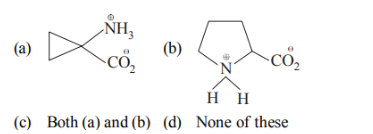
Which of the following is/are -amino acid?
1
A
2
B
3
C
4
D
Official Solution
Correct Option: (3)
Step 1: Definition of -amino acids.
In -amino acids, the amino group is attached to the carbon atom that is adjacent to the carboxyl group. Both structures given in options (1) and (2) describe -amino acids.
Step 2: Conclusion.
The correct answer is both (1) and (2), corresponding to option (3).
24
PYQ 2013
medium
chemistryID: viteee-2
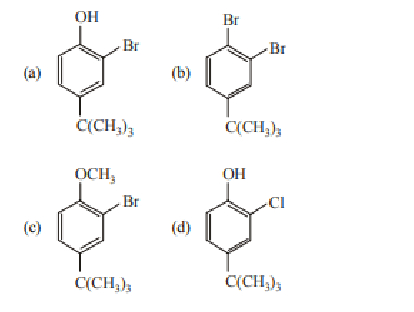
Treating anisole with the following reagents, the major product obtained is I. , CCl , II. Cl , FeCl , III. HBr, Heat
1
A
2
B
3
C
4
D
Official Solution
Correct Option: (4)
Step 1: Reagent action.
Anisole reacts with these reagents to form methylation of the aromatic ring with a methyl group from .
Step 2: Conclusion.
The major product formed is , corresponding to option (4).
25
PYQ 2013
medium
chemistryID: viteee-2
Benzene diazonium chloride on treatment with hypophosphorous acid and water yields benzene. Which of the following is used as a catalyst in this reaction?
1
2
Red P
3
4
Official Solution
Correct Option: (2)
Step 1: Understanding the reaction.
In the reduction of benzene diazonium chloride with hypophosphorous acid and water, red phosphorus ( ) is commonly used as the catalyst. This reduces the diazonium ion to produce benzene.
Step 2: Conclusion.
The catalyst used in this reaction is red phosphorus, corresponding to option (2).
26
PYQ 2016
medium
chemistryID: viteee-2
The product P in this reaction is
1
2
3
4
Official Solution
Correct Option: (1)
Step 1: LiAlH4 Reduction.
Lithium aluminium hydride (LiAlH4) is a strong reducing agent and can reduce nitriles (R-C≡N) to primary amines (R-NH2). Step 2: Conclusion.
The correct answer is (A), .
27
PYQ 2017
medium
chemistryID: viteee-2
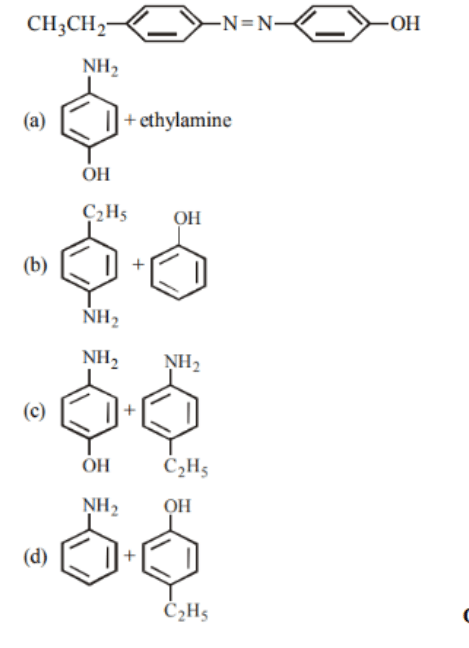
The starting reagents needed to make the azo compound shown below
1
A
2
B
3
C
4
D
Official Solution
Correct Option: (1)
Step 1: Identify the reaction type.
The azo compound shown is likely formed by a diazotization reaction involving ethylamine and CH CH . Step 2: Conclusion.
Thus, the starting reagents needed are CH CH and ethylamine. Final Answer:
28
PYQ 2017
medium
chemistryID: viteee-2
An organic compound (A) on reduction gives compound (B). (B) on treatment with CHCl and alcoholic KOH gives N-methyl aniline. The compound A is
1
Methylamine
2
Aniline
3
Nitromethane
4
Nitrobenzene
Official Solution
Correct Option: (4)
Step 1: Analyze the reaction sequence.
Compound A must be nitrobenzene, as its reduction and subsequent treatment with CHCl and alcoholic KOH lead to the formation of N-methyl aniline. Step 2: Conclusion.
Thus, the compound A is nitrobenzene. Final Answer:
29
PYQ 2018
medium
chemistryID: viteee-2
In the series of reaction
X and Y are respectively:
1
2
3
4
Official Solution
Correct Option: (2)
Step 1: The reaction of aniline with nitrous acid leads to diazotization to form a diazonium salt. Step 2: On further reaction with HNO₃, a substitution reaction occurs, producing a compound with a nitro group attached to the phenyl ring.
Final Answer:
30
PYQ 2018
medium
chemistryID: viteee-2
An organic compound (A), when treated with nitrous acid, gave an alcohol and gas was evolved. (A) on warming with and caustic potash gave (C), which on reduction gave isopropylmethylamine. Predict the structure of (A):
1
2
3
4
Official Solution
Correct Option: (3)
Step 1: Nitrous acid reacts with primary amines to form alcohols and release gas. The reaction suggests a primary amine group. Step 2: The structure of the compound formed on reduction suggests an amine group with two alkyl groups attached. This is consistent with isopropylmethylamine.
Final Answer:
31
PYQ 2018
medium
chemistryID: viteee-2
Nitrosamines are soluble in water. On heating them with concentrated , they give secondary amines. This reaction is called:
1
Perkin reaction
2
Sandmeyer’s reaction
3
Fitting reaction
4
Liebermann nitroso reaction
Official Solution
Correct Option: (4)
Step 1: The reaction of nitrosamines with concentrated forms secondary amines and is classified as a nitroso reaction. Step 2: The reaction follows the mechanism of the Liebermann nitroso reaction, which involves the formation of secondary amines.
Final Answer:
32
PYQ 2019
medium
chemistryID: viteee-2
Starting from propanoic acid, the following reactions were carried out:
1
Benzoic acid
2
Salicylaldehyde
3
Chlorobenzene
4
Salicylic acid
Official Solution
Correct Option: (4)
This sequence of reactions converts propanoic acid to salicylic acid by first converting it to an acyl chloride using thionyl chloride (SOCl2), then reacting with ammonia (NH3), followed by bromination and hydrolysis. Final Answer:
33
PYQ 2019
medium
chemistryID: viteee-2
Which compound can exist in a dipolar (zwitter) state?
1
2
3
4
Official Solution
Correct Option: (1)
A zwitterion is a molecule with both positive and negative charges on different atoms. Compound (1) exists in this state due to the amine and carboxyl groups. Final Answer:
34
PYQ 2021
medium
chemistryID: viteee-2
Which of the following reactions can produce aniline as the main product?
1
2
3
4
Official Solution
Correct Option: (4)
Step 1: Reduction of nitrobenzene.
Aniline can be obtained by reducing nitrobenzene with zinc in hydrochloric acid.
Step 2: Final product.
Thus, the correct reaction is , which produces aniline as the main product.