Step 1: Naming coordination complexes. The given complex consists of nickel coordinated with ligands. The correct way to name this is as "Tetra(phosphorus (III) fluoride) nickel." Step 2: Conclusion. Thus, the correct name is "Tetra(phosphorus (III) fluoride) nickel."
02
PYQ 2006
medium
chemistryID: viteee-2
NH , group in a coordination compound is named as:
1
Ammine
2
Ammonia
3
Ammonium
4
Ammonium ion
Official Solution
Correct Option:
(1)
Step 1: Naming conventions in coordination compounds. In coordination chemistry, the ligand derived from ammonia is named "ammine," not ammonia. Step 2: Conclusion. Thus, the correct name for NH in coordination compounds is "ammine."
03
PYQ 2006
medium
chemistryID: viteee-2
The magnetic moment of lanthanide ions is determined from which one of the following relation?
1
2
3
4
Official Solution
Correct Option:
(2)
Step 1: Understanding the relation for magnetic moment. The magnetic moment of lanthanide ions is typically given by the relation: Where is the total angular momentum quantum number, and is the g-factor. Step 2: Conclusion. Thus, the correct relation is .
04
PYQ 2006
medium
chemistryID: viteee-2
How many isomers does have?
1
1
2
2
3
3
4
4
Official Solution
Correct Option:
(3)
Step 1: Isomerism in coordination compounds. The isomerism in coordination compounds arises from the different ways the ligands can be arranged around the central metal ion. Step 2: Conclusion. The compound has 3 isomers due to different possible arrangements of the benzene ligands.
05
PYQ 2007
medium
chemistryID: viteee-2
Which of the following is hexadentate ligand?
1
Ethylene diamine
2
Ethylene diamine tetra acetic acid
3
1, 10-phenanthroline
4
Acetyl acetonate
Official Solution
Correct Option:
(2)
Step 1: Identifying hexadentate ligand. A hexadentate ligand is one that can donate six pairs of electrons to a metal ion. Ethylene diamine tetra acetic acid (EDTA) is a well-known hexadentate ligand as it has six donor atoms.
Step 2: Conclusion. Thus, the correct answer is option (B).
Final Answer:
06
PYQ 2007
medium
chemistryID: viteee-2
A coordinate bond is a dative covalent bond. Which of the below is true?
1
Three atoms form bond by sharing their electrons
2
Two atoms form bond by sharing their electrons
3
Two atoms form bond and one of them provides both electrons
4
Two atoms form bond by sharing electrons obtained from both electrons
Official Solution
Correct Option:
(3)
Step 1: Understanding coordinate bonds. In a coordinate bond (dative covalent bond), one atom provides both electrons for the bond formation, while the other atom accepts the electrons.
Step 2: Conclusion. Thus, the correct answer is option (C).
Final Answer:
07
PYQ 2007
medium
chemistryID: viteee-2
Which of the following complex has zero magnetic moment (spin only)?
1
2
Na₃[FeF₆]
3
4
Official Solution
Correct Option:
(4)
Step 1: Identifying zero magnetic moment. Zero magnetic moment occurs when the metal center in the complex has no unpaired electrons. This can happen when the metal is in a low-spin configuration with all electrons paired.
Step 2: Conclusion. Thus, the correct answer is option (D).
Final Answer:
08
PYQ 2007
medium
chemistryID: viteee-2
AgCl dissolves in a solution of NH₃, but not in water because
1
NH₃ is a better solvent than H₂O
2
Ag⁺ forms a complex ion with NH₃
3
NH₃ is a stronger base than H₂O
4
the dipole moment of water is higher than NH₃
Official Solution
Correct Option:
(2)
Step 1: Solubility of AgCl. AgCl is insoluble in water but dissolves in ammonia due to the formation of a soluble complex ion . This occurs because NH₃ acts as a ligand and binds to Ag⁺.
Step 2: Conclusion. Thus, the correct answer is option (B).
Final Answer:
09
PYQ 2007
medium
chemistryID: viteee-2
Among the following, the compound that is both paramagnetic and coloured is
1
2
3
4
Official Solution
Correct Option:
(3)
Step 1: Paramagnetic and Colour. has an unpaired electron in the d-orbital of the vanadium ion, making it both paramagnetic and coloured.
Step 2: Conclusion. Thus, the correct answer is option (C).
Final Answer:
10
PYQ 2007
medium
chemistryID: viteee-2
The IUPAC name of is}
1
bis dichloro (triphenylphosphine) nickel (II)
2
dichloro bis (triphenylphosphine) nickel (II)
3
dichloro triphenylphosphine nickel (II)
4
triphenylphosphine nickel (II) dichloride
Official Solution
Correct Option:
(2)
Step 1: Understanding IUPAC naming. The IUPAC name is determined by the ligands in alphabetical order and their number in the complex. The correct name for is "dichloro bis (triphenylphosphine) nickel (II)."
Step 2: Conclusion. Thus, the correct IUPAC name is option (B).
Final Answer:
11
PYQ 2008
medium
chemistryID: viteee-2
The IUPAC name of the given compound is
1
pentaamino cobalt chloride chlorate
2
cobalt pentaamine chloro chloride
3
pentaamine chloro cobalt(III) chloride
4
pentaamino cobalt(III) chlorate
Official Solution
Correct Option:
(3)
Step 1: Identify complex ion and counter ions.
Complex ion: Counter ions: Step 2: Find oxidation state of cobalt. Let oxidation state of Co be . Ligands: NH is neutral, Cl is . Charge on complex is .
Step 3: Name ligands in alphabetical order. NH = ammine (5) pentaammine Cl = chloro (1) Alphabetically: ammine comes before chloro, so order is pentaammine chloro. Step 4: Name the metal with oxidation state. Cobalt(III). Step 5: Name counter ion. Chloride. Step 6: Final name.
Final Answer:
12
PYQ 2008
medium
chemistryID: viteee-2
When SCN is added to an aqueous solution containing Fe(NO ) , the complex produced is
1
2
3
4
Official Solution
Correct Option:
(2)
Step 1: Identify initial complex of Fe in water. Fe in aqueous medium exists mainly as:
Step 2: Addition of thiocyanate ion. SCN replaces one water molecule and forms a red coloured complex.
Step 3: Charge calculation. Fe + 5 neutral water + SCN gives overall charge:
Step 4: Final conclusion. The complex formed is . Final Answer:
13
PYQ 2008
medium
chemistryID: viteee-2
The number of unpaired electrons calculated in and are
1
4 and 4
2
0 and 2
3
2 and 4
4
0 and 4
Official Solution
Correct Option:
(4)
Step 1: Find oxidation state and electronic configuration of Co. Cobalt (Z = 27):
Step 2: For .} Oxidation state of Co is .
NH is a strong field ligand, so it causes pairing (low spin). So in octahedral low spin:
Unpaired electrons = . Step 3: For . Let oxidation state of Co be .
So again . F is a weak field ligand, so complex is high spin. In high spin octahedral :
Unpaired electrons = . Step 4: Final conclusion. So unpaired electrons are and . Final Answer:
14
PYQ 2009
medium
chemistryID: viteee-2
Aluminium reacts with NaOH and forms compound . If the coordination number of aluminium in is , the correct formula of is
1
2
3
4
Official Solution
Correct Option:
(3)
Step 1: Identify the reaction. Al reacts with NaOH forming sodium aluminate in solution. The aluminate ion is:
Step 2: Coordination number condition. If coordination number is 6, aluminium must be surrounded by 6 ligands. So two water molecules also coordinate along with 4 hydroxide ions:
Step 3: Confirm coordination number. Number of ligands:
So coordination number is 6. Final Answer:
15
PYQ 2010
medium
chemistryID: viteee-2
The correct formula of the complex tetraammineaquachlorocobalt (III) chloride is
1
2
3
4
Official Solution
Correct Option:
(4)
Step 1: Decode the name of the complex. The complex is named: tetraammineaquachlorocobalt (III) chloride. This means the coordination sphere contains: - 4 ammine ligands - 1 aqua ligand - 1 chloro ligand And central metal is cobalt in +3 oxidation state . Step 2: Write the complex ion. So coordination entity is: Step 3: Determine charge on complex ion. Oxidation state of Co = . Charge contributed by ligands: - is neutral - is neutral - contributes So charge on complex: Thus the complex ion is: Step 4: Add chloride ions outside to balance charge. To balance charge, we need chloride ions outside: Final Answer:
16
PYQ 2010
medium
chemistryID: viteee-2
and exhibit which type of isomerism?
1
Geometrical
2
Optical
3
Linkage
4
Ionisation
Official Solution
Correct Option:
(4)
Step 1: Understand ionisation isomerism. Ionisation isomerism occurs when a counter ion and a ligand exchange their positions between coordination sphere and ionisable part. Step 2: Analyze the two given complexes. Here is outside coordination sphere (counter ion). Here is inside coordination sphere and is outside. Step 3: Exchange of ions. Since and exchange positions, this is ionisation isomerism. Final Answer:
17
PYQ 2010
medium
chemistryID: viteee-2
Coordination number of Ni in is
1
3
2
6
3
4
4
5
Official Solution
Correct Option:
(2)
Step 1: Identify ligand type. Oxalate is a bidentate ligand. It coordinates through two oxygen atoms. Step 2: Number of ligands. There are 3 oxalate ligands in complex. Step 3: Calculate coordination number. Each oxalate contributes 2 coordination sites: Final Answer:
18
PYQ 2011
medium
chemistryID: viteee-2
Amongst , , and , which is paramagnetic?
1
and are diamagnetic but is paramagnetic
2
and are diamagnetic but is paramagnetic
3
and are diamagnetic but is paramagnetic
4
is diamagnetic but and are paramagnetic
Official Solution
Correct Option:
(2)
Step 1: Understanding the magnetic properties of the complexes. The magnetic properties of these complexes depend on the presence of unpaired electrons. In , the nickel ion has unpaired electrons, making it paramagnetic. The other two complexes are diamagnetic due to paired electrons. Step 2: Conclusion. Thus, is paramagnetic while the other two are diamagnetic. Final Answer:
19
PYQ 2011
medium
chemistryID: viteee-2
In which of the following octahedral complexes of Co (At no. 27), will the magnitude of be the highest?
1
2
3
4
Official Solution
Correct Option:
(1)
Step 1: Ligand effect on splitting. CO and CN are strong field ligands, but CN is known to cause a greater splitting in the d-orbitals of the central metal ion, resulting in a higher . Step 2: Conclusion. Thus, the magnitude of is highest for the complex . Final Answer:
20
PYQ 2011
medium
chemistryID: viteee-2
Assertion (A): and are separated by first adding KCN solution and then passing H S gas. Reason (R): KCN reduces to and forms a complex with it.
1
Both (A) and (R) are true and (R) is the correct explanation of (A)
2
Both (A) and (R) are true but (R) is not the correct explanation of (A)
3
(A) is true but (R) is false
4
(A) is false but (R) is true
Official Solution
Correct Option:
(2)
Step 1: Understand the reaction. KCN reduces to , and this complex formation aids in the separation of and by selective precipitation using H S gas. Step 2: Conclusion. Thus, the assertion is true, but the reason is not a complete explanation for the separation. Final Answer:
21
PYQ 2011
medium
chemistryID: viteee-2
The effective atomic number of cobalt in the complex is:
1
36
2
24
3
33
4
30
Official Solution
Correct Option:
(3)
Step 1: Understand the effective atomic number (EAN). The EAN is calculated as the sum of the number of electrons donated by the ligands and the number of valence electrons of the central metal. In this case, donates 2 electrons per ligand. Step 2: Calculation. The EAN of cobalt in the complex is calculated as: Final Answer:
22
PYQ 2011
medium
chemistryID: viteee-2
The IUPAC name for the complex is:
1
nitrito-N-pentamamine cobalt (III) chloride
2
nitrito-N-pentamamine cobalt (III) chloride
3
pentamminenitrito-N-cobalt (III) chloride
4
pentamminenitrito-N-cobalt (III) chloride
Official Solution
Correct Option:
(4)
Step 1: Understand the naming convention. The IUPAC name for coordination compounds involves naming the ligands first (NH and NO ) followed by the metal and its oxidation state. Step 2: Conclusion. Thus, the correct IUPAC name is pentamminenitrito-N-cobalt (III) chloride. Final Answer:
23
PYQ 2011
medium
chemistryID: viteee-2
In which of the following octahedral complexes of Co (At. no. 27), will the magnitude of be the highest?
1
2
3
4
Official Solution
Correct Option:
(1)
Spectrochemical series. According to the strength of splitting is as :
Crystal field stabilisation energy (CFSE) foroctahedral complex, depends on the strengthof negative ligand. [Higher the strength morewill be the CFSE]
24
PYQ 2012
medium
chemistryID: viteee-2
Which one of the following complexes is not expected to exhibit isomerism?
1
2
3
4
Official Solution
Correct Option:
(3)
The complex does not exhibit isomerism because it is a simple octahedral complex without any possibility of geometric or optical isomerism due to the symmetry of the ligands.
Step 2: Conclusion.
The complex is the one that does not exhibit isomerism, corresponding to option (c).
25
PYQ 2013
medium
chemistryID: viteee-2
Which of these ions is expected to be coloured in aqueous solution?
1
Fe
2
Ni
3
Al
4
I and III
Official Solution
Correct Option:
(1)
Step 1: Color of ions in solution.
Transition metal ions such as often exhibit color in solution due to d-d transitions, whereas ions like and do not show such color.
Step 2: Conclusion.
The ion is expected to be colored in solution, corresponding to option (1).
26
PYQ 2013
medium
chemistryID: viteee-2
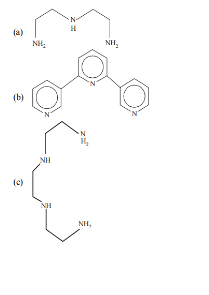
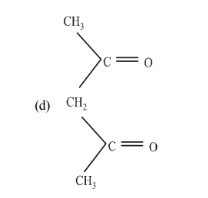
Which of the following ligands is tetradentate?
1
A
2
B
3
C
4
D
Official Solution
Correct Option:
(3)
Step 1: Understanding tetradentate ligands.
A tetradentate ligand is one that can form four bonds with a metal ion. Both and can act as tetradentate ligands in certain coordination complexes.
Step 2: Conclusion.
Both and are tetradentate ligands, corresponding to option (3).
27
PYQ 2013
medium
chemistryID: viteee-2
What is the EAN of ?
1
28
2
22
3
16
4
10
Official Solution
Correct Option:
(2)
Step 1: Understanding Effective Atomic Number (EAN).
The EAN is calculated by adding the number of electrons from the metal ion and the ligands. For this complex, the number of electrons is 22.
Step 2: Conclusion.
The EAN of the complex is 22, corresponding to option (2).
28
PYQ 2013
medium
chemistryID: viteee-2
What is the EAN of ?
1
28
2
22
3
16
4
10
Official Solution
Correct Option:
(2)
Effective atomic number EAN = Atomic number - oxidation number coordination number For
EAN
29
PYQ 2021
medium
chemistryID: viteee-2
For the reaction,
Which of the following statement is INCORRECT?
1
The equilibrium constant is large, suggestive of reaction going to completion and so no catalyst is required.
2
The equilibrium will shift in forward direction as the pressure increases.
3
The equilibrium constant decreases as the temperature increases.
4
The addition of inert gas at constant volume will not affect the equilibrium constant.
Official Solution
Correct Option:
(1)
A large equilibrium constant does suggest that the reaction favors the formation of products. However, catalysts are needed to increase the rate of achieving equilibrium, not to shift the equilibrium. Thus, option (1) is incorrect.
Step 2: Conclusion.
Thus, the correct answer is (1).
30
PYQ 2024
easy
chemistryID: viteee-2
The strongest acid among the following is:
1
Salicylic acid
2
-hydroxybenzoic acid
3
-hydroxybenzoic acid
4
Benzoic acid
Official Solution
Correct Option:
(1)
Step 1: Understanding Acid Strength The strength of an acid depends on the stability of its conjugate base. The more stable the conjugate base, the stronger the acid. Step 2: Analyzing the Compounds Salicylic acid: Contains both a carboxylic acid group and a hydroxyl group at the ortho position. The ortho hydroxyl group can form intramolecular hydrogen bonding with the carboxylate anion, stabilizing the conjugate base. -hydroxybenzoic acid: The hydroxyl group is at the meta position, which does not significantly stabilize the carboxylate anion. -hydroxybenzoic acid: The hydroxyl group is at the para position, which also does not significantly stabilize the carboxylate anion. Benzoic acid: Lacks any additional substituents that could stabilize the conjugate base. Step 3: Determining the Strongest Acid Salicylic acid is the strongest acid because the ortho hydroxyl group stabilizes the conjugate base through intramolecular hydrogen bonding, making it easier to lose a proton. Step 4: Matching with the Options The strongest acid is salicylic acid, which corresponds to option (A).
Final Answer: The strongest acid is (A) Salicylic acid.
31
PYQ 2025
medium
chemistryID: viteee-2
The IUPAC name of is:
1
Pentaamminechloridocobalt(III) sulphate
2
Chloropentaamminecobalt(III) sulphate
3
Pentaamminechlorocobalt(II) sulphate
4
Amminechlorocobalt(III) sulphate
Official Solution
Correct Option:
(1)
The complex cation is with Co in +3 state.
32
PYQ 2025
medium
chemistryID: viteee-2
The coordination number and geometry of and are respectively:}
1
4, square planar and 4, tetrahedral
2
4, tetrahedral and 4, square planar
3
6, octahedral and 6, octahedral
4
4, square planar and 6, octahedral
Official Solution
Correct Option:
(1)
CN is a strong field ligand giving square planar complex, Cl is a weak field ligand giving tetrahedral complex.
33
PYQ 2025
medium
chemistryID: viteee-2
Which of the following compounds will show geometrical isomerism?
1
CH -CH=CH-CH
2
CH =CH-Cl
3
CH -CH=CH-Cl
4
(CH ) C=CH
Official Solution
Correct Option:
(1)
In but-2-ene, each carbon of the double bond has two different groups, allowing cis–trans isomerism.
About Coordination Compounds - VITEEE
Coordination Compounds is a vital chapter for VITEEE aspirants. Mastering the concepts covered in this chapter is essential for securing a top rank.
By rigorously practicing the previous year questions associated with this chapter, you can identify high-yield topics, understand the examiner's perspective, and boost your confidence during the actual exam.
Frequently Asked Questions
Why focus on Coordination Compounds PYQs?
Analyzing PYQs for this specific chapter reveals the most frequently tested concepts and the typical complexity of questions, allowing you to tailor your study plan efficiently.
How to best use this analysis?
Review the topic breakdown to see which sub-topics within Coordination Compounds carry the most weight. Then, tackle the questions iteratively to solidify your understanding.