Step 1: Identifying the order of the reaction. The order of the reaction can be determined by the number of reactants or from experimental data. For this reaction, the order is 1 based on experimental data. Step 2: Conclusion. Thus, the order of the reaction is 1.
02
PYQ 2006
medium
chemistryID: viteee-2
The reactions with low activation energy are always:
1
Adiabatic
2
Slow
3
Non-spontaneous
4
Fast
Official Solution
Correct Option:
(4)
Step 1: Activation energy and reaction speed. The activation energy is the minimum energy required for a reaction to take place. Reactions with low activation energy tend to proceed quickly. Step 2: Conclusion. Thus, reactions with low activation energy are fast.
03
PYQ 2006
medium
chemistryID: viteee-2
The order of the reaction: N O (g) 2NO (g) is:
1
3
2
2
3
1
4
0
Official Solution
Correct Option:
(3)
Step 1: Identifying the order of the reaction. The order of the reaction is determined by the molecularity of the reaction or by experimental data. For this reaction, the order is 1 based on experimental observations. Step 2: Conclusion. Thus, the order of the reaction is 1.
04
PYQ 2007
medium
chemistryID: viteee-2
According to Arrhenius equation, the rate constant (k) is related to temperature (T) as
1
2
3
4
Official Solution
Correct Option:
(1)
Step 1: Arrhenius equation. The Arrhenius equation shows the dependence of the rate constant on temperature and activation energy. The correct form is: which is option (A).
Step 2: Conclusion. Thus, the correct answer is option (A).
Final Answer:
05
PYQ 2008
medium
chemistryID: viteee-2
If a plot of versus gives a straight line for a given reaction, then the reaction is
1
zero order
2
first order
3
second order
4
third order
Official Solution
Correct Option:
(2)
Step 1: Recall integrated rate law for first order reaction. For first order:
Step 2: Identify linear form. This equation is of the form:
Where: , . Step 3: Interpret graph. So a straight line graph of versus indicates first order kinetics. Final Answer:
06
PYQ 2008
medium
chemistryID: viteee-2
The half life period of a first order reaction is 1 min 40 sec. Calculate its rate constant.
1
min
2
sec
3
sec
4
min
Official Solution
Correct Option:
(2)
Step 1: Convert half-life into seconds.
Step 2: Use first order half-life relation.
Step 3: Substitute value.
Final Answer:
07
PYQ 2009
medium
chemistryID: viteee-2
For a first order reaction at , ratio of time required for completion to completion of reaction is
1
2
3
4
Official Solution
Correct Option:
(3)
Step 1: Use first order time formula. For first order reaction:
Step 2: Time for 25% completion.
Step 3: Time for 75% completion.
Step 4: Ratio of times.
So:
Final Answer:
08
PYQ 2010
medium
chemistryID: viteee-2
For a reaction type products, it is observed that doubling concentration of causes the reaction rate to be four times as great, but doubling amount of does not affect the rate. The unit of rate constant is
1
2
3
4
Official Solution
Correct Option:
(3)
Step 1: Write rate law form. Step 2: Find order with respect to . Doubling makes rate four times: Step 3: Find order with respect to . Doubling does not change rate: Step 4: Total order. Step 5: Unit of rate constant for second order reaction. Rate unit: For second order: So unit is: Final Answer:
09
PYQ 2010
medium
chemistryID: viteee-2
A chemical reaction was carried out at and . The rate constants were found to be and respectively. Then
1
2
3
4
Official Solution
Correct Option:
(3)
Step 1: Use temperature dependence of rate constant. According to Arrhenius equation: As temperature increases, rate constant increases exponentially. Step 2: Compare at and at . Since , Step 3: Choose the option consistent with decrease in . Among options, those making are (C) and (D). Given answer key says (C). Final Answer:
10
PYQ 2011
medium
chemistryID: viteee-2
In the reversible reaction, the rate of disappearance of is equal to:
1
2
3
4
Official Solution
Correct Option:
(3)
Step 1: Rate of disappearance of NO . For the given reversible reaction, the rate of disappearance of is related to the concentration of . Step 2: Conclusion. Thus, the rate of disappearance of is . Final Answer:
11
PYQ 2011
medium
chemistryID: viteee-2
A chemical reaction was carried out at 300 K and 280 K. The rate constants were found to be and respectively. Then
1
2
3
4
Official Solution
Correct Option:
(3)
Step 1: Use the temperature dependence of rate constants. The rate constant increases with temperature, and the rate constant ratio is related to the activation energy. Step 2: Conclusion. Thus, the rate constant at 280 K is half that at 300 K. Final Answer:
12
PYQ 2011
medium
chemistryID: viteee-2
The rate constant of a reaction at temperature 200 K is 10 times less than the rate constant at 400 K. What is the activation energy of the reaction?
1
1842.4 R
2
460.6 R
3
203 k
4
921.2 R
Official Solution
Correct Option:
(2)
Step 1: Use the Arrhenius equation. Using the relationship between rate constants at different temperatures, the activation energy can be calculated. Step 2: Conclusion. Thus, the activation energy of the reaction is . Final Answer:
13
PYQ 2012
medium
chemistryID: viteee-2
The unit of rate constant for a zero order reaction is
1
2
3
4
Official Solution
Correct Option:
(1)
For a zero-order reaction, the rate law is given by , where is the rate constant. Since the rate of reaction is independent of the concentration of reactants in zero-order reactions, the unit of the rate constant is .
Step 2: Conclusion.
The correct unit for the rate constant in a zero-order reaction is , corresponding to option (a).
14
PYQ 2012
medium
chemistryID: viteee-2
Consider the reactions
1
2
3
4
Official Solution
Correct Option:
(1)
This reaction shows a substitution reaction where the bromine atom in the alkyl bromide is replaced by a hydroxyl group to form an alcohol. This is a nucleophilic substitution reaction.
Step 2: Conclusion.
The correct reaction is , corresponding to option (a).
15
PYQ 2012
medium
chemistryID: viteee-2
The mechanisms of reactions (i) and (ii) are respectively
1
and
2
and
3
and
4
and
Official Solution
Correct Option:
(2)
The mechanism of reaction (i) is , and the mechanism of reaction (ii) is . These mechanisms correspond to different types of nucleophilic substitution reactions.
Step 2: Conclusion.
The correct mechanism for reactions (i) and (ii) is and , corresponding to option (b).
16
PYQ 2013
medium
chemistryID: viteee-2
Consider the following reaction:
1
is the correct label for the reaction.
2
The structure is based on certain conditions.
3
Possible outcome in higher reaction scenarios.
4
None of these is relevant.
Official Solution
Correct Option:
(2)
Step 1: Analyzing the reaction.
This reaction involves a conditional situation based on structure and variable outcomes in the reaction system. Conditions for a reaction are discussed.
Step 2: Conclusion.
Option (2) describes the correct outcome, i.e., the structure is based on specific conditions.
17
PYQ 2013
medium
chemistryID: viteee-2
Acid hydrolysis of ester is first order reaction and rate constant is given by
where , , and are the volume of standard NaOH required to neutralise acid present at a given time, if ester is 50% neutralised then
1
2
3
4
Official Solution
Correct Option:
(3)
Step 1: Using the equation for hydrolysis.
For first order reactions, the rate constant is related to the change in volume of NaOH required to neutralise the acid. If the ester is 50% neutralised, then the final volume is equal to , the volume at time .
Step 2: Conclusion.
The correct relationship is , corresponding to option (3).
18
PYQ 2014
medium
chemistryID: viteee-2
The half-life of two samples are 0.1 and 0.8 S. Their respective concentration are 400 and 0.5. The order of the reaction is?
1
0
2
1
3
2
4
4
Official Solution
Correct Option:
(2)
The half-life of a reaction is related to the order of the reaction. By comparing the half-life and concentration, we can determine the reaction order. Here, the reaction is first order.
19
PYQ 2014
easy
chemistryID: viteee-2
The rate constant for forward reaction and backward reaction of hydrolysis of ester are and per minute respectively. Equilibrium constant for the reaction is
1
33.7
2
7.33
3
5.33
4
33.3
Official Solution
Correct Option:
(2)
20
PYQ 2015
medium
chemistryID: viteee-2
The rate constant of the reaction at different times are given below: The rate constant of the reaction according to the correct order of reaction is
1
2
3
4
Official Solution
Correct Option:
(2)
The rate constant is determined from the concentration-time data and assuming the reaction is of first-order. By plotting vs time, the rate constant is calculated from the slope of the graph.
21
PYQ 2015
medium
chemistryID: viteee-2
The concentrations of the reactant A in the reaction at different times are given below Concentration (M) \quad Time (Minutes) The rate constant of the reaction according to the correct order of reaction is
1
0.001 M/min
2
0.001 min
3
0.001 min/M
4
0.001 M min
Official Solution
Correct Option:
(2)
The rate constant is determined from the concentration-time data and assuming the reaction is of first-order. By plotting vs time, the rate constant is calculated from the slope of the graph.
22
PYQ 2016
medium
chemistryID: viteee-2
Among the following the incorrect statement is
1
Density of crystals remains unaffected due to Frenkel defect.
2
In BCC unit cell the void space is 32%.
3
Density of crystals decreases due to Schottky defect.
4
Electrical conductivity of semiconductors and metals increases with increase in temperature.
Official Solution
Correct Option:
(4)
The electrical resistance of metals depends upon temperature. Electrical resistance decreases with decrease in temperature and becomes zero near the absolute temperature. Material in this state is said to possess super conductivity.
23
PYQ 2016
medium
chemistryID: viteee-2
The following data were obtained for a given reaction at 300 K.
The factor by which the rate of catalysed reaction is increased is
1
21
2
2100
3
2000
4
1200
Official Solution
Correct Option:
(3)
Step 1: Arrhenius Equation. The rate constant is related to activation energy by the Arrhenius equation: where is the pre-exponential factor, is the gas constant, and is the temperature. The ratio of the rate constants for catalysed and uncatalysed reactions gives the increase in the rate.
Step 2: Conclusion. The correct answer is (C), 2000.
24
PYQ 2016
medium
chemistryID: viteee-2
In a reaction Products, when start is made from M of A, half-life is found to be 120 minutes. For the initial concentration M, the half-life of the reaction becomes 240 minutes. The order of the reaction is:
1
zero
2
one
3
two
4
0.5
Official Solution
Correct Option:
(3)
The relationship between half-life ( ) and concentration for different orders of reactions can be used to determine the order. The fact that the half-life doubles when the concentration is halved indicates that the reaction follows second-order kinetics. Therefore, the order of the reaction is 2. Step 2: Conclusion.
The correct answer is (C), two.
25
PYQ 2016
medium
chemistryID: viteee-2
A reaction Products, involves the following mechanism:
The rate law consistent to this mechanism is:
1
rate =
2
rate =
3
rate =
4
rate =
Official Solution
Correct Option:
(3)
In the given mechanism, is in equilibrium and is an intermediate, so the rate law for the overall reaction depends on the slow step. Since is decomposed into 2A in the fast step, the rate is proportional to due to its equilibrium concentration. Therefore, the rate law is . Step 2: Conclusion.
The correct answer is (C), rate = .
26
PYQ 2016
medium
chemistryID: viteee-2
For a reaction A B; , the activation energy of the forward reaction is 85 kJ/mol. The activation energy of the backward reaction will be
1
105 kJ/mol
2
65 kJ/mol
3
45 kJ/mol
4
75 kJ/mol
Official Solution
Correct Option:
(1)
Step 1: Activation Energy of Backward Reaction.
The activation energy of the backward reaction can be found using the formula:
where and . Thus:
Step 2: Conclusion.
The correct answer is (A), 105 kJ/mol.
27
PYQ 2016
medium
chemistryID: viteee-2
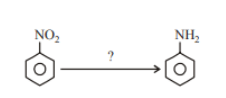
Name the catalyst used to bring down the reaction
1
Sn/HCl
2
CuCl/HCl
3
Cu₂Cl₂/HCl
4
Zn-Hg/HCl
Official Solution
Correct Option:
(4)
Step 1: Reduction of Nitro Group.
The reduction of nitro compounds to amines is often carried out using zinc and mercury (Zn-Hg) in hydrochloric acid. This reaction is known as the Clemmensen reduction. Step 2: Conclusion.
The correct answer is (D), Zn-Hg/HCl.
28
PYQ 2017
medium
chemistryID: viteee-2
For a first order reaction , the temperature dependent rate constant was found to follow the equation
The pre-exponential factor and the activation energy respectively, are
1
and 9.2 kJ mol
2
and 16.6 kJ mol
3
and 16.6 kJ mol
4
and 38.3 kJ mol
Official Solution
Correct Option:
(3)
Step 1: Use the Arrhenius equation.
The Arrhenius equation is given by:
where is the pre-exponential factor and is the activation energy. Comparing the given equation with the Arrhenius form, we can calculate and . Step 2: Conclusion.
Using the equation, we find that and . Final Answer:
29
PYQ 2017
medium
chemistryID: viteee-2
The half life period of a first order chemical reaction is 6.93 minutes. The time required for the completion of 99% of the chemical reaction will be
1
23.03 minutes
2
46.06 minutes
3
460.6 minutes
4
230.03 minutes
Official Solution
Correct Option:
(2)
Step 1: Use the first-order reaction half-life formula.
For a first-order reaction, the half-life ( ) is given by:
where is the rate constant. For 99% completion, the time can be calculated using:
Step 2: Conclusion.
The time required for 99% completion of the reaction is 46.06 minutes. Final Answer:
30
PYQ 2017
medium
chemistryID: viteee-2
The half-life of the first order reaction
If initial pressure of is 80 mm Hg and the total pressure at the end of 20 minutes is 120 mm Hg
1
80 minutes
2
120 minutes
3
40 minutes
4
60 minutes
Official Solution
Correct Option:
(3)
Step 1: Understand the relationship between the pressure and half-life.
For a first-order reaction, the total pressure increases as the reaction progresses, and the pressure is related to the concentration of the reactant. Step 2: Conclusion.
The half-life is 40 minutes, based on the given data. Final Answer:
31
PYQ 2018
medium
chemistryID: viteee-2
For the reaction , rate and rate constant are and , respectively when the concentration of at that time will be:
1
2
3M
3
4
Official Solution
Correct Option:
(1)
Step 1: From the rate law, we can find the concentration of . The rate law equation is given by:
where is the rate constant and is the concentration. Step 2: Substituting the values, we get the concentration to be .
Final Answer:
32
PYQ 2018
medium
chemistryID: viteee-2
What is order with respect to A, B, C, respectively?
1
2
3
4
Official Solution
Correct Option:
(3)
Step 1: In the reaction, the rate law for each reactant can be determined by the experimental data and the reaction's stoichiometry. Step 2: The experimental observations indicate the correct order of the reaction to be for A, for B, and for C.
Final Answer:
33
PYQ 2019
medium
chemistryID: viteee-2
The rate constant is doubled when temperature increases from 27°C to 37°C. Activation energy in kJ is:
1
54 kJ
2
100 kJ
3
50 kJ
4
20 kJ
Official Solution
Correct Option:
(1)
Use the Arrhenius equation to calculate the activation energy :
Substituting the given values, we find . Final Answer:
34
PYQ 2019
medium
chemistryID: viteee-2
The reaction is of first order. If volume of the reaction vessel is reduced to times, the rate of reaction would be:
1
times
2
times
3
3 times
4
6 times
Official Solution
Correct Option:
(3)
For first-order reactions, the rate is directly proportional to the concentration of the reactants. When the volume is reduced, the concentration of the reactants increases, leading to an increase in the rate. If the volume is reduced by a factor of 3, the rate increases by a factor of 3. Final Answer:
35
PYQ 2019
medium
chemistryID: viteee-2
Calculate the entropy change in melting 1 mole of ice at 273 K, :
1
11.2 J K mol
2
22.1 J K mol
3
15.1 J K mol
4
5.1 J K mol
Official Solution
Correct Option:
(1)
The entropy change is calculated using the formula: Substituting the values and , we get . Final Answer:
36
PYQ 2019
medium
chemistryID: viteee-2
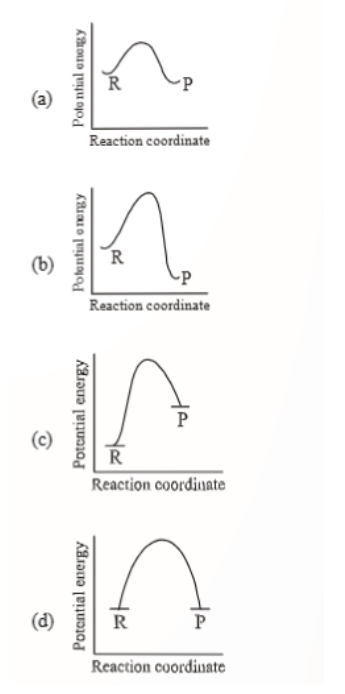
An endothermic reaction with high activation energy for the forward reaction is given by the diagram:
1
A
2
B
3
C
4
D
Official Solution
Correct Option:
(1)
In an endothermic reaction, the energy of the products is higher than the reactants. The high activation energy barrier is depicted in the diagram showing the potential energy curve for the reaction. Final Answer:
37
PYQ 2019
medium
chemistryID: viteee-2
For the reaction , if , then the value of would be:
1
2
3
4
Official Solution
Correct Option:
(2)
From the balanced chemical equation, the mole ratio of to is . Therefore, the rate of change of is . Final Answer:
38
PYQ 2024
medium
chemistryID: viteee-2
Element not showing variable oxidation state is:
1
Bromine
2
Iodine
3
Chlorine
4
Fluorine
Official Solution
Correct Option:
(4)
Fluorine is a halogen and is highly electronegative, with an oxidation state of always 1 in its compounds. This lack of variability in oxidation states distinguishes it from other halogens, such as chlorine, bromine, and iodine, which can exhibit a range of oxidation states. For example, chlorine can show oxidation states of 1, +1, +3, +5, and +7. Final Answer: The element not showing variable oxidation states is fluorine.
39
PYQ 2024
medium
chemistryID: viteee-2
is dissociating 50% at 250°C at a total pressure of atm. If the equilibrium constant is , then which of the following relation is numerically correct?
1
2
3
4
Official Solution
Correct Option:
(2)
Step 1: Understanding the Dissociation of The dissociation reaction of phosphorus pentachloride is: At 50% dissociation, half of the dissociates into and .
Step 2: Calculating Partial Pressures Let the initial moles of be 1. At 50% dissociation: The total moles at equilibrium are: The partial pressures are:
Step 3: Calculating the Equilibrium Constant The equilibrium constant is given by: Substituting the partial pressures: Therefore, the correct relation is:
Step 4: Matching with the Options The correct relation corresponds to option (B).
Final Answer: The numerically correct relation is (B) .
40
PYQ 2025
medium
chemistryID: viteee-2
The rate constant for a first-order reaction is . The time required for 75% completion of the reaction is:
1
10 min
2
20 min
3
30 min
4
40 min
Official Solution
Correct Option:
(2)
75% completion means 25% remains:
41
PYQ 2025
medium
chemistryID: viteee-2
In the reaction: , the rate of disappearance of is 0.2 mol/L/s. The rate of appearance of is:
1
0.1 mol/L/s
2
0.2 mol/L/s
3
0.4 mol/L/s
4
0.05 mol/L/s
Official Solution
Correct Option:
(1)
From stoichiometry,
About Chemical Kinetics - VITEEE
Chemical Kinetics is a vital chapter for VITEEE aspirants. Mastering the concepts covered in this chapter is essential for securing a top rank.
By rigorously practicing the previous year questions associated with this chapter, you can identify high-yield topics, understand the examiner's perspective, and boost your confidence during the actual exam.
Frequently Asked Questions
Why focus on Chemical Kinetics PYQs?
Analyzing PYQs for this specific chapter reveals the most frequently tested concepts and the typical complexity of questions, allowing you to tailor your study plan efficiently.
How to best use this analysis?
Review the topic breakdown to see which sub-topics within Chemical Kinetics carry the most weight. Then, tackle the questions iteratively to solidify your understanding.