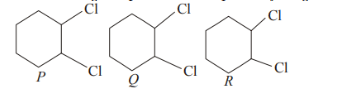
Following compounds are respectively ... geometrical isomers
1
, ,
2
, ,
3
, ,
4
, ,
Official Solution
Correct Option:
(1)
Step 1: Identifying isomers.
The compounds are described as geometrical isomers, and the given options are evaluated based on cis-trans isomerism. Option (1) provides the correct sequence of cis and trans forms.
Step 2: Conclusion.
The correct answer is , , , corresponding to option (1).
02
PYQ 2016
medium
chemistryID: viteee-2
Which one of the following show stereoisomerism?
1
2-Butene
2
3-Butyl but-1-ene
3
2-Methyl butene
4
3-Methyl butene
Official Solution
Correct Option:
(1)
Step 1: Stereoisomerism.
Stereoisomerism occurs in compounds that have the same molecular formula but differ in the spatial arrangement of atoms. 2-Butene exhibits cis-trans isomerism, hence it shows stereoisomerism. Step 2: Conclusion.
The correct answer is (A), 2-Butene.
03
PYQ 2016
medium
chemistryID: viteee-2
For meso tartaric acid, the correct configuration for chiral carbon is
1
2R, 3S
2
2R, 3R
3
2S, 3R
4
1D, 2L
Official Solution
Correct Option:
(1)
Step 1: Understanding Meso Compounds.
Meso compounds have chiral centers but are achiral due to internal symmetry. In meso tartaric acid, the two chiral centers have opposite configurations (R and S). The correct configuration for the chiral carbons in meso tartaric acid is 2R, 3S. Step 2: Conclusion.
The correct answer is (A), 2R, 3S.
04
PYQ 2017
medium
chemistryID: viteee-2
The number of geometrical isomers of is
1
2
2
4
3
6
4
8
Official Solution
Correct Option:
(2)
Step 1: Identify the possible isomers.
The given compound has double bonds that allow for cis-trans isomerism. Since there are 2 double bonds, there are multiple possible isomers, including cis-trans forms. Step 2: Conclusion.
Thus, the compound has 4 geometrical isomers. Final Answer:
05
PYQ 2017
medium
chemistryID: viteee-2
The optically active tartaric acid is named as D - (+) tartaric acid because it has a positive
1
optical rotation and is derived from D - glucose
2
optical rotation and is derived from D - glyceraldehyde
3
optical rotation and is derived from substituted optical rotation
4
optical rotation when substituted by deuterium
Official Solution
Correct Option:
(2)
Step 1: Understand the concept of optical activity.
Optically active compounds rotate the plane of polarized light. D- (+) tartaric acid is derived from D-glyceraldehyde and shows optical rotation. Step 2: Conclusion.
Thus, D - (+) tartaric acid is optically active and derived from D - glyceraldehyde. Final Answer:
06
PYQ 2017
medium
chemistryID: viteee-2
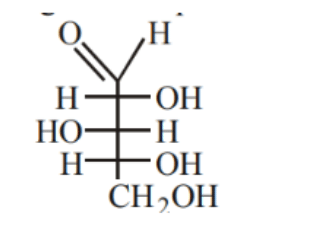
What is the R and S configuration for each stereogenic center in this sugar from top to bottom?
1
R, R, S
2
R, S, R
3
S, S, R
4
S, R, R
Official Solution
Correct Option:
(2)
Step 1: Identify the stereogenic centers.
Determine the priorities of the substituents attached to each chiral carbon, then use the Cahn-Ingold-Prelog rules to assign the R or S configuration. Step 2: Conclusion.
Thus, the R and S configuration from top to bottom is R, S, R. Final Answer:
07
PYQ 2017
medium
chemistryID: viteee-2
The number of stereoisomers possible for a compound of the molecular formula is:
1
2
2
4
3
6
4
8
Official Solution
Correct Option:
(2)
Step 1: Analyze the compound.
The given compound has two double bonds and can exhibit cis-trans isomerism at both the positions, leading to a total of 4 stereoisomers. Step 2: Conclusion.
Thus, the compound has 4 stereoisomers. Final Answer:
08
PYQ 2018
medium
chemistryID: viteee-2
Which one of the following has an optical isomer?
1
2
3
4
Official Solution
Correct Option:
(1)
Step 1: Optical isomers exist when a compound has chiral centers, meaning that it lacks a plane of symmetry. Step 2: Among the given options, is chiral and can form optical isomers due to the non-superimposability of its mirror images.
Final Answer:
About Stereochemistry - VITEEE
Stereochemistry is a vital chapter for VITEEE aspirants. Mastering the concepts covered in this chapter is essential for securing a top rank.
By rigorously practicing the previous year questions associated with this chapter, you can identify high-yield topics, understand the examiner's perspective, and boost your confidence during the actual exam.
Frequently Asked Questions
Why focus on Stereochemistry PYQs?
Analyzing PYQs for this specific chapter reveals the most frequently tested concepts and the typical complexity of questions, allowing you to tailor your study plan efficiently.
How to best use this analysis?
Review the topic breakdown to see which sub-topics within Stereochemistry carry the most weight. Then, tackle the questions iteratively to solidify your understanding.