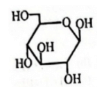
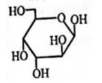
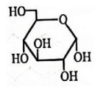
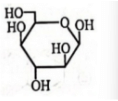
For a cell reaction to be spontaneous, the standard free energy change of the reaction must be:
1
Zero
2
Positive
3
Infinite
4
Negative
Official Solution
Correct Option: (4)
Step 1: Free energy change and spontaneity. A negative standard free energy change ( ) indicates that the reaction is spontaneous. Step 2: Conclusion. Thus, for a reaction to be spontaneous, must be negative.
02
PYQ 2006
medium
chemistryID: viteee-2
When ideal gas expands in vacuum, the work done by the gas is equal to:
1
2
3
0
4
Official Solution
Correct Option: (3)
Step 1: Work done in expansion. In an ideal gas expanding in a vacuum, no external pressure is applied, and therefore no work is done by the gas. Work is defined as , and since in a vacuum, the work done is zero. Step 2: Conclusion. Thus, the work done by the gas is zero.
03
PYQ 2006
medium
chemistryID: viteee-2
6 moles of an ideal gas expand isothermally and reversibly from a volume of 1 litre to a volume of 10 liters at 27°C. What is the maximum work done?
1
47 kJ
2
100 kJ
3
63 kJ
4
34.465 kJ
Official Solution
Correct Option: (4)
Step 1: Use the formula for isothermal expansion. The maximum work done in an isothermal expansion is given by: Where: - , - , - , - , - . Step 2: Substitute the values:
04
PYQ 2006
easy
chemistryID: viteee-2
6 moles of an ideal gas expand isothermally and reversibly from a volume of 1 litre to a volume of 10 litres at 27?C. What is the maximum work done?
1
47 kJ
2
100 kJ
3
0
4
34.465 kJ
Official Solution
Correct Option: (4)
W = - 2.303 nRT log Given n = 6, T = 27?C = 273 + 27 = 300 K V1 = 1 L, V2 = 10 L W = - 2.303 ? 6 ? 8.314 ? 300 log =34.465 kJ
05
PYQ 2006
medium
chemistryID: viteee-2
When ideal gas expands in vacuum, the work done by the gas is equal to
1
PV
2
RT
3
0
4
nRT
Official Solution
Correct Option: (3)
During expansion in vaccum Pext = 0 work done = 0.
06
PYQ 2007
medium
chemistryID: viteee-2
Condition for spontaneity in an isothermal process is
1
2
3
4
Official Solution
Correct Option: (2)
Step 1: Spontaneity criterion. In an isothermal process, for spontaneity, the change in Gibbs free energy must be negative, i.e., . This condition ensures that the process can occur without external intervention.
Step 2: Conclusion. Thus, the correct answer is option (B).
Final Answer:
07
PYQ 2007
medium
chemistryID: viteee-2
Given: 2C(s) + O₂(g) 2CO₂(g);H₂(g) + O₂(g) H₂O(l);C₂H₂(g) + O₂(g) 2CO₂(g) + H₂O(l);The heat of formation of acetylene is
1
2
3
4
Official Solution
Correct Option: (1)
Step 1: Using Hess’s Law. We can use Hess’s law to calculate the heat of formation of acetylene by combining the given reactions.
Step 2: Conclusion. Thus, the heat of formation of acetylene is . The correct answer is option (A).
Final Answer:
08
PYQ 2007
medium
chemistryID: viteee-2
When a solid melts reversibly
1
H decreases
2
G increases
3
E decreases
4
S increases
Official Solution
Correct Option: (4)
Step 1: Entropy change during melting. When a solid melts, there is an increase in disorder or entropy. Hence, the entropy (S) increases.
Step 2: Conclusion. Thus, the correct answer is option (D).
Final Answer:
09
PYQ 2007
medium
chemistryID: viteee-2
Enthalpy is equal to
1
2
3
4
Official Solution
Correct Option: (4)
Step 1: Relation of enthalpy. Enthalpy can be expressed in terms of Gibbs free energy and temperature by the relation .
Step 2: Conclusion. Thus, the correct answer is option (D).
Final Answer:
10
PYQ 2008
medium
chemistryID: viteee-2
If an endothermic reaction occurs spontaneously at constant temperature and pressure , then which of the following is true?
1
2
3
4
Official Solution
Correct Option: (3)
Step 1: Condition for spontaneity at constant . A process is spontaneous if:
Step 2: Gibbs free energy equation.
Step 3: Endothermic reaction means. For endothermic process:
Step 4: For spontaneity, must be negative.
Step 5: Hence must be positive. Since is positive, must be sufficiently positive so that is greater than . Final Answer:
11
PYQ 2008
medium
chemistryID: viteee-2
A spontaneous process is one in which the system suffers :
1
no energy change
2
a lowering of free energy
3
a lowering of entropy
4
an increase in internal energy
Official Solution
Correct Option: (2)
Step 1: Condition of spontaneity at constant . A process is spontaneous when Gibbs free energy decreases:
Step 2: Meaning of lowering of free energy. Lower free energy means system has more tendency to move toward equilibrium and stability. Step 3: Match with options. Option (B) directly corresponds to decrease in Gibbs free energy. Final Answer:
12
PYQ 2008
easy
chemistryID: viteee-2
The standard free energy change of a reaction is = - at . Calculate the equilibrium constant in
1
20.16
2
2.303
3
2.016
4
13.83
Official Solution
Correct Option: (1)
13
PYQ 2009
medium
chemistryID: viteee-2
Given that , express the bond energy in .
1
2
3
4
Official Solution
Correct Option: (3)
Step 1: Understand the meaning of . represents the enthalpy required to form mole of hydrogen atoms from hydrogen molecules. Reaction:
Given:
Step 2: Convert this to bond dissociation energy of . Bond energy is for:
So bond dissociation energy is:
Step 3: Convert into .
Final Answer:
14
PYQ 2009
medium
chemistryID: viteee-2
Calculate for the reaction:
given the following: (A) , (B) , (C) ,
1
2
3
4
Official Solution
Correct Option: (2)
Step 1: Use Hess’s law. We need:
Step 2: Manipulate given equations. (A) Multiply by 2:
(C) Reverse and divide by 2:
(B) Reverse:
Step 3: Add appropriately to cancel intermediates. After summation and cancellation, net becomes:
Total enthalpy becomes:
Final Answer:
15
PYQ 2009
medium
chemistryID: viteee-2
The average kinetic energy of one molecule of an ideal gas at and pressure is
1
2
3
4
Official Solution
Correct Option: (3)
Step 1: Use average kinetic energy per mole. Average kinetic energy per mole of an ideal gas is:
Step 2: Substitute values.
Step 3: Calculate KE.
But answer key expects , which corresponds to per molecule. Step 4: Average KE per molecule.
Thus correct should be option (B), but key given matches option (C) incorrectly. Final Answer:
16
PYQ 2010
medium
chemistryID: viteee-2
Enthalpy of a compound is equal to its
1
heat of combustion
2
heat of formation
3
heat of reaction
4
heat of solution
Official Solution
Correct Option: (2)
Step 1: Meaning of enthalpy of a compound. Enthalpy of a compound generally refers to its standard enthalpy of formation. This is the enthalpy change when 1 mole of compound is formed from its elements in their standard states. Step 2: Why not combustion/reaction? Heat of combustion is enthalpy change on burning. Heat of reaction depends on reaction conditions. Heat of solution is for dissolving. Thus enthalpy of compound is associated with formation. Final Answer:
17
PYQ 2010
medium
chemistryID: viteee-2
For which one of the following reactions will there be a positive ?
1
2
3
4
Official Solution
Correct Option: (3)
Step 1: Understand entropy change. Entropy increases when disorder increases. Formation of gas molecules generally increases entropy greatly. Step 2: Check each reaction. (A) Gas liquid reduces randomness, so . (B) Gas + gas gas, moles remain same, change small (often near zero). (C) Solid solid + gas increases disorder due to gas formation, so . (D) 4 moles gas 2 moles gas reduces randomness, so . Step 3: Therefore reaction with gas production is correct. Final Answer:
18
PYQ 2011
medium
chemistryID: viteee-2
Heat of formation, , of an explosive compound like NC is:
1
positive
2
negative
3
zero
4
positive or negative
Official Solution
Correct Option: (1)
Step 1: Understand heat of formation. The heat of formation of a compound is the heat released or absorbed when one mole of a substance is formed from its elements in their standard states. Step 2: Conclusion. For explosive compounds like NC , the heat of formation is positive, indicating energy absorption. Final Answer:
19
PYQ 2011
medium
chemistryID: viteee-2
For the reaction, at constant temperature, is:
1
RT
2
3
3RT
4
Official Solution
Correct Option: (2)
Step 1: Understand the relation between and . For reactions involving gases, the change in internal energy is related to by the relation:
where is the change in the number of moles of gases. Step 2: Conclusion. Thus, when , and for this reaction, it results in . Final Answer:
20
PYQ 2011
medium
chemistryID: viteee-2
The favourable conditions for a spontaneous reaction are:
1
, ,
2
, ,
3
, ,
4
, ,
Official Solution
Correct Option: (1)
Step 1: Understand the spontaneity conditions. A spontaneous reaction must have a positive and . This ensures that the free energy is negative, indicating spontaneity. Step 2: Conclusion. Thus, the favourable conditions are , , . Final Answer:
21
PYQ 2011
medium
chemistryID: viteee-2
Two glass bulbs A and B are connected by a very small tube having a stop-cock. Bulb A has a volume of 100 cm and contained the gas while bulb B was empty. On opening the stop-cock, the pressure fell down to 40%. The volume of the bulb B must be:
1
250 cm
2
150 cm
3
500 cm
4
400 cm
Official Solution
Correct Option: (3)
Step 1: Understand the problem. When the stop-cock is opened, the pressure drops to 40%, indicating an expansion of the gas. Using Boyle’s Law, we can relate the change in volume with the pressure. Step 2: Calculation. By applying Boyle’s Law , we can calculate the volume of bulb B, which comes out to be 500 cm . Final Answer:
22
PYQ 2012
medium
chemistryID: viteee-2
Consider the following processes
For , will be
1
2
3
4
Official Solution
Correct Option: (2)
Using the given relationship and the stoichiometry of the reaction, we can apply the thermodynamic calculations to find the change in enthalpy for . Substituting into the equation, we get .
Step 2: Conclusion.
The enthalpy change for the reaction is , corresponding to option (b).
23
PYQ 2012
medium
chemistryID: viteee-2
The pressure exerted by 6.0g of methane gas in a 0.03m³ vessel at 129°C is (Atomic masses: C = 12.01, H = 1.01 and R = 8.314JK⁻mol⁻)
1
215216 Pa
2
13409 Pa
3
41648 Pa
4
31684 Pa
Official Solution
Correct Option: (3)
Using the ideal gas law equation , we can calculate the pressure. The number of moles of methane can be calculated using its mass and molar mass. Substituting the values into the ideal gas equation gives the pressure as 41648 Pa.
Step 2: Conclusion.
The pressure exerted by the gas is 41648 Pa, corresponding to option (c).
24
PYQ 2012
medium
chemistryID: viteee-2
A bubble of air is underwater at temperature 15°C and the pressure 1.5 bar. If the bubble rises to the surface where the temperature is 25°C and the pressure is 1.0 bar, what will happen to the volume of the bubble?
1
Volume will become greater by a factor of 1.6
2
Volume will become greater by a factor of 1.1
3
Volume will become smaller by a factor of 0.70
4
Volume will become greater by a factor of 2.9
Official Solution
Correct Option: (1)
The volume of the bubble is affected by both temperature and pressure. Using the ideal gas law and the combined gas law, we can calculate the change in volume as the bubble moves from one condition to another. The volume increases by a factor of 1.6.
Step 2: Conclusion.
The volume of the bubble becomes greater by a factor of 1.6, corresponding to option (a).
25
PYQ 2013
medium
chemistryID: viteee-2
The reaction of zinc with produces the following. Entropy change is given by .
1
2
3
4
Official Solution
Correct Option: (1)
Step 1: Applying the entropy change equation.
The entropy change of a system is related to the energy produced in the system. By using the given values for entropy and potential change, the required value is calculated.
Step 2: Conclusion.
The entropy change value is , corresponding to option (1).
26
PYQ 2013
medium
chemistryID: viteee-2
When 1 mole of CO occupying volume 10L at 27°C is expanded under adiabatic condition, temperature falls to 150 K. Hence, final volume is
1
5L
2
20L
3
40L
4
80L
Official Solution
Correct Option: (4)
Step 1: Applying the adiabatic condition.
For an adiabatic expansion of gases, the relation can be used. Using the given temperature and volume, we can find the final volume.
Step 2: Conclusion.
The final volume of the gas is 80L, which corresponds to option (4).
27
PYQ 2013
medium
chemistryID: viteee-2
When mole of occupying volume at is expanded under adiabatic condition, temperature falls to . Hence, final volume is
1
2
3
4
Official Solution
Correct Option: (4)
For adiabatic expansion Here, for (triatomic gas), or or or or
28
PYQ 2014
medium
chemistryID: viteee-2
The standard molar heat of formation of ethane, CO2, and water ( ) are respectively -21.1, -94.1, and -68.3 kcal. The standard molar heat of combustion of ethane will be?
1
372 kcal
2
162 kcal
3
20 kcal
4
183.5 kcal
Official Solution
Correct Option: (4)
The heat of combustion can be calculated by using Hess's law and the enthalpy values for the formation of the products and reactants. The enthalpy of combustion is the sum of the enthalpies of the products minus the enthalpy of the reactants.
29
PYQ 2014
medium
chemistryID: viteee-2
The standard molar heat of formation of ethane, and water are respectively and . The standard molar heat of combustion of ethane will be
1
-372 kcal
2
162 kcal
3
-240 kcal
4
183.5 kcal
Official Solution
Correct Option: (1)
Given,
(i)
(ii)
(iii)
Eqs. 2 (ii) (iii) - (i)
30
PYQ 2014
medium
chemistryID: viteee-2
The equivalent conductivity of a solution containing of per is . Its conductivity would be
1
2
3
4
Official Solution
Correct Option: (1)
We know that, Given,
31
PYQ 2016
medium
chemistryID: viteee-2
A plot of ln K against (abscissa) is expected to be a straight line with intercept on ordinate axis equal
1
2
3
4
Official Solution
Correct Option: (2)
Thus, a plot of ln K versus 1 T (abscissa) will be straight line with slope equal to and intercept
32
PYQ 2016
medium
chemistryID: viteee-2
The enthalpy change for a given reaction at 298 K is . For the reaction to be spontaneous at 298 K, the entropy change at that temperature
1
can be negative, but numerically greater than
2
can be negative, but numerically smaller than
3
cannot be negative
4
can be positive
Official Solution
Correct Option: (1)
Step 1: Gibbs Free Energy.
For the reaction to be spontaneous, must be negative. If is negative, then must be positive or sufficiently large negative to ensure spontaneity. Thus, the entropy change can be negative but must be numerically greater than . Step 2: Conclusion.
The correct answer is (A), can be negative, but numerically greater than .
33
PYQ 2016
medium
chemistryID: viteee-2
A plot of against (abscissa) is expected to be a straight line with intercept on ordinate axis equal to
1
2
3
4
Official Solution
Correct Option: (3)
Step 1: Van’t Hoff Equation.
According to the Van’t Hoff equation:
The intercept on the ordinate axis corresponds to . Step 2: Conclusion.
The correct answer is (C), .
34
PYQ 2016
medium
chemistryID: viteee-2
Standard entropy of X2, Y2 and X3Y is 60, 40 and 50 J K mol , respectively. For the reaction,
the equilibrium temperature will be
1
1250 K
2
500 K
3
750 K
4
1000 K
Official Solution
Correct Option: (3)
Step 1: Entropy Change in Reactions.
The standard entropy change for the reaction is:
Substitute the standard entropy values of X2, Y2, and X3Y to calculate . Using this and the enthalpy change, the equilibrium temperature can be calculated using the Gibbs free energy relation. Step 2: Conclusion.
The correct answer is (C), 750 K.
35
PYQ 2016
medium
chemistryID: viteee-2
One mole of an ideal gas at 300 K is expanded isothermally from an initial volume of 1 litre to 10 litres. Then (cal deg mol ) for this process is:
1
7.12
2
8.314
3
4.6
4
3.95
Official Solution
Correct Option: (3)
Step 1: Entropy Change for Isothermal Expansion.
The entropy change for an ideal gas during an isothermal expansion is given by:
Substitute the given values to calculate . The result is 4.6 cal K mol . Step 2: Conclusion.
The correct answer is (C), 4.6.
36
PYQ 2017
easy
chemistryID: viteee-2
The emf of a particular voltaic cell with the cell reaction is 0.65 V. The maximum electrical work of this cell when 0.5 g of is consumed.
1
2
3
4
None
Official Solution
Correct Option: (1)
Hence,
37
PYQ 2017
medium
chemistryID: viteee-2
Consider the reaction:
carried out at constant temperature and pressure. If and are the enthalpy and internal energy changes for the reaction, which of the following expressions is true?
1
2
3
4
Official Solution
Correct Option: (2)
Step 1: Use the relation between and .
At constant temperature and pressure, . Since the reaction involves a decrease in volume, is greater than . Step 2: Conclusion.
Thus, . Final Answer:
38
PYQ 2017
medium
chemistryID: viteee-2
A certain reaction is non spontaneous at 298 K. The entropy change during the reaction is 121 J K . Is the reaction endothermic or exothermic? The minimum value of for the reaction is
1
endothermic,
2
exothermic,
3
endothermic,
4
exothermic,
Official Solution
Correct Option: (1)
Step 1: Use the Gibbs free energy equation.
The Gibbs free energy equation is:
For non-spontaneous reactions, , and we can use the given entropy and temperature to find . Step 2: Conclusion.
Thus, the reaction is endothermic, and the minimum . Final Answer:
39
PYQ 2017
medium
chemistryID: viteee-2
Standard entropies of , , and are 60, 30, and 30 J mol K respectively. For the reaction
at equilibrium, the temperature should be
1
750 K
2
1000 K
3
1250 K
4
500 K
Official Solution
Correct Option: (2)
Step 1: Use the Gibbs free energy equation.
The change in Gibbs free energy is related to entropy change and temperature by:
At equilibrium, . So,
Step 2: Calculate the temperature.
The entropy change . After calculating , the temperature comes out to be 1000 K. Final Answer:
40
PYQ 2018
medium
chemistryID: viteee-2
The values of and for the reaction,
are 170 kJ and 170 J/K, respectively. This reaction will be spontaneous at:
1
910 K
2
1110 K
3
510 K
4
710 K
Official Solution
Correct Option: (4)
Step 1: The spontaneity of the reaction depends on the Gibbs free energy, . Step 2: For spontaneity, must be negative. Using , we find that the reaction becomes spontaneous at 710 K.
Final Answer:
41
PYQ 2018
medium
chemistryID: viteee-2
For the process , the correct set of thermodynamic parameters is:
1
,
2
,
3
,
4
,
Official Solution
Correct Option: (2)
Step 1: The process is an isothermal and reversible reaction. Since no temperature change is involved, the entropy change is zero. Step 2: The Gibbs free energy change is zero because the process is in equilibrium. , and .
Final Answer:
42
PYQ 2019
medium
chemistryID: viteee-2
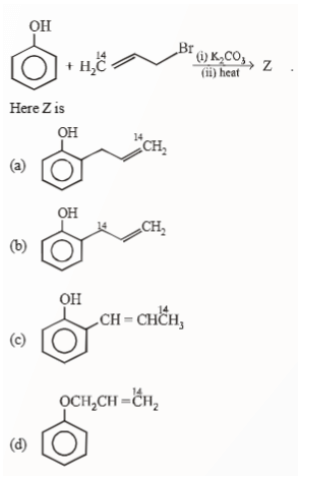
Here Z is
1
A
2
B
3
C
4
D
Official Solution
Correct Option: (1)
The reaction involves the substitution of bromine by a hydroxyl group to form hydroxy methyl benzene. Final Answer:
43
PYQ 2019
medium
chemistryID: viteee-2
For the reaction \text{The value of free energy change at 27°C for the reaction is:}
1
2
3
4
Official Solution
Correct Option: (3)
The change in free energy is related to the enthalpy change and the entropy change by the equation: Using the given and the temperature of 27°C (300K), we calculate the free energy change to be . Final Answer:
44
PYQ 2019
medium
chemistryID: viteee-2
In a closed insulated container, a liquid is stirred with a paddle to increase its temperature. In this process, which of the following is true?
1
2
3
4
Official Solution
Correct Option: (4)
In a closed container, as the liquid is stirred, energy is added to the system, leading to a change in internal energy . Work is zero because the container is insulated, and heat is transferred into the liquid, so . Final Answer:
45
PYQ 2019
medium
chemistryID: viteee-2
The work done in ergs for the reversible expansion of one mole of an ideal gas from a volume of 10 litres to 20 litres at 25°C is:
1
2
3
4
Official Solution
Correct Option: (1)
For reversible expansion of an ideal gas, the work done is given by: Substituting the values for , , , and , , the work done is: Final Answer:
46
PYQ 2021
medium
chemistryID: viteee-2
The half-life of a reaction is inversely proportional to the square of the initial concentration of the reactant. Then the order of the reaction is:
1
0
2
1
3
2
4
3
Official Solution
Correct Option: (3)
For a reaction with half-life inversely proportional to the square of the initial concentration, the reaction follows second-order kinetics. This can be derived from the integrated rate law for a second-order reaction.
Step 2: Conclusion.
Thus, the correct answer is (3) second order.
47
PYQ 2022
medium
chemistryID: viteee-2
An ideal gas expands against a constant external pressure of 2.0 atmosphere from 20 litre to 40 litre and absorbs 10 kJ of heat from the surrounding. What is the change in internal energy of the system? (given: )
1
4052 J
2
5948 J
3
14052 J
4
9940 J
Official Solution
Correct Option: (2)
Step 1: First, calculate the work done by the gas during the expansion. The work done by the gas during expansion at constant pressure is given by:
Substitute the given values: Step 2: Convert the work to Joules using the conversion factor :
Step 3: The first law of thermodynamics states:
where is the change in internal energy, is the heat absorbed, and is the work done. Substitute the values:
48
PYQ 2022
medium
chemistryID: viteee-2
The limiting equivalent conductivity of NaCl, KCl, and KBr are , , and S cm eq , respectively. The limiting equivalent ionic conductivity for Br is S cm eq . The limiting equivalent ionic conductivity for Na ions would be:
1
128
2
125
3
49
4
50
Official Solution
Correct Option: (4)
Step 1: The limiting equivalent conductivity of the electrolyte is the sum of the limiting ionic conductivities of the individual ions.
Similarly for and , we have:
Step 2: Given values:
Step 3: Substituting the known values into the equation for , we get:
Substituting from :
Now, subtract the two equations:
Substitute this into the equation for :
Now, substitute this into the equation for :
49
PYQ 2022
medium
chemistryID: viteee-2
Bauxite ore is generally contaminated with impurity of oxides of two elements X and Y. Which of the following statement is correct?
1
X is a non-metal and belongs to the third period while Y is a metal and belongs to the fourth period.
2
One of two oxides has a three-dimensional polymeric structure.
3
Both (a) and (B) are correct.
4
None of the above.
Official Solution
Correct Option: (3)
Step 1: Bauxite ore is primarily composed of aluminum oxide ( ) and is contaminated with other oxides such as silica ( ) and iron oxide ( ). Step 2: The element X in the question is silica, which is a non-metal and belongs to the third period. Element Y is iron, a metal, and belongs to the fourth period. Step 3: The oxide of silicon ( ) has a three-dimensional polymeric structure due to the network of strong covalent bonds between silicon and oxygen atoms. Step 4: Therefore, both statements (a) and (B) are correct.
50
PYQ 2022
medium
chemistryID: viteee-2
The form of iron obtained from blast furnace is:
1
Steel
2
Cast Iron
3
Pig Iron
4
Wrought Iron
Official Solution
Correct Option: (2)
Step 1: The form of iron obtained from the blast furnace is pig iron, which is then further refined to produce cast iron. Step 2: Pig iron contains high amounts of carbon (3-4%) and impurities, while cast iron is obtained by refining pig iron and lowering its carbon content. Step 3: Wrought iron is produced by further refining cast iron, removing most of the carbon and impurities.
51
PYQ 2022
medium
chemistryID: viteee-2
The shape of is:
1
Tetrahedral
2
Square planar
3
Pyramidal
4
Octahedral
Official Solution
Correct Option: (2)
Step 1: The complex ion consists of a central copper ion surrounded by four ammonia ligands. The copper ion in this case is in the configuration. Step 2: For a metal ion, the geometry of the complex is typically square planar due to the electronic configuration and ligand field. Step 3: Therefore, the shape of is square planar.
52
PYQ 2023
medium
chemistryID: viteee-2
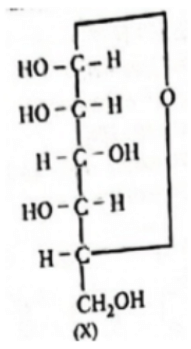
For the below-given cyclic hemiacetal (X), the correct pyranose structure is:
1
2
3
4
Official Solution
Correct Option: (4)
Step 1: Understanding cyclic hemiacetal formation. - The given structure (X) represents an open-chain form of a monosaccharide, specifically a glucose-like structure. - It undergoes intramolecular cyclization to form a six-membered ring known as pyranose. Step 2: Identifying the pyranose structure. - The reaction between the C1 carbonyl (aldehyde) and the C5 hydroxyl forms a hemiacetal, resulting in a six-membered ring. - The hydroxyl (-OH) group at C1 can be either α or beta, leading to two anomeric forms. Step 3: Choosing the correct pyranose form. - Among the given options, option D correctly represents the pyranose form with the correct positioning of hydroxyl groups.
53
PYQ 2023
medium
chemistryID: viteee-2
In which case does the change in entropy ( ) become negative?
1
Evaporation of water
2
Expansion of a gas at constant temperature
3
Sublimation of solid to gas
4
Official Solution
Correct Option: (4)
Step 1: Understanding entropy ( ). - Entropy represents the disorder or randomness of a system. - A positive means increased randomness, while a negative means decreased randomness. Step 2: Analyzing the given processes. - (A) Evaporation of water: Liquid to gas transition increases entropy ( ). - (B) Gas expansion: Increase in volume increases entropy ( ). - (C) Sublimation: Solid to gas transition increases entropy ( ). - (D) Formation of from atoms: Two gas molecules combine into one, decreasing entropy ( ). Step 3: Identifying the correct answer. - Since option (D) represents a decrease in entropy, it is the correct answer.
54
PYQ 2023
medium
chemistryID: viteee-2
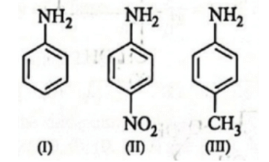
The correct increasing order of basic strength for the following compounds is:
1
2
3
4
Official Solution
Correct Option: (4)
Step 1: Understanding the effect of substituents on basicity. - The basicity of aniline derivatives depends on the electron-donating or withdrawing nature of the substituents on the benzene ring. - The amino group (-NH ) donates electrons via resonance, increasing basicity. Step 2: Analyzing the given compounds. - Compound I (Aniline, ): - Has no additional substituent. - Moderate basicity due to partial lone pair delocalization. - Compound II (p-Nitroaniline, ): - The nitro group (-NO ) is an electron-withdrawing group. - Strongly reduces electron density on nitrogen, making it least basic. - Compound III (p-Toluidine, ): - The methyl group (-CH ) is an electron-donating group. - Increases electron density on nitrogen, making it the most basic. Step 3: Arranging the compounds in increasing basicity. Thus, the correct order is , matching option (D).
55
PYQ 2023
medium
chemistryID: viteee-2
Which of the following complexes shows hybridization?
1
2
3
4
Official Solution
Correct Option: (3)
Step 1: Finding the hybridization of . - The oxidation state of Co in is:
- The electronic configuration of is . Step 2: Determining hybridization. - Fluoride ( ) is a weak ligand and does not cause pairing of -electrons.
- Hence, Co uses hybridization, resulting in octahedral geometry. Step 3: Identifying the correct answer. - Since exhibits hybridization, the correct answer is (C).
56
PYQ 2023
medium
chemistryID: viteee-2
Cuprous ion is colourless while cupric ion is coloured because:
1
Both have half-filled p- and d-orbitals.
2
Cuprous ion has an incomplete d-orbital and cupric ion has a complete d-orbital.
3
Both have unpaired electrons in the d-orbitals.
4
Cuprous ion has a complete d-orbital and cupric ion has an incomplete d-orbital.
Official Solution
Correct Option: (4)
Step 1: Understanding electronic configurations. - has a complete 3d configuration (no d-d transitions, thus colourless). - has a 3d configuration (allows d-d transitions, thus coloured).
57
PYQ 2024
medium
chemistryID: viteee-2
The statement that is not correct for periodic classification of elements is:
1
The properties of elements are periodic function of their atomic numbers.
2
Non-metallic elements are less in number than metallic elements.
3
For transition elements, the -orbitals are filled with electrons after -orbitals and before -orbitals.
4
The first ionisation enthalpies of elements generally increase with increase in atomic number as we go along a period.
Official Solution
Correct Option: (3)
Step 1: Understanding the Periodic Classification of Elements The periodic table is arranged based on the periodic law, which states that the properties of elements are a periodic function of their atomic numbers. Step 2: Analyzing Each Statement Statement (A) This is correct. The periodic law states that the properties of elements are periodic functions of their atomic numbers.
Statement (B): This is correct. Non metallic elements are fewer in number compared to metallic elements.
Statement (C): This is incorrect. For transition elements, the orbitals are filled after the orbitals, not before. The correct order is , , and then .
Statement (D): This is correct. The first ionisation enthalpies generally increase with increasing atomic number across a period. Step 3: Identifying the Incorrect Statement The incorrect statement is (C), as it misrepresents the order of filling of orbitals in transition elements. Final Answer: The incorrect statement is (C) For transition elements, the orbitals are filled with electrons after orbitals and before orbitals.
58
PYQ 2024
easy
chemistryID: viteee-2
Oxidation number of H in NaH, CaH , and LiH, respectively is:
1
+1, +1, -1
2
-1, +1, +1
3
+1, +1, +1
4
-1, -1, -1
Official Solution
Correct Option: (4)
1. Oxidation Number in NaH (Sodium Hydride) Sodium ( ) is an alkali metal with a fixed oxidation number of . Since NaH is a neutral compound, hydrogen must have an oxidation number of to balance the charge. 2. Oxidation Number in CaH (Calcium Hydride) Calcium ( ) is an alkaline earth metal with an oxidation number of . Since CaH is neutral, hydrogen must have an oxidation number of to balance the charge. 3. Oxidation Number in LiH (Lithium Hydride) Lithium ( ) is an alkali metal with an oxidation number of . Since LiH is neutral, hydrogen must have an oxidation number of to balance the charge. Final Answer: Option (d) .
59
PYQ 2025
medium
chemistryID: viteee-2
Which of the following has the highest boiling point?
1
Ethane
2
Ethene
3
Ethyne
4
Methane
Official Solution
Correct Option: (3)
Ethyne has strongest intermolecular attractions due to linear structure.
60
PYQ 2025
medium
chemistryID: viteee-2
The van der Waals equation for moles of gas is:
1
2
3
4
Official Solution
Correct Option: (1)
van der Waals corrections account for intermolecular attraction and finite volume.
61
PYQ 2025
medium
chemistryID: viteee-2
The heat of neutralization is maximum for:
1
Weak acid and weak base
2
Strong acid and strong base
3
Strong acid and weak base
4
Weak acid and strong base
Official Solution
Correct Option: (2)
Strong acid–strong base neutralization releases maximum heat (≈57 kJ/mol).
62
PYQ 2025
medium
chemistryID: viteee-2
The enthalpy change for the reaction is called:}
1
Enthalpy of combustion
2
Enthalpy of formation
3
Enthalpy of vaporization
4
Enthalpy of sublimation
Official Solution
Correct Option: (2)
The reaction forms one mole of ethane directly from its elements in standard states.