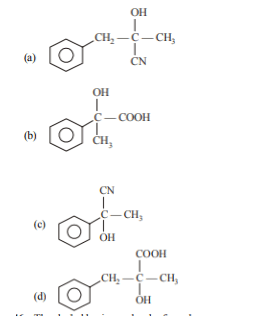
The O–H stretching vibration of alcohols absorbs in the region 3700–3500 cm . The O–H stretching of carboxylic acids absorbs in the region:
1
3090–3700 cm
2
3000–2500 cm
3
3700–3500 cm
4
1700–2000 cm
Official Solution
Correct Option:
(2)
Step 1: IR absorption regions. The O–H stretch in alcohols absorbs around 3700–3500 cm . The O–H stretch in carboxylic acids absorbs in the 3000–2500 cm range due to hydrogen bonding. Step 2: Conclusion. Thus, carboxylic acids absorb O–H stretch in the range 3000–2500 cm .
02
PYQ 2007
medium
chemistryID: viteee-2
Give the IUPAC name for
1
Ethyl-4-oxoheptanate
2
Methyl-4-oxoheptanate
3
Ethyl-4-oxohexonate
4
Methyl-4-oxohexonate
Official Solution
Correct Option:
(4)
Step 1: Naming the compound. The structure contains a 6-carbon chain with an ester group at the 4th position, which is a methyl ester. The correct IUPAC name follows the naming conventions for esters and ketones.
Step 2: Conclusion. Thus, the correct IUPAC name is option (D).
Final Answer:
03
PYQ 2007
medium
chemistryID: viteee-2
The weakest acid amongst the following is
1
CCl₃COOH
2
HCOOH
3
FCH₂CH₂COOH
4
CH₃COOH
Official Solution
Correct Option:
(2)
Step 1: Acid strength comparison. Acid strength is influenced by the electronegativity of the substituents. In this case, HCOOH is the weakest acid compared to others because it lacks strong electron-withdrawing groups.
Step 2: Conclusion. Thus, the correct answer is option (B).
Final Answer:
04
PYQ 2007
medium
chemistryID: viteee-2
HOOC–(CH₂)₄–COOH + 2C₂H₅OH C₂H₅COOC–CH₂–COOC₂H₅ The purpose of using toluene here is
1
to make both substances (acid and alcohol) miscible
2
that the product is insoluble in toluene
3
that the reactants are insoluble in water
4
because of the formation of low boiling azeotrope
Official Solution
Correct Option:
(1)
Step 1: Purpose of toluene in esterification. Toluene is used as a solvent in esterification reactions because it helps dissolve both the alcohol and the acid, making the reaction more efficient.
Step 2: Conclusion. Thus, the correct answer is option (A).
Final Answer:
05
PYQ 2007
medium
chemistryID: viteee-2
Transesterification is the process of
1
conversion of an aliphatic acid to ester
2
conversion of an aromatic acid to ester
3
conversion of one ester to another ester
4
conversion of an ester into its components namely acid and alcohol
Official Solution
Correct Option:
(3)
Step 1: Understanding transesterification. Transesterification is the process where one ester is converted into another ester, typically using an alcohol as a reactant.
Step 2: Conclusion. Thus, the correct answer is option (C).
Final Answer:
06
PYQ 2008
medium
chemistryID: viteee-2
Maleic acid and Fumaric acid are
1
Position Isomers
2
Geometric Isomers
3
Enantiomers
4
Functional Isomers
Official Solution
Correct Option:
(2)
Step 1: Structures of maleic and fumaric acids. Both have formula . Step 2: Difference in arrangement around double bond. Maleic acid: cis form (COOH groups on same side). Fumaric acid: trans form (COOH groups on opposite sides). Step 3: Type of isomerism. Cis-trans due to restricted rotation around double bond is geometrical isomerism. Final Answer:
07
PYQ 2008
medium
chemistryID: viteee-2
The gas evolved on heating alkali formate with soda-lime is
1
CO
2
CO
3
Hydrogen
4
water vapor
Official Solution
Correct Option:
(3)
Step 1: Identify alkali formate. Alkali formate is or . Step 2: Understand soda lime. Soda lime is a mixture of NaOH and CaO. It is generally used for decarboxylation. Step 3: Reaction of alkali formate with NaOH (soda lime). When heated, alkali formate decomposes giving hydrogen gas:
Step 4: Conclusion. Thus the gas evolved is hydrogen. Final Answer:
Step 2: Reaction (ii). Acetic acid reduced with gives ethane:
So:
Step 3: Reaction (iii). Two moles of acetic acid with gives acetic anhydride:
So:
Final Answer:
09
PYQ 2011
medium
chemistryID: viteee-2
In a set of reactions acetic acid yielded a product D:
1
A
2
B
3
C
4
D
Official Solution
Correct Option:
(2)
Step 1: Analyze the reaction. In this reaction, acetic acid undergoes several transformations. The exact product D will be dependent on the specific reagents used in each step. Step 2: Conclusion. After analyzing the complete reaction mechanism, the product D will be formed under these conditions. Final Answer:
10
PYQ 2013
medium
chemistryID: viteee-2
Which is more basic oxygen in an ester?
1
Carbonyl oxygen,
2
Carboxyl oxygen,
3
Equally basic
4
Both are acidic oxygen
Official Solution
Correct Option:
(1)
Step 1: Understanding ester basicity.
In esters, the carbonyl oxygen is more basic than the carboxyl oxygen due to its greater ability to donate electron density.
Step 2: Conclusion.
The carbonyl oxygen is more basic, corresponding to option (1).
11
PYQ 2013
medium
chemistryID: viteee-2
An optically active compound has molecular formula , it evolves with aqueous NaHCO . reacts with LiAlH to give an achiral compound. is
1
2
3
4
Official Solution
Correct Option:
(1)
Step 1: Analyzing the reaction.
The given reactions and the molecular formula suggest that is acetic acid. The reaction with NaHCO shows the presence of a carboxyl group, and the reduction to an achiral compound supports this.
Step 2: Conclusion.
The correct compound is acetic acid, corresponding to option (1).
12
PYQ 2013
medium
chemistryID: viteee-2
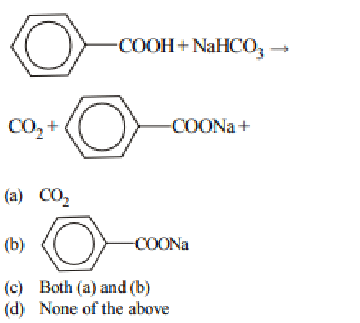
The reaction between COOH and NaHCO is:
1
A
2
B
3
C
4
D
Official Solution
Correct Option:
(1)
Step 1: Understanding the reaction.
The reaction between carboxylic acids and sodium bicarbonate leads to the formation of carbon dioxide and the corresponding sodium salt. The reaction does not involve the formation of carbon.
Step 2: Conclusion.
The correct product of the reaction is and sodium salt, corresponding to option (1).
13
PYQ 2016
medium
chemistryID: viteee-2
IUPAC name of valeric acid is
1
Propanoic acid
2
Butanoic acid
3
Ethanoic acid
4
Pentanoic acid
Official Solution
Correct Option:
(2)
Step 1: Naming the Compound.
Valeric acid is a carboxylic acid with the formula , and its IUPAC name is butanoic acid. Step 2: Conclusion.
The correct answer is (B), Butanoic acid.
14
PYQ 2016
medium
chemistryID: viteee-2
Which of the following name reaction is not used for introducing a group?
1
Cannizzaro reaction
2
Benzoic acid rearrangement
3
Baeyer - Villiger oxidation
4
Iodomorphism reaction
Official Solution
Correct Option:
(1)
Step 1: Cannizzaro Reaction.
The Cannizzaro reaction is a base-induced disproportionation of non-enolizable aldehydes, resulting in the formation of an alcohol and an acid, but not specifically introducing a carboxyl group ( ). The other reactions are directly involved in the introduction of the carboxyl group. Step 2: Conclusion.
The correct answer is (A), Cannizzaro reaction.
15
PYQ 2016
medium
chemistryID: viteee-2
Esterification of acid chloride with ethanol is usually carried out in the presence of pyridine. The function of pyridine is
1
To remove HCl formed in the reaction
2
To react with acid chloride to form an acylpyridinium ion
3
Both (a) and (b)
4
As a catalyst
Official Solution
Correct Option:
(3)
Step 1: Role of Pyridine in Esterification.
Pyridine acts as both a base to remove HCl and a nucleophile to react with acid chloride, forming an acylpyridinium ion, which facilitates the esterification reaction. Step 2: Conclusion.
The correct answer is (C), both (a) and (b).
16
PYQ 2016
medium
chemistryID: viteee-2
can’t give decarboxylation while normally unsaturated acid give this reaction because
1
t-butyl group has large size and does not let the group to leave.
2
t-butyl group can’t extract H from .
3
t-butyl group stabilises the carbocation formed.
4
t-butyl group does not allow this composition to convert to -unsaturated acid.
Official Solution
Correct Option:
(1)
Step 1: Decarboxylation Mechanism.
Decarboxylation typically occurs when an unsaturated acid can stabilize the leaving group. The large size of the t-butyl group hinders the departure of the group. Step 2: Conclusion.
The correct answer is (A), t-butyl group has large size and does not let the group to leave.
17
PYQ 2016
medium
chemistryID: viteee-2
Which of the two acids form anhydrides? (I) Oxalic acid
(II) Succinic acid
(III) Benzoic acid
(IV) Phthalic acid
1
I & III
2
II & IV
3
I & II
4
III & IV
Official Solution
Correct Option:
(3)
Step 1: Anhydride Formation.
Anhydrides are formed by the dehydration of carboxylic acids. Oxalic acid (I) and succinic acid (II) can form anhydrides. Benzoic acid (III) and phthalic acid (IV) are less likely to form anhydrides. Step 2: Conclusion.
The correct answer is (C), I & II.
18
PYQ 2021
medium
chemistryID: viteee-2
The position of both, an electron and a helium atom is known within 1.0 nm. Further the momentum of the electron is known within . The minimum uncertainty in the measurement of the momentum of the helium atom is:
1
2
3
4
Official Solution
Correct Option:
(4)
The uncertainty principle relates the uncertainty in position and momentum. Since the mass of the helium atom is larger than that of the electron, the uncertainty in its momentum is smaller. Therefore, the minimum uncertainty in the momentum of the helium atom is .
Step 2: Conclusion.
Thus, the correct answer is .
About Carboxylic Acids - VITEEE
Carboxylic Acids is a vital chapter for VITEEE aspirants. Mastering the concepts covered in this chapter is essential for securing a top rank.
By rigorously practicing the previous year questions associated with this chapter, you can identify high-yield topics, understand the examiner's perspective, and boost your confidence during the actual exam.
Frequently Asked Questions
Why focus on Carboxylic Acids PYQs?
Analyzing PYQs for this specific chapter reveals the most frequently tested concepts and the typical complexity of questions, allowing you to tailor your study plan efficiently.
How to best use this analysis?
Review the topic breakdown to see which sub-topics within Carboxylic Acids carry the most weight. Then, tackle the questions iteratively to solidify your understanding.