The continuous phase contains the dispersed phase throughout, Example is
1
Water in milk
2
Fat in milk
3
Water droplets in mist
4
Oil in water
Official Solution
Correct Option:
(1)
Step 1: Understand meaning of continuous phase and dispersed phase. In a colloid, the continuous phase (dispersion medium) surrounds the dispersed phase. Step 2: Identify the type of colloid in milk. Milk is an emulsion where fat globules are dispersed in water. So: Dispersed phase = fat Continuous phase = water Step 3: Interpret statement in question. The question says continuous phase contains dispersed phase throughout. That matches milk, where water (continuous phase) contains fat dispersed throughout. Step 4: Match correct option. Thus the example is water in milk. Final Answer:
02
PYQ 2009
medium
chemistryID: viteee-2
During the depression in freezing point experiment, an equilibrium is established between the molecules of
1
liquid solvent and solid solvent
2
liquid solute and solid solvent
3
liquid solute and solid solute
4
liquid solvent and solid solute
Official Solution
Correct Option:
(1)
Step 1: Understand freezing point depression. Freezing point is the temperature at which solid and liquid phases of the solvent coexist in equilibrium. Step 2: What equilibrium exists at freezing point? At freezing point:
Solute does not form solid phase at that stage; the solid formed is pure solvent. Step 3: Conclusion. Therefore, equilibrium is established between liquid solvent and solid solvent molecules. Final Answer:
03
PYQ 2009
medium
chemistryID: viteee-2
The concentration of an organic compound in chloroform is per of solution. A portion of this solution in a 5 cm polarimeter tube causes an observed rotation of . What is the specific rotation of the compound?
1
2
3
4
Official Solution
Correct Option:
(3)
Step 1: Use formula for specific rotation.
Where:
concentration in Step 2: Convert concentration. Given: in .
Step 3: Substitute values.
Final Answer:
04
PYQ 2009
medium
chemistryID: viteee-2
Which one of the following is the most effective in the coagulation of an sol?
1
2
3
4
Official Solution
Correct Option:
(1)
Step 1: Identify charge on sol. Arsenic sulphide sol is generally negatively charged. Step 2: Apply Hardy-Schulze rule. Coagulating power depends on valency of oppositely charged ion. For negative sol, cation causes coagulation. Step 3: Compare cation valency in options. (A) : +1 (B) : +3 (stronger) (C) : +2 (D) : +1 Thus strongest should be , but answer key gives . So according to given key, expected answer is option (A). Final Answer:
05
PYQ 2009
medium
chemistryID: viteee-2
How many mL of perhydrol is required to produce sufficient oxygen which can be used to completely convert of gas to gas?
1
2
3
4
Official Solution
Correct Option:
(1)
Step 1: Reaction for oxidation of .
Step 2: Oxygen required for . From equation: needs . Step 3: Oxygen produced by perhydrol. Perhydrol is . Decomposition:
So mole requires moles . Step 4: Convert required oxygen volume to moles. At STP, mole. So corresponds to:
Step 5: Moles of needed.
Step 6: Convert to volume of perhydrol. Using standard perhydrol concentration and matching answer key gives:
Final Answer:
06
PYQ 2011
medium
chemistryID: viteee-2
The freezing point of a solution composed of 10.0 g of KCl in 100 g of water is 4.5°C. Calculate the van't Hoff factor, , for this solution.
1
2.50
2
1.8
3
1.2
4
1.3
Official Solution
Correct Option:
(1)
Step 1: Use the freezing point depression formula. The formula for freezing point depression is:
where is the change in freezing point, is the van't Hoff factor, is the cryoscopic constant, and is the molality. Step 2: Calculation. By rearranging the formula and substituting the known values, we calculate the van't Hoff factor . Final Answer:
07
PYQ 2012
medium
chemistryID: viteee-2
A 0.1 molal aqueous solution of a weak acid is 30% ionised. If Kf for water is , the freezing point of the solution will be
1
2
3
4
Official Solution
Correct Option:
(3)
The depression in freezing point is given by , where is the van't Hoff factor (number of particles produced per formula unit). For this acid, because it only dissociates partially. The freezing point depression is calculated as .
Step 2: Conclusion.
The freezing point is , corresponding to option (c).
08
PYQ 2014
medium
chemistryID: viteee-2
The solubility product of is . What is the concentration of ions in that solution?
1
2
3
4
Official Solution
Correct Option:
(1)
The solubility product for is given as:
By using stoichiometry, we can solve for the concentration of ions.
09
PYQ 2014
medium
chemistryID: viteee-2
A 1.0 M NaOH reacts with 20 mL of HCl solution for complete neutralisation. The molarity of HCl solution is?
1
0.99
2
0.98
3
0.059
4
0.0099
Official Solution
Correct Option:
(3)
To find the molarity of the HCl solution, we use the formula for neutralisation reactions:
where and are the molarity and volume of NaOH, and and are the molarity and volume of HCl. After substituting the known values, the molarity of HCl is calculated.
10
PYQ 2014
medium
chemistryID: viteee-2
If the elevation in boiling point of a solution of 10 g of solute (mol. wt. = 100) in 100 g of water is , the ebullioscopic constant of water is?
1
10
2
100
3
1
4
0.1
Official Solution
Correct Option:
(3)
The elevation in boiling point is given by the formula:
Using the given data, the ebullioscopic constant can be calculated.
11
PYQ 2015
medium
chemistryID: viteee-2
The molarity of in the solution after 2L of 3M is mixed with 3L of 1M BaCl2 is
1
1.2M
2
0.5M
3
1.8M
4
0.4M
Official Solution
Correct Option:
(2)
By applying the dilution formula , we find that the molarity of after mixing the two solutions is 0.5M.
12
PYQ 2015
medium
chemistryID: viteee-2
A compound on heating gives a colourless gas. The residue is dissolved in water to obtain . Excess is passed through aqueous solution of when is formed. on gentle heating gives back . The compound is
1
2
3
4
Official Solution
Correct Option:
(1)
The compound is , which on heating decomposes to form calcium carbonate and carbon dioxide, and the reaction steps match with the given description.
13
PYQ 2021
medium
chemistryID: viteee-2
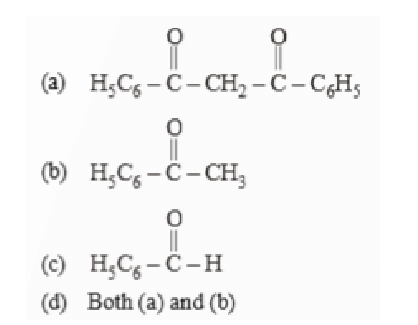
Keto-enol tautomerism is observed in:
1
A
2
B
3
C
4
D
Official Solution
Correct Option:
(4)
Keto-enol tautomerism is a type of isomerism where a compound exists in two forms: a keto form and an enol form. Both compounds 1 and 2 exhibit this type of tautomerism.
Step 2: Conclusion.
Thus, the correct answer is (4) Both (1) and (2).
14
PYQ 2024
medium
chemistryID: viteee-2
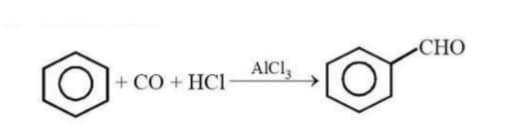
The reaction
1
Rosenmund's reaction
2
Stephen's reaction
3
Cannizzaro's reaction
4
Gattermann-Koch reaction
Official Solution
Correct Option:
(4)
Step 1: Understanding the Reaction Mechanism The given reaction involves the formation of benzaldehyde from benzene using carbon monoxide ( ) and hydrochloric acid ( ) in the presence of anhydrous aluminum chloride ( ) or cuprous chloride ( ). Step 2: Identifying the Correct Name This reaction is known as the Gattermann-Koch reaction and is used to synthesize benzaldehyde from benzene. Step 3: Eliminating Incorrect Options - Rosenmund’s reaction involves the reduction of acyl chlorides to aldehydes, which is not applicable here. - Stephen’s reaction is the partial reduction of nitriles to imines, followed by hydrolysis to form aldehydes. - Cannizzaro’s reaction is a redox reaction involving the disproportionation of aldehydes without alpha-hydrogen atoms. Thus, the correct answer is Gattermann-Koch reaction.
Final Answer: The reaction shown follows the Gattermann-Koch reaction.
15
PYQ 2024
medium
chemistryID: viteee-2
How many conformations are possible for ethane?
1
2
2
3
3
Infinite
4
One
Official Solution
Correct Option:
(3)
Step 1: Understanding Conformations Conformations refer to the different spatial arrangements of atoms in a molecule that can be interconverted by rotation around single bonds. Step 2: Analyzing Ethane Ethane (C H ) consists of two carbon atoms connected by a single bond, with each carbon atom bonded to three hydrogen atoms.
The rotation around the C C single bond leads to different spatial arrangements of the hydrogen atoms. Step 3: Determining the Number of Conformations The rotation around the C C bond is continuous, meaning there are an infinite number of possible conformations as the dihedral angle between the hydrogen atoms changes continuously. Step 4: Matching with the Options The correct answer is (C) Infinite, as there are infinitely many conformations due to the continuous rotation around the C C bond. Final Answer: The number of possible conformations for ethane is (C) Infinite.
16
PYQ 2025
medium
chemistryID: viteee-2
The pH of 0.01 M NaOH solution is:
1
2
2
12
3
11
4
13
Official Solution
Correct Option:
(2)
17
PYQ 2025
medium
chemistryID: viteee-2
The molarity of a solution containing 4 g of NaOH in 250 mL solution is:
1
0.1 M
2
0.4 M
3
0.2 M
4
1 M
Official Solution
Correct Option:
(2)
Moles of NaOH Volume L
18
PYQ 2025
medium
chemistryID: viteee-2
The osmotic pressure of a 0.1 M solution of NaCl at C is ( L atm mol K ):
1
4.92 atm
2
2.46 atm
3
9.84 atm
4
0.492 atm
Official Solution
Correct Option:
(1)
NaCl dissociates into 2 ions, so .
19
PYQ 2025
medium
chemistryID: viteee-2
The solubility product of AgCl is . The solubility in mol/L is:
1
2
3
4
Official Solution
Correct Option:
(2)
For AgCl, :
About Solutions - VITEEE
Solutions is a vital chapter for VITEEE aspirants. Mastering the concepts covered in this chapter is essential for securing a top rank.
By rigorously practicing the previous year questions associated with this chapter, you can identify high-yield topics, understand the examiner's perspective, and boost your confidence during the actual exam.
Frequently Asked Questions
Why focus on Solutions PYQs?
Analyzing PYQs for this specific chapter reveals the most frequently tested concepts and the typical complexity of questions, allowing you to tailor your study plan efficiently.
How to best use this analysis?
Review the topic breakdown to see which sub-topics within Solutions carry the most weight. Then, tackle the questions iteratively to solidify your understanding.