Step 1: Identify the main carbohydrate in milk. Milk contains lactose (milk sugar), which is a disaccharide. Step 2: Digestion (hydrolysis) of lactose. Lactose is broken down by enzyme lactase into:
Step 3: Match with options. Among options, glucose is a correct digestion product. Final Answer:
02
PYQ 2008
medium
chemistryID: viteee-2
Which of the following sets consists only of essential amino acids?
1
Alanine, tyrosine, cystine
2
Leucine, lysine, tryptophan
3
Alanine, glutamine, lysine
4
Leucine, proline, glycine
Official Solution
Correct Option:
(2)
Step 1: Meaning of essential amino acids. Essential amino acids are those which cannot be synthesized by the human body and must be obtained from diet. Step 2: Check the given amino acids. Essential amino acids include: Leucine, Lysine, Tryptophan, Valine, Isoleucine, Methionine, Threonine, Phenylalanine, Histidine. Step 3: Analyze options. (A) Alanine and tyrosine are non-essential incorrect. (C) Alanine and glutamine are non-essential incorrect. (D) Proline and glycine are non-essential incorrect. (B) Leucine, lysine, tryptophan are all essential correct. Final Answer:
03
PYQ 2008
medium
chemistryID: viteee-2
Which of the following is ketohexose ?
1
Glucose
2
Sucrose
3
Fructose
4
Ribose
Official Solution
Correct Option:
(3)
Step 1: Understand ketohexose. Ketohexose means: - keto = contains ketone group - hexose = contains 6 carbon atoms Step 2: Identify among options. Glucose is an aldohexose (aldehyde + 6 carbons). Sucrose is a disaccharide, not a monosaccharide. Ribose is a pentose (5 carbons). Fructose is a monosaccharide with 6 carbons and a ketone group, hence ketohexose. Final Answer:
04
PYQ 2009
medium
chemistryID: viteee-2
How many tripeptides can be prepared by linking the amino acids glycine, alanine and phenyl alanine?
1
One
2
Three
3
Six
4
Twelve
Official Solution
Correct Option:
(3)
Step 1: Understand the concept. A tripeptide consists of 3 amino acids linked in a sequence. Different sequences give different peptides. Step 2: Count permutations of 3 different amino acids. Amino acids: Gly, Ala, Phe (all different). Number of tripeptides possible:
Step 3: List them (for clarity).
Final Answer:
05
PYQ 2009
medium
chemistryID: viteee-2
A codon has a sequence of and specifies a particular that is to be incorporated into a . What are , , ?
1
3 bases, amino acid, carbohydrate
2
3 acids, carbohydrate, protein
3
3 bases, protein, amino acid
4
3 bases, amino acid, protein
Official Solution
Correct Option:
(4)
Step 1: Understand codon definition. A codon is a sequence of three nucleotide bases in mRNA. So:
Step 2: What does codon specify? Each codon codes for a specific amino acid. So:
Step 3: Where is amino acid incorporated? Amino acids are incorporated into polypeptide chain which forms protein. So:
Final Answer:
06
PYQ 2009
medium
chemistryID: viteee-2
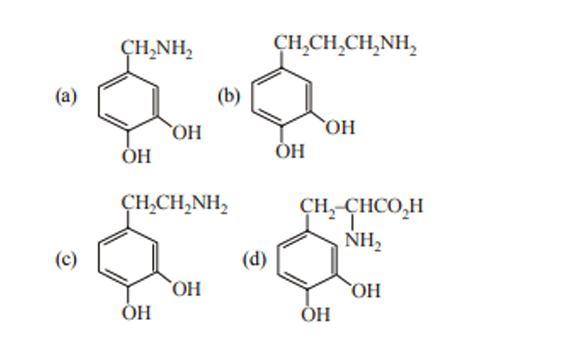
Parkinson's disease is linked to abnormalities in the levels of dopamine in the body. The structure of dopamine is
1
A
2
B
3
C
4
D
Official Solution
Correct Option:
(3)
Step 1: Recall dopamine structure. Dopamine is 3,4-dihydroxyphenethylamine. It contains: - Benzene ring - Two adjacent groups (catechol) - side chain Step 2: Match with given structures. Option (c) shows: - Catechol ring ( at 3 and 4 positions) - substituent So it matches dopamine exactly. Final Answer:
07
PYQ 2010
medium
chemistryID: viteee-2
Mg is an important component of which biomolecule occurring extensively in living world?
1
Haemoglobin
2
Chlorophyll
3
Florigen
4
ATP
Official Solution
Correct Option:
(2)
Step 1: Role of magnesium in biology. Magnesium is the central metal ion in the porphyrin-like ring structure of chlorophyll. Step 2: Compare with haemoglobin. Haemoglobin contains iron (Fe) as central metal, not Mg. Step 3: Therefore correct biomolecule. Chlorophyll is present in plants and is essential for photosynthesis. Final Answer:
08
PYQ 2010
medium
chemistryID: viteee-2
The fatty acid which shows reducing property is
1
acetic acid
2
ethanoic acid
3
oxalic acid
4
formic acid
Official Solution
Correct Option:
(4)
Step 1: Identify reducing acid. Among carboxylic acids, formic acid is unique because it contains an aldehydic hydrogen. Step 2: Reason for reducing behaviour. Formic acid can get oxidized to , hence it reduces Tollens’ reagent and Fehling’s solution. Step 3: Conclusion. Thus formic acid shows reducing property. Final Answer:
09
PYQ 2011
medium
chemistryID: viteee-2
The secondary structure of a protein refers to:
1
-helical backbone
2
hydrophobic interactions
3
sequence of -amino acids
4
fixed configuration of the polypeptide backbone
Official Solution
Correct Option:
(1)
Step 1: Define secondary structure. The secondary structure of a protein involves the local folding patterns such as -helices and -sheets formed by the backbone interactions of the protein's amino acid sequence. Step 2: Conclusion. Thus, the secondary structure refers to the -helical backbone and similar structures. Final Answer:
10
PYQ 2012
medium
chemistryID: viteee-2
Which of the following is not a fat-soluble vitamin?
1
Vitamin B-complex
2
Vitamin D
3
Vitamin E
4
Vitamin A
Official Solution
Correct Option:
(1)
Vitamin B-complex includes water-soluble vitamins, whereas vitamins A, D, and E are fat-soluble.
Step 2: Conclusion.
Vitamin B-complex is not a fat-soluble vitamin, corresponding to option (a).
11
PYQ 2012
medium
chemistryID: viteee-2
Which of the following is not a fat-soluble vitamin?
1
Vitamin B-complex
2
Vitamin D
3
Vitamin E
4
Vitamin A
Official Solution
Correct Option:
(1)
Vitamin B-complex includes water-soluble vitamins, while vitamins A, D, E, and K are fat-soluble.
Step 2: Conclusion.
The correct answer is Vitamin B-complex, as it is not fat-soluble, corresponding to option (a).
12
PYQ 2012
medium
chemistryID: viteee-2
Which of the statements about 'Denaturation' given below are correct? (a) Denaturation of proteins causes loss of secondary and tertiary structures of the protein. (b) Denaturation leads to the conversion of double strand of DNA into single strand. (c) Denaturation affects the primary structure which gets destroyed.
1
(ii) and (iii)
2
(i) and (iii)
3
(i) and (ii)
4
(i) and (iii) are correct
Official Solution
Correct Option:
(3)
Denaturation of proteins disrupts their secondary and tertiary structures, but does not affect the primary structure. Denaturation can also involve the conversion of double-stranded DNA into single strands.
Step 2: Conclusion.
The correct statements are (i) and (iii), corresponding to option (c).
13
PYQ 2015
medium
chemistryID: viteee-2
A compound which gives a negative test with ninhydrin, it cannot be a protein or an amino acid. As, it gives a positive test with Benedict’s solution. The compound is
1
a protein
2
a monosaccharide
3
an amino acid
4
none of the above
Official Solution
Correct Option:
(2)
Monosaccharides give a positive test with Benedict’s solution, whereas proteins and amino acids react with ninhydrin. The absence of a ninhydrin test indicates it is not a protein or amino acid.
14
PYQ 2015
medium
chemistryID: viteee-2
Caffeine has a molecular weight of 194.1 g/l. It contains 28.9% by mass of nitrogen, number of atoms of nitrogen in one molecule of caffeine is
1
4
2
6
3
5
4
3
Official Solution
Correct Option:
(4)
By calculating the mass of nitrogen in a single molecule and using the molar mass of nitrogen, we determine that there are three nitrogen atoms in a caffeine molecule.
15
PYQ 2016
medium
chemistryID: viteee-2
The protein present in the hair is
1
Lysine
2
Keratin
3
Myosine
4
Alanine
Official Solution
Correct Option:
(2)
Step 1: Identifying the Protein.
Keratin is the structural protein found in hair, skin, and nails. It is a fibrous protein that provides strength and elasticity. Step 2: Conclusion.
The correct answer is (B), Keratin.
16
PYQ 2017
medium
chemistryID: viteee-2
Which of the following statements is not true regarding Lactose?
1
On hydrolysis Lactose gives equal amount of D glucose and D galactose
2
Lactose is a -glycoside formed by the union of one molecule of D glucose and a molecule of D galactose.
3
Lactose is a reducing sugar and does not exhibit mutarotation.
4
Lactose, contains 8-OH groups.
Official Solution
Correct Option:
(3)
Step 1: Understand the properties of Lactose.
Lactose is a reducing sugar, meaning it can reduce other substances and undergo mutarotation, where its specific rotation changes as the anomeric forms interconvert. Step 2: Conclusion.
Thus, Lactose does exhibit mutarotation, and statement (3) is incorrect. Final Answer:
17
PYQ 2017
medium
chemistryID: viteee-2
If one strand of DNA has the sequence
1
TAGGAACCT
2
TCCGAACT
3
TACGGAACG
4
TAGCTGAT
Official Solution
Correct Option:
(2)
Step 1: Complementary base pairing.
In DNA, adenine (A) pairs with thymine (T), and cytosine (C) pairs with guanine (G). Therefore, the complementary strand will have the bases paired accordingly. Step 2: Conclusion.
The complementary strand for is . Final Answer:
18
PYQ 2017
medium
chemistryID: viteee-2
Saponification of coconut oil yields glycerol and palmitic acid.
1
sodium palmitate
2
citric acid
3
oleic acid
4
stearic acid
Official Solution
Correct Option:
(1)
Step 1: Understand the process of saponification.
Saponification of coconut oil, which is a triglyceride, produces glycerol and fatty acids like palmitic acid. The fatty acid then forms a soap in the presence of sodium hydroxide. Step 2: Conclusion.
Thus, the product is sodium palmitate. Final Answer:
19
PYQ 2018
medium
chemistryID: viteee-2
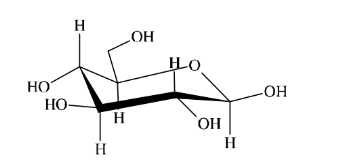
The following carbohydrate is:
1
a ketohexose
2
an aldopentose
3
an -furanose
4
an -pyranose
Official Solution
Correct Option:
(1)
Step 1: The given structure indicates a carbohydrate with a ketone group and 6 carbon atoms. Hence, it is a ketohexose.
Final Answer:
20
PYQ 2019
medium
chemistryID: viteee-2
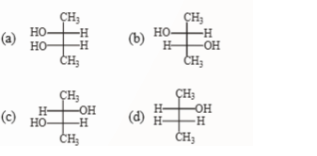
A Fischer projection of (2R, 3S)-2,3-butanediol is:
1
A
2
B
3
C
4
D
Official Solution
Correct Option:
(1)
The Fischer projection for (2R, 3S)-2,3-butanediol should correctly show the stereochemistry at both the 2nd and 3rd positions as given by the R and S configurations. Final Answer:
21
PYQ 2019
medium
chemistryID: viteee-2
Glucose when heated with in presence of dry HCl gas gives - and -methyl glucosides because it contains:
1
An aldehyde group
2
A group
3
A ring structure
4
Five hydroxyl groups
Official Solution
Correct Option:
(4)
Glucose contains five hydroxyl groups, which can react with methanol in the presence of HCl to form methyl glucosides. Final Answer:
22
PYQ 2021
medium
chemistryID: viteee-2
If , and then heat of formation of CO is:
1
R + S
2
R - S
3
R x S
4
S - R
Official Solution
Correct Option:
(2)
The heat of formation of CO can be derived from Hess's Law, by adding and subtracting the enthalpy changes of the reactions. The result is .
Step 2: Conclusion.
Thus, the correct answer is .
23
PYQ 2021
medium
chemistryID: viteee-2
Which of the following compounds does not follow Markovnikov's law?
1
2
3
4
None
Official Solution
Correct Option:
(3)
Markovnikov's rule states that in the addition of HX to an alkene, the hydrogen atom adds to the carbon with the greater number of hydrogen atoms. The exception is the compound , which does not follow this rule.
Step 2: Conclusion.
Thus, the correct answer is .
24
PYQ 2024
medium
chemistryID: viteee-2
Specific conductance of 0.1 M HNO is . The molar conductance of the solution is:
1
2
3
4
Official Solution
Correct Option:
(3)
Step 1: Understanding the Terms Specific Conductance ( ): Given as .
Molar Conductance ( ): This is the conductance of all ions produced by 1 mole of the electrolyte in a solution. Step 2: Formula for Molar Conductance The molar conductance ( ) is calculated using the formula:
where:
is the specific conductance,
is the concentration of the solution in mol/L (0.1 M in this case). Step 3: Substituting the Values Substitute the given values into the formula:
Step 4: Matching with the Options The calculated molar conductance is , which corresponds to option (C). Final Answer: The molar conductance of the solution is (C) .
25
PYQ 2024
medium
chemistryID: viteee-2
Lanthanoid which has the smallest size in state is:
1
Tb
2
Er
3
Ce
4
Lu
Official Solution
Correct Option:
(4)
In the lanthanide series, the ionic size of lanthanoids decreases as we move from to because the effective nuclear charge increases with the increasing atomic number while the electron shielding remains nearly constant. Lanthanum and Lutetium have the smallest ionic radii in the oxidation state. Lutetium ( ) has the smallest ionic radius because of the f block contraction, where the size of the atoms decreases as the atomic number increases from to . Final Answer: Option (d) .
About Biomolecules - VITEEE
Biomolecules is a vital chapter for VITEEE aspirants. Mastering the concepts covered in this chapter is essential for securing a top rank.
By rigorously practicing the previous year questions associated with this chapter, you can identify high-yield topics, understand the examiner's perspective, and boost your confidence during the actual exam.
Frequently Asked Questions
Why focus on Biomolecules PYQs?
Analyzing PYQs for this specific chapter reveals the most frequently tested concepts and the typical complexity of questions, allowing you to tailor your study plan efficiently.
How to best use this analysis?
Review the topic breakdown to see which sub-topics within Biomolecules carry the most weight. Then, tackle the questions iteratively to solidify your understanding.