Law Of Chemical Equilibrium And Equilibrium Constant
34 previous year questions.
Volume: 34 Ques
Yield: High
High-Yield Trend
4
2025
1
2021
2
2019
3
2018
2
2017
2
2016
1
2015
1
2014
1
2013
2
2012
2
2011
4
2010
3
2009
1
2008
3
2007
Chapter Questions
34 MCQs
01
PYQ 2006
medium
chemistryID: viteee-2
For a closed system consisting of a reaction, N O 2NO , the pressure:
1
Remains constant
2
Decreases
3
Increases
4
Becomes zero
Official Solution
Correct Option: (2)
Step 1: Understand the equilibrium concept. In this reaction, as the system approaches equilibrium, the volume decreases because the number of moles of gas decreases. This leads to a decrease in pressure. Step 2: Conclusion. Thus, the pressure decreases as the reaction progresses.
02
PYQ 2006
medium
chemistryID: viteee-2
For the reaction, H (g) + I (g) 2HI(g), = 0, what happens if the pressure on ice is increased at a constant temperature?
1
Water to vaporize
2
Water to freeze
3
Increases
4
No change
Official Solution
Correct Option: (2)
Step 1: Le Chatelier's Principle. According to Le Chatelier's principle, when the pressure is increased on ice at constant temperature, the equilibrium will shift to the side with fewer molecules of gas, which is the solid phase. Step 2: Conclusion. Thus, the water will freeze.
03
PYQ 2007
medium
chemistryID: viteee-2
Given the equilibrium system:What change will shift the equilibrium to the right?
1
Decreasing the temperature
2
Increasing the temperature
3
Dissolving NaCl crystals in the equilibrium mixture
4
Dissolving NHβNOβ crystals in the equilibrium mixture
Official Solution
Correct Option: (2)
Step 1: Effect of temperature on equilibrium. For an endothermic reaction (positive ), increasing the temperature shifts the equilibrium to the right, favoring the forward reaction.
Step 2: Conclusion. Thus, the correct answer is option (B).
Final Answer:
04
PYQ 2007
medium
chemistryID: viteee-2
Equivalent amounts of Hβ and Iβ are heated in a closed vessel till equilibrium is obtained. If 80% of the hydrogen can be converted to HI, the at this temperature is
1
64
2
16
3
0.25
4
0.5
Official Solution
Correct Option: (1)
Step 1: Understanding the equilibrium. The reaction is: If 80% of hydrogen reacts, this gives us the concentration of reactants and products, which can be used to calculate .
Step 2: Conclusion. Thus, the correct value of is 64. Hence, the correct answer is option (A).
Final Answer:
05
PYQ 2007
medium
chemistryID: viteee-2
For the reaction , the equilibrium constant changes with
1
total pressure
2
catalyst
3
the amount Hβ and Iβ
4
temperature
Official Solution
Correct Option: (4)
Step 1: Temperature dependence of equilibrium constant. The equilibrium constant depends on temperature, as shown by the van't Hoff equation. A change in temperature alters the position of equilibrium.
Step 2: Conclusion. Thus, the correct answer is option (D).
Final Answer:
06
PYQ 2008
medium
chemistryID: viteee-2
The standard free energy change of a reaction is kJ at 298 K. Calculate equilibrium constant in . (R = 8.314 J k mol )
1
20.16
2
2.303
3
2.016
4
13.83
Official Solution
Correct Option: (1)
Step 1: Use relation between and equilibrium constant.
Step 2: Convert into J.
Step 3: Substitute values.
Step 4: Convert to .
Final Answer:
07
PYQ 2009
medium
chemistryID: viteee-2
The equilibrium constant for the given reaction is .
What is the equilibrium constant for the reaction given below?
1
2
3
4
Official Solution
Correct Option: (3)
Step 1: Given equilibrium constant. For reaction:
Step 2: Reverse the reaction. Reversing gives:
So new constant becomes:
Step 3: Divide the reaction by 2. Required reaction is:
So equilibrium constant becomes:
Final Answer:
08
PYQ 2009
medium
chemistryID: viteee-2
of acetic acid is mixed with of potassium acetate. of acetic acid . At , calculate the concentration of potassium acetate if pH of the mixture is .
1
2
3
4
Official Solution
Correct Option: (1)
Step 1: Use Henderson-Hasselbalch equation.
Step 2: Find .
Step 3: Substitute given pH.
Step 4: Calculate moles of acid.
Step 5: Moles of salt needed.
Step 6: Find salt concentration. Salt volume = .
Thus as per answer key:
Final Answer:
09
PYQ 2009
medium
chemistryID: viteee-2
pH of a buffer solution decreases by units when of acetic acid is added to of a buffer solution of acetic acid and potassium acetate at . The buffer capacity of the solution is
1
2
3
4
Official Solution
Correct Option: (4)
Step 1: Use definition of buffer capacity. Buffer capacity is:
where = moles of acid/base added, = volume in litres. Step 2: Calculate moles of acetic acid added. Molar mass of .
Step 3: Given pH change.
Volume:
Step 4: Compute buffer capacity.
Final Answer:
10
PYQ 2010
medium
chemistryID: viteee-2
For the reaction, the equilibrium constant, at is . The value of for is
1
8
2
0.25
3
0.125
4
32
Official Solution
Correct Option: (2)
Step 1: Given equilibrium. Step 2: Required reaction is reverse and half. Target: This is exactly of the reverse of the given reaction. Step 3: Reverse reaction constant. Reverse of given reaction: Step 4: Take half reaction. When coefficients are divided by 2, equilibrium constant becomes square root: Final Answer:
11
PYQ 2010
medium
chemistryID: viteee-2
The standard Gibbs free energy change, is related to equilibrium constant, , as
1
2
3
4
Official Solution
Correct Option: (4)
Step 1: Fundamental relation. Thermodynamics gives: Step 2: Rearranging for . Taking exponential: Final Answer:
12
PYQ 2010
medium
chemistryID: viteee-2
The yield of the product in the reaction would be higher at
1
high temperature and high pressure
2
high temperature and low pressure
3
low temperature and high pressure
4
low temperature and low pressure
Official Solution
Correct Option: (3)
Step 1: Analyze effect of temperature (Le Chatelier principle). Reaction gives on product side, so reaction is exothermic. For exothermic reactions, lowering temperature shifts equilibrium towards products. Step 2: Analyze effect of pressure. Reactant moles of gas: Product moles of gas: Since products have fewer moles, increasing pressure shifts equilibrium towards products. Step 3: Combine both effects. To maximize product yield: - low temperature (favours exothermic direction) - high pressure (favours fewer moles side) Final Answer:
13
PYQ 2010
medium
chemistryID: viteee-2
In which of the following case, does the reaction go farthest to completion?
1
2
3
4
Official Solution
Correct Option: (1)
Step 1: Meaning of equilibrium constant. If is very large ( ), equilibrium lies far to the right, meaning products dominate. If , reactants dominate. Step 2: Compare values. Largest value is . Step 3: Conclusion. So reaction goes farthest to completion when . Final Answer:
14
PYQ 2011
medium
chemistryID: viteee-2
For the reaction , cal, which one of the following conditions would favour the yield of C on the basis of Le-Chatelier's principle?
1
High pressure, high temperature
2
Low pressure, low temperature
3
High pressure, low temperature
4
Only low pressure
Official Solution
Correct Option: (1)
Step 1: Understand Le-Chatelier's Principle. According to Le-Chatelier's principle, if a reaction is exothermic ( is negative), lowering the temperature will favour the product formation. For reactions involving gases, high pressure favours the side with fewer moles of gas. Step 2: Conclusion. Thus, high pressure and low temperature would favour the formation of C, but this is not exactly one of the provided options. The most fitting option is (A). Final Answer:
15
PYQ 2011
medium
chemistryID: viteee-2
A vessel at 1000 K contains CO with a pressure of 0.5 atm. Some of the CO is converted into CO on the addition of graphite. The value of K if the total pressure at equilibrium is 0.8 atm, is:
1
1.8 atm
2
3 atm
3
0.3 atm
4
0.18 atm
Official Solution
Correct Option: (3)
Step 1: Understand the reaction. The reaction is:
At equilibrium, the total pressure is the sum of the pressures of CO and CO. Step 2: Calculation. Given the initial pressure and the equilibrium pressures, calculate the equilibrium constant for this reaction. Final Answer:
16
PYQ 2012
medium
chemistryID: viteee-2
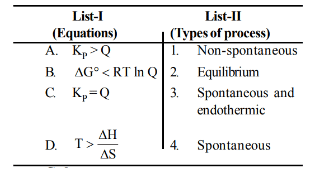
Match List-I with List-II for the equations and select the correct option.
1
1 - 2, 3 - 4
2
3 - 4, 1 - 2
3
4 - 1, 2 - 3
4
2 - 1, 4 - 3
Official Solution
Correct Option: (3)
By examining the equations and their corresponding types of processes, we match them based on the definitions of spontaneity, equilibrium, and other thermodynamic principles.
Step 2: Conclusion.
The correct matching of equations to processes is option (c).
17
PYQ 2012
medium
chemistryID: viteee-2
The following reaction is a reversible reaction that exhibits high temperature behaviour:
1
2
3
4
Official Solution
Correct Option: (1)
This reaction is reversible at high temperatures, where magnesium oxide reacts with chlorine gas to produce magnesium chloride and oxygen. The reaction is temperature dependent, and high temperatures favor the forward direction.
Step 2: Conclusion.
The reversible reaction that exhibits high-temperature behaviour is , corresponding to option (a).
18
PYQ 2013
medium
chemistryID: viteee-2
is heated in a test tube. Vapours are brought in contact with red litmus paper, which changes it to blue and then to red. It is because of
1
formation of and HCl
2
formation of and HCl
3
greater diffusion of than HCl
4
greater diffusion of HCl than
Official Solution
Correct Option: (3)
Step 1: Analyzing the reaction.
When is heated, it dissociates into ammonia and HCl. The ammonia diffuses faster than HCl, which changes the litmus paper.
Step 2: Conclusion.
The correct answer is that the ammonia diffuses faster than HCl, corresponding to option (3).
19
PYQ 2014
medium
chemistryID: viteee-2
The rate constant for forward reaction and backward reaction of hydrolysis of ester are and per minute respectively. Equilibrium constant for the reaction is?
1
33.7
2
7.3
3
53
4
33
Official Solution
Correct Option: (2)
The equilibrium constant for a reversible reaction is the ratio of the rate constants for the forward and reverse reactions:
where is the rate constant for the forward reaction and is the rate constant for the backward reaction.
20
PYQ 2015
medium
chemistryID: viteee-2
Consider the water gas equilibrium reaction,
Which of the following statements is true at equilibrium?
1
If the amount of is increased, less water would be formed
2
If the amount of is increased, more CO and would be formed
3
If the pressure on the system is increased by halving the volume, more water would be formed
4
If the pressure on the system is increased by halving the volume, more CO and would be formed
Official Solution
Correct Option: (2)
Increasing the amount of carbon shifts the equilibrium towards the products, increasing the concentrations of CO and according to Le Chatelier's principle.
21
PYQ 2016
medium
chemistryID: viteee-2
moles of is heated in a closed container to equilibrate
at a pressure of atm. If moles of dissociate at equilibrium, then the correct expression for the equilibrium constant is
1
2
3
4
Official Solution
Correct Option: (1)
Step 1: Equilibrium Expression.
The equilibrium expression for this reaction is given by:
Using the mole fractions and pressures at equilibrium, we can derive the expression for . Step 2: Conclusion.
The correct answer is (A), .
22
PYQ 2016
medium
chemistryID: viteee-2
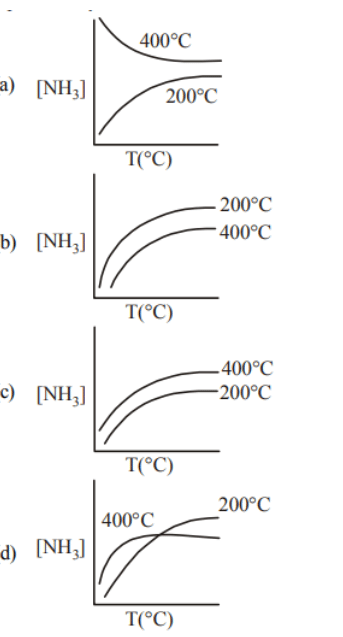
If the reaction occurs at 200Β°C and 1000 atm then the graph showing the correct equilibrium yield at 400Β°C is
1
A
2
B
3
C
4
D
Official Solution
Correct Option: (2)
Step 1: Le Chatelierβs Principle.
According to Le Chatelierβs principle, increasing the temperature of an exothermic reaction (like the formation of ammonia) will shift the equilibrium to the left, decreasing the concentration of ammonia at higher temperatures. Step 2: Conclusion.
The correct answer is (B), vs (200Β°C to 400Β°C) is decreasing.
23
PYQ 2017
medium
chemistryID: viteee-2
The exothermic formation of is represented by the equation:
Which of the following will increase the quantity of in an equilibrium mixture of , , and ?
1
Adding
2
Increasing the volume of the container
3
Removing
4
Increasing the temperature
Official Solution
Correct Option: (1)
Step 1: Apply Le Chatelier's principle.
To increase the quantity of , we can shift the equilibrium towards the product side. Adding more will push the reaction towards the formation of . Step 2: Conclusion.
Thus, adding more will increase the quantity of . Final Answer:
24
PYQ 2017
medium
chemistryID: viteee-2
For the reaction
When and are compared at 184Β°C, it is found that
1
Whether is greater than, less than or equal to depends upon the total gas pressure
2
3
is less than
4
is greater than
Official Solution
Correct Option: (1)
Step 1: Understand the relationship between and .
The relation between and is given by:
where is the change in the number of moles of gas, and is the gas constant. Step 2: Conclusion.
Thus, the value of depends on the total gas pressure and the change in the number of moles. Final Answer:
25
PYQ 2018
medium
chemistryID: viteee-2
For the reaction:
, In equilibrium condition, pressure of is dependent on:
1
mass of
2
mass of
3
temperature of equilibrium
4
mass of and both
Official Solution
Correct Option: (3)
Step 1: In reactions with a positive , the equilibrium position shifts with temperature. The pressure of is influenced by the temperature at equilibrium.
Final Answer:
26
PYQ 2018
medium
chemistryID: viteee-2
Given that the equilibrium constant for the reaction has a value of at a particular temperature. What is the value of the equilibrium constant for the following reaction at the same temperature?
1
2
3
4
Official Solution
Correct Option: (1)
Step 1: The equilibrium constant for the new reaction can be derived by taking the square root of the equilibrium constant for the original reaction. Step 2: Since the stoichiometry is halved, the equilibrium constant for the new reaction is: Final Answer:
27
PYQ 2018
medium
chemistryID: viteee-2
For which of the following systems at equilibrium, at constant temperature, will the doubling of the volume cause a shift to the right?
1
2
3
4
Official Solution
Correct Option: (3)
Step 1: According to Le Chatelierβs principle, increasing the volume of a system at equilibrium will shift the equilibrium to the side with more moles of gas. Step 2: In the case of , the left side has 4 moles of gas, and the right side has 2 moles. Therefore, increasing the volume will shift the equilibrium to the right.
Final Answer:
28
PYQ 2019
medium
chemistryID: viteee-2
The value of for the reaction:
1
2
3
4
Official Solution
Correct Option: (2)
We can use the relationship between and for ideal gases: where is the change in the number of moles of gas, , and . After calculating , we find that the value of is . Final Answer:
29
PYQ 2019
medium
chemistryID: viteee-2
The volume of a closed reaction vessel in which the following equilibrium reaction occurs is halved: \text{As a result,}
1
The rates of forward and backward reactions will remain the same.
2
The equilibrium will not shift.
3
The equilibrium will shift to the right.
4
The rate of forward reaction will become double that of reverse reaction and the equilibrium will shift to the right.
Official Solution
Correct Option: (3)
For a reaction involving gases, according to Le Chatelierβs principle, reducing the volume shifts the equilibrium towards the side with fewer moles of gas. In this case, the right side has fewer moles of gas, so the equilibrium shifts to the right. Final Answer:
30
PYQ 2021
medium
chemistryID: viteee-2
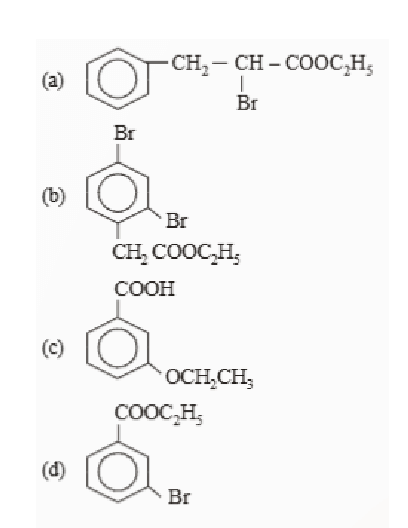
In a set of reactions, ethylbenzene yields a product D. Identify D:
1
A
2
B
3
C
4
D
Official Solution
Correct Option: (4)
- The reaction of ethylbenzene with results in oxidation, forming a carboxylic acid group. - The subsequent reaction with leads to substitution at the benzylic position. - Finally, the hydration of the product gives the final product as , i.e., a bromo-substituted product.
Step 2: Conclusion.
Thus, the correct product is (4) Br.
31
PYQ 2025
medium
chemistryID: viteee-2
For the reaction , kJ/mol. The equilibrium constant will increase with:
1
Increase in temperature
2
Decrease in temperature
3
Increase in pressure
4
Addition of catalyst
Official Solution
Correct Option: (2)
The reaction is exothermic. Lowering temperature favors product formation, increasing .
32
PYQ 2025
medium
chemistryID: viteee-2
The number of moles of oxygen required for complete combustion of 2 moles of methane is:
1
2
2
4
3
6
4
8
Official Solution
Correct Option: (2)
1 mole of methane needs 2 moles of oxygen. So, 2 moles need 4 moles of oxygen.
33
PYQ 2025
medium
chemistryID: viteee-2
Which of the following is not a buffer solution?
1
CH COOH + CH COONa
2
NH OH + NH Cl
3
H SO + Na SO
4
HCN + KCN
Official Solution
Correct Option: (3)
Strong acid + its salt does not form a buffer.
34
PYQ 2025
medium
chemistryID: viteee-2
According to Le Chatelierβs principle, increasing pressure favours the reaction that:
1
Produces more moles of gas
2
Produces fewer moles of gas
3
Has no change in moles
4
Is exothermic
Official Solution
Correct Option: (2)
Increasing pressure shifts equilibrium towards the side with fewer moles of gas to reduce pressure.