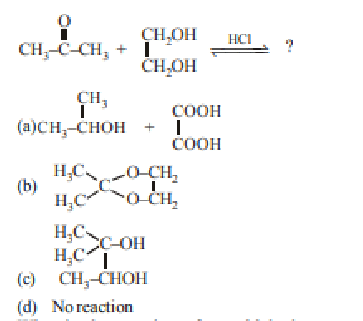
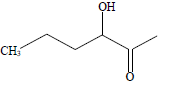
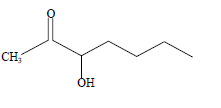
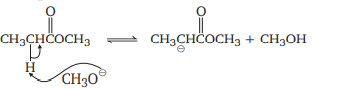
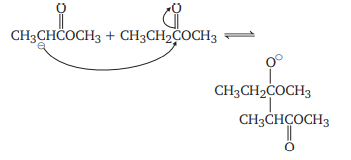
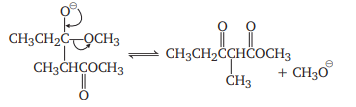
Step 1: Reaction analysis. In this reaction, the organic product involves an alcohol group with a carboxyl group. Step 2: Conclusion. Thus, the correct product is H C–C OH + COOH.
02
PYQ 2006
medium
chemistryID: viteee-2
Calcium Acetate on heating under distillation gives:
1
Acetaldehyde and Calcium Oxide
2
Calcium Carbonate and Acetic acid
3
Acetone and Calcium Carbonate
4
Calcium Oxide and CO
Official Solution
Correct Option: (3)
Step 1: Reaction of Calcium acetate. When calcium acetate is heated, it decomposes to form acetone and calcium carbonate. Step 2: Conclusion. Thus, calcium acetate on heating gives acetone and calcium carbonate.
03
PYQ 2006
medium
chemistryID: viteee-2
Identify the correct statement.
1
Aldehydes on reduction give secondary alcohols
2
Ketones on reduction give primary alcohols
3
Ketones reduce Fehling’s solution and give red cuprous oxide
4
Ketones do not react with alcohols
Official Solution
Correct Option: (4)
Step 1: Reactivity of Aldehydes and Ketones. Aldehydes are reduced to primary alcohols, while ketones are reduced to secondary alcohols. Ketones do not react with Fehling’s solution. Step 2: Conclusion. Thus, ketones do not react with alcohols.
04
PYQ 2006
medium
chemistryID: viteee-2
Calcium Acetate on heating under distillation gives
1
Acetaldehyde and Calcium Oxide
2
Calcium Carbonate and Acetic acid
3
Acetone and Calcium Carbonate
4
Calcium Oxide and
Official Solution
Correct Option: (3)
05
PYQ 2007
medium
chemistryID: viteee-2
Aldol condensation is given by
1
trimethylacetaldehyde
2
acetaldehyde
3
benzaldehyde
4
formaldehyde
Official Solution
Correct Option: (2)
Step 1: Aldol condensation. Aldol condensation typically involves the reaction of aldehydes or ketones with at least one alpha-hydrogen. Acetaldehyde, being a simple aldehyde with alpha-hydrogens, undergoes aldol condensation.
Step 2: Conclusion. Thus, the correct answer is option (B).
Final Answer:
06
PYQ 2007
medium
chemistryID: viteee-2
(CH₃CO)₂O + RMgX ?
1
ROOC(CH₂COOR)
2
RCOCH₂COOH
3
RCOOR
4
RCOOH
Official Solution
Correct Option: (2)
Step 1: Understanding the reaction. This is a reaction of an ester with a Grignard reagent, followed by hydrolysis. The product is a beta-hydroxy acid.
Step 2: Conclusion. Thus, the correct product is option (B).
Final Answer:
07
PYQ 2008
medium
chemistryID: viteee-2
Alkyl cyanides undergo Stephen reduction to produce
1
aldehyde
2
secondary amine
3
primary amine
4
amide
Official Solution
Correct Option: (1)
Step 1: Recall Stephen reduction. Stephen reduction is the partial reduction of nitriles ( ) using . Step 2: Intermediate formation. Nitrile is reduced to iminium salt:
Step 3: Hydrolysis gives aldehyde. On hydrolysis:
Step 4: Conclusion. Hence alkyl cyanides give aldehydes in Stephen reduction. Final Answer:
08
PYQ 2008
medium
chemistryID: viteee-2
A wittig reaction with an aldehyde gives
1
ketone compound
2
a long chain fatty acid
3
olefin compound
4
epoxide
Official Solution
Correct Option: (3)
Step 1: Recall Wittig reaction. Wittig reaction involves reaction of an aldehyde/ketone with a phosphonium ylide to form an alkene (olefin). Step 2: General reaction.
Step 3: Product type. The carbonyl oxygen is removed and replaced by a C=C bond, so an olefin (alkene) is formed. Final Answer:
09
PYQ 2008
medium
chemistryID: viteee-2
Cannizzaro reaction is given by
1
HCHO
2
CH COCH
3
CH CHO
4
CH CH OH
Official Solution
Correct Option: (1)
Step 1: Condition for Cannizzaro reaction. Cannizzaro reaction is shown by aldehydes that do not have alpha hydrogen. Step 2: Check each option. (A) HCHO (formaldehyde) has no alpha hydrogen because it has no carbon chain. So it undergoes Cannizzaro reaction. (C) CH CHO has alpha hydrogens, so it undergoes aldol reaction instead. Others are not aldehydes. Step 3: Conclusion. Hence HCHO gives Cannizzaro reaction. Final Answer:
10
PYQ 2009
medium
chemistryID: viteee-2
The synthesis of crotonaldehyde from acetaldehyde is an example of ...... reaction.
1
nucleophilic addition
2
elimination
3
electrophilic addition
4
nucleophilic addition-elimination
Official Solution
Correct Option: (4)
Step 1: Identify the reaction. Crotonaldehyde is formed by aldol condensation of acetaldehyde.
Step 2: Explain mechanism. Aldol condensation involves: - nucleophilic addition of enolate ion to carbonyl carbon - followed by elimination of water to form -unsaturated aldehyde Step 3: Conclusion. Thus it is nucleophilic addition followed by elimination. Final Answer:
11
PYQ 2010
medium
chemistryID: viteee-2
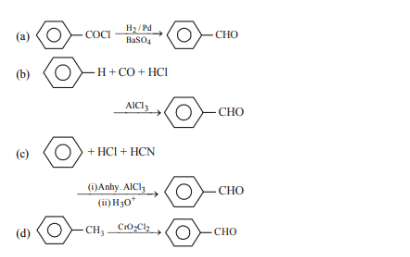
Which of the following is a Gattermann aldehyde synthesis?
1
A
2
B
3
C
4
D
Official Solution
Correct Option: (3)
Step 1: Recall Gattermann aldehyde synthesis. Gattermann reaction converts aromatic compounds to aromatic aldehydes using: followed by hydrolysis. Step 2: Identify correct option. Option (C) matches the exact reagents: benzene + HCN + HCl with and then hydrolysis to benzaldehyde. Step 3: Why other options are not Gattermann. (A) is Rosenmund reduction. (B) is Gattermann-Koch reaction (CO + HCl). (D) is Etard reaction. Final Answer:
12
PYQ 2010
medium
chemistryID: viteee-2
Aldol is
1
-hydroxybutyraldehyde
2
-hydroxybutanal
3
-hydroxypropanal
4
None of the above
Official Solution
Correct Option: (1)
Step 1: Meaning of aldol. Aldol is the product of aldol condensation of acetaldehyde. Step 2: Aldol from acetaldehyde. Two molecules of acetaldehyde combine to form: This is 3-hydroxybutanal. Step 3: Classification. In this compound, is on -carbon with respect to aldehyde group. Hence it is -hydroxybutyraldehyde. Final Answer:
13
PYQ 2010
medium
chemistryID: viteee-2
On treatment of propanone with dilute , the product formed is
1
aldol
2
phorone
3
propionaldehyde
4
4-hydroxy-4-methyl-2-pentanone
Official Solution
Correct Option: (4)
Step 1: Identify reaction type. Propanone (acetone) in presence of dilute base undergoes aldol addition (self-condensation). Step 2: Product of aldol addition of acetone. Two acetone molecules combine to form diacetone alcohol: Step 3: IUPAC name. Diacetone alcohol is: Final Answer:
14
PYQ 2010
medium
chemistryID: viteee-2
Formation of cyanohydrin from a ketone is an example of
1
electrophilic addition
2
nucleophilic addition
3
nucleophilic substitution
4
electrophilic substitution
Official Solution
Correct Option: (2)
Step 1: Reaction involved. Ketone reacts with HCN to form cyanohydrin: Step 2: Identify attacking species. In this reaction, attacks the carbonyl carbon. Carbonyl carbon is electrophilic due to polar bond. Step 3: Type of reaction. Since a nucleophile adds to carbonyl carbon, this is nucleophilic addition. Final Answer:
15
PYQ 2010
hard
chemistryID: viteee-2
On treatment of propanone with dilute , the product formed is
1
aldol
2
phorone
3
propionaldehyde
4
4-hydroxy-4-methyl-2-pentanone
Official Solution
Correct Option: (4)
In the presence of , propanone (acetone) undergoes aldol type condensation as
16
PYQ 2011
medium
chemistryID: viteee-2
The reaction is called:
1
Reimer-Tiemann reaction
2
Lederer-Manasse reaction
3
Sandmeyer reaction
4
Kolbe's reaction
Official Solution
Correct Option: (2)
Step 1: Understand the reaction. The reaction shown corresponds to the Lederer-Manasse reaction, which involves the halogenation of aromatic compounds. Step 2: Conclusion. Thus, the given reaction is identified as the Lederer-Manasse reaction. Final Answer:
17
PYQ 2012
medium
chemistryID: viteee-2
Which of the following carbonyls will have the strongest C—O bond?
1
2
3
4
Official Solution
Correct Option: (1)
The strength of the C—O bond in carbonyl complexes is influenced by the metal's ability to back-donate electrons. The larger the metal's atomic number, the weaker the C—O bond typically is due to stronger back-donation. Thus, will have the strongest C—O bond.
Step 2: Conclusion.
The correct answer is , corresponding to option (a).
18
PYQ 2012
medium
chemistryID: viteee-2
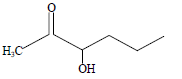
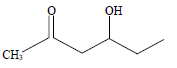
Which of the above compounds on being warmed with iodine solution and NaOH will give iodoform?
1
(i), (ii) and (iv)
2
Only (ii)
3
(i), (ii) and (iii)
4
(i) and (ii)
Official Solution
Correct Option: (1)
Iodoform reaction occurs with compounds that have a methyl group adjacent to a carbonyl group. The compounds in (i), (ii), and (iv) will give iodoform on reaction with iodine and NaOH.
Step 2: Conclusion.
The compounds that will give iodoform are (i), (ii), and (iv), corresponding to option (a).
19
PYQ 2012
medium
chemistryID: viteee-2
Which one of the following compounds will be most readily dehydrated ?
1
2
3
4
Official Solution
Correct Option: (2)
Dehydration of alcohols involve formation of carbocation intermediate. More the stability of carbocation, higher is the ease of dehydration. The order of stability of carbocation, given by the given compounds, is. Thus, compound given in option readily undergoes dehydration.
20
PYQ 2013
medium
chemistryID: viteee-2
Ketones where, alkyl group can be obtained in one step by
1
Hydrolysis of esters
2
Oxidation of primary alcohols
3
Oxidation of secondary alcohols
4
Reaction of acid halide with alcohols
Official Solution
Correct Option: (3)
Oxidation of Ketones, yield secondary alcohol
21
PYQ 2013
easy
chemistryID: viteee-2
In a Claisen condensation reaction (when an ester is treated with a strong base)
1
a proton is removed from the -carbon to form a resonance stabilised carbanion of the ester
2
carbanion acts as a nucleophile in a nucleophilic acyl substitution reaction with another ester molecule
3
a new bond is formed
4
All of the above statements are correct
Official Solution
Correct Option: (4)
When two molecules of an ester undergo a condensation reaction, the reaction is called as Claisen condensation and product is a - keto ester.
Mechanism Step I
undefinedundefined
Step II
Step III
22
PYQ 2013
medium
chemistryID: viteee-2
Ketones , where group can be obtained in one step by
1
Hydrolysis of esters
2
Oxidation of primary alcohols
3
Oxidation of secondary alcohols
4
Reaction of acid halide with alcohols
Official Solution
Correct Option: (3)
Step 1: Identifying ketone formation.
Ketones are formed by oxidation of secondary alcohols, where the alcohol is converted to a carbonyl group (C=O).
Step 2: Conclusion.
The correct answer is oxidation of secondary alcohols, which corresponds to option (3).
23
PYQ 2013
medium
chemistryID: viteee-2
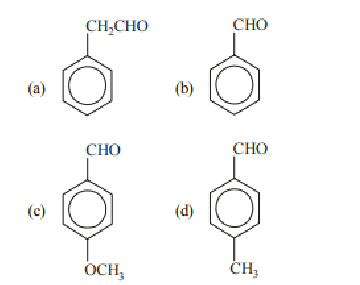
Which of the following does not undergo benzoin condensation?
1
A
2
B
3
C
4
D
Official Solution
Correct Option: (1)
Step 1: Understanding benzoin condensation.
Benzoin condensation is a reaction between aldehydes in the presence of a catalyst. Certain functional groups on aldehydes, like the presence of , prevent them from undergoing benzoin condensation.
Step 2: Conclusion.
does not undergo benzoin condensation, which corresponds to option (1).
24
PYQ 2016
medium
chemistryID: viteee-2
IUPAC name of valeric acid is
1
Propanoic acid
2
Butanoic acid
3
Ethanoic acid
4
Pentanoic acid
Official Solution
Correct Option: (4)
The common name of Pentanoic acid is valeric acid.
25
PYQ 2025
medium
chemistryID: viteee-2
The compound that gives iodoform test is:
1
Acetaldehyde
2
Benzaldehyde
3
Formaldehyde
4
Propionaldehyde
Official Solution
Correct Option: (1)
Compounds containing group give iodoform test. Acetaldehyde satisfies this condition.
26
PYQ 2025
medium
chemistryID: viteee-2
Cannizzaro reaction is shown by aldehydes which:
1
Have alpha hydrogen
2
Do not have alpha hydrogen
3
Have beta hydrogen
4
Are aromatic
Official Solution
Correct Option: (2)
Aldehydes without -hydrogen undergo Cannizzaro reaction.