The metal that crystallizes in simple cubic system is:
1
Po
2
Na
3
Cu
4
Ag
Official Solution
Correct Option:
(2)
Step 1: Identify metals in simple cubic structures. Of the given options, sodium (Na) crystallizes in a simple cubic structure. Other metals such as Cu, Ag, and Po typically crystallize in more complex structures like body-centered or face-centered cubic. Step 2: Conclusion. Thus, the metal that crystallizes in a simple cubic system is sodium (Na).
02
PYQ 2006
medium
chemistryID: viteee-2
How many lattice points belong to a face-centered cubic unit cell?
1
1
2
2
3
4
4
8
Official Solution
Correct Option:
(3)
Step 1: Face-centered cubic (FCC) unit cell. In a face-centered cubic unit cell, there is 1 lattice point at each corner of the cube and 1/2 of a lattice point at each face center. Thus, the total number of lattice points in an FCC unit cell is 4. Step 2: Conclusion. Thus, the correct answer is 4 lattice points.
03
PYQ 2006
medium
chemistryID: viteee-2
Schottky defect in solids is due to:
1
A pair of cation and anion vacancies
2
Occupation of interstitial site by a pair of cation and anion
3
Occupation of interstitial site by a cation
4
Occupation of interstitial site by an anion
Official Solution
Correct Option:
(1)
Step 1: Schottky defect. Schottky defect occurs when there is a pair of vacancies, one for a cation and one for an anion, in a crystal lattice. This defect maintains electrical neutrality. Step 2: Conclusion. Thus, the Schottky defect is due to a pair of cation and anion vacancies.
04
PYQ 2006
medium
chemistryID: viteee-2
Which one of the following is amorphous?
1
Polystyrene
2
Table salt
3
Silica
4
Diamond
Official Solution
Correct Option:
(1)
Step 1: Identifying amorphous substances. Amorphous substances do not have a regular, repeating structure. Polystyrene is an amorphous polymer, while silica, table salt, and diamond are crystalline. Step 2: Conclusion. Thus, polystyrene is amorphous.
05
PYQ 2008
medium
chemistryID: viteee-2
Schottky defects occurs mainly in electrovalent compounds where
1
positive ions and negative ions are of different size
2
positive ions and negative ions are of same size
3
positive ions are small and negative ions are big
4
positive ions are big and negative ions are small
Official Solution
Correct Option:
(2)
Step 1: Define Schottky defect. Schottky defect is a type of point defect in ionic crystals where equal number of cations and anions are missing from their lattice sites. Step 2: Condition for Schottky defect. This defect is mainly found when both ions are of comparable sizes, so that removing them does not distort the lattice much. Examples: NaCl, KCl, CsCl. Step 3: Conclusion. Thus Schottky defect occurs mainly when positive and negative ions are of same size. Final Answer:
06
PYQ 2009
medium
chemistryID: viteee-2
The cubic unit cell of a metal (molar mass = ) has an edge length of . Its density is . The type of unit cell is
1
primitive
2
face centred
3
body centred
4
end centred
Official Solution
Correct Option:
(2)
Step 1: Use density formula for unit cell.
Where: = number of atoms per unit cell
Step 2: Substitute values.
Step 3: Compute .
Step 4: Solve for .
Step 5: Identify lattice type.
Final Answer:
07
PYQ 2010
medium
chemistryID: viteee-2
Frenkel defect is generally observed in
1
AgBr
2
AgI
3
ZnS
4
All of the above
Official Solution
Correct Option:
(4)
Step 1: Definition of Frenkel defect. Frenkel defect occurs when an ion (usually cation) leaves its lattice site and occupies an interstitial site. This creates: - a vacancy defect - an interstitial defect Step 2: Conditions for Frenkel defect. It is common in ionic solids where: - cation is small - anion is large So small cation can move into interstitial positions. Step 3: Examples. AgBr, AgI and ZnS show Frenkel defect because their cations are relatively small. Final Answer:
08
PYQ 2010
medium
chemistryID: viteee-2
Most crystals show cleavage because their atoms, ions or molecules are
1
weakly bonded together
2
strongly bonded together
3
spherically symmetrical
4
arranged in planes
Official Solution
Correct Option:
(4)
Step 1: Meaning of cleavage. Cleavage means a crystal breaks along certain definite directions producing smooth surfaces. Step 2: Reason behind cleavage. In crystals, atoms/ions are arranged in regular layers (planes). Some planes have weaker bonding compared to others. So when force is applied, crystal splits along these planes. Step 3: Hence correct option. Cleavage is due to planar arrangement of particles in crystal lattice. Final Answer:
09
PYQ 2010
medium
chemistryID: viteee-2
The radius of is and that of ion is . Hence, the coordination number of will be
1
4
2
6
3
8
4
unpredictable
Official Solution
Correct Option:
(2)
Step 1: Use radius ratio rule. Step 2: Compare with standard limits. Radius ratio ranges: - CN = 4 (tetrahedral): - CN = 6 (octahedral): - CN = 8 (cubic): Step 3: Locate 0.525. Since coordination number is 6. Final Answer:
10
PYQ 2011
medium
chemistryID: viteee-2
Tetragonal crystal system has the following unit cell dimensions:
1
,
2
,
3
,
4
,
Official Solution
Correct Option:
(3)
Step 1: Understand the unit cell dimensions. In the tetragonal crystal system, two of the axes have equal lengths, and the angles between all axes are 90°. Step 2: Conclusion. Thus, the correct unit cell dimensions are , and the angles . Final Answer:
11
PYQ 2011
medium
chemistryID: viteee-2
A crystalline solid:
1
changes rapidly from solid to liquid
2
has no definite melting point
3
undergoes deformation of its geometry easily
4
softens easily
Official Solution
Correct Option:
(2)
Step 1: Understand the characteristics of crystalline solids. Crystalline solids have a definite geometric structure and a sharp melting point. If the solid is non-crystalline, it might not have a clear melting point. Step 2: Conclusion. Thus, the crystalline solid has a definite melting point. Final Answer:
12
PYQ 2012
medium
chemistryID: viteee-2
A solid compound XY has NaCl structure. If the radius of the cation is 100 pm, the radius of the anion will be
1
141.5 pm
2
153.5 pm
3
122.5 pm
4
165.7 pm
Official Solution
Correct Option:
(3)
For a NaCl structure, the ratio of the radii of the cation and anion is approximately 0.5. Thus, the radius of the anion can be calculated as:
Step 2: Conclusion.
The correct radius of the anion is , corresponding to option (c).
13
PYQ 2012
medium
chemistryID: viteee-2
Among the following, which one has the highest cation to anion size ratio?
1
CsI
2
CsF
3
LiF
4
NaF
Official Solution
Correct Option:
(2)
To find the highest cation to anion size ratio, we compare the ionic radii of the cations and anions in each compound. CsF has the highest ratio due to the relatively larger size of the cesium ion compared to the fluoride ion.
Step 2: Conclusion.
The compound with the highest cation to anion size ratio is CsF, corresponding to option (b).
14
PYQ 2013
medium
chemistryID: viteee-2
The density of solid argon is 1.65 g per cc at 233°C. If the argon atom is assumed to be a sphere of radius cm, what percent of solid argon is apparently empty space?
1
16.5%
2
38%
3
50%
4
62%
Official Solution
Correct Option:
(2)
Step 1: Volume and density relationship.
The volume occupied by argon can be calculated from the density, and the volume of a single argon atom can be calculated assuming it is a sphere. By comparing these volumes, we find that 38% of the solid argon is empty space.
Step 2: Conclusion.
The percentage of empty space in solid argon is 38%, which corresponds to option (2).
15
PYQ 2014
medium
chemistryID: viteee-2
A metal has bcc structure and the edge length of its unit cell is 3.04 Å. The volume of the unit cell in cm³ will be?
1
2
3
4
Official Solution
Correct Option:
(2)
The volume of the unit cell can be calculated using the formula , where is the edge length of the unit cell. After converting the edge length to cm, the volume can be calculated.
16
PYQ 2014
medium
chemistryID: viteee-2
A metal has bcc structure and the edge length of its unit cell is . The volume of the unit cell in will be
1
2
3
4
Official Solution
Correct Option:
(2)
Volume of unit cell (V)
17
PYQ 2015
medium
chemistryID: viteee-2
An alloy of copper, silver and gold is found to have copper atom constituting the ccp lattice. If silver atoms occupy the edge centres and gold atoms are present at body centres, the alloy has a formula
1
2
3
4
Official Solution
Correct Option:
(1)
In a ccp lattice, the number of atoms in each unit cell is determined by the number of atoms at edge and body centres. The copper, silver, and gold atoms fit into this arrangement in the ratio .
18
PYQ 2016
medium
chemistryID: viteee-2
An ionic compound has a unit cell consisting of A ions at the corners of a cube and B ions on the centres of the faces of the cube. The empirical formula for this compound would be
1
2
3
4
Official Solution
Correct Option:
(3)
Step 1: Understanding the Ionic Arrangement.
In the unit cell, A ions are at the corners, and B ions are at the face centers. The number of A ions per unit cell is 8, and the number of B ions per unit cell is 6 (since each face center has half an ion). Therefore, the empirical formula is . Step 2: Conclusion.
The correct answer is (C), .
19
PYQ 2017
medium
chemistryID: viteee-2
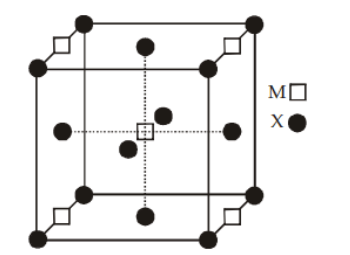
A compound has cubic close packing (ccp) arrangement of . Its unit cell structure is shown below. The empirical formula of the compound is
1
2
3
4
Official Solution
Correct Option:
(1)
Step 1: Analyze the structure.
In a cubic close packing (ccp) structure, each unit cell contains one atom of and one atom of . Since the number of atoms of and are in a 1:1 ratio, the empirical formula is . Step 2: Conclusion.
Thus, the empirical formula is . Final Answer:
20
PYQ 2017
medium
chemistryID: viteee-2
Schottky defect in crystals is observed when
1
unequal number of cations and anions are missing from the lattice
2
equal number of cations and anions are missing from the lattice
3
an ion leaves its normal site and occupies an interstitial site
4
density of the crystal is increased
Official Solution
Correct Option:
(2)
Step 1: Understand Schottky defect.
Schottky defects occur when equal numbers of cations and anions are missing from the lattice, resulting in vacancies that maintain the electrical neutrality of the crystal. Step 2: Conclusion.
Thus, Schottky defects are characterized by an equal number of cations and anions being absent from their normal lattice sites. Final Answer:
21
PYQ 2017
medium
chemistryID: viteee-2
Iron crystallizes in several modifications. At about 911°C, the bcc ‘a’ form undergoes a transition to the ‘ ’ form. If the distance between the two nearest neighbors is the same in the two forms at the transition temperature, the ratio of the density of iron in to that of iron in at the transition temperature is
1
2
3
4
Official Solution
Correct Option:
(1)
Step 1: Use the relationship between density and atomic packing.
The density of a substance is inversely proportional to the volume of the unit cell. Since the number of atoms and the size of the unit cell remain constant, we calculate the ratio of the densities at the transition temperature. Step 2: Conclusion.
Thus, the ratio of densities is . Final Answer:
22
PYQ 2017
medium
chemistryID: viteee-2
If stands for the edge length of the cubic systems: simple cubic, body centered cubic and face centered cubic, then the ratio of radii of the spheres in these systems will be respectively
1
2
3
4
Official Solution
Correct Option:
(3)
Step 1: Understand the relationship between the edge length and radius.
For simple cubic, body-centered cubic, and face-centered cubic, the ratio of radius to edge length differs based on the arrangement of the atoms in the unit cell. Step 2: Conclusion.
For these arrangements, the radius to edge length ratio is for the face-centered cubic structure. Final Answer:
23
PYQ 2018
medium
chemistryID: viteee-2
In a compound, atoms of element Y form ccp lattice and those of element X occupy rd of tetrahedral voids. The formula of the compound will be:
1
2
3
4
Official Solution
Correct Option:
(1)
Step 1: In a ccp lattice, each unit cell contains 4 atoms of element Y. Step 2: The number of tetrahedral voids in a ccp structure is also 4, and of these voids are occupied by element X. Step 3: Therefore, the number of atoms of element X is , and the number of atoms of element Y is 4. Thus, the formula is .
Final Answer:
24
PYQ 2018
medium
chemistryID: viteee-2
An element occurring in the bcc structure has unit cells. The total number of atoms of the element in these cells will be:
1
2
3
4
Official Solution
Correct Option:
(1)
Step 1: In the body-centered cubic (bcc) structure, there are 2 atoms per unit cell. Step 2: The total number of atoms in unit cells is atoms.
Final Answer:
25
PYQ 2019
medium
chemistryID: viteee-2
Bragg's law is given by which of the following equation?
1
2
3
4
Official Solution
Correct Option:
(1)
Bragg's law describes the condition for constructive interference of X-rays scattered by a crystal lattice. The correct equation is: where is the order of reflection, is the wavelength of the incident wave, is the distance between the crystal planes, and is the angle of incidence. Final Answer:
26
PYQ 2022
medium
chemistryID: viteee-2
Which of the following shows Frenkel's defect?
Official Solution
Correct Option:
(1)
The correct answer is only AgCl shows Frenkel defect.
27
PYQ 2024
medium
chemistryID: viteee-2
The number of hydrogen bonds formed by a water molecule at normal conditions is:
1
1
2
2
3
3
4
4
Official Solution
Correct Option:
(2)
Water molecules exhibit a bent shape due to the presence of two lone pairs on the oxygen atom. This enables the molecule to form hydrogen bonds with other water molecules. Each water molecule can form 2 hydrogen bonds: one with the hydrogen atom of another molecule and the other with the oxygen atom of a different molecule. Final Answer: The number of hydrogen bonds formed by a water molecule at normal conditions is 2.
28
PYQ 2024
easy
chemistryID: viteee-2
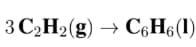
At 25°C and 1 atm pressure, the enthalpy of combustion of benzene (l) and acetylene (g) are and , respectively. The change in enthalpy for the reaction is
1
+324 kJ mol−1
2
+632 kJ mol−1
3
−632 kJ mol−1
4
−732 kJ mol−1
Official Solution
Correct Option:
(3)
Step 1: Write the Given Reactions and Their Enthalpies1. Combustion of Benzene:2. Combustion of Acetylene: Step 2: Use Hess’s Law to Find the Enthalpy Change for the Desired Reaction The desired reaction is:
Using Hess’s Law, the enthalpy change for the desired reaction ( ) is:
Step 3: Determine the Correct Option The change in enthalpy for the reaction is , which matches option (C). Final Answer: The enthalpy change for the reaction is .
About The Solid State - VITEEE
The Solid State is a vital chapter for VITEEE aspirants. Mastering the concepts covered in this chapter is essential for securing a top rank.
By rigorously practicing the previous year questions associated with this chapter, you can identify high-yield topics, understand the examiner's perspective, and boost your confidence during the actual exam.
Frequently Asked Questions
Why focus on The Solid State PYQs?
Analyzing PYQs for this specific chapter reveals the most frequently tested concepts and the typical complexity of questions, allowing you to tailor your study plan efficiently.
How to best use this analysis?
Review the topic breakdown to see which sub-topics within The Solid State carry the most weight. Then, tackle the questions iteratively to solidify your understanding.
 is
is