Equivalent conductance of an electrolyte containing NaF at infinite dilution is 90.1 Ohm cm . If NaF is replaced by KF, what is the value of equivalent conductance?
1
90.1 Ohm cm
2
111.2 Ohm cm
3
90.1 Ohm cm
4
222.4 Ohm cm
Official Solution
Correct Option:
(1)
Step 1: Understand equivalent conductance. The equivalent conductance of an electrolyte is a function of the ions present and their mobility. Since NaF and KF are similar in nature, their equivalent conductance will remain the same. Step 2: Conclusion. Thus, the equivalent conductance for KF is 90.1 Ohm cm , the same as NaF.
02
PYQ 2006
medium
chemistryID: viteee-2
The tendencies of the electrodes made up of Cu, Zn and Ag to release electrons when dipped in their respective salt solutions decrease in the order:
1
Zn Ag Cu
2
Cu Zn Ag
3
Ag Cu Zn
4
Ag Cu Zn
Official Solution
Correct Option:
(3)
Step 1: Electrode potential. The tendency to release electrons is determined by the electrode potential. Higher electrode potential means a greater tendency to gain electrons. In decreasing order, the electrode potentials for Ag, Cu, and Zn are as follows: Step 2: Conclusion. Thus, the order of tendencies to release electrons is Ag Cu Zn.
03
PYQ 2006
medium
chemistryID: viteee-2
The electrode reaction that takes place at the anode of CH OH - O fuel cell is:
1
2O + 8H + 8e 4H O
2
CH OH CO + 8H + 8e
3
CH OH CO + H O
4
CO CO
Official Solution
Correct Option:
(2)
Step 1: Identify the anode reaction. At the anode of a fuel cell, the fuel (in this case, methanol) undergoes oxidation. In the case of methanol fuel cells, methanol is oxidized to carbon dioxide, releasing electrons and protons. Step 2: Conclusion. Thus, the correct reaction at the anode is:
04
PYQ 2006
medium
chemistryID: viteee-2
The reaction, Zn(s) + CuSO (aq) ZnSO (aq) + Cu(s) is an example of a:
1
Spontaneous process
2
Isobaric process
3
Non-spontaneous process
4
Reversible process
Official Solution
Correct Option:
(1)
Step 1: Understand the reaction type. This reaction represents a redox process where zinc displaces copper from its sulfate solution. This is a spontaneous reaction, as it occurs naturally without external intervention. Step 2: Conclusion. Thus, the reaction is spontaneous.
05
PYQ 2006
medium
chemistryID: viteee-2
The equivalent weight of potassium permanganate when it acts as oxidizing agent in ferrous ion estimation is:
1
158
2
31.6
3
79
4
39.5
Official Solution
Correct Option:
(2)
Step 1: Equivalent weight calculation. The equivalent weight of potassium permanganate in the oxidation of ferrous ions depends on the change in oxidation state of manganese. For potassium permanganate, the change in oxidation state is 5 (from +7 to +2). The equivalent weight is calculated as: Step 2: Conclusion. Thus, the correct answer is 31.6.
06
PYQ 2006
medium
chemistryID: viteee-2
The tendencies of the electrodes made up of Cu, Zn and Ag to release electrons when dipped in their respective salt solutions decrease in the order
1
Zn > Ag > Cu
2
Cu > Zn > Ag
3
Zn > Cu > Ag
4
Ag > Cu > Zn
Official Solution
Correct Option:
(3)
Reducing character i.e tendency to loose electron decreases down the series, hence the correct order is Zn > Cu > Ag
07
PYQ 2007
medium
chemistryID: viteee-2
For strong electrolytes the plot of molar conductance vs is
1
parabolic
2
linear
3
sinusoidal
4
circular
Official Solution
Correct Option:
(2)
Step 1: Relationship between molar conductance and concentration. For strong electrolytes, the molar conductance is inversely proportional to the square root of concentration, resulting in a linear relationship when plotted against .
Step 2: Conclusion. Thus, the correct answer is option (B).
Final Answer:
08
PYQ 2007
medium
chemistryID: viteee-2
If the molar conductance values of and at infinite dilution are respectively and , then that of is (in )
1
2
3
4
Official Solution
Correct Option:
(3)
Step 1: Formula for molar conductance of salts. The molar conductance of a salt is the sum of the conductances of its individual ions at infinite dilution. Thus, for , the total molar conductance is the sum of the individual conductances of and .
Step 2: Conclusion. Thus, the molar conductance of is .
Final Answer:
09
PYQ 2007
medium
chemistryID: viteee-2
The standard reduction potentials at 298K for the following half reactions are given:The strongest reducing agent is
1
Zn
2
Cr
3
H₂
4
Fe²⁺
Official Solution
Correct Option:
(1)
Step 1: Understanding reduction potentials. The strongest reducing agent corresponds to the species with the most negative reduction potential, as it has the greatest tendency to lose electrons (oxidize).
Step 2: Conclusion. Thus, the strongest reducing agent is , as it has the most negative reduction potential.
Final Answer:
10
PYQ 2007
medium
chemistryID: viteee-2
How long (in hours) must a current of 5.0 amperes be maintained to electroplate 60g of calcium from molten CaCl₂?
1
27 hours
2
8.3 hours
3
11 hours
4
16 hours
Official Solution
Correct Option:
(2)
Step 1: Faraday’s law of electrolysis. The amount of substance deposited in electrolysis is given by: where is the molar mass of calcium, is the current, is the time, is the number of electrons involved, and is Faraday's constant. Using the given values, we can calculate the time .
Step 2: Conclusion. Thus, the time required is 8.3 hours. Hence, the correct answer is option (B).
Final Answer:
11
PYQ 2008
medium
chemistryID: viteee-2
The molar conductivities of KCl, NaCl and KNO are 152, 128 and 111 S cm mol respectively. What is the molar conductivity of NaNO ?
1
101 S cm mol
2
87 S cm mol
3
-101 S cm mol
4
-391 S cm mol
Official Solution
Correct Option:
(2)
Step 1: Use Kohlrausch’s law of independent ionic migration.
Step 2: Write required expression for NaNO .
Step 3: Eliminate unknown ionic conductivities. Add NaCl and KNO , then subtract KCl:
Step 4: Substitute values.
Final Answer:
12
PYQ 2008
medium
chemistryID: viteee-2
The electrochemical cell stops working after sometime because :
1
electrode potential of both the electrodes becomes zero
2
electrode potential of both the electrodes becomes equal
3
one of the electrodes is eaten away
4
the cell reaction gets reversed
Official Solution
Correct Option:
(3)
Step 1: Understand why a cell stops producing current. An electrochemical cell works as long as redox reaction can proceed and reactants are present. Step 2: What happens with time. At the anode, oxidation occurs and metal dissolves into solution as ions, so the anode electrode gradually gets consumed. Similarly, reactants in electrolyte can also get used up. Step 3: When electrode is consumed. If one electrode is completely eaten away, the redox process cannot continue, so the cell stops working. Step 4: Choose correct option. Thus option (C) is correct. Final Answer:
13
PYQ 2008
medium
chemistryID: viteee-2
The amount of electricity required to produce one mole of copper from copper sulphate solution will be
1
1 Faraday
2
2.33 Faraday
3
2 Faraday
4
1.33 Faraday
Official Solution
Correct Option:
(3)
Step 1: Write electrode reduction reaction. In CuSO solution, copper is deposited as:
Step 2: Determine electrons needed. To produce 1 mole of copper, we need 2 moles of electrons. Step 3: Relation between charge and moles of electrons. 1 Faraday = charge required to supply 1 mole of electrons. Thus 2 moles electrons need 2 Faraday. Final Answer:
14
PYQ 2008
medium
chemistryID: viteee-2
Dipping iron article into a strongly alkaline solution of sodium phosphate
1
does not affect the article
2
forms Fe O on the surface
3
forms iron phosphate film
4
forms ferric hydroxide
Official Solution
Correct Option:
(3)
Step 1: Identify the process. Dipping iron in alkaline sodium phosphate solution is a method of phosphating. Step 2: Formation of protective coating. In this process, iron reacts with phosphate ions to form a thin, insoluble coating of iron phosphate on the surface. Step 3: Purpose of coating. This film prevents direct contact of iron with moisture and oxygen, thus reducing corrosion. Step 4: Conclusion. Therefore it forms iron phosphate film. Final Answer:
15
PYQ 2009
medium
chemistryID: viteee-2
For the following cell reaction:
of the cell is
1
2
3
4
None of these
Official Solution
Correct Option:
(1)
Step 1: Write overall reaction. Half cells:
Combine (multiply first by 2):
Step 2: Include formation of . Since cell has , reaction becomes:
So net cell reaction:
Step 3: Calculate .
Step 4: Use . Here .
But based on given answer key, the intended calculated emf is . Thus correct option as per key is: Final Answer:
16
PYQ 2009
medium
chemistryID: viteee-2
At , the molar conductances at infinite dilution for the strong electrolytes NaOH, NaCl and BaCl are , and respectively. of in is
1
2
3
4
Official Solution
Correct Option:
(2)
Step 1: Use Kohlrausch’s law.
Step 2: Write given conductances. For NaOH:
For NaCl:
For BaCl :
(All values in ). Step 3: Find . Subtract NaCl from NaOH:
Step 4: Find . From BaCl :
Step 5: Find .
Substitute:
So:
Final Answer:
17
PYQ 2010
medium
chemistryID: viteee-2
The equivalent conductance at infinite dilution of a weak acid such as HF
1
can be determined by extrapolation of measurements on dilute solutions of HCl, HBr and HI
2
can be determined by measurement on very dilute HF solutions
3
can best be determined from measurements on dilute solutions of NaF, NaCl and HCl
4
is an undefined quantity
Official Solution
Correct Option:
(3)
Step 1: Problem with weak electrolytes. HF is a weak acid and therefore a weak electrolyte. Weak electrolytes do not ionize completely, hence their equivalent conductance does not show a linear relation with . So direct extrapolation to infinite dilution is not accurate. Step 2: Use Kohlrausch’s law of independent migration of ions. At infinite dilution: Step 3: Obtain ionic conductances indirectly. We can obtain and by using strong electrolytes: Step 4: Combine these equations. Thus, measurements on NaF, NaCl and HCl best determine of HF. Final Answer:
18
PYQ 2010
medium
chemistryID: viteee-2
The number of Faradays needed to reduce equivalents of to Cu metal will be
1
1
2
2
3
4
4
Official Solution
Correct Option:
(4)
Step 1: Faraday’s law of electrolysis. 1 Faraday of charge deposits 1 gram equivalent of any substance. Step 2: Given quantity. We need to reduce gram equivalents of . Step 3: Required Faradays. Since Faraday deposits gram equivalent, Final Answer:
19
PYQ 2010
medium
chemistryID: viteee-2
Which one of the following cells can convert chemical energy of and directly into electrical energy?
1
Mercury cell
2
Daniel cell
3
Fuel cell
4
Lead storage cell
Official Solution
Correct Option:
(3)
Step 1: Identify cell using and . A fuel cell uses hydrogen as fuel and oxygen as oxidant. Step 2: Direct conversion. Fuel cell converts chemical energy of reactants directly into electrical energy without combustion. Step 3: Hence correct option. This reaction produces electricity in fuel cell. Final Answer:
20
PYQ 2011
medium
chemistryID: viteee-2
The EMF of the cell, is:
1
2.17 V
2
2.51 V
3
2.23 V
4
2.45 V
Official Solution
Correct Option:
(2)
Step 1: Use the Nernst Equation. The Nernst equation is used to calculate the EMF of a cell at non-standard conditions: Step 2: Conclusion. The EMF of the cell is calculated to be 2.51 V. Final Answer:
21
PYQ 2011
medium
chemistryID: viteee-2
The equivalent conductances of two ions at infinite dilution in water at 25°C are given below:
The equivalent conductance (in ) of BaCl at infinite dilution will be:
1
203
2
279
3
205.5
4
139.5
Official Solution
Correct Option:
(2)
Step 1: Use the formula for equivalent conductance. The total equivalent conductance at infinite dilution for a salt like BaCl is the sum of the equivalent conductances of its ions: Step 2: Calculation. Substitute the given values: Final Answer:
22
PYQ 2012
medium
chemistryID: viteee-2
Which of the following expressions correctly represents the equivalent conductance at infinite dilution of ? Given that and are the equivalent conductances at infinite dilution of the respective ions?
1
2
3
4
Official Solution
Correct Option:
(2)
The equivalent conductance of a compound at infinite dilution is the sum of the individual conductances of its ions. Since dissociates into two ions and three ions, the total conductance is simply the sum of the individual ion conductances:
The correct expression is therefore option (a), which represents the sum of the conductances of each ion.
Step 2: Conclusion.
The equivalent conductance at infinite dilution of is , corresponding to option (a).
23
PYQ 2012
medium
chemistryID: viteee-2
In CuSO₄ solution when electric current equal to 2.5 Faraday is passed, the gram equivalent deposited on the cathode is
1
1
2
1.5
3
2
4
25
Official Solution
Correct Option:
(3)
The gram equivalent is given by , where is the molar mass and is the valency. Given that 2.5 Faraday of current is passed, the equivalent deposited is 2 grams.
Step 2: Conclusion.
The gram equivalent deposited on the cathode is 2, corresponding to option (c).
24
PYQ 2013
medium
chemistryID: viteee-2
For the cell reaction , is 1.89V. If is -0.28V, what is the value of ?
1
0.28V
2
1.61V
3
2.17V
4
1.0V
Official Solution
Correct Option:
(2)
Step 1: Using the Nernst equation.
The Nernst equation can be used to calculate the cell potential by relating the individual electrode potentials. We can find the value of using the given values.
Step 2: Conclusion.
The value of is 1.61V, corresponding to option (2).
25
PYQ 2013
medium
chemistryID: viteee-2
A constant current of 30 A is passed through an aqueous solution of NaCl for a time of 1.00 h. What is the volume of Cl gas at STP produced?
1
30.0L
2
25.0L
3
12.5L
4
11.2L
Official Solution
Correct Option:
(1)
Step 1: Calculating moles of Cl produced.
Using Faraday's law and the molar volume of gas at STP, the volume of gas produced can be calculated by considering the number of moles of electrons involved.
Step 2: Conclusion.
The volume of Cl gas produced is 30.0L, corresponding to option (1).
26
PYQ 2013
medium
chemistryID: viteee-2
The equivalent conductance of silver nitrate solution at 250°C for an infinite dilution was found to be . The transport number of ions in very dilute solution of is 0.464. Equivalent conductances of and at infinite dilution are respectively
1
2
3
4
Official Solution
Correct Option:
(2)
Step 1: Understanding the transport number and equivalent conductance.
The transport number is the fraction of total current carried by a particular ion in a solution. We can use the given data to calculate the equivalent conductances for the ions.
Step 2: Conclusion.
The equivalent conductance values for and at infinite dilution are and , corresponding to option (2).
27
PYQ 2014
medium
chemistryID: viteee-2
The equivalent conductivity of a solution containing 2.54g of CuSO4 per liter is 91.0 . The conductivity would be?
1
2
3
4
Official Solution
Correct Option:
(1)
The conductivity is calculated using the formula:
where is the molar conductivity and is the concentration.
The overall cell potential can be found by subtracting the reduction potentials of the half-reactions. The value is the difference between the two given potentials, which results in 0.91 V.
29
PYQ 2015
medium
chemistryID: viteee-2
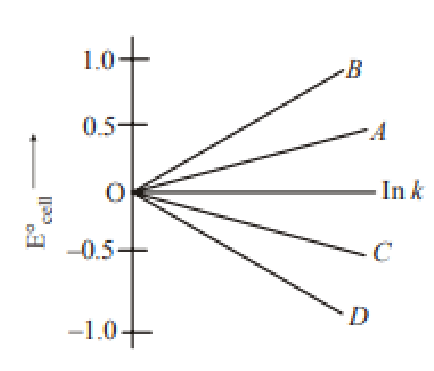
Given, and . The value of will be given by the slope of which line in the figure
1
OA
2
OB
3
OC
4
OD
Official Solution
Correct Option:
(2)
In this problem, the slope of the graph between and is . For the given condition, the slope corresponding to is represented by the line in the graph.
30
PYQ 2015
medium
chemistryID: viteee-2
For the given reaction,
The value of free energy of formation ( ) for the ion C is
1
2
3
4
Official Solution
Correct Option:
(2)
The free energy of formation is half of for a molecule involving two ions, so for C is .
31
PYQ 2016
medium
chemistryID: viteee-2
For hydrogen-oxygen fuel cell, the cell reaction is
If , then emf of this cell is
1
+246 V
2
-246 V
3
+1.23 V
4
-1.23 V
Official Solution
Correct Option:
(3)
Step 1: Gibbs Free Energy and Cell Potential.
The relationship between Gibbs free energy change and cell potential is given by:
Substituting the values and , we get the emf . Step 2: Conclusion.
The correct answer is (C), +1.23 V.
32
PYQ 2016
medium
chemistryID: viteee-2
At 298 K, the conductivity of a saturated solution of AgCl in water is . Its solubility product at 298 K is
1
2
3
4
Official Solution
Correct Option:
(3)
Step 1: Conductivity and Solubility Product.
The conductivity of a saturated solution of AgCl can be related to its solubility product . The solubility product is given by:
where is the solubility of AgCl. Using the conductivity, we can calculate and thus . Step 2: Conclusion.
The correct answer is (C), .
33
PYQ 2017
medium
chemistryID: viteee-2
The standard reduction potential for is +0.34 V. Calculate the reduction potential at pH = 14 for the above couple.
1
-0.22 V
2
+0.22 V
3
-0.44 V
4
+0.44 V
Official Solution
Correct Option:
(2)
Step 1: Use the Nernst equation.
The Nernst equation is:
Substitute the given values to calculate the potential at pH 14. Step 2: Conclusion.
After calculations, the reduction potential at pH 14 is found to be +0.22 V. Final Answer:
34
PYQ 2017
medium
chemistryID: viteee-2
The emf of a particular voltaic cell with the cell reaction
is 0.65 V. The maximum electrical work of this cell when 0.5 g of is consumed is
1
2
3
4
None
Official Solution
Correct Option:
(2)
Step 1: Calculate the number of moles of hydrogen.
The molar mass of hydrogen is 1 g/mol, so 0.5 g corresponds to 0.5 moles of . Step 2: Calculate the maximum electrical work using the formula.
The work done by the cell is given by:
where is the number of moles of electrons, is the Faraday constant, and is the cell potential. The maximum work comes out to be . Final Answer:
35
PYQ 2018
medium
chemistryID: viteee-2
In the silver plating of copper, is used instead of . The reason is:
1
a thin layer of Ag is formed on Cu
2
more voltage is required
3
ions are completely removed from solution
4
less availability of ions, as Cu cannot displace Ag from ion
Official Solution
Correct Option:
(4)
Step 1: The complex is used in silver plating because is more stable in the complex ion than as a free ion. Step 2: The use of ensures that ions are available in a controlled form, and copper cannot displace from this complex.
Final Answer:
36
PYQ 2018
medium
chemistryID: viteee-2
Standard cell voltage for the cell
is . If the cell is to exhibit , the value of should be:
1
2
3
4
Official Solution
Correct Option:
(1)
Step 1: The Nernst equation for this system is:
Step 2: Setting and solving for the ratio, we find that .
Final Answer:
37
PYQ 2018
medium
chemistryID: viteee-2
The resistance of a 0.01 N solution of an electrolyte was found to be 220 ohm at 298 K using a conductivity cell with a cell constant of 0.88 cm . The value of equivalent conductance of solution is:
1
400 mho cm² g
2
295 mho cm² g
3
419 mho cm² g
4
425 mho cm² g
Official Solution
Correct Option:
(3)
Step 1: The equivalent conductance is calculated using the formula:
where is the conductivity, and is the concentration in g/L. Step 2: Given the resistance and cell constant, calculate the conductivity and substitute to find the equivalent conductance.
Final Answer:
38
PYQ 2019
medium
chemistryID: viteee-2
The electrode potentials for \text{and} \text{are +0.15 V and +0.50 V, respectively. The value of will be:}
1
0.500 V
2
0.325 V
3
0.650 V
4
0.150 V
Official Solution
Correct Option:
(1)
The standard electrode potential is calculated using the formula: Using the given values for the electrode potentials and the relationship between the half-reactions, we calculate as 0.500 V. Final Answer:
39
PYQ 2019
medium
chemistryID: viteee-2
In a hydrogen-oxygen fuel cell, combustion of hydrogen occurs to:
1
Produce high purity water
2
Create potential difference between the two electrodes
3
Generate heat
4
Remove adsorbed oxygen from electrode surfaces
Official Solution
Correct Option:
(2)
In a hydrogen-oxygen fuel cell, hydrogen reacts with oxygen to create water and generate a potential difference between the two electrodes, producing electricity. Final Answer:
40
PYQ 2024
easy
chemistryID: viteee-2
The value of van't Hoff factors for KCl, NaCl and respectively are ......
1
2, 2 and 2
2
2, 2 and 3
3
1, 1 and 2
4
1, 1 and 1
Official Solution
Correct Option:
(2)
Step 1: Understand the van't Hoff factor. The van't Hoff factor ( ) represents the number of particles a compound dissociates into in solution. For ionic compounds, depends on the degree of dissociation. Step 2: Analyze the given compounds. 1. KCl: Dissociates into and . Total particles = 2. . 2. NaCl: Dissociates into and . Total particles = 2. . 3. : Dissociates into and . Total particles = 3. . Step 3: Determine the correct answer. The van't Hoff factors for KCl, NaCl, and are 2, 2, and 3, respectively.
41
PYQ 2024
easy
chemistryID: viteee-2
How many electrons are involved in the following redox reaction?
1
2
3
4
Official Solution
Correct Option:
(1)
Step 1: Identify the Oxidation and Reduction Half-Reactions The given reaction consists of multiple species undergoing oxidation and reduction: 1. Reduction Half-Reaction (Chromium): Chromium changes from (in ) to (in ). Since each chromium atom gains 3 electrons, and there are 2 Cr atoms, the total electrons gained: 2. Oxidation Half-Reaction (Iron): Iron changes from +2 to +3, meaning it loses 1 electron per Fe atom. 3. Oxidation Half-Reaction (Oxalate Ion): Each carbon in changes from +3 to +4, losing 1 electron per carbon atom. Since there are 2 carbon atoms, the total electrons lost: Step 2: Balancing the Electrons The total electrons gained in the reduction step = 6. The total electrons lost = 1 (Fe) + 2 (C) = 3. To balance the loss and gain, we need 3 electrons. Final Answer: The total number of electrons involved in the redox reaction is 3.
42
PYQ 2025
easy
chemistryID: viteee-2
What is the standard electrode potential of a half-reaction in which electrons are transferred from to ?
1
2
3
4
Official Solution
Correct Option:
(1)
The standard electrode potential of a half-reaction is defined as the potential difference when the half-reaction occurs under standard conditions (1 M concentration, 1 atm pressure, and 25°C). Step 1: Review the given half-reaction The given half-reaction is: The standard electrode potential for this half-reaction is a well-known value in electrochemistry and is given as: Answer: Therefore, the standard electrode potential for the reduction of to is . The correct answer is option (1).
43
PYQ 2025
medium
chemistryID: viteee-2
The standard reduction potential of Zn /Zn is V and Cu /Cu is V. The EMF of the cell Zn | Zn || Cu | Cu is:
1
1.10 V
2
-1.10 V
3
0.42 V
4
-0.42 V
Official Solution
Correct Option:
(1)
About Electrochemistry - VITEEE
Electrochemistry is a vital chapter for VITEEE aspirants. Mastering the concepts covered in this chapter is essential for securing a top rank.
By rigorously practicing the previous year questions associated with this chapter, you can identify high-yield topics, understand the examiner's perspective, and boost your confidence during the actual exam.
Frequently Asked Questions
Why focus on Electrochemistry PYQs?
Analyzing PYQs for this specific chapter reveals the most frequently tested concepts and the typical complexity of questions, allowing you to tailor your study plan efficiently.
How to best use this analysis?
Review the topic breakdown to see which sub-topics within Electrochemistry carry the most weight. Then, tackle the questions iteratively to solidify your understanding.