all the four valence electrons are bonded to each carbon atoms by covalent bonds
2
it is a giant molecule
3
it is made up of carbon atoms
4
it cannot be burnt
Official Solution
Correct Option: (1)
Step 1: Structure of diamond. In diamond, each carbon atom is sp hybridized and forms four strong covalent bonds with four neighbouring carbon atoms. Step 2: Formation of rigid 3D network. These covalent bonds extend throughout the crystal forming a rigid three-dimensional tetrahedral lattice. Step 3: Reason for hardness. Since every carbon is strongly bonded in all directions, it is extremely difficult to break the structure, hence diamond is very hard. Step 4: Conclusion. Thus hardness is due to strong covalent bonding of all four valence electrons. Final Answer:
02
PYQ 2008
medium
chemistryID: viteee-2
The oxidation number of oxygen in KO , Na O is
1
3, 2
2
1, 0
3
0, 1
4
-0.33, -1
Official Solution
Correct Option: (4)
Step 1: Oxidation state of oxygen in KO . In KO , potassium has oxidation state . Let oxidation state of oxygen be .
Step 2: Oxidation state of oxygen in Na O . Na O is a peroxide. In peroxides, oxygen has oxidation state . Step 3: Final conclusion. So oxidation numbers are and . Final Answer:
03
PYQ 2009
medium
chemistryID: viteee-2
Assertion (A): , and form superoxides. Reason (R): The stability of superoxides increases from to due to decrease in lattice energy.
1
Both (A) and (R) are true and (R) is correct explanation of (A)
2
Both (A) and (R) are true but (R) is not correct explanation of (A)
3
(A) is true but (R) is not true
4
(A) is not true but (R) is true
Official Solution
Correct Option: (3)
Step 1: Check Assertion. , , and form superoxides such as . So Assertion (A) is true. Step 2: Check Reason. Stability of superoxides increases down the group because larger cations stabilize the larger anion due to lower polarizing power, not due to decrease in lattice energy. So Reason (R) is not correct. Step 3: Final decision. Assertion true, Reason false. Final Answer:
04
PYQ 2009
medium
chemistryID: viteee-2
Match the following: List IList II (A) Felspar (I) (B) Asbestos (II) (C) Pyrargyrite (III) (D) Diaspore (IV) (V)
1
(A) V \quad (B) II \quad (C) III \quad (D) I
2
(A) IV \quad (B) V \quad (C) I \quad (D) II
3
(A) I \quad (B) III \quad (C) II \quad (D) IV
4
(A) II \quad (B) IV \quad (C) V \quad (D) I
Official Solution
Correct Option: (2)
Step 1: Identify chemical formula of each mineral. Felspar is a potassium aluminosilicate:
Asbestos is a silicate mineral like hornblende group:
Pyrargyrite is silver antimony sulphide:
Diaspore is hydrated alumina:
Step 2: Write final matching.
Final Answer:
05
PYQ 2009
medium
chemistryID: viteee-2
Which one of the following order is correct for the first ionisation energies of the elements?
1
2
3
4
Official Solution
Correct Option: (3)
Step 1: General trend. Ionisation energy generally increases across a period due to increasing nuclear charge. Step 2: Apply known exceptions. - has lower IE than because loses a electron (easier to remove). - has lower IE than because has paired electrons in causing extra repulsion. Step 3: Arrange with exceptions.
Final Answer:
06
PYQ 2012
medium
chemistryID: viteee-2
What is the value of electron gain enthalpy of , if ?
1
2
3
4
Official Solution
Correct Option: (1)
The electron gain enthalpy of sodium ( ) is the negative of its ionisation energy, as it involves gaining an electron. Thus, the electron gain enthalpy is , equal to the ionisation energy value for sodium.
Step 2: Conclusion.
The correct answer is , corresponding to option (a).
07
PYQ 2012
medium
chemistryID: viteee-2
Among the elements Ca, Mg, P and Cl, the order of increasing atomic radii is
1
2
3
4
Official Solution
Correct Option: (2)
The atomic radii of elements generally increase as you move down a group and decrease as you move across a period from left to right. Based on this trend, the correct order of increasing atomic radii is .
Step 2: Conclusion.
The correct order of increasing atomic radii is , corresponding to option (b).
08
PYQ 2012
medium
chemistryID: viteee-2
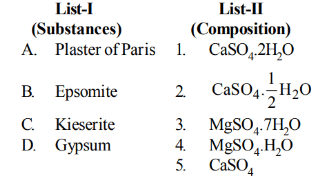
Match List-I with List-II for the compositions of substances and select the correct answer using the codes given below the lists.
1
A - B, B - C, C - D, D - A
2
A - C, B - D, C - A, D - B
3
A - D, B - A, C - B, D - C
4
A - C, B - A, C - D, D - B
Official Solution
Correct Option: (2)
We match the compositions of substances in List-I with the corresponding compositions in List-II. By analyzing the chemical formulas and the substances, the correct matching is found.
Step 2: Conclusion.
The correct matching is A - C, B - D, C - A, D - B, corresponding to option (b).
09
PYQ 2014
medium
chemistryID: viteee-2
Which of the following does not represent the correct order of the property indicated?
1
— ionic radii
2
— density
3
— ionic radii
4
— basic nature
Official Solution
Correct Option: (1)
The order of ionic radii is incorrect because has a smaller ionic radius than , making the sequence incorrect.
10
PYQ 2016
medium
chemistryID: viteee-2
Group 15 elements have more electron gain enthalpy than group 16 elements. The correct reason for this is
1
Poor shielding in group 15
2
Poor shielding in group 16
3
Half-filled stability of group 15 elements
4
Half-filled stability of group 16 elements
Official Solution
Correct Option: (3)
Step 1: Understanding Electron Gain Enthalpy.
Group 15 elements (such as nitrogen) have a half-filled p-orbital configuration, which is more stable. This results in a higher electron gain enthalpy compared to group 16 elements, which do not have this half-filled stability. Step 2: Conclusion.
The correct answer is (C), Half-filled stability of group 15 elements.
11
PYQ 2021
medium
chemistryID: viteee-2
In a set of reactions, acetic acid yields a product D: The structure of would be:
1
A
2
B
3
C
4
D
Official Solution
Correct Option: (4)
Step 1: Reaction of acetic acid with thionyl chloride.
Acetic acid reacts with thionyl chloride (SOCl ) to form acetyl chloride.
Step 2: Friedel-Crafts acylation.
Acetyl chloride reacts with benzene in the presence of AlCl to form acetophenone.
Step 3: Hydrolysis.
The next reaction involves hydrolysis of the nitrile group to form a carboxylic acid, yielding the final product as (benzoic acid).
12
PYQ 2021
medium
chemistryID: viteee-2
A galvanic cell is set up from electrodes A and B Electrode A: Electrode B: Which of the following statements is false?
1
Standard e.m.f of the cell is 0.56 V
2
Current will flow from electrode A to B in the external circuit
3
A will act as cathode and have positive polarity
4
None of these
Official Solution
Correct Option: (4)
The standard e.m.f of the cell is given by: Current flows from anode to cathode, and the anode is where oxidation occurs, so electrode A (Cr) will act as the anode, and electrode B (Fe) will act as the cathode. Therefore, the given statements are true, making option (4) correct.
13
PYQ 2021
medium
chemistryID: viteee-2
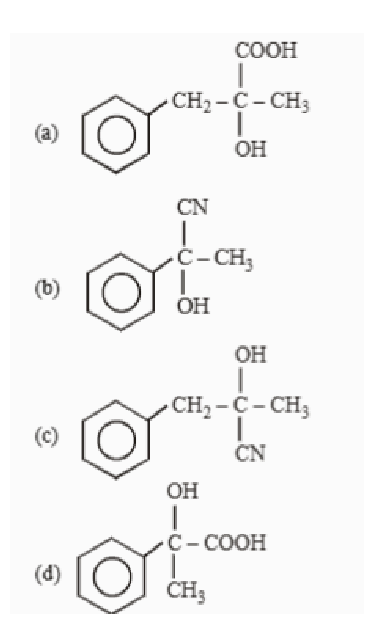
What will be the final product in the following reaction sequence:
1
2
3
4
Official Solution
Correct Option: (3)
Step 1: Hydrolysis of nitrile.
The hydrolysis of a nitrile (CH CH CN) leads to the formation of an amide (CH CH CONH ).
Step 2: Reaction with ammonia.
When the amide reacts with ammonia, it undergoes reduction to form an amine.
Step 3: Conclusion.
The final product is the primary amine .