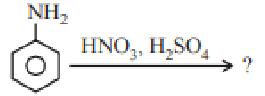
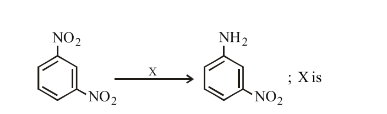
Step 1: Understanding the Reaction.
In the given reaction, the nitration of aniline occurs with a mixture of and , resulting in the formation of p-nitroaniline as the major product due to the activating effect of the amino group in the para position. Step 2: Conclusion.
The correct answer is (C), p-nitroaniline.
02
PYQ 2017
medium
chemistryID: viteee-2
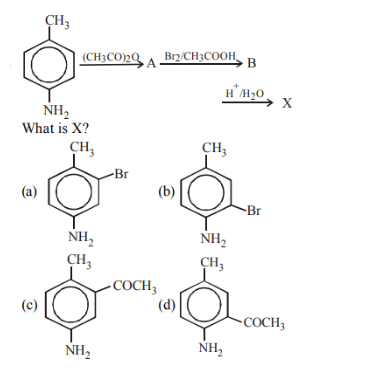
What is X in the following reaction?
1
A
2
B
3
C
4
D
Official Solution
Correct Option:
(4)
Step 1: Analyze the reaction sequence.
In this reaction, undergoes a bromination and subsequent hydrogenation. The final product, X, is likely to be a methylated benzene. Step 2: Conclusion.
Thus, the product is . Final Answer:
03
PYQ 2017
medium
chemistryID: viteee-2
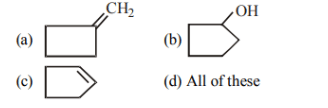
The cyclobutyl methylene with nitrous acid gives
1
A
2
B
3
C
4
D
Official Solution
Correct Option:
(4)
Step 1: Understand the reaction mechanism.
Cyclobutyl methylene reacts with nitrous acid to form a variety of products due to the nature of the reaction, resulting in CH2, OH, and CH3 groups as possible products. Step 2: Conclusion.
Thus, the reaction with nitrous acid can yield all of the mentioned products. Final Answer:
04
PYQ 2017
medium
chemistryID: viteee-2
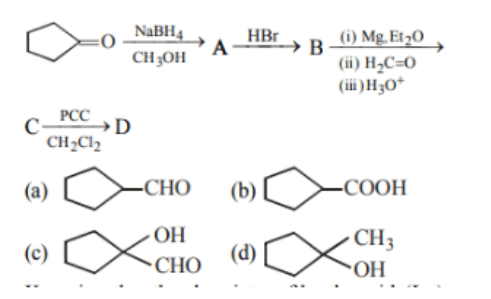
What is D in the following sequence of reactions?
1
A
2
B
3
C
4
D
Official Solution
Correct Option:
(1)
Step 1: Analyze the reaction sequence.
The reaction sequence involves reduction of aldehyde to alcohol with sodium borohydride, followed by oxidation with PCC to form the aldehyde. Step 2: Conclusion.
Thus, the compound D is CHO. Final Answer:
05
PYQ 2017
medium
chemistryID: viteee-2
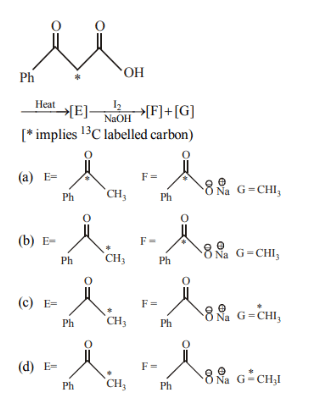
In the following reaction sequence, the correct structures of F, F, and G are
1
A
2
B
3
C
4
D
Official Solution
Correct Option:
(3)
Step 1: Analyze the reaction steps.
The reaction proceeds by oxidation and the resulting products are hydroxyl groups, finally forming a methylated product. Step 2: Conclusion.
Thus, the correct structures of F, F, and G are Ph - OH, F - OH, and G - CH . Final Answer:
06
PYQ 2018
medium
chemistryID: viteee-2
In the reaction:
1
2
3
4
Official Solution
Correct Option:
(1)
Step 1: This reaction involves nitrogen dioxide and ammonia as reactants. The product formed is silicon carbide, .
Final Answer:
07
PYQ 2018
medium
chemistryID: viteee-2
Which of the following is best method for reducing 3-bromopropanal to 1-bromopropane?
1
Wolf-Kishner reduction
2
Clemmenson reduction
3
Either (a) or (b)
4
Stephen's reduction
Official Solution
Correct Option:
(3)
Step 1: The Wolf-Kishner and Clemmenson reductions are both suitable methods for reducing aldehydes and ketones to alkanes. Step 2: Both of these methods could be used to reduce 3-bromopropanal to 1-bromopropane.
Final Answer:
08
PYQ 2018
medium
chemistryID: viteee-2
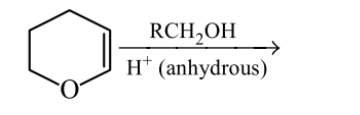
The major product of the following reaction is:
1
a hemiacetal
2
an acetal
3
an ether
4
an ester
Official Solution
Correct Option:
(2)
Step 1: In the presence of anhydrous , alcohols undergo acetal formation with aldehydes or ketones. Step 2: The major product formed is an acetal when the alcohol reacts with the carbonyl compound.
Final Answer:
09
PYQ 2024
medium
chemistryID: viteee-2
100 mL of 0.04 N HCl aqueous solution is mixed with 100 mL of 0.02 N NaOH solution. The pH of the resulting solution is:
1
1.0
2
1.7
3
2.0
4
2.3
Official Solution
Correct Option:
(3)
Step 1: Understanding the Problem We are mixing 100 mL of 0.04 N HCl with 100 mL of 0.02 N NaOH. We need to find the pH of the resulting solution. Step 2: Calculating the Moles of H and OH Moles of H from HCl: Moles of OH from NaOH: Step 3: Determining the Remaining Moles of H The reaction between H and OH is: Moles of H remaining after the reaction: Step 4: Calculating the Concentration of H Total volume of the resulting solution: Concentration of H : Step 5: Calculating the pH The pH is given by: Substituting the concentration of H : Step 6: Matching with the Options The calculated pH is 2.0, which corresponds to option (C). Final Answer: The pH of the resulting solution is (C) 2.0.
About Organic Reactions - VITEEE
Organic Reactions is a vital chapter for VITEEE aspirants. Mastering the concepts covered in this chapter is essential for securing a top rank.
By rigorously practicing the previous year questions associated with this chapter, you can identify high-yield topics, understand the examiner's perspective, and boost your confidence during the actual exam.
Frequently Asked Questions
Why focus on Organic Reactions PYQs?
Analyzing PYQs for this specific chapter reveals the most frequently tested concepts and the typical complexity of questions, allowing you to tailor your study plan efficiently.
How to best use this analysis?
Review the topic breakdown to see which sub-topics within Organic Reactions carry the most weight. Then, tackle the questions iteratively to solidify your understanding.