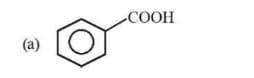
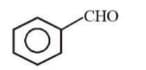
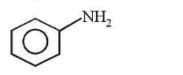
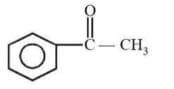
The order of reactivity of phenyl magnesium bromide ( ) with the following compounds is:
1
III>II>I
2
II>III>I
3
I>III>II
4
II>I>III
Official Solution
Correct Option: (4)
Phenyl magnesium bromide is a strong nucleophile and will react most readily with compounds that have a weak or reactive electrophilic center. The order of reactivity is determined by the electrophilicity of the compounds.
Step 2: Conclusion.
The correct order of reactivity is II>I>III, corresponding to option (d).
02
PYQ 2012
medium
chemistryID: viteee-2
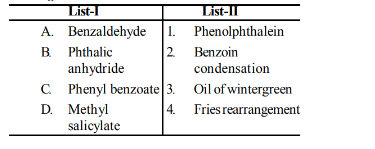
Match the compounds given in List-I with List-II and select the suitable option using the codes given below:
1
1 - 2, 2 - 3, 3 - 4
2
2 - 1, 4 - 3, 1 - 4, 3 - 2
3
3 - 4, 1 - 2, 2 - 3
4
2 - 3, 3 - 4, 1 - 2, 4 - 1
Official Solution
Correct Option: (4)
By matching each substance with its corresponding manufacturing process, we find that option (d) is correct. This involves matching each compound with its correct industrial process.
Step 2: Conclusion.
The correct matching is 2 - 3, 3 - 4, 1 - 2, 4 - 1, corresponding to option (d).
03
PYQ 2012
medium
chemistryID: viteee-2
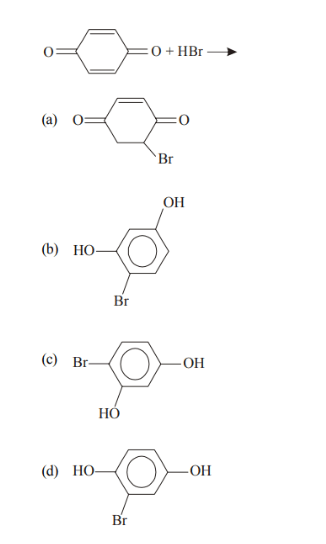
In the following reaction,
1
2
3
4
Official Solution
Correct Option: (3)
This is an example of a nucleophilic substitution reaction, where displaces from and the product is (benzyl alcohol).
Step 2: Conclusion.
The correct reaction is , corresponding to option (c).
04
PYQ 2012
medium
chemistryID: viteee-2
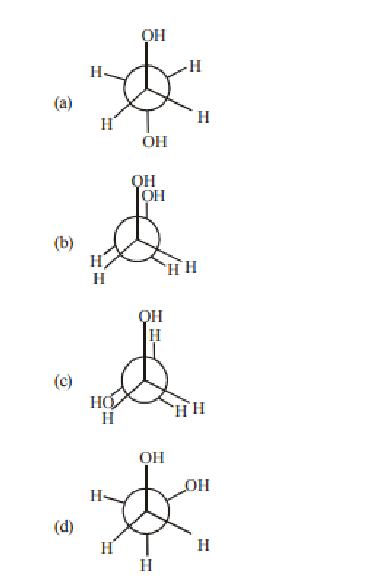
Which of the following conformers for ethylene glycol is most stable?
1
A
2
B
3
C
4
D
Official Solution
Correct Option: (4)
The conformer is the most stable form because it allows for favorable hydrogen bonding between the hydroxyl groups, enhancing stability.
Step 2: Conclusion.
The most stable conformer for ethylene glycol is , corresponding to option (d).
05
PYQ 2012
medium
chemistryID: viteee-2
Which of the following species is not electrophilic in nature?
1
Cl
2
BHโ
3
Iโ
4
NOโ
Official Solution
Correct Option: (3)
Electrophilic species are electron-pair acceptors. Among the options, is not electrophilic because iodine is less likely to accept electron pairs compared to the other species.
Step 2: Conclusion.
The non-electrophilic species is , corresponding to option (c).
06
PYQ 2012
medium
chemistryID: viteee-2
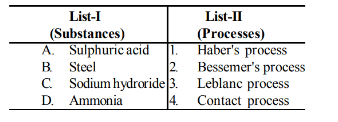
Match List-I (Substances) with List-II (Processes employed in the manufacture of the substances) and select the correct option.
1
1 - 4, 2 - 3, 3 - 1, 4 - 2
2
2 - 1, 4 - 3, 1 - 4, 3 - 2
3
3 - 1, 4 - 2, 1 - 3, 2 - 4
4
2 - 3, 3 - 4, 1 - 2, 4 - 1
Official Solution
Correct Option: (4)
We match each substance with the appropriate process used in its manufacturing, based on the given codes for processes.
An organic compound is formed by the reaction of ethyl magnesium iodide with a substance , followed by treatment with dilute aqueous acid. Compound does not react with PCC or PDC in dichloromethane. Which of the following is a possible compound for ?
1
2
3
4
Official Solution
Correct Option: (1)
Step 1: Reaction with Grignard reagent.
The reaction of ethyl magnesium iodide (a Grignard reagent) with a carbonyl compound like an aldehyde or ketone forms an alcohol. The fact that does not react with PCC or PDC suggests that is an alcohol, specifically a secondary alcohol.
Step 2: Conclusion.
The correct compound is acetic acid, corresponding to option (1).
08
PYQ 2013
medium
chemistryID: viteee-2
The product Y is
1
p-chloro nitrobenzene
2
o-chloro nitrobenzene
3
m-chloro nitrobenzene
4
o, p-dichloro nitrobenzene
Official Solution
Correct Option: (3)
Step 1: Identifying the reaction.
The reaction mechanism leads to the formation of a chloro nitrobenzene derivative at the meta position due to the positions of the substituents in the starting material.
Step 2: Conclusion.
The product is m-chloro nitrobenzene, corresponding to option (3).
09
PYQ 2013
medium
chemistryID: viteee-2
End product of the following reaction is
1
A
2
B
3
C
4
D
Official Solution
Correct Option: (1)
Step 1: Analyzing the reaction.
The reaction of the given compound with the reactants forms benzoic acid and HBr as products.
Step 2: Conclusion.
The end product is , corresponding to option (1).
10
PYQ 2013
medium
chemistryID: viteee-2
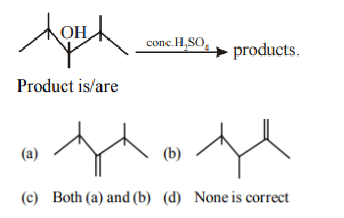
Product is/are
1
A
2
B
3
C
4
D
Official Solution
Correct Option: (1)
Step 1: Analyzing the reaction.
The reaction involves the reduction of a carboxyl group to form an aldehyde or alcohol. Based on the given options, the correct product is acetic acid.
Step 2: Conclusion.
The correct product is acetic acid, corresponding to option (1).
11
PYQ 2013
medium
chemistryID: viteee-2
Phenol is heated with phthalic anhydride in the presence of cone. H SO . The product gives pink colour with alkaline ferric chloride. The product is
1
Salicylic acid
2
Bakelite
3
Phenolphthalein
4
Fluorescein
Official Solution
Correct Option: (1)
Step 1: Reaction analysis.
When phenol reacts with phthalic anhydride in the presence of sulfuric acid, the product formed is salicylic acid, which gives a pink colour with alkaline ferric chloride.
Step 2: Conclusion.
The correct product is salicylic acid, corresponding to option (1).
12
PYQ 2013
medium
chemistryID: viteee-2
โ is identified as
1
2
3
4
None of these
Official Solution
Correct Option: (4)
Step 1: Identifying the structure.
The provided information involves the transformation of water to another compound. However, based on the given context, none of the provided options corresponds to the transformation described.
Step 2: Conclusion.
The correct answer is "None of these" because no option matches the reaction.
13
PYQ 2013
medium
chemistryID: viteee-2
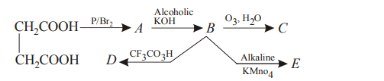
Consider the following reaction sequence: Isomers are:
1
and
2
and
3
and
4
and
Official Solution
Correct Option: (3)
Step 1: Analyzing the reaction sequence.
In the given reaction, acetic acid undergoes a reaction with to form an intermediate, followed by a reaction with alcoholic KOH to form isomers. The correct isomers are and .
Step 2: Conclusion.
The isomers formed in the reaction are and , corresponding to option (3).
14
PYQ 2014
medium
chemistryID: viteee-2
In the sequence of reactions, the final product (IV) is?
1
2
3
4
Official Solution
Correct Option: (2)
The given sequence of reactions shows the transformation of a compound through several stages, with the final product being acetic acid ( ).
15
PYQ 2014
medium
chemistryID: viteee-2
2.76 g of silver carbonate on being strongly heated yields a residue weighing?
1
3.33 g
2
3.09 g
3
1.36 g
4
2.16 g
Official Solution
Correct Option: (3)
Upon heating, silver carbonate decomposes to form silver oxide and carbon dioxide. The residue left is silver oxide. By applying stoichiometry, the weight of the residue can be calculated.
16
PYQ 2014
medium
chemistryID: viteee-2
The final product (IV) in the sequence of reactions is?
1
2
3
4
Official Solution
Correct Option: (2)
In the given sequence, starting from the organic compound, it undergoes a series of reactions to form the final product, acetic acid ( ).
17
PYQ 2014
medium
chemistryID: viteee-2
The sodium extract of an organic compound on acidification with acetic acid and addition of lead acetate solution gives a black precipitate. The organic compound contains?
1
nitrogen
2
halogen
3
phosphorus
4
sulphur
Official Solution
Correct Option: (3)
The formation of a black precipitate when lead acetate is added to the sodium extract of an organic compound indicates the presence of phosphorus, which forms lead phosphate under these conditions.
18
PYQ 2014
medium
chemistryID: viteee-2
Which of the following isomerism is shown by ethyl acetoacetate?
1
Geometrical isomerism
2
Keto-enol tautomerism
3
Enantiomerism
4
Diastereoisomerism
Official Solution
Correct Option: (2)
N/A
19
PYQ 2014
medium
chemistryID: viteee-2
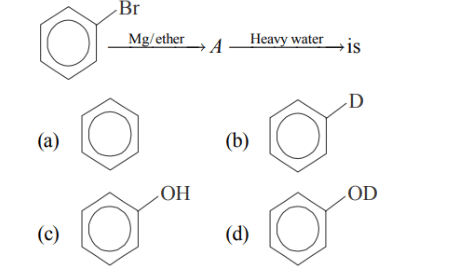
The final product obtained in the reaction,
1
A
2
B
3
C
4
D
Official Solution
Correct Option: (2)
In the reaction, the alkyl halide undergoes a Grignard reaction to form a magnesium alkoxide, which reacts with heavy water (D2O), replacing the hydroxyl group with deuterium.
20
PYQ 2014
medium
chemistryID: viteee-2
Among the following the strongest nucleophile is?
1
2
3
4
Official Solution
Correct Option: (1)
Sulfide ions ( ) are typically stronger nucleophiles than amines or carboxylates due to their higher electron density and lower basicity.
Tranquillizers like Equanil, heroin, and valium are classified differently from antiseptics, analgesics, and bactericidal agents, which are used for different therapeutic purposes.
22
PYQ 2014
medium
chemistryID: viteee-2
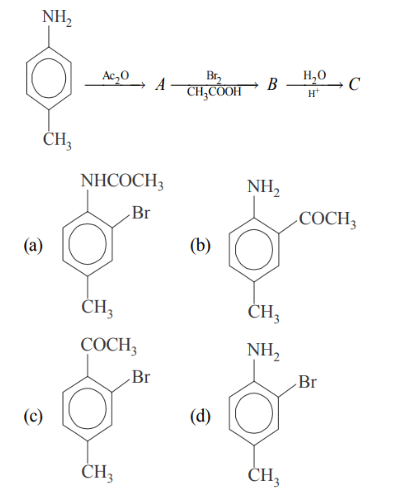
The final product in the above reaction is?
1
A
2
B
3
C
4
D
Official Solution
Correct Option: (4)
In the reaction, the intermediate undergoes hydrolysis with water to yield the final product , which is an amide derivative with the functional group .
23
PYQ 2014
medium
chemistryID: viteee-2
Which of the following has an ester linkage?
1
Nylon-66
2
Dacron
3
PVC
4
Bakelite
Official Solution
Correct Option: (2)
Dacron is a polyester, which contains ester linkages between the monomers. PVC and Bakelite do not contain ester linkages.
24
PYQ 2015
medium
chemistryID: viteee-2
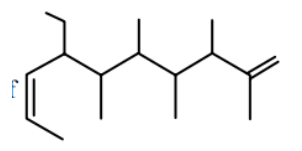
The IUPAC name of
1
4-ethyl-5,6,7,9-tetramethyldec-2,9-diene
2
7-ethyl-2,4,5,6-tetramethyldec-1,8-diene
3
6-ethyl-2,4,5,6-tetramethyldec-1,8-diene
4
7-1-propanyl-2,3,4,5-tetramethyl non-1-ene
Official Solution
Correct Option: (1)
The IUPAC name corresponds to the structure and functional groups of the compound as determined by the correct naming conventions. Here, the compound is a diene with multiple substituents and methyl groups.
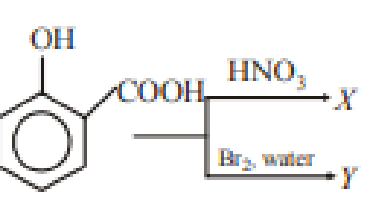
This reaction involves the nitration and bromination of salicylic acid to form picric acid and 2, 4, 6-tribromophenol.
26
PYQ 2015
medium
chemistryID: viteee-2
In the Cannizzaro reaction given below: the slowest step is
1
the attack of OH at the carbonyl group
2
the transfer of Hydride ion to the carbonyl group
3
the abstraction of a proton from the carboxylate group
4
the deprotonation of Ph-CH OH
Official Solution
Correct Option: (2)
The rate-determining step in the Cannizzaro reaction is the transfer of a hydride ion from one molecule to another, leading to the formation of alcohol and acid.
27
PYQ 2015
medium
chemistryID: viteee-2
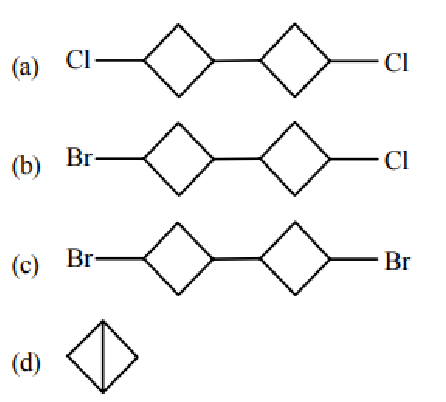
The reaction of 1-bromo-3-chlorocyclobutane with metallic sodium in dioxane under reflux conditions gives
1
A
2
B
3
C
4
D
Official Solution
Correct Option: (4)
The reaction leads to the formation of bicyclic compounds due to the coupling of two cyclobutane rings in the presence of sodium and dioxane.
28
PYQ 2015
medium
chemistryID: viteee-2
Identify in the following reaction sequence
1
2
3
4
Official Solution
Correct Option: (2)
The reaction sequence involves the dehydration of alcohol to form alkene, followed by a strong base ( ) which induces elimination to form the alkyne.
29
PYQ 2015
medium
chemistryID: viteee-2
For the preparation of paracetamol
1
+ +
2
+ +
3
4
Official Solution
Correct Option: (4)
The preparation of paracetamol involves the reaction of aniline with acetic anhydride or acetylation using .
30
PYQ 2015
medium
chemistryID: viteee-2
Point out incorrect stability order
1
2
3
4
Official Solution
Correct Option: (4)
The incorrect stability order is option (4) because it shows the same complex ion, , appearing twice with contradictory charge states.
31
PYQ 2015
medium
chemistryID: viteee-2
In benzene, the triple bond consists of
1
one sigma bond and two pi bonds
2
two sigma bonds and one pi bond
3
one sigma bond, one pi bond and one pi bond
4
None of the above
Official Solution
Correct Option: (3)
In the triple bond of benzene, the sigma bond is formed by overlapping of the hybridized orbitals and the bonds are the pi bonds formed by sideways overlapping of unhybridized p-orbitals. Benzene has a resonance structure, which means it is a conjugated system with delocalized electrons.
32
PYQ 2015
medium
chemistryID: viteee-2
In keto-enol tautomerism of dicarbonyl compounds, the enol-form is preferred in contrast to the keto-form, this is due to
1
presence of carbonyl group on each side of group
2
resonance stabilization of enol form
3
presence of methylene group
4
rapid chemical exchange
Official Solution
Correct Option: (2)
In keto-enol tautomerism, the enol form is stabilized by resonance between the lone pair of electrons on oxygen and the C=C bond. This makes the enol form more stable than the keto form, which lacks this resonance stabilization.
33
PYQ 2015
medium
chemistryID: viteee-2
An organic compound having carbon, hydrogen and sulphur contains 4% of sulphur. The minimum molecular weight of the compound is
1
200
2
400
3
600
4
800
Official Solution
Correct Option: (4)
The molecular weight of the compound can be calculated by considering the proportion of sulfur in the compound. Using the percentage of sulfur, we calculate the minimum molecular weight by applying the formula for molecular weight based on the percentage of sulfur.
34
PYQ 2016
medium
chemistryID: viteee-2
Esterification of acid chloride with ethanol is usually carried out in the presence of pyridine. The function of pyridine is
1
to remove HCl formed in the re
2
to react with acid chloride to form an acylpyridinium ion
3
both (a) and (b)
4
as a catalyst
Official Solution
Correct Option: (3)
N/A
35
PYQ 2019
medium
chemistryID: viteee-2
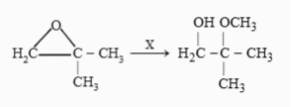
What is X in the following change?
1
2
3
followed by
4
Official Solution
Correct Option: (1)
The reaction involves a nucleophilic substitution, where is methanol (CH3OH) and sulfuric acid (H2SO4), which are involved in the transformation. Final Answer:
36
PYQ 2024
easy
chemistryID: viteee-2
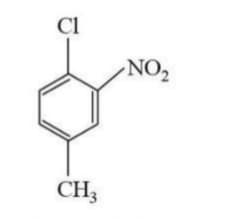
The IUPAC name for
1
1-chloro-2-nitro-4-methylbenzene
2
1-chloro-4-methyl-2-nitrobenzene

3
2-chloro-1-nitro-5-methylbenzene
4
m-nitro-p-chlorotoluene
Official Solution
Correct Option: (2)
Step 1: Identify the substituents and their positions on the benzene ring. The benzene ring has three substituents: 1. Chlorine (Cl) at position 1. 2. Nitro group at position 2. 3. Methyl group at position 4. Step 2: Assign the IUPAC name based on the substituent positions. The correct IUPAC name follows the numbering that gives the lowest possible locants to the substituents. The name is: 1-chloro-4-methyl-2-nitrobenzene.
37
PYQ 2024
easy
chemistryID: viteee-2
Product of the following reaction is:
1
2
3
4
Official Solution
Correct Option: (2)
Step 1: Understanding the Reaction Mechanism The given reaction involves the reduction of a nitrile ( ) group using stannous chloride ( ) and hydrochloric acid ( ). This reaction follows a two-step mechanism: % Option
(A) The nitrile ( ) is first reduced to an imine intermediate ( ) in the presence of SnCl\textsubscript{2} and HCl.
% Option
(B) Acidic hydrolysis ( ) of the imine intermediate leads to the formation of an aldehyde ( ). Step 2: Identifying the Final Product The final product obtained after hydrolysis is benzaldehyde ( ). Step 3: Matching with the Given Options The correct answer is benzaldehyde ( ), which corresponds to option (B). Final Answer: The product of the reaction is benzaldehyde ( ).
38
PYQ 2025
medium
chemistryID: viteee-2
Which of the following is the major product of the reaction between 1-bromobutane and potassium hydroxide in ethanol?
1
Butan-1-ol
2
But-2-ene
3
Butan-2-ol
4
Butane
Official Solution
Correct Option: (2)
The reaction involves 1-bromobutane (an alkyl halide) with potassium hydroxide (KOH) in ethanol. This is a typical example of an elimination reaction (E2 mechanism), where the hydroxide ion (OHรขยยป) removes a proton from the carbon adjacent to the carbon that is bonded to the leaving group (Brรขยยป), leading to the formation of a double bond. Step 1: Identify the type of reaction Since the reaction is occurring in ethanol, which is a polar protic solvent, the elimination occurs via the E2 mechanism. Step 2: Identify the product - The E2 mechanism will lead to the formation of an alkene. - The hydrogen is removed from the carbon next to the carbon bearing the bromine (the รยฒ-carbon), leading to the formation of But-2-ene. Answer: The major product of the reaction is But-2-ene, and thus the correct answer is option (2).