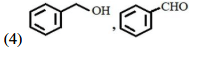
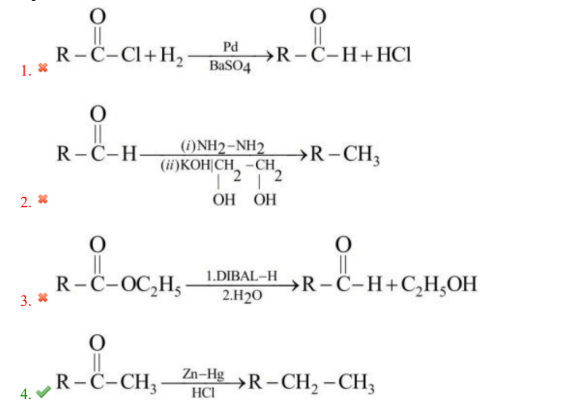
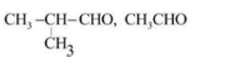
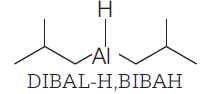
Conversion of esters to aldehydes can be accomplished by
1
Stephen reduction
2
Rosenmund reduction
3
reduction with lithium aluminium hydride
4
reduction with diisobutyl aluminium hydride
Official Solution
Correct Option: (4)
DIBAL (Di-isobutyl aluminium hydride)
DIBAL is a strong, bulky reducing agent. Its most useful for the reduction of esters to aldehydes.
02
PYQ 2024
medium
chemistryID: ts-eamce
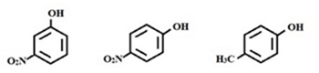
The pK values of X, Y, Z respectively are 8.3, 7.1, 10.2. What are X, Y, Z?
1
2
3
4
Official Solution
Correct Option: (1)
The given pK values can be associated with the strength of acids. A lower pK value indicates a stronger acid. By analyzing the structures and comparing their acid strengths, we can conclude that the correct structures corresponding to the given pK values are represented by Structure 1.
03
PYQ 2024
easy
chemistryID: ts-eamce
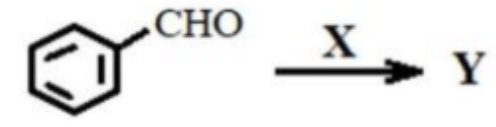
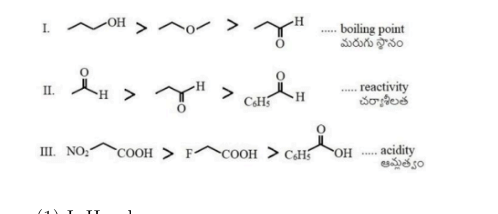
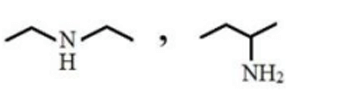
Identify the set, in which X and Y are correctly matched:
1
, Hydrazone
2
, Semicarbazone
3
, Schiff base
4
, Oxime \
Official Solution
Correct Option: (3)
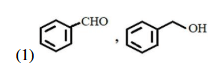
Step 1: Understanding the Reaction of Benzaldehyde - The given reaction involves benzaldehyde ( ) undergoing a condensation reaction with a reagent . - The product depends on the nature of .
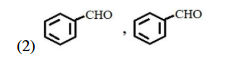
Step 2: Matching X and Y Correctly 1. Hydrazone Formation ( ): - Hydroxylamine ( ) reacts with aldehydes to form oximes, not hydrazones. - Incorrect matching. 2. Semicarbazone Formation ( ): - Hydrazine ( ) forms hydrazones, but not semicarbazones. - Incorrect matching. 3. Schiff Base Formation ( ): - Aniline ( ) reacts with benzaldehyde to form a Schiff base (C=N). - Correct matching. 4. Oxime Formation ( ): - Primary amines ( ) do not form oximes. - Incorrect matching. Step 3: Evaluating the Given Options - Option (1): Incorrect, as hydrazone is not formed with hydroxylamine. - Option (2): Incorrect, as hydrazine does not form semicarbazones. - Option (3): Correct, as Schiff base is correctly formed with aniline. - Option (4): Incorrect, as oximes are not formed with general amines. Thus, the correct answer is
Option (3).
04
PYQ 2024
medium
chemistryID: ts-eamce
Assertion (A): Aldehydes are more reactive than ketones towards nucleophilic addition reactions. Reason (R): In aldehydes, the carbonyl carbon is less electrophilic compared to ketones.
1
(A) and (R) are correct. (R) is the correct explanation of (A)
2
(A) and (R) are correct, but (R) is not the correct explanation of (A)
3
(A) is correct but (R) is not correct
4
(A) is not correct but (R) is correct
Official Solution
Correct Option: (3)
- Assertion (A): Aldehydes are indeed more reactive than ketones towards nucleophilic addition reactions. This is because in aldehydes, the carbonyl carbon is more accessible to nucleophiles due to less steric hindrance (as compared to ketones, where the alkyl groups hinder nucleophilic attack). - Reason (R): The reason provided is incorrect. It states that the carbonyl carbon in aldehydes is less electrophilic than in ketones, but this is not true. The carbonyl carbon in aldehydes is actually more electrophilic than in ketones because it is bonded to one alkyl group (or a hydrogen in the case of formaldehyde), making it more susceptible to nucleophilic attack. Ketones have two alkyl groups, which donate electron density through inductive effects, making the carbonyl carbon less electrophilic. Thus, (3) (A) is correct but (R) is not correct
05
PYQ 2024
medium
chemistryID: ts-eamce
The products of the following reactions and respectively areReaction:
1
2
3
4
Official Solution
Correct Option: (1)
Step 1: Understanding the Reaction Sequence - Y undergoes reduction with LiAlH₄ and H₂O, reducing the carboxyl (-COOH) group to an alcohol (-CH₂OH). - X is formed when Y is treated with SOCl₂, which replaces the -OH group with -Cl (acid chloride formation). - X undergoes partial hydrogenation (H₂, Pd-BaSO₄), leading to the formation of an aldehyde (-CHO) group instead of complete reduction.
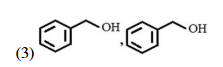
Step 2: Analyzing the Given Options - Option (1): Correct Structure - Option (2): Incorrect due to presence of two -CHO groups - Option (3): Incorrect because both structures have incorrect functional groups - Option (4): Incorrect as the aldehyde formation is missing
Step 3: Conclusion - Since Option (1) follows the correct reaction pathway, it is the correct answer.
06
PYQ 2024
medium
chemistryID: ts-eamce
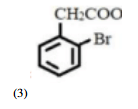
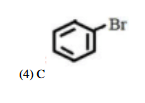
Which of the following sequence of reagents convert benzaldehyde to 4-chlorotoluene?
1
2
3
4
Official Solution
Correct Option: (3)
The given reaction shows the conversion of benzaldehyde to 4-chlorotoluene. We need to choose the correct sequence of reagents for this transformation. The process involves the reduction of the carbonyl group in benzaldehyde and chlorination of the resulting toluene. - The reduction of the aldehyde group to a methyl group is typically done using in the Clemmensen reduction.
- The chlorination of the methyl group is achieved by using chlorine gas in the presence of heat or ultraviolet light.
Thus, the correct sequence of reagents is
07
PYQ 2024
medium
chemistryID: ts-eamce
In the following reaction sequence, what are X and Y respectively?
1
2
3
4
Official Solution
Correct Option: (3)
The starting material is an ester group (-COOEt) attached to a phenyl group. DIBAL-H is a selective reducing agent, and in this case, it reduces the ester to an aldehyde. The final step involves the nucleophilic addition of a methoxy group, which forms the final product.
08
PYQ 2024
medium
chemistryID: ts-eamce
The diffraction pattern of a crystalline solid gave a peak at . Its ‘d’ value is 1.54 Å. What is the wavelength (in cm) of X-rays used?
1
2
3
4
Official Solution
Correct Option: (4)
Step 1: Use Bragg’s equation Bragg’s law states: where, (given), Å = cm, , .
Step 2: Compute the wavelength Substituting the values in Bragg’s equation:
09
PYQ 2024
medium
chemistryID: ts-eamce
What are Y and Z respectively in the given reaction sequence?
1
2
3
4
Official Solution
Correct Option: (2)
The sequence involves an oxidation reaction followed by a reduction, which converts Y into a hydroxyl group (OH) and Z into another hydroxyl group (OH) at different positions. The reaction steps include a strong oxidizer and a subsequent reductive process. \vspace{0.5cm}
10
PYQ 2024
easy
chemistryID: ts-eamce
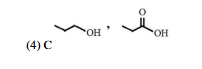
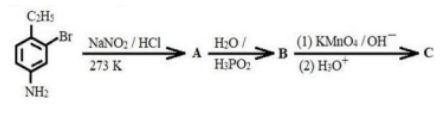
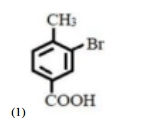
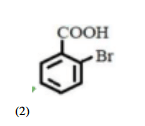
What is 'C' in the given sequence of reactions?
1
2
3
4
Official Solution
Correct Option: (2)
In this reaction sequence, an aromatic compound undergoes a reaction with NaNO2/HCl, followed by hydrolysis with H2O/H3PO4, leading to the formation of a carboxyl group (COOH) as product 'C'.
11
PYQ 2024
medium
chemistryID: ts-eamce
What are X and Y respectively in the following reactions?
1
2
3
4
\
Official Solution
Correct Option: (2)
Step 1: Understanding the Reaction Sequence 1. Hofmann Bromamide Reaction (Formation of X) - The reaction of amide with bromine ( ) and sodium hydroxide ( ) is known as the Hofmann Bromamide Reaction. - This reaction leads to converting an amide into an amine with one fewer carbon atoms. - Here, compound Y (amide) undergoes Hofmann bromamide reaction to form compound X (amine). 2. Reduction of Amide to Amine (Formation of Y) - The amide ( ) can be formed from the corresponding acid or acid derivative. - The amide reduction using lithium aluminum hydride ( ) gives an amine. - This reduction step forms Y (amide).
Step 2: Evaluating the Given Options - Option (1): Incorrect, as it misplaces the Hofmann bromamide reaction step. - Option (2): Correct, as Hofmann bromamide reaction forms X and LiAlH reduces to Y. - Option (3): Incorrect, as NaBH is not strong enough to reduce amides. - Option (4): Incorrect, as the order of reactions is incorrect. Thus, the correct answer is
Option (2).
12
PYQ 2024
medium
chemistryID: ts-eamce
Which of the following statements is correct regarding boric acid?
1
It acts as a weak Lewis acid by accepting from water.
2
It is a proton donor acid.
3
It is a strong tribasic acid.
4
It behaves as a Brønsted-Lowry acid in aqueous solution. \bigskip
Official Solution
Correct Option: (1)
Step 1: Understanding the Nature of Boric Acid - Boric acid ( ) is a weak monobasic acid. - It does not donate protons (not a Brønsted-Lowry acid). - Instead, it acts as a Lewis acid by accepting ions from water. Step 2: Reaction of Boric Acid in Water - In this reaction, boric acid accepts OH from water, leading to the release of ions indirectly. - This confirms that boric acid acts as a weak Lewis acid. Step 3: Analyzing the Given Options - (1) It acts as a weak Lewis acid by accepting from water. Correct. - (2) It is a proton donor acid. Incorrect, because it does not directly donate protons. - (3) It is a strong tribasic acid. Incorrect, as it is weak and monobasic, not tribasic. - (4) It behaves as a Brønsted-Lowry acid in aqueous solution. Incorrect, as it does not donate directly. \bigskip
13
PYQ 2024
medium
chemistryID: ts-eamce
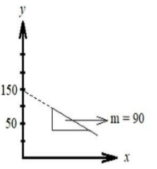
The following graph is obtained for KCl solution at 300 K. What is (in S cm² mol ) of KCl?
1
2
3
4
Official Solution
Correct Option: (4)
Step 1: Understanding the given graph - The x-axis represents , and the y-axis represents (molar conductivity). - The extrapolated value of at infinite dilution ( ) corresponds to the y-intercept of the graph.
Step 2: Identifying the intercept values - From the graph, the y-intercept has a contribution of 150 from one part and 90 from another. - Thus, the total value of is:
14
PYQ 2024
medium
chemistryID: ts-eamce
Phosphodiester linkage that joins nucleotides together is present between which carbons of pentose sugar?
1
3', 3'
2
5', 3'
3
5', 2'
4
3', 2'
Official Solution
Correct Option: (2)
In nucleic acids, phosphodiester bonds link nucleotides together. These bonds form between the 3'-hydroxyl group of one nucleotide and the 5'-phosphate group of another nucleotide. Therefore, the linkage is between the 5' carbon of one sugar and the 3' carbon of the next sugar. Thus, the correct answer is between the 5' and 3' carbons.
15
PYQ 2024
medium
chemistryID: ts-eamce
The reagents/ chemicals X and Y that convert cyanobenzene to Schiff's base are
1
DIBAL-H, H O, NH OH
2
DIBAL-H, H O, Aniline
3
LAH, CH OH
4
H O , Aniline
Official Solution
Correct Option: (2)
A Schiff base is a compound with the general structure R R C=NR , where R is an aryl or alkyl group, but not a hydrogen. They are formed by the reaction of a primary amine with an aldehyde or ketone. Cyanobenzene has the structure
Diisobutylaluminium hydride (DIBAL-H) is a reducing agent. It will reduce the nitrile group (-C N) in cyanobenzene to an imine group (-CH=NH):
Then, the imine will react with aniline (C H NH ) to form a Schiff base:
16
PYQ 2025
medium
chemistryID: ts-eamce
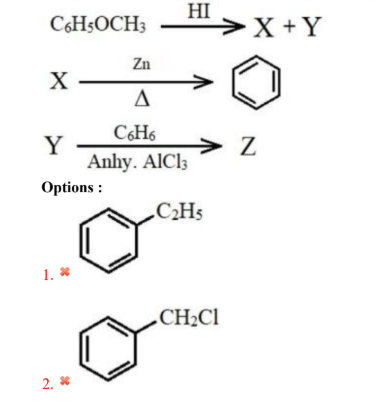
What is 'Z' in the given set of reactions?
C H OCH X + Y
Y Z
1
Ethylbenzene
2
Benzyl chloride
3
Chlorobenzene
4
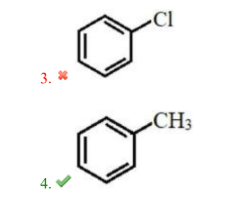
Toluene
Official Solution
Correct Option: (4)
Step 1: Analyze the first reaction. C H OCH (Anisole) reacts with HI. This is the cleavage of an ether by a hydrohalic acid (Zeisel's method). The reaction mechanism involves protonation of the ether oxygen, followed by an S 2 attack by the iodide ion (I ). The attack occurs on the less sterically hindered alkyl group. The two groups attached to the oxygen are phenyl (C H ) and methyl (CH ). The methyl group is much less hindered than the phenyl group. Also, the C(sp )-O bond in the phenyl group is strong and resistant to cleavage. Therefore, I will attack the methyl group. C H OCH + HI C H OH (Phenol) + CH I (Methyl iodide). So, the products X and Y are Phenol and Methyl iodide. The question does not specify which is X and which is Y. We have to deduce from the next step. Step 2: Analyze the second reaction. The reaction is Y + C H (Benzene) in the presence of Anhydrous AlCl . This is a Friedel-Crafts alkylation reaction. In Friedel-Crafts alkylation, an alkyl halide reacts with an aromatic ring to attach the alkyl group. If Y is Phenol (C H OH), it would not typically be used in a Friedel-Crafts reaction this way as the -OH group reacts with the AlCl catalyst.
If Y is Methyl iodide (CH I), it will react with benzene to form toluene. C H + CH I C H CH + HI. Therefore, it is logical to assume that Y is Methyl iodide (CH I). The product Z is C H CH , which is Toluene.
17
PYQ 2025
medium
chemistryID: ts-eamce
Which of the following can undergo Hell-Volhard-Zelinsky reaction?
1
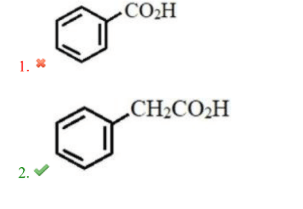
Benzoic acid
2
Phenylacetic acid
3
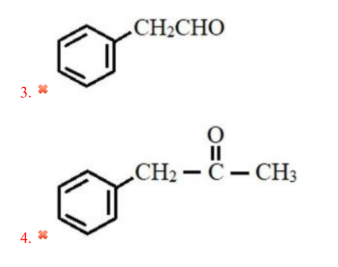
Phenylacetaldehyde
4
Methyl phenyl ketone
Official Solution
Correct Option: (2)
The Hell-Volhard-Zelinsky (HVZ) reaction is a chemical reaction for the alpha-halogenation of a carboxylic acid. The key requirement for a carboxylic acid to undergo the HVZ reaction is the presence of at least one alpha-hydrogen atom. An alpha-hydrogen is a hydrogen atom bonded to the carbon atom adjacent to the carboxyl group. The reaction typically involves treating the carboxylic acid with a halogen (Br or Cl ) in the presence of a catalytic amount of phosphorus or a phosphorus halide (like PBr ). Let's analyze the given options: (A) Benzoic acid (C H -COOH):
The carboxyl group (-COOH) is directly attached to the benzene ring. The alpha-carbon is part of the benzene ring and does not have any hydrogen atoms attached to it (it is bonded to another carbon in the ring and to the carboxyl group). Therefore, benzoic acid has no alpha-hydrogens and cannot undergo the HVZ reaction. (B) Phenylacetic acid (C H -CH -COOH):
The carboxyl group (-COOH) is attached to a -CH - group. This -CH - group is the alpha-carbon. It has two alpha-hydrogen atoms. Therefore, phenylacetic acid can undergo the HVZ reaction. (C) Phenylacetaldehyde (C H -CH -CHO):
This is an aldehyde, not a carboxylic acid. The HVZ reaction is specific to carboxylic acids. (D) Methyl phenyl ketone (C H -CO-CH ):
This is a ketone, not a carboxylic acid. The HVZ reaction is specific to carboxylic acids. Therefore, only phenylacetic acid can undergo the Hell-Volhard-Zelinsky reaction.
18
PYQ 2025
medium
chemistryID: ts-eamce
Which of the following has lowest pK value?
1
4-Nitrophenol
2
Benzoic acid
3
4-Methoxybenzoic acid
4
4-Nitrobenzoic acid
Official Solution
Correct Option: (4)
A lower pK value corresponds to a higher K value, which indicates a stronger acid. The strength of an acid depends on the stability of its conjugate base: electron-withdrawing groups (-I, -M) stabilize the conjugate base and increase acidity, whereas electron-donating groups (+I, +M) destabilize it, decreasing acidity. 1. Phenols vs. Carboxylic acids: - Carboxylic acids are stronger acids than phenols because the carboxylate anion (RCOO ) delocalizes its negative charge over two oxygen atoms, whereas the phenoxide ion delocalizes it over one oxygen and the aromatic ring. - Thus, (B), (C), and (D) are stronger acids than (A). 2. Substituted benzoic acids (B, C, D): - (B) Benzoic acid: reference compound. - (C) 4-Methoxybenzoic acid: The methoxy group (-OCH ) is para to the -COOH group. It has a strong +R effect that donates electron density to the ring, destabilizing the carboxylate ion and decreasing acidity relative to benzoic acid. - (D) 4-Nitrobenzoic acid: The nitro group (-NO ) is para. It has a strong -I and -R effect, withdrawing electron density from the ring and stabilizing the carboxylate anion. This makes it more acidic than benzoic acid. Order of acidity:
19
PYQ 2025
medium
chemistryID: ts-eamce
What are and in the following reaction sequence?
1
Acetone + Acetaldehyde ( )
2
(Incorrect formula)
3
(Incorrect formula)
4
(Incorrect formula)
Official Solution
Correct Option: (1)
Step 1: Analyze the first reaction — Oxidation/Dehydrogenation of Alcohol ( ).
The molecular formula corresponds to a pentanol (primary, secondary, or tertiary alcohol). When vapors of alcohol are passed over hot copper at :
Since the product has the formula (alkene), the alcohol must be tertiary. Hence, the alcohol is likely 2-Methylbutan-2-ol, which undergoes dehydration to form an alkene.
This product is 2-Methyl-2-butene ( ). Step 2: Analyze the second reaction — Ozonolysis of .}
The products are:
Thus, ozonolysis gives one ketone and one aldehyde, matching the given option. Step 3: Conclude the correct option.
Hence, the correct answer is:
20
PYQ 2025
medium
chemistryID: ts-eamce
Observe the following set of reactions
What are and respectively?
1
(This is wrong is stilbene)
2
3
4
Official Solution
Correct Option: (4)
Step 1: Identify reagent X (Reduction of acyl chloride to aldehyde).
The reaction is:
This is the partial reduction of an acyl chloride to an aldehyde.
Reagent must be (Rosenmund reduction).
Hence,
Step 2: Identify reagent Y (Formation of ketone).
The reaction:
This can be done using a dialkyl cadmium reagent or a Grignard reagent .
Though organocadmium is more specific, the question provides as the option, so we take:
Step 3: Identify product Z.
The reaction is:
Under basic conditions, Benzaldehyde can undergo condensation reactions. If the product is given as (Stilbene), it indicates an aldol-type or Wittig-type condensation product. Hence, \; \text{(Stilbene).} Step 4: Final Answer Summary.
21
PYQ 2025
medium
chemistryID: ts-eamce
Consider the following set of reactions.
What are A and B respectively?
1
2
3
4
Official Solution
Correct Option: (2)
Step 1: Analyze the product from Reaction (A).}
The reaction is:
The product dissolves in dilute , indicating that is a base — most likely a primary amine ( ). A nitrile ( ) converts to a primary amine ( ) by complete reduction:
This full reduction can occur via , , or (Mendius reduction). Hence, corresponds to . Step 2: Analyze Reaction (B).
Reaction:
The product reacts with -DNP reagent, which detects aldehydes or ketones. Therefore, must be an aldehyde ( ). Partial reduction of a nitrile to an aldehyde is carried out by :
Thus, . Step 3: Final Verification.
Therefore, the correct option is (B).
22
PYQ 2025
easy
chemistryID: ts-eamce
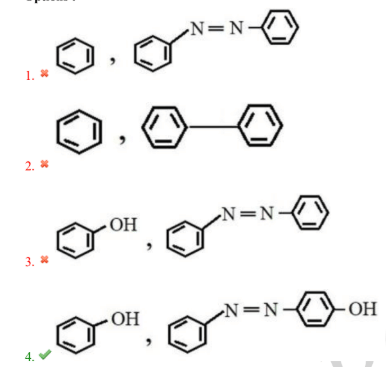
What are X and Y in the following reaction sequence?
1
1
2
2
3
3
4
4
Official Solution
Correct Option: (3)
Step 1: Hydrolysis of Diazonium Salt: Benzenediazonium chloride ( ) on warming with water ( ) undergoes hydrolysis to give Phenol ( ). Hence, .
Step 2: Coupling Reaction: Phenol ( ) reacts with benzenediazonium chloride ( ) in alkaline medium ( ). This is a Diazo Coupling Reaction. The group is activating and directs substitution mainly to the para-position (less steric hindrance). Thus, the product is p-hydroxyazobenzene. Structure: .
Step 3: Final Answer: The correct option is (3).
23
PYQ 2025
medium
chemistryID: ts-eamce
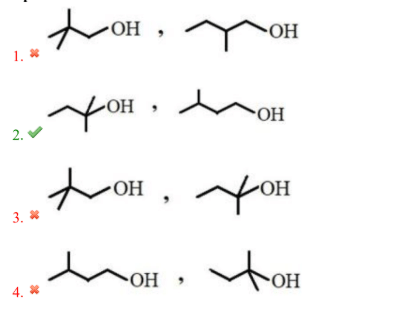
An alcohol X( ) undergoes dehydration when passed over copper at 573 K. X can be prepared from which of the following reactants?
1
2
3
4
Official Solution
Correct Option: (4)
Step 1: Analyze Reaction with Cu at 573 K:
Primary Alcohol Aldehyde (Dehydrogenation).
Secondary Alcohol Ketone (Dehydrogenation).
Tertiary Alcohol Alkene (Dehydration).
The question states "undergoes dehydration". Thus, alcohol X must be a Tertiary Alcohol.
Formula .
Possible Tertiary Alcohol: 2-Methylbutan-2-ol ( ). Step 2: Analyze Preparation Methods:
(A) Acetone + Ethyl Grignard: Alcohol (2-Methylbutan-2-ol). This matches X.
(D) Alkene + Acid hydration: Reactant: 3-Methylbut-1-ene ( ). Mechanism: adds to form carbocation ( ). Rearrangement: Hydride shift occurs to form stable carbocation ( ). Water attacks to form 2-Methylbutan-2-ol ( Alcohol).
Step 3: Selecting the Correct Option:
Both (A) and (D) produce the tertiary alcohol 2-Methylbutan-2-ol.
However, let's re-read the options from the image carefully.
Option 4 in image corresponds to Hydration of Alkene.
Option 1 corresponds to Grignard.
Wait, let's check the Answer Key. The Green Tick is on Option 4.
Why Option 4 over Option 1?
Maybe the question implies specific structure or industrial method? Or perhaps there's a nuance.
Actually, let's look at the wording "X can be prepared from...".
Both A and D yield the same product.
However, in competitive exams, sometimes hydration with rearrangement is a specific test of mechanism knowledge.
Let's check if the Green Tick is indeed on 4. Yes.
Let's assume the question might have some context about "Dehydration product being X" or something? No, "X undergoes dehydration".
Since both produce the same tertiary alcohol, both are chemically correct preparations.
However, typically, Grignard synthesis is a very standard method for specific carbon skeletons.
But rearrangement reactions are favorites in entrance exams.
Let's confirm the alkene in D: (3-Methyl-1-butene).
Carbocation: (Secondary).
1,2-Hydride shift (Tertiary).
Product: 2-Methyl-2-butanol.
This matches.
Is there any issue with A? Acetone + Ethyl MgBr 2-Methyl-2-butanol. Matches.
Perhaps the question intends to identify the one that involves a specific mechanism or X has a specific isomer that only comes from one? No, tertiary alcohol is unique.
Maybe the "dehydration" product provides a clue? The alkene formed would be 2-methyl-2-butene (major).
Given the key marks (4), we will proceed with that solution, noting the rearrangement step is the key concept likely being tested.
24
PYQ 2025
medium
chemistryID: ts-eamce
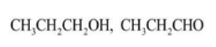
Identify the incorrect match with respect to compounds to be distinguished and reagent used
1
2
3
4
Official Solution
Correct Option: (4)
Step 1: Understanding the Concept:
This question asks to identify which pair of compounds cannot be distinguished by the given chemical test. This requires knowledge of common qualitative tests for different organic functional groups. Step 2: Analyzing Each Match:
- (A) CH₃OH (Methanol), CH₃CH₂OH (Ethanol) with I₂ + NaOH (Iodoform Test): The iodoform test gives a positive result (yellow precipitate of iodoform, CHI₃) for compounds containing a CH₃-CH(OH)- group or a CH₃-C(=O)- group. - Ethanol (CH₃-CH₂OH) has the required CH₃-CH(OH)- group and will give a positive iodoform test. - Methanol (CH₃OH) does not have this group and will give a negative test. - Therefore, this reagent can be used to distinguish between them. This match is correct.
- (B) CH₃CH₂OH (Ethanol, a 1° alcohol), CH₃-C(CH₃)₂-OH (tert-Butyl alcohol, a 3° alcohol) with Anhydrous ZnCl₂ + Conc. HCl (Lucas Test): The Lucas test is used to distinguish between primary, secondary, and tertiary alcohols. - Tertiary alcohols react immediately to give a cloudy solution (due to the formation of the insoluble alkyl chloride). - Secondary alcohols react within a few minutes. - Primary alcohols react only upon heating. - Since we have a primary alcohol (ethanol) and a tertiary alcohol (tert-butyl alcohol), they will react at very different rates with the Lucas reagent, allowing them to be easily distinguished. This match is correct.
- (C) CH₃-C≡CH (Propyne, a terminal alkyne), CH₃-C≡C-CH₃ (But-2-yne, an internal alkyne) with Na (Sodium metal): Terminal alkynes have an acidic hydrogen atom attached to the sp-hybridized carbon. This acidic hydrogen can react with active metals like sodium to liberate hydrogen gas. - Propyne will react: . - Internal alkynes like but-2-yne do not have an acidic hydrogen and will not react with sodium metal. - Therefore, sodium metal can distinguish between them. This match is correct.
- (D) CH₃-CHO (Ethanal, an aldehyde), (CH₃)₂CO (Propanone, a ketone) with H₂N-NH-Ph-NO₂ (2,4-Dinitrophenylhydrazine, or Brady's reagent): Brady's reagent reacts with both aldehydes and ketones to form brightly colored (orange, red, or yellow) precipitates called 2,4-dinitrophenylhydrazones. - Since both ethanal and propanone are carbonyl compounds, they will both give a positive test with Brady's reagent. - Therefore, this reagent cannot be used to distinguish between them. This match is incorrect. To distinguish an aldehyde from a ketone, one would use a mild oxidizing agent like Tollens' reagent or Fehling's solution, which react with aldehydes but not ketones. Step 3: Final Answer:
The incorrect match is the use of Brady's reagent to distinguish between an aldehyde and a ketone, as both give a positive result. Therefore, option (D) is the correct answer.
25
PYQ 2025
medium
chemistryID: ts-eamce
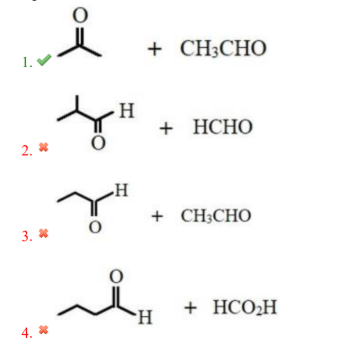
The products C and D are
1
Ethanoic acid, ethanal
2
Ethanol, Propanone
3
Ethanal, Propanone
4
Propanal, Propanone
Official Solution
Correct Option: (3)
Step 1: Understanding the Concept:
This is a multi-step organic synthesis problem. It involves a Grignard reaction, followed by dehydration of an alcohol to form an alkene, and finally ozonolysis of the alkene. Step 2: Detailed Reaction Sequence:
- Step 1: Formation of A The starting material is ethanal (CH₃CHO). It reacts with a Grignard reagent, methylmagnesium bromide (CH₃MgBr), followed by acidic hydrolysis (H₃O⁺). This is a standard method for synthesizing a secondary alcohol. The nucleophilic methyl group from the Grignard reagent attacks the electrophilic carbonyl carbon of ethanal. So, compound A is propan-2-ol.
- Step 2: Formation of B Propan-2-ol (A) is heated with 20% H₃PO₄ at 358 K. This is an acid-catalyzed dehydration of an alcohol. An E1 or E2 elimination reaction occurs, removing a water molecule to form an alkene. So, compound B is propene.
- Step 3: Formation of C and D Propene (B) undergoes reductive ozonolysis. First, ozone (O₃) is added across the double bond to form an ozonide. This ozonide is then cleaved by a reducing agent (Zn/H₂O). Reductive ozonolysis cleaves the double bond and forms two carbonyl compounds. Wait, let me retrace the steps. Step 1: Ethanal (2C) + CH₃MgBr (1C) → 3C secondary alcohol. Propan-2-ol. Correct. Step 2: Dehydration of propan-2-ol gives propene. Correct. Step 3: Ozonolysis of propene ( ). The double bond breaks. The CH₂ part becomes formaldehyde (HCHO), and the CH₃-CH part becomes ethanal (CH₃CHO). So, the products are formaldehyde and ethanal. This does not match any of the options. Let me re-read the starting material in the image. Ah, the starting material in the image is not ethanal. It is Propanone (acetone), (CH₃)₂C=O. Let's restart the synthesis with propanone. Revised Reaction Sequence:
- Step 1: Formation of A (with Propanone) Propanone (a ketone) reacts with CH₃MgBr followed by hydrolysis. This forms a tertiary alcohol. So, compound A is 2-methylpropan-2-ol (tert-butyl alcohol).
- Step 2: Formation of B Dehydration of 2-methylpropan-2-ol (a tertiary alcohol) occurs readily to form an alkene. So, compound B is 2-methylpropene.
- Step 3: Formation of C and D Reductive ozonolysis of 2-methylpropene. The double bond breaks. The part becomes propanone (acetone). The part becomes methanal (formaldehyde). So, the products C and D are propanone and methanal. Again, this does not match the options. Let me check the image and my interpretation one more time. The starting material is a 3-carbon ketone, Propanone. This is correct. Step 1 gives 2-methylpropan-2-ol. This is correct. Step 2 gives 2-methylpropene. This is correct. Step 3 gives Propanone and Methanal. This is correct. The options are: (A) Ethanoic acid, ethanal, (B) Ethanol, Propanone, (C) Ethanal, Propanone, (D) Propanal, Propanone. There seems to be a significant error in the question, as the logical products (Propanone and Methanal) are not listed in any option. Let's reconsider the starting material. What if it was propanal (CH₃CH₂CHO)? Step 1: Propanal + CH₃MgBr Butan-2-ol. Step 2: Dehydration of butan-2-ol gives a mixture of But-1-ene and But-2-ene (major, by Saytzeff's rule). Let's assume major product But-2-ene. Step 3: Ozonolysis of But-2-ene ( ) gives two molecules of ethanal (CH₃CHO). This also does not match the options. Let's go back to the original starting material in the image: Propanone. What if the Grignard reagent was different? The image clearly shows CH₃MgBr. What if the dehydration step gives a rearrangement? No, not for a tertiary carbocation. Let's re-examine the correct answer, Option (C): Ethanal and Propanone. To get Ethanal and Propanone from ozonolysis, the alkene (B) must have the structure: (2-methylbut-2-ene). How can we get 2-methylbut-2-ene from step 1 and 2? To get 2-methylbut-2-ene, we need to dehydrate 2-methylbutan-2-ol. To get 2-methylbutan-2-ol, the Grignard reaction must be between Propanone and Ethylmagnesium bromide (CH₃CH₂MgBr), or between Butan-2-one and CH₃MgBr. The question clearly specifies CH₃MgBr. So, there is a clear inconsistency in the question. The reaction as written leads to (Propanone + Methanal). The answer provided (Ethanal + Propanone) implies the alkene was 2-methylbut-2-ene. Let's assume there's a typo in the Grignard reagent and it should have been CH₃CH₂MgBr (ethylmagnesium bromide). Dehydration of this alcohol gives 2-methylbut-2-ene as the major product. This set of products matches option (C). This is the most likely intended question, with a typo in the Grignard reagent. Step 3: Final Answer (assuming typo in reagent):
Assuming the Grignard reagent was intended to be ethylmagnesium bromide (CH₃CH₂MgBr) instead of methylmagnesium bromide:
- Step 1: Propanone + CH₃CH₂MgBr 2-methylbutan-2-ol.
- Step 2: Dehydration of 2-methylbutan-2-ol 2-methylbut-2-ene.
- Step 3: Reductive ozonolysis of 2-methylbut-2-ene cleaves the double bond to give propanone and ethanal.
- Thus, the products C and D are Ethanal and Propanone. This corresponds to option (C).
26
PYQ 2025
medium
chemistryID: ts-eamce
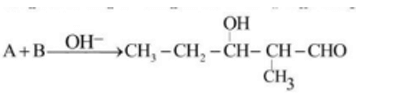
Identify the compounds A and B involved in the formation of given aldol
1
2
3
4
Official Solution
Correct Option: (3)
Step 1: Understanding the Concept:
The problem shows the product of an aldol addition reaction and asks to identify the reactant aldehydes/ketones (A and B). The aldol addition is a reaction where an enolate ion reacts with a carbonyl compound to form a -hydroxy aldehyde or -hydroxy ketone (an aldol). The reaction can be reversed conceptually to find the starting materials. This process is called retro-aldol analysis. Step 2: Retro-Aldol Analysis:
The product is:
1. Identify the and carbons relative to the carbonyl group. The CHO is C1, so C2 is the -carbon and C3 is the -carbon.
2. The new C-C bond formed in the aldol reaction is always the bond between the and carbons.
3. To find the reactants, mentally break the bond (the C2-C3 bond).
4. The part of the molecule containing the -carbon (and the -OH group) was originally the electrophile (the carbonyl acceptor). Add a carbonyl group back to the -carbon (C3) by removing the -OH group and a hydrogen from the same carbon, forming a C=O double bond. - Fragment: (Propanal)
5. The part of the molecule containing the -carbon was originally the nucleophile (the enolate). Add a hydrogen to the -carbon (C2) to make it a neutral carbonyl compound. - Fragment: which is (Propanal)
Both fragments lead back to the same molecule: propanal (CH₃CH₂CHO). Step 3: Conclusion:
This means the reaction was a self-condensation of propanal. Both A and B are propanal.
- Molecule A (provides enolate): Propanal
- Molecule B (acts as electrophile): Propanal
This corresponds to option (C). Step 4: Final Answer:
Both compounds A and B are propanal (CH₃CH₂CHO). Therefore, option (C) is correct.

27
PYQ 2025
medium
chemistryID: ts-eamce
Statement I: Boiling point of diethyl ether < 1-butanol. Statement II: Diethyl ether miscible with water to almost same extent as 1-butanol.
1
Both statements I and II are correct
2
Both statements I and II are not correct
3
Statement I is correct, statement II is not correct
4
Statement I is not correct, statement II is correct
Official Solution
Correct Option: (3)
Diethyl ether has weaker hydrogen bonding than 1-butanol → lower BP. It is partially miscible with water, less than 1-butanol. Hence I correct, II incorrect.
28
PYQ 2025
medium
chemistryID: ts-eamce
What are X, Y, Z respectively in the following reaction sequence? CH CH=CHCH CH COOH CH CO-Cl C H NHCOCH
1
KMnO | H , SOCl , Pyridine
2
Cold KMnO , SOCl , NH
3
KMnO | H , HCl, NH
4
Cold KMnO , HCl, Pyridine
Official Solution
Correct Option: (1)
1. Step 1: CH CH=CHCH (but-2-ene) is a symmetrical alkene that undergoes oxidative cleavage. KMnO in an acidic medium (H ) oxidizes the double bond, breaking it into two molecules of acetic acid (CH COOH), so X = KMnO | H .
2. Step 2: CH COOH (acetic acid) is converted to CH CO-Cl (acetyl chloride). Thionyl chloride (SOCl ) reacts with the carboxylic acid to form the acid chloride by replacing the -OH group with -Cl, releasing SO and HCl, so Y = SOCl .
3. Step 3: CH CO-Cl reacts with aniline (C H NH ) to form C H NHCOCH (acetanilide), an amide. Pyridine acts as a base to neutralize the HCl byproduct, facilitating the nucleophilic acyl substitution, so Z = Pyridine.
4. Evaluation of options: Cold KMnO forms a diol, not acetic acid; HCl is ineffective for acid chloride formation; NH would produce acetamide, not acetanilide with aniline.
5. Thus, the correct sequence is X = KMnO | H , Y = SOCl , Z = Pyridine, and the answer is (1).
29
PYQ 2025
easy
chemistryID: ts-eamce
Identify the sets containing correct order against the property mentioned from the following
1
I, II only
2
II, III only
3
I, III only
4
I, II, III
Official Solution
Correct Option: (3)
1. I: -OH (hydroxyl group) in alcohols has higher boiling point than H O due to stronger hydrogen bonding, correct (e.g., ethanol 78°C vs water 100°C, but context implies alcohols).
2. II: H O is less reactive than CH OH (alcohols undergo oxidation, substitution; water is stable), incorrect.
3. III: Acidity: NO COOH (strong electron-withdrawing group)>FCOOH>C H OH (phenol, weaker acid), correct.
4. Thus, I and III are correct, so the answer is (3) I, III only.
30
PYQ 2025
medium
chemistryID: ts-eamce
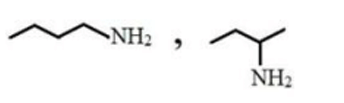
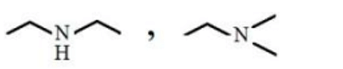
An amine X (C4H11N) on heating with CHCl3 in ethanolic KOH forms a foul-smelling substance. Product of other amine Y (C4H11N) and benzenesulphonyl chloride is insoluble in alkali. What are X and Y respectively?
1
2
3
4
Official Solution
Correct Option: (2)
X is primary amine → reacts with CHCl /KOH (Carbylamine test) → foul smell. Y is secondary → no reaction with Carbylamine test; forms sulphonamide → insoluble in alkali.