The rate of diffusion of a gas A is √5 times more than of gas B. If the molar mass of A is x gmol-1, the molar mass of B ( in g mole-1) is
1
4x
2
5x
3
16x
4
25x
Official Solution
Correct Option: (2)
To solve the problem, we apply Graham’s law of diffusion, which relates the rate of diffusion of two gases to their molar masses.
1. Graham’s Law of Diffusion: The rate of diffusion of a gas is inversely proportional to the square root of its molar mass:
Where: - and are the rates of diffusion of gases A and B - and are the molar masses of gases A and B
2. Given: , and
3. Substitute into Graham’s Law:
4. Square Both Sides:
Final Answer: The molar mass of gas B is .
02
PYQ 2024
medium
chemistryID: ts-eamce
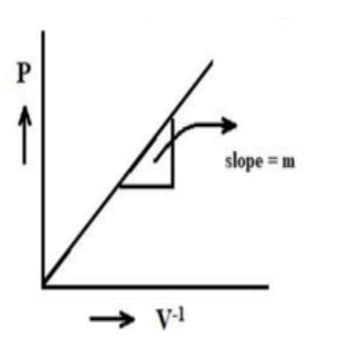
At 400 K, the following graph is obtained for moles of an ideal gas. is equal to (R = gas constant, P = pressure, V = volume)
1
2
3
4
Official Solution
Correct Option: (1)
The equation of the graph at constant temperature for an ideal gas follows Boyle's law, which is: Given the graph, it suggests a straight-line relation between pressure and the inverse of volume, which implies that the slope of the line is related to the equation. The correct relation would be: Thus, the slope is .
03
PYQ 2025
medium
chemistryID: ts-eamce
The isobar of one mole of an ideal gas was obtained at P atm. The slope of the isobar is . What is P (in atm)?
1
10
2
1
3
0.1
4
0.01
Official Solution
Correct Option: (3)
Step 1: Understand Isobaric Graph:
An isobar is a graph of Volume ( ) versus Temperature ( ) at constant Pressure ( ).
From the ideal gas equation:
Rearranging for vs :
This represents a straight line equation passing through origin, where , , and slope . Step 2: Calculation:
Given:
Slope .
Moles .
Universal Gas Constant (using atm and L units). Equating slope:
Step 3: Final Answer:
The pressure is 0.1 atm.
04
PYQ 2025
medium
chemistryID: ts-eamce
The isobars of one mole of an ideal gas were obtained at three different pressures and . The slopes of these isobars are and respectively. If , then the correct relation of the slopes is
1
2
3
4
Official Solution
Correct Option: (1)
Step 1: Write the equation of state for an ideal gas.
The ideal gas law is .
We are given that mole, so .
Step 2: Express the relationship for an isobar.
An isobar is a graph plotted at constant pressure ( ). The graph is plotted with Volume ( ) on the y-axis and Temperature ( ) on the x-axis.
We rearrange the ideal gas law to express as a function of :
Step 3: Determine the slope of the isobar.
The equation is a straight line equation of the form , where , , and is the slope.
The slope of the isobar is:
Step 4: Relate the slopes to the given pressures.
We are given three different pressures, , and their corresponding slopes .
Step 5: Determine the relationship between the slopes.
We are given the pressure relationship .
Since the slope is inversely proportional to the pressure (i.e., ), a smaller pressure corresponds to a larger slope.
Therefore, the order of the slopes must be the inverse of the order of the pressures.
Multiplying by (which is a positive constant) maintains the inequality:
05
PYQ 2025
medium
chemistryID: ts-eamce
At 298K, a flask 'A' of unknown volume (V) contains oxygen at 5 atm. Another flask 'B' of volume 2L contains helium at 3 atm. Two flasks are connected together by a small tube of zero volume. After the two gases are completely mixed, if the resulting mixture is found to have the mole fraction of oxygen as 0.2, the volume of flask 'A' (in L) is (Assume oxygen and helium as ideal gases)
1
0.1
2
0.3
3
0.2
4
0.4
Official Solution
Correct Option: (2)
According to the ideal gas law, . Since temperature is constant, the number of moles is proportional to the product . Let's find the number of moles (or a quantity proportional to it) for each gas before mixing. For Oxygen (O ) in flask A:
atm.
L.
Number of moles of O , . For Helium (He) in flask B:
atm.
L.
Number of moles of He, . After mixing, the total number of moles is . The mole fraction of oxygen in the final mixture is given by: . We are given that the mole fraction of oxygen is 0.2. . Now, we solve this equation for V. . . . L. The volume of flask 'A' is 0.3 L.
06
PYQ 2025
medium
chemistryID: ts-eamce
At T(K) root mean square (rms) velocity of argon (molar mass 40 g mol⁻¹) is 20 ms⁻¹. The average kinetic energy of the same gas at T(K) (in J mol⁻¹) is
1
8
2
16
3
4
4
2
Official Solution
Correct Option: (1)
Step 1: Understanding the Concept:
This problem connects two concepts from the kinetic theory of gases: the root mean square (rms) velocity and the average kinetic energy of gas molecules. The average kinetic energy of a gas depends only on its temperature, while the rms velocity depends on both temperature and molar mass. Step 2: Key Formula or Approach:
1. Root Mean Square (rms) Velocity: , where is the ideal gas constant, is the absolute temperature, and is the molar mass in kg/mol.
2. Average Kinetic Energy per mole: .
We can see a relationship between these two formulas: from the rms velocity formula, , which means . And from the KE formula, . We can also relate them directly: . Step 3: Detailed Explanation:
We are given:
- Gas: Argon (Ar)
- Molar mass, (must be in SI units).
- RMS velocity, .
- Temperature = T(K).
We need to find the average kinetic energy per mole ( ) at this same temperature T. Using the direct relationship derived in Step 2:
Substitute the given values (making sure M is in kg/mol): Alternative Method (Finding T first):
First, find the temperature T using the rms velocity formula. (Let's use R 8.314 J/mol·K, though it's not needed for the final answer).
Now, calculate the average kinetic energy per mole:
The terms cancel out.
Both methods give the same result. Step 4: Final Answer:
The average kinetic energy of the gas is 8 J mol⁻¹. Therefore, option (A) is correct.
07
PYQ 2025
medium
chemistryID: ts-eamce
The slope of isobar of one mole of an ideal gas at p (atm) is 0.082 L K . What is the value of p in atm? (R=0.082 L atm mol K )
1
0.082
2
10
3
1
4
0.1
Official Solution
Correct Option: (3)
1. An isobar is a plot at constant pressure; for ideal gas, .
2. For n=1 mole, , so slope of V vs T is .
3. Given slope = 0.082 L K , R = 0.082 L atm mol K .
4. Thus, , so atm.
5. Units confirm: slope in L/K, R/P in (L atm / mol K) / atm = L / mol K, but for n=1, yes.
6. Therefore, the correct option is (3) 1.
08
PYQ 2025
medium
chemistryID: ts-eamce
Isotherms ( - lines) of one mole of an ideal gas at and have slope ratio 1:2. If K, find .