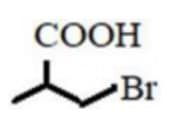
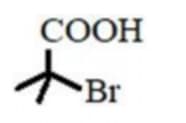
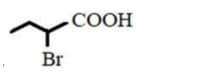
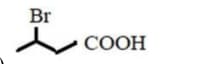
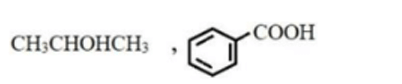
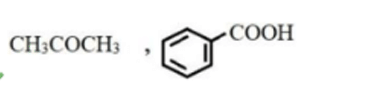
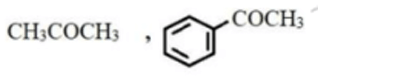
In the following reaction sequence, what are X and Y respectively?
1
2
3
4
Official Solution
Correct Option:
(1)
In this reaction sequence, the starting material is an ester (ethyl acetate, C6H5COOCH3). The first step involves hydrazine (NH2NH2) reacting with the ester, which undergoes reduction to form hydrazone (X). Subsequent treatment with KOH or water hydrolyzes the hydrazone to form the corresponding amine, which is the final product (Y).
02
PYQ 2024
medium
chemistryID: ts-eamce
Identify 'Z' in the following sequence of reactions:
1
2
3
4
Official Solution
Correct Option:
(3)
The given reaction involves the conversion of the benzene ring to a carboxylated product by bromination followed by nucleophilic substitution. The third step (reduction) leads to the formation of Z, the final product, as an alkyl group is introduced.
03
PYQ 2025
medium
chemistryID: ts-eamce
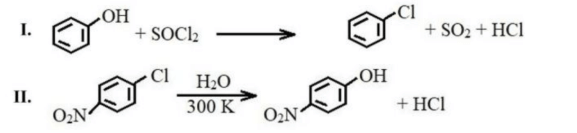
Two reactions I and II are given below:
Correct statement regarding the reactions is
1
Both reactions I and II are feasible
2
Both reactions I and II are not feasible
3
Reaction I feasible, but Reaction II not feasible
4
Reaction I not feasible, but Reaction II feasible
Official Solution
Correct Option:
(4)
Step 1: Analyze Reaction I:
Reactant: Phenol (or substituted phenol). Reagent: .
The bond in phenol has partial double bond character due to resonance with the benzene ring. It is very strong and difficult to break. Therefore, phenols do not react with thionyl chloride ( ) or hydrogen halides to form aryl halides under normal conditions (unlike alcohols).
Conclusion: Reaction I is not feasible. Step 2: Analyze Reaction II:
Reactant: Benzyl Alcohol derivative (p-Nitrophenylmethanol). Reagent: (with or without catalyst).
The bond here is a purely single bond attached to an carbon. Benzyl alcohols react readily with halogen acids because the intermediate benzylic carbocation is resonance stabilized (though destabilizes it, the reaction is still characteristic of alcohols, not phenols). Alternatively, primary alcohols react via .
Standard reaction: .
Conclusion: Reaction II is feasible. Step 3: Final Answer:
I is not feasible, II is feasible. Option (D).
04
PYQ 2025
medium
chemistryID: ts-eamce
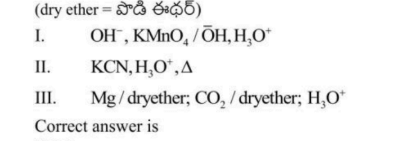
Which of the following sets of reagents are required for the conversion of ethyl bromide to propanoic acid?
1
I,II
2
II,III
3
I,III
4
I,II,III
Official Solution
Correct Option:
(2)
Goal: Convert Ethyl Bromide ( ) to Propanoic Acid ( ).
This involves ascent of series (adding one Carbon). Method II (Nitrile Synthesis):
.
This is a standard valid method. Method III (Grignard Synthesis):
.
This is also a standard valid method to increase carbon chain by one and form carboxylic acid. Method I (Oxidation):
(Ethanoic acid).
This does not increase the carbon chain length. It yields a 2-carbon acid, not propanoic (3-carbon). Incorrect. Conclusion:
Methods II and III work.
05
PYQ 2025
medium
chemistryID: ts-eamce
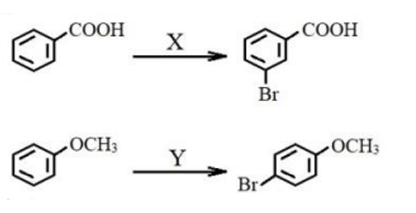
X and Y in reactions:
1
X: Br /Fe; Y: Br /hv
2
X: Br /CH COOH; Y: Br /CH COOH
3
X: Br /CH COOH; Y: Br /Fe
4
X: Br /Fe; Y: Br /CH COOH
Official Solution
Correct Option:
(1)
Electrophilic aromatic substitution on benzoic acid gives meta-bromination with Br /Fe. Side-chain bromination occurs under radical conditions (hv).
06
PYQ 2025
medium
chemistryID: ts-eamce
The sequence of reagents required to convert benzoic acid to n-propyl benzene is
1
SOCl , (C H ) Cd, LiAlH
2
SOCl , (C H ) Cd, Zn-Hg, HCl
3
SOCl , C H MgBr, Zn/H
4
HCl, C H MgBr, LiAlH
Official Solution
Correct Option:
(2)
1. Benzoic acid (C H COOH) to n-propylbenzene (C H CH CH CH ).
2. Step 1: SOCl converts COOH to COCl (benzoyl chloride).
3. Step 2: (C H ) Cd reacts with COCl to form ketone C H COCH CH .
4. Step 3: Zn-Hg/HCl (Clemmensen reduction) reduces ketone to C H CH CH CH .
5. Other options: (1) LiAlH reduces to alcohol; (3) Grignard gives tertiary alcohol; (4) HCl is ineffective.
6. Thus, the answer is (2) SOCl , (C H ) Cd, Zn-Hg, HCl.
07
PYQ 2025
medium
chemistryID: ts-eamce
Reagents and compound to convert ethyl bromide → 2-butanone:
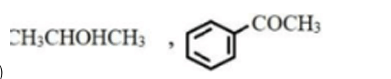
What are X and Y respectively in the following set of reactions?
1
2
3
4
Official Solution
Correct Option:
(3)
1. Cumene (C H CH(CH ) ) undergoes oxidation with KMnO /KOH/ to form benzoic acid (C H COOH, X) via cleavage of isopropyl group.
2. The side product is acetone (CH COCH , Y) after hydrolysis (H , H O).
3. Reaction: C H CH(CH ) C H COOH + CH COCH .
4. Options (1), (2), (4) have incorrect products (e.g., isopropanol or acetophenone).
5. Thus, the answer is (3) COOH, CH COCH .
About Carboxylic Acids - TS-EAMCET
Carboxylic Acids is a vital chapter for TS-EAMCET aspirants. Mastering the concepts covered in this chapter is essential for securing a top rank.
By rigorously practicing the previous year questions associated with this chapter, you can identify high-yield topics, understand the examiner's perspective, and boost your confidence during the actual exam.
Frequently Asked Questions
Why focus on Carboxylic Acids PYQs?
Analyzing PYQs for this specific chapter reveals the most frequently tested concepts and the typical complexity of questions, allowing you to tailor your study plan efficiently.
How to best use this analysis?
Review the topic breakdown to see which sub-topics within Carboxylic Acids carry the most weight. Then, tackle the questions iteratively to solidify your understanding.