The volume of water required to dissolve 0.1 g PbCl to get a saturated solution (in mL) is (Given K (PbCl ) = ; Atomic mass of Pb = 207u)
1
150
2
100
3
120
4
180
Official Solution
Correct Option: (4)
Step 1: Relate the solubility product constant (K ) to the molar solubility (s). The dissolution of lead(II) chloride is: . If the molar solubility of PbCl is 's' mol/L, then at equilibrium, [Pb ] = s and [Cl ] = 2s. The expression for K is: . . Step 2: Calculate the molar solubility (s). We are given . . . mol/L. Step 3: Calculate the solubility in grams per liter. Molar mass of PbCl = (Atomic mass of Pb) + 2 (Atomic mass of Cl). Molar mass g/mol. Solubility in g/L = Molar solubility (mol/L) Molar mass (g/mol). Solubility = g/L. This means that 1 liter (1000 mL) of water can dissolve 0.556 g of PbCl to form a saturated solution. Step 4: Calculate the volume of water needed to dissolve 0.1 g of PbCl . We can set up a proportion: . Volume required = . Volume required = mL. This value is approximately 180 mL.
02
PYQ 2025
medium
chemistryID: ts-eamce
The force (F) required to maintain the flow of layers of a liquid is equal to (A = area of contact of layers, dz = distance between the layers, du = change in velocity, = coefficient of viscosity)
1
2
3
4
Official Solution
Correct Option: (3)
This question relates to Newton's law of viscosity. Newton's law of viscosity states that the shear stress ( ) in a fluid is directly proportional to the rate of shear strain, which is also called the velocity gradient. Shear stress is defined as the force per unit area: . The velocity gradient is the rate of change of velocity with respect to the distance perpendicular to the flow: . The proportionality is expressed as: . The constant of proportionality is the coefficient of viscosity, . So, the equation is . Substituting the definition of shear stress, we get: . To find the force (F), we multiply both sides by the area (A). . This matches option (C).
03
PYQ 2025
medium
chemistryID: ts-eamce
In a mixture of liquids A and B, if the mole fractions of component A in vapour phase and liquid mixture are and respectively, then the total vapour pressure of liquid mixture is (where P and P are the vapour pressures of pure A and B)
1
2
3
4
Official Solution
Correct Option: (3)
This problem combines Raoult's Law and Dalton's Law of partial pressures. Let be the total vapour pressure of the liquid mixture. Let and be the mole fractions in the liquid phase. From the question, . Let and be the mole fractions in the vapour phase. From the question, . According to Raoult's Law, the partial pressure of a component in the vapour phase ( ) is equal to the product of its mole fraction in the liquid phase ( ) and the vapour pressure of the pure component ( ). . Using the notation from the question, this is: . (Equation 1) According to Dalton's Law, the partial pressure of a component in the vapour phase ( ) is also equal to the product of its mole fraction in the vapour phase ( ) and the total vapour pressure ( ). . Using the notation from the question, this is: . (Equation 2) Now we have two expressions for the partial pressure . We can equate them. . We are asked to find the total vapour pressure, . We can rearrange the equation to solve for . . This matches option (C).
04
PYQ 2025
medium
chemistryID: ts-eamce
A current of 0.5 ampere is passed through molten AlCl for 96.5 seconds. The mass of aluminium deposited at cathode is x mg and volume of chlorine liberated (at STP) at anode is y mL. x and y are respectively
1
18.0, 22.4
2
13.5, 16.8
3
9.0, 11.2
4
4.5, 5.6
Official Solution
Correct Option: (4)
Step 1: Calculate the total charge passed through the electrolyte. Charge (Q) = Current (I) Time (t). C. Step 2: Calculate the number of moles of electrons transferred. One Faraday (F) is the charge of one mole of electrons, which is approximately 96500 C/mol. Moles of electrons = moles. Step 3: Calculate the mass of Aluminium deposited (x). The reaction at the cathode is: . This shows that 3 moles of electrons are required to deposit 1 mole of Aluminium. Moles of Al deposited = moles. Molar mass of Al is 27 g/mol. Mass of Al = Moles Molar mass = g. The question asks for the mass x in milligrams (mg). . Step 4: Calculate the volume of Chlorine liberated (y). The reaction at the anode is: . This shows that 2 moles of electrons are produced for every 1 mole of Cl gas. Moles of Cl liberated = moles. At STP, 1 mole of any gas occupies 22400 mL. Volume of Cl (y) = Moles Molar volume at STP. mL. Therefore, x = 4.5 and y = 5.6.
05
PYQ 2025
medium
chemistryID: ts-eamce
R P is a first order reaction. For this reaction a graph of ln[R] (on y-axis) and time (on x-axis) gave a straight line with negative slope. The intercept on y-axis is equal to (k=rate constant)
1
ln[R]
2
[R]
3
k 2.303
4
Official Solution
Correct Option: (1)
For a first-order reaction R P, the integrated rate law is given by: . Here: - is the concentration of the reactant R at time t. - is the initial concentration of the reactant R at time t=0. - k is the first-order rate constant. This equation is in the form of a straight line, . If we plot a graph with on the y-axis and on the x-axis, we get: . From this comparison, we can see that: - The slope of the line (m) is . This matches the description of a straight line with a negative slope. - The y-intercept (c), which is the value of y when x=0, is . Therefore, the intercept on the y-axis is equal to .
06
PYQ 2025
medium
chemistryID: ts-eamce
The correct statements about the properties of colloidal solutions are
A. Tyndall effect is used to distinguish between a colloidal solution and a true solution
B. Zeta potential is related to movement of colloidal particles
C. Brownian motion in colloidal solution is faster if the viscosity of the solution is very high
D. Brownian motion stabilises the sols
1
A & B
2
B & C
3
A & D
4
B & D
Official Solution
Correct Option: (3)
Let's analyze each statement: A. Tyndall effect is used to distinguish between a colloidal solution and a true solution. This is correct. The Tyndall effect is the scattering of a light beam by particles in a colloid. Colloidal particles are large enough to scatter light, making the beam's path visible. Particles in a true solution are too small to scatter light, so the beam is not visible. B. Zeta potential is related to movement of colloidal particles. This is not the most accurate description. Zeta potential is the potential difference between the surface of the tightly bound layer (stern layer) of ions on a colloidal particle and the bulk of the dispersion medium. It is a measure of the magnitude of the electrostatic repulsion between adjacent, similarly charged colloidal particles. While a high zeta potential leads to stability and prevents aggregation, it is not directly "related to the movement" (like Brownian motion) but rather to the *stability* and interaction between particles. Electrophoresis (movement in an electric field) depends on the charge, which is related to zeta potential. However, the keyed answer implies this statement is incorrect in the chosen context. C. Brownian motion in colloidal solution is faster if the viscosity of the solution is very high. This is incorrect. Brownian motion is the random movement of colloidal particles caused by collisions with the smaller molecules of the dispersion medium. Higher viscosity means greater resistance to movement. Therefore, Brownian motion would be *slower* in a more viscous solution. D. Brownian motion stabilises the sols. This is correct. The constant, random motion of the colloidal particles counteracts the force of gravity. It keeps the particles suspended throughout the medium and prevents them from settling down, thus contributing to the stability of the sol. Based on the analysis, statements A and D are correct. However, the provided key is C, which pairs A & D. Therefore, our analysis is consistent with the answer key. Let's re-evaluate B. Zeta potential *is* related to electrophoresis, which is movement. But the primary role of zeta potential is stability. Given that A and D are definitively correct and C is definitively incorrect, the pairing of A & D is the most logical correct answer. % Quick tip
07
PYQ 2025
medium
chemistryID: ts-eamce
Sodium metal crystallises in a body centred cubic lattice with edge length of x Å. If the radius of sodium atom is 1.86 Å, the value of x is
1
4.29
2
3.29
3
2.39
4
3.93
Official Solution
Correct Option: (1)
In a body-centered cubic (BCC) lattice, the atoms touch along the body diagonal of the cube. Let 'a' be the edge length of the cubic unit cell (given as 'x' in the problem). Let 'r' be the radius of the atom. The length of the body diagonal of a cube with edge length 'a' is . Along this body diagonal, there is one full atom at the center and one radius from each of the two corner atoms. So, the total length of the body diagonal in terms of the atomic radius is . By equating these two expressions for the length of the body diagonal, we get the relationship between the edge length and the atomic radius for a BCC lattice: . We need to find the value of the edge length, . . We are given the radius of the sodium atom, Å. Substitute this value into the formula. . Using the value : . Rounding to two decimal places, the value of x is 4.29 Å.
08
PYQ 2025
medium
chemistryID: ts-eamce
Observe the following list of molecules. Number of polar and non polar molecules are respectively
1
4, 4
2
3, 5
3
5, 3
4
2, 6
Official Solution
Correct Option: (3)
Step 1: Determine Polarity of each molecule Polar molecules have a net dipole moment ( ). Non-polar molecules have zero net dipole moment ( ). 1. : Pyramidal structure, unsymmetrical. Polar. 2. : Trigonal planar, symmetrical. Dipoles cancel. Non-polar. 3. : Pyramidal structure, unsymmetrical. Polar. 4. : Bent structure, lone pairs on S. Polar. 5. : Linear structure ( ). Symmetrical. Non-polar. 6. : Tetrahedral structure. Symmetrical. Non-polar. 7. : Tetrahedral but atoms are different (3 Cl, 1 H). Unsymmetrical. Polar. 8. : Bent structure, lone pairs on O. Polar. Step 2: CountPolar molecules: . Total = 5. Non-polar molecules: . Total = 3. Final Answer: 5, 3.
09
PYQ 2025
medium
chemistryID: ts-eamce
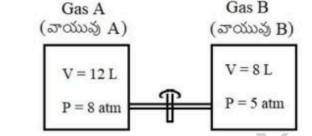
Two vessels are filled with ideal gases A and B and are connected through a pipe of zero volume as shown in figure. The stop cock is opened and the gases are allowed to mix homogeneously and the temperature is kept constant. The partial pressures of A and B respectively (in atm) are
1
8.0, 5
2
9.6, 4
3
6.4, 4
4
4.8, 2
Official Solution
Correct Option: (4)
Step 1: Calculate Total Volume When the stopcock is opened, the total volume available for each gas is the sum of individual volumes. Step 2: Calculate Partial Pressure of Gas A Using Boyle's Law ( ) for Gas A: Initial state: . Final state: . Step 3: Calculate Partial Pressure of Gas B Using Boyle's Law for Gas B: Initial state: . Final state: . Final Answer: 4.8, 2.
10
PYQ 2025
medium
chemistryID: ts-eamce
The osmotic pressure (in atm) of an aqueous solution containing 0.01 mol of NaCl (degree of dissociation 0.94) and 0.03 mol of glucose in 500 mL at is
1
2.43
2
4.23
3
3.24
4
3.42
Official Solution
Correct Option: (1)
Step 1: Calculate Van't Hoff Factor for Electrolytes: For NaCl (Electrolyte): ( ). Given . . For Glucose (Non-electrolyte): . Step 2: Calculate Effective Molarity (C): Volume . Temperature . Total effective moles ( ): . Step 3: Calculate Osmotic Pressure ( ): Final Answer: 2.43 atm.
11
PYQ 2025
medium
chemistryID: ts-eamce
A solid contains elements A and B. Anions of B form ccp lattice. Cations of A occupy 50% of octahedral voids and 50% of tetrahedral voids. What is the molecular formula of the solid?
1
2
3
4
Official Solution
Correct Option: (2)
Step 1: Determine the number of atoms of B: The anions B form a Cubic Close Packed (ccp) lattice. Let the number of atoms of B in the unit cell be . (For a standard unit cell calculation, ccp corresponds to FCC, so , but utilizing is general). Step 2: Determine number of Voids: In a close packing of atoms: - Number of Octahedral Voids (OV) = - Number of Tetrahedral Voids (TV) = Step 3: Determine the number of atoms of A: Cations A occupy: - 50% of Octahedral Voids = - 50% of Tetrahedral Voids = Total atoms of A = . Step 4: Find the simplest ratio (Formula): Ratio Multiply by 2 to get whole numbers: So, the empirical formula is . Final Answer: .
12
PYQ 2025
medium
chemistryID: ts-eamce
Electrolysis of aqueous copper (II) sulphate between Pt electrodes gives 'X' at anode and 'Y' at cathode. X and Y are respectively
1
2
3
4
Official Solution
Correct Option: (2)
Step 1: Identify Species Present: Electrolyte: . Solvent: . Electrodes: Platinum (Inert). Step 2: Reaction at Cathode (Negative Electrode): Cations migrate to cathode: and . Reduction potential of ( ) is higher than ( or lower at pH 7). Reaction: . So, Y is Copper (Cu). Step 3: Reaction at Anode (Positive Electrode): Anions migrate to anode: and (or ). Oxidation of water is energetically favored over oxidation of sulphate ions. Reaction: . So, X is Oxygen ( ). Final Answer: X = , Y = Cu.
13
PYQ 2025
medium
chemistryID: ts-eamce
Consider a general first order reaction . If the initial pressure is 200 mm and after 20 minutes it is 250 mm, then the half-life period of the reaction (in minutes) is ( )
1
40.2
2
50.2
3
20.5
4
60.5
Official Solution
Correct Option: (2)
Step 1: Express Pressures at time t: Initial ( ): \quad 0 \quad 0 At time : \quad \quad Total Pressure . From this, . Pressure of reactant A remaining, . Step 2: Substitute Values: Given , at . . Step 3: Calculate Rate Constant (k): For first order: . Using given logs: . . Step 4: Calculate Half-Life ( ): . . Given the options, 50.2 is the closest and correct answer. Final Answer: 50.2 min.
14
PYQ 2025
medium
chemistryID: ts-eamce
The most effective coagulating agent for antimony sulphide sol is
1
2
3
4
Official Solution
Correct Option: (4)
Step 1: Determine Charge of Sol: Antimony sulphide ( ) is a metal sulphide sol, which are generally negatively charged. Step 2: Apply Hardy-Schulze Rule: The rule states: 1. The effective ion for coagulation is the one carrying a charge opposite to that of the sol particles. (Here, we need cations). 2. Higher the valency of the flocculating ion (coagulating ion), greater is its power to cause coagulation. Step 3: Analyze Options: We need the cation with the highest positive charge. (A) (Charge +1) (B) (Charge +2) (C) (Charge +1) (D) (Charge +3) Since has the highest valency (+3), Aluminum sulphate is the most effective coagulating agent. Final Answer: Option (D).
15
PYQ 2025
medium
chemistryID: ts-eamce
If the number of moles of ions oxidized by one mole of acidified is , the number of moles of ions oxidized by one mole of acidified is
1
2
3
4
Official Solution
Correct Option: (2)
Step 1: Determine for In acidic medium, is reduced to . Change in oxidation state of Mn: . n-factor for . Reaction: . Thus, 1 mole of oxidizes 5 moles of . So, . Step 2: Determine moles for In acidic medium, is reduced to . Change in oxidation state of Cr: . Since there are 2 Cr atoms, total change = . n-factor for . Reaction: . Thus, 1 mole of oxidizes 6 moles of . Step 3: Express the result in terms of We need the value 6. We have . Substitute into the options: (A) (B) (Matches) (C) (D) Final Answer: .
16
PYQ 2025
medium
chemistryID: ts-eamce
One mole of an ideal gas at 300 K and 20 atm expands to 2 atm under isothermal and reversible conditions. The work done by the gas is . The value of is
1
5.73
2
7.37
3
3.75
4
4.57
Official Solution
Correct Option: (1)
Step 1: Formula for Reversible Isothermal Expansion Work Given: Step 2: Calculate work done Since : Step 3: Convert to kJ and find Given . Final Answer: 5.73.
17
PYQ 2025
medium
chemistryID: ts-eamce
At 1000 K, the equilibrium constant for the reaction is 0.53. In a one litre vessel, at equilibrium the mixture contains 0.25 mole of CO, 0.5 mole of , 0.6 mole of and moles of . The value of is
1
0.563
2
0.363
3
0.636
4
0.736
Official Solution
Correct Option: (3)
Step 1: Write Equilibrium Constant Expression For the reaction: Since volume is 1 Litre, Molar concentration = Number of moles. Step 2: Substitute values Given: Step 3: Solve for Final Answer: 0.636.
18
PYQ 2025
medium
chemistryID: ts-eamce
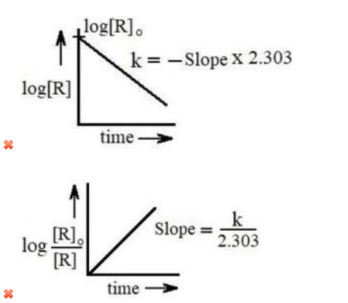
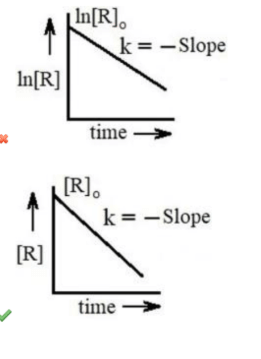
For the reaction , half life is independent of initial concentration of the reactant, R. Which one of the following graphs is not correct for this reaction?
1
A
2
B
3
C
4
D
Official Solution
Correct Option: (2)
Step 1: Identify Reaction Order:
The statement "half life is independent of initial concentration" defines a First Order Reaction.
For 1st order: (Constant). Step 2: Analyze Validity of Graphs for First Order:
Option A: The integrated rate equation is . Plotting vs gives a straight line with slope . Correct.
Option B: Plotting vs . Since , this graph should be an exponential decay curve. A straight line with negative slope corresponds to a Zero Order reaction ( ). Thus, this graph is Incorrect for a first-order reaction.
Option D: From the rate law, . Plotting vs gives a straight line passing through origin with slope . Correct.
Step 3: Conclusion:
Graph (B) represents a zero-order reaction, not first-order. Step 4: Final Answer:
Graph (B) is not correct.
19
PYQ 2025
medium
chemistryID: ts-eamce
At 298 K, if emf of the cell corresponding to the reaction, (1 atm) is 0.28 V, then the pH of the solution at the hydrogen electrode is ,
1
8
2
7
3
9
4
10
Official Solution
Correct Option: (3)
Step 1: Standard Cell Potential:
The cell reaction involves Zinc oxidation (Anode) and Hydrogen reduction (Cathode).
Step 2: Applying Nernst Equation:
Reaction: .
Number of electrons .
Reaction Quotient .
Equation:
Substitute values:
Step 3: Solving for pH:
Rearrange the equation:
Divide by -0.03:
Since , we can substitute :
Step 4: Final Answer:
The pH is 9.
20
PYQ 2025
medium
chemistryID: ts-eamce
A substance has a density of . It crystallizes in the fcc crystal with an edge length of 600 pm. The molar mass of the substance (in ) is ( )
1
54.8
2
64.8
3
74.8
4
84.7
Official Solution
Correct Option: (2)
Step 1: Understanding the Concept:
The density of a crystal unit cell is given by the formula:
where is the number of atoms per unit cell, is molar mass, is edge length, and is Avogadro's number. We need to solve for . Step 2: Key Formula or Approach:
For FCC lattice, .
.
Ensure is in cm. . Step 3: Detailed Explanation:
Given:
Density .
Edge length .
Avogadro's number .
. Calculate :
Calculate :
Step 4: Final Answer:
The molar mass is 64.8 g mol .
21
PYQ 2025
medium
chemistryID: ts-eamce
For the reaction , the correct relation between degree of dissociation ( ) of and equilibrium constant, is (P = total pressure of mixture)
1
2
3
4
Official Solution
Correct Option: (3)
Step 1: Understanding the Concept:
We need to derive the expression for the equilibrium constant in terms of partial pressures, which depend on the mole fractions (determined by the degree of dissociation ) and the total pressure . Step 2: Key Formula or Approach:
1. Reaction: .
2. Let initial moles be 1. At equilibrium: - - - Total moles .
3. Partial Pressure .
4. . Step 3: Detailed Explanation:
Calculate partial pressures:
Substitute these into the expression:
Now, solve for :
Divide numerator and denominator by :
Taking the square root:
Step 4: Final Answer:
The relation is .
22
PYQ 2025
medium
chemistryID: ts-eamce
The RMS velocity of dihydrogen is times more than that of dinitrogen. If and are the temperatures of dihydrogen and dinitrogen, then the correct relationship between them is
1
2
3
4
Official Solution
Correct Option: (4)
Step 1: Understanding the Concept:
RMS velocity formula: .
Relation given: . Note: "times more than" usually means , but in physics/chem MCQ context, it often means "times of". The options suggest a direct multiplicative relationship. Let's check calculations for "times". Step 3: Detailed Explanation:
g/mol.
g/mol.
Given: .
Squaring both sides:
Substitute formula:
Step 4: Final Answer:
The relationship is .
23
PYQ 2025
medium
chemistryID: ts-eamce
Which of the following is not correct about Freundlich adsorption isotherm?
1
x/m = k p1/n (n > 1)
2
Extent of adsorption of gas is more at high temperature than at low temperature
3
represents the slope of the isotherm (log-log plot)
4
holds good over a limited range of pressures
Official Solution
Correct Option: (2)
Step 1: Understanding Freundlich Isotherm:
It describes physical adsorption (Physisorption).
Equation: , where . Step 2: Analyzing the Options:
- (A) Equation: Correct representation.
- (B) Temperature Effect: Physisorption involves weak van der Waals forces and is an exothermic process ( ). According to Le Chatelier's principle, increasing temperature favors the reverse process (desorption). Thus, adsorption decreases as temperature increases. The statement says adsorption is more at high temperature, which is Incorrect.
- (C) Slope: Taking logs, . A plot of vs is linear with slope . Correct.
- (D) Limitation: The empirical isotherm fails at high pressures where adsorption reaches saturation (independent of pressure). It is valid only for a limited intermediate pressure range. Correct. Step 3: Final Answer:
Statement (B) is not correct.
24
PYQ 2025
medium
chemistryID: ts-eamce
Observe the following statements.
Statement - I: The boiling point of 0.1 M urea solution is less than that of 0.1 M KCl solution.
Statement - II: Elevation of boiling point is inversely proportional to molar mass of solute.
The correct answer is
1
Both statements I and II are correct
2
Statement I is correct, but statement II is not correct
3
Statement I is not correct, but statement II is correct
4
Both statements I and II are not correct
Official Solution
Correct Option: (2)
Step 1: Understanding the Concept:
Boiling point elevation ( ) is a colligative property, meaning it depends on the number of solute particles in the solution.
Formula: , where is the van't Hoff factor. Step 2: Detailed Explanation:
Analysis of Statement I:
Urea is a non-electrolyte, so it does not dissociate. . Effective concentration = .
KCl is an electrolyte, dissociating into and . . Effective concentration = .
Since is directly proportional to the effective concentration ( ), the elevation for KCl is greater than for Urea.
Higher elevation means higher boiling point. Thus, B.P.(KCl) \textgreater B.P.(Urea).
Statement I says B.P.(Urea) \textless B.P.(KCl), which is Correct.
Analysis of Statement II:
Statement II says "Elevation of boiling point is inversely proportional to molar mass of solute."
Colligative properties depend on the *number of particles*, which relates to the number of moles.
While the formula shows in the denominator, this implies an inverse relationship only if the *mass percentage* or *mass concentration* is constant.
However, as a fundamental definition, the property depends on molality (moles). Saying it is purely inversely proportional to molar mass is conceptually incomplete or incorrect without specifying "for a fixed mass of solute". Furthermore, it completely ignores the van't Hoff factor , which is critical.
In the context of comparing "0.1 M solutions" (fixed molarity), the molar mass is already factored into the concentration. The difference in BP arises solely from dissociation (i), not molar mass directly. Thus, in this context, Statement II is false or irrelevant.
Step 3: Final Answer:
Statement I is correct, Statement II is not correct.