Given below are the two statements regarding chlorobenzene
Statement I: Chlorobenzene is less reactive than benzene towards electrophilic substitution due to the -I effect of chlorine.
Statement II: Because of the -I effect of chlorine, it is a meta directing group.
1
Both statements I and II are correct.
2
Both statements I and II are not correct.
3
Statement I is correct but statement II is not correct.
4
Statement I is not correct but statement II is correct.
Official Solution
Correct Option: (3)
- Statement I is correct: Chlorobenzene is less reactive than benzene towards electrophilic substitution due to the -I effect of chlorine. Chlorine donates lone pair electrons to the aromatic ring through resonance, which decreases the electron density on the ring, making it less reactive.
- Statement II is incorrect: The -I effect of chlorine is deactivating and it directs incoming electrophiles to the meta position, but this is not because of the -I effect. The meta-directing property is due to the combination of the -I effect and the absence of a positive charge donation through resonance.
02
PYQ 2024
medium
chemistryID: ts-eamce
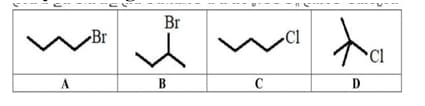
Arrange the following halides in decreasing order of their reactivity towards dehydrohalogenation:
1
B>D>A>C
2
B>D>C>A
3
D>B>C>A
4
D>B>A>C
Official Solution
Correct Option: (3)
Reactivity in dehydrohalogenation increases with the availability of a more stable leaving group and the ability to stabilize the resulting alkene. Thus, D>B>C>A.
03
PYQ 2025
medium
chemistryID: ts-eamce
In which of the following, the compounds are arranged in the correct order of acidic strength?
1
II
2
II
3
III
4
III
Official Solution
Correct Option: (3)
Step 1: Identify Acidic Protons:
Acidity in alkynes is due to the hydrogen attached to the hybridized carbon (terminal hydrogen).
I (Ethylacetylene): . Has 1 acidic H. Alkyl group (Ethyl) has +I effect.
II (Methylacetylene): . Has 1 acidic H. Alkyl group (Methyl) has +I effect.
III (Dimethylacetylene): . No acidic H (Internal alkyne). Least acidic.
Step 2: Compare I and II:
Both have one acidic proton. The stability of the conjugate base (carbanion) determines acidity.
Alkyl groups are electron-releasing (+I effect), which destabilizes the negative charge on the anion.
Ethyl group ( )>Methyl group ( ).
Therefore, the anion of Ethylacetylene is less stable than that of Methylacetylene.
Acidity: Methylacetylene>Ethylacetylene. Step 3: Final Order:
Dimethylacetylene (Non-acidic)
04
PYQ 2025
medium
chemistryID: ts-eamce
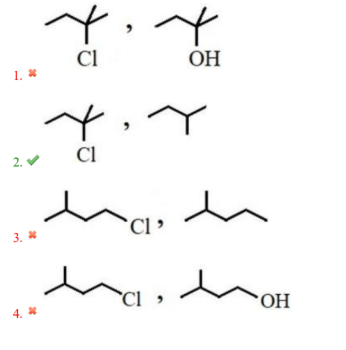
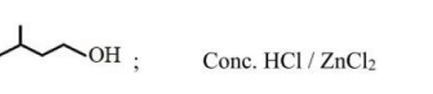
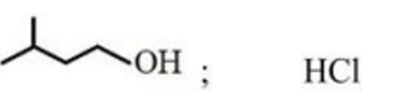
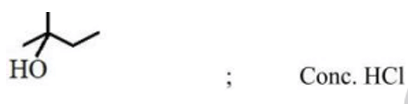
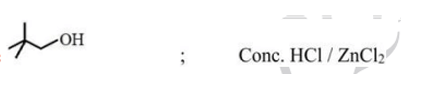
An alcohol X( ) is converted to corresponding chloride Y by shaking it with conc. HCl at room temperature. Reaction of Y with Mg in dry ether and then with water gave Z. What are Y and Z?
1
1
2
2
3
3
4
4
Official Solution
Correct Option: (2)
Step 1: Identify Alcohol X:
Formula .
Condition: Reacts with conc. HCl at room temperature to form Chloride Y.
This indicates the Lucas Test. Tertiary alcohols react immediately at room temperature. Secondary take minutes, Primary require heat/ZnCl2.
Structure of X (Tertiary Butyl Alcohol): (2-Methylpropan-2-ol). Step 2: Identify Chloride Y:
Reaction: .
Y is t-Butyl Chloride (2-Chloro-2-methylpropane). Step 3: Identify Z:
Reaction of Y with Mg/Ether Grignard Reagent ( ).
Reaction with Water Hydrolysis.
.
Z is Isobutane (2-Methylpropane). Step 4: Check Options:
Y = 2-Chloro-2-methylpropane.
Z = 2-Methylpropane.
Matches Option (B) (Diagram corresponds to t-butyl chloride and isobutane).
05
PYQ 2025
medium
chemistryID: ts-eamce
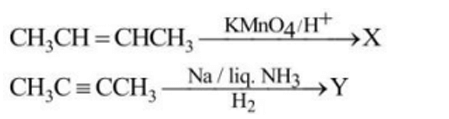
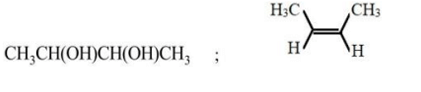
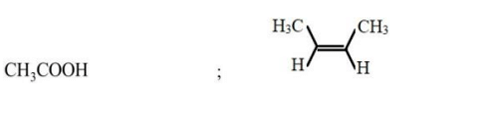
X and Y in reactions:
1
2
3
4
Official Solution
Correct Option: (1)
Alkene reacts with KMnO under mild conditions → syn dihydroxylation → vicinal diol (X). Alkyne reacts with Na/NH → anti addition → trans-alkene (Y).
06
PYQ 2025
medium
chemistryID: ts-eamce
Identify the chain isomers from the following
1
Pent-1-ene and Pent-2-ene
2
2-Methylbut-1-ene and 2-Methylbut-2-ene
3
Pent-2-ene and 2-Methylbut-2-ene
4
2-Methylbut-1-ene and 3-Methylbut-1-ene
Official Solution
Correct Option: (4)
1. Chain isomers have the same molecular formula but different carbon skeletons. All options are C H .
2. (1) Pent-1-ene (CH =CH-CH -CH -CH ) and Pent-2-ene (CH -CH=CH-CH -CH ): Same chain, position isomers.
3. (2) 2-Methylbut-1-ene ((CH ) C=CH ) and 2-Methylbut-2-ene (CH -C(CH )=CH-CH ): Same branched chain, position isomers.
4. (3) Pent-2-ene and 2-Methylbut-2-ene: Different skeletons (straight vs branched), but not chain isomers in strict sense.
5. (4) 2-Methylbut-1-ene and 3-Methylbut-1-ene (CH =C(CH )-CH -CH vs CH =CH-CH(CH ) ): Different branching, chain isomers.
6. Thus, the answer is (4).
07
PYQ 2025
hard
chemistryID: ts-eamce
Observe the following set of reactions 2-Methylpropene Y 2-Methylpropene X Correct statement regarding X and Y is

1
Both X and Y undergo nucleophilic substitution by mechanism
2
Both X and Y undergo nucleophilic substitution by mechanism
3
X undergoes nucleophilic substitution by and Y by mechanism
4
X undergoes nucleophilic substitution by and Y by mechanism
Official Solution
Correct Option: (4)
1. 2-Methylpropene ((CH ) C=CH ) reacts with HBr via electrophilic addition, not nucleophilic substitution, but the question likely refers to the mechanism of Br addition.
2. Without peroxide: HBr adds via Markovnikov rule, forming (CH ) CBr (X) via carbocation (tertiary, stable), so -like addition.
3. With peroxide ((CH COO) ): Free radical mechanism gives anti-Markovnikov product (CH ) CHCH Br (Y) via primary radical, -like addition.
4. Thus, X (Markovnikov) is , Y (anti-Markovnikov) is , so the answer is (4).
08
PYQ 2025
medium
chemistryID: ts-eamce
What are X and Y in the following reaction sequence?
1
2
3
4
x
Official Solution
Correct Option: (3)
Isopentane (\ce{C5H12}) undergoes oxidation with \ce{KMnO4} to form a diol, X, which is \ce{HO-CH2-CH(CH3)-CH2OH} (a 1,3-diol). This diol reacts to form an intermediate \ce{C5H12O}, and Y is formed with Conc. HCl, leading to \ce{C5H11Cl} through chlorination.