Two statements are given below. Statement I: Adsorption of a gas on the surface of charcoal is primarily an exothermic process.
Statement II: A closed vessel containing , , , has a pressure of 9 atm. About 1 g of charcoal was added to this vessel and after some time its pressure is atm. It is observed that . Choose the correct answer.
1
Both statements I and II are correct
2
Both statements I and II are not correct
3
Statement I is correct but statement II is not correct
4
Statement I is not correct but statement II is correct
Official Solution
Correct Option:
(3)
Step 1: Statement I is correct. Adsorption of gases on a surface is indeed an exothermic process, as the gas molecules lose energy while being adsorbed onto the surface. Step 2: Statement II is incorrect. When a gas is adsorbed on charcoal, it leads to a decrease in pressure, not an increase. This happens because the molecules move from the gas phase to the surface, reducing the volume of the gas phase and therefore lowering the pressure in the vessel. Hence, the pressure should be less than , not greater. Thus, the correct answer is option (3).
02
PYQ 2025
medium
chemistryID: ts-eamce
Observe the following colloids:
I. Gold
II. Detergent
III. Starch
IV. Soap
V. Synthetic rubber
VI. Sulphur
VII. Cellulose
The number of multimolecular colloids and macromolecular colloids in the above list is respectively
1
2, 3
2
1, 3
3
3, 4
4
4, 3
Official Solution
Correct Option:
(1)
Step 1: Classify each colloid:
Multimolecular Colloids: Formed by aggregation of many small atoms or molecules (diameter ).
Examples from list: Gold sol (I), Sulphur sol (VI).
Macromolecular Colloids: Formed by large molecules (polymers) having colloidal dimensions.
Examples from list: Starch (III), Synthetic rubber (V), Cellulose (VII).
Associated Colloids (Micelles): Aggregates formed at higher concentrations.
Examples from list: Detergent (II), Soap (IV).
Step 2: Count the numbers: Number of Multimolecular colloids = (I, VI) Number of Macromolecular colloids = (III, V, VII)
Step 3: Final Answer: The respective numbers are and .
03
PYQ 2025
medium
chemistryID: ts-eamce
Identify the correct statements from the following I. Adsorption is an endothermic process. II. Adsorption of a gas on the surface of a solid is accompanied by a decrease in enthalpy and a decrease in entropy. III. Adsorption capacity of A, B and C gases on 1g of activated charcoal follows the order A>B>C. Their critical temperatures (T ) follow the order T (A)>T (B)>T (C).
1
I, II only
2
I, III only
3
II, III only
4
I, II, III
Official Solution
Correct Option:
(3)
1. I: Adsorption is generally exothermic (negative ), as molecules bind to surfaces, releasing energy, so I is incorrect.
2. II: Gas adsorption reduces enthalpy (exothermic) and entropy (molecules lose freedom), correct.
3. III: Higher critical temperature (T ) indicates stronger intermolecular forces, leading to higher adsorption capacity, so A>B>C is correct.
4. Thus, II and III are correct, so the answer is (3) II, III only.
04
PYQ 2025
medium
chemistryID: ts-eamce
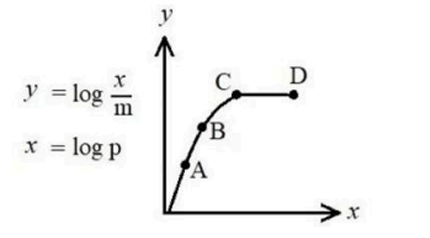
Freundlich adsorption isotherm: log(mx) vs log(p) increases then flattens (points C-D). Experimental condition represented by C-D?
1
Saturation due to very low pressure
2
Saturation due to high pressure
3
Saturation due to variable temperature
4
Saturation due to variable volume
Official Solution
Correct Option:
(2)
At high pressure, adsorption sites are fully occupied → adsorption reaches maximum → flattening of Freundlich isotherm. Low pressure does not saturate adsorption.
About Surface Chemistry - TS-EAMCET
Surface Chemistry is a vital chapter for TS-EAMCET aspirants. Mastering the concepts covered in this chapter is essential for securing a top rank.
By rigorously practicing the previous year questions associated with this chapter, you can identify high-yield topics, understand the examiner's perspective, and boost your confidence during the actual exam.
Frequently Asked Questions
Why focus on Surface Chemistry PYQs?
Analyzing PYQs for this specific chapter reveals the most frequently tested concepts and the typical complexity of questions, allowing you to tailor your study plan efficiently.
How to best use this analysis?
Review the topic breakdown to see which sub-topics within Surface Chemistry carry the most weight. Then, tackle the questions iteratively to solidify your understanding.