TS-EAMCET SERIES
Chemistry

Electrochemistry

15 previous year questions.

Volume: 15 Ques
Yield: Medium

High-Yield Trend

6
2025
7
2024
2
2017

Chapter Questions
15 MCQs

01
PYQ 2017
easy
chemistry ID: ts-eamce
Consider the following electrode process of a cell, If EMF of this cell is and value of the cell is at , the value of the equilibrium constant of the sparingly soluble salt MCl is in the order of
1
2
3
4
02
PYQ 2017
medium
chemistry ID: ts-eamce
Consider the single electrode process catalyzed by platinum black electrode in electrolyte. The potential of the electrode is . What is the concentration of the acid in the hydrogen half cell if the pressure is bar ?
1
1 M
2
10 M
3
0.1 M
4
0.01 M
03
PYQ 2024
medium
chemistry ID: ts-eamce
The molar conductivity of 0.02 M solution of an electrolyte is S m mol . What is the resistance of the same solution (in ohms), kept in a cell of cell constant 129 m ?
1
390
2
130
3
260
4
520
\bigskip
04
PYQ 2024
medium
chemistry ID: ts-eamce
Identify the correct statements from the following: A) At 298 K, the potential of the hydrogen electrode placed in a solution of pH = 10 is -0.59 V.
B) The limiting molar conductivity of and is 119 and 76 , respectively. The limiting molar conductivity of is 195 .
C) The correct relationship between and is .
1
A, B, C
2
A, B only
3
A, C only
4
B, C only
05
PYQ 2024
medium
chemistry ID: ts-eamce

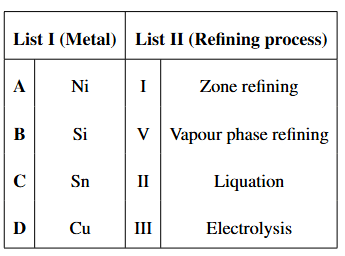
Match the following:Β 

1

2

3

4
06
PYQ 2024
medium
chemistry ID: ts-eamce
What is the electrode potential (in V) of copper electrode dipped in solution?
1
0.399
2
0.1405
3
0.199
4
0.281
07
PYQ 2024
medium
chemistry ID: ts-eamce

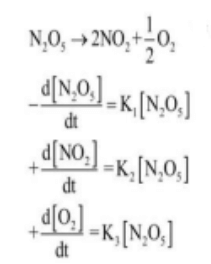
For the gaseous reaction , the rate can be expressed as follows:Β 

The correct relation between and is

1

2

3

4

08
PYQ 2024
medium
chemistry ID: ts-eamce
What is the electrode potential (in V) of copper electrode dipped in solution?
1
0.399
2
0.1405
3
0.199
4
0.281
09
PYQ 2024
medium
chemistry ID: ts-eamce
If the degree of dissociation of formic acid is 11.0\%, what is the molar conductivity of its 0.02 M solution?
1

2

3

4

10
PYQ 2025
medium
chemistry ID: ts-eamce
The equilibrium constant for the reaction is . What is the Gibbs energy change ( in KJ mol ) for this reaction?
( ; F = 96500 C mol )
1

2

3

4
11
PYQ 2025
medium
chemistry ID: ts-eamce
At the equilibrium constant for the reaction, is . What is the (in ) for this reaction? ( )
1
0.45
2
0.90
3
0.225
4
1.10
12
PYQ 2025
easy
chemistry ID: ts-eamce
The Gibbs energy change of the reaction (in kJ mol⁻¹) corresponding to the following cell
Cr | Cr³⁺(0.1M) || Fe²⁺(0.01 M) | Fe
(Given: ; , 1F = 96,500 C mol⁻¹)
1
-150.9
2
+150.9
3
-173.7
4
+173.7
13
PYQ 2025
easy
chemistry ID: ts-eamce
The molar conductivity of acetic acid solution at infinite dilution is 390 S cm mol . What is the molar conductivity of 0.01 M acetic acid solution (in S cm mol )? (Given: , assume )
1
10.64
2
16.54
3
51.64
4
15.64
14
PYQ 2025
medium
chemistry ID: ts-eamce
Identify the correct statements from the following
I. In LeclanchΓ© cell, Mn is oxidized to Mn
II. Electrolysis of aqueous CuCl solution using Pt electrodes liberate Cl (g) at anode
III. Lead storage battery is a secondary battery
1
I, II only
2
I, III only
3
II, III only
4
I, II, III
15
PYQ 2025
medium
chemistry ID: ts-eamce
At 298 K, equilibrium: M(s)+2Ag (aq)β†’M (aq)+2Ag(s), K=10 , Ξ”S=10 J/K. Find Ξ”rH (kJ/mol). FRTΓ—2.303=0.06, F=96500 C/mol.
1
-86.85
2
-89.83
3
-96.5
4
-83.87

About Electrochemistry - TS-EAMCET

Electrochemistry is a vital chapter for TS-EAMCET aspirants. Mastering the concepts covered in this chapter is essential for securing a top rank.

By rigorously practicing the previous year questions associated with this chapter, you can identify high-yield topics, understand the examiner's perspective, and boost your confidence during the actual exam.

Frequently Asked Questions

Why focus on Electrochemistry PYQs?

Analyzing PYQs for this specific chapter reveals the most frequently tested concepts and the typical complexity of questions, allowing you to tailor your study plan efficiently.

How to best use this analysis?

Review the topic breakdown to see which sub-topics within Electrochemistry carry the most weight. Then, tackle the questions iteratively to solidify your understanding.